
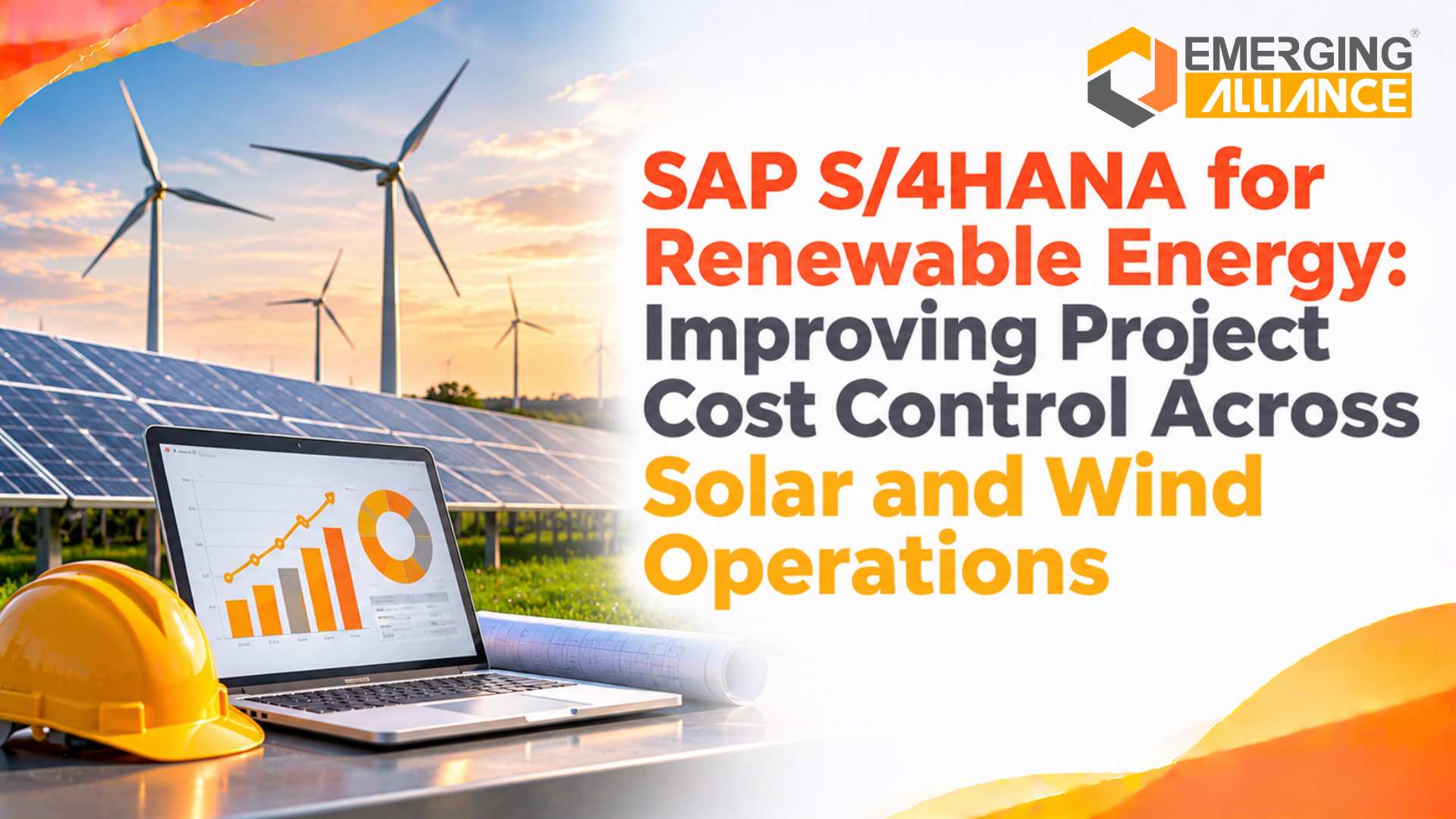
SAP S/4HANA for Renewable Energy: Improving Project Cost Control Across Solar and Wind Operations
Quick Answer: How SAP S/4HANA Strengthens Project Cost Control in Renewable Energy
SAP S/4HANA helps renewable energy companies strengthen project cost control by connecting project budgets, procurement, inventory, financial accounting and operational reporting. With appropriately configured project structures and reliable data, businesses can compare planned and actual expenditure, monitor cost commitments, identify budget deviations and improve financial visibility across solar and wind projects.
Why Project Cost Control Is a Growing Challenge in Renewable Energy
Renewable energy companies operate in a project-driven environment where financial performance depends on controlling expenditure across multiple activities, locations and execution stages. Solar parks, wind farms and hybrid energy projects involve substantial capital investment, equipment procurement, contractor management, installation activities and ongoing asset operations.
As companies expand their renewable energy portfolios, controlling these costs becomes increasingly complex. A business may manage several projects simultaneously, each with different budgets, suppliers, execution timelines, equipment requirements and financial commitments.
The difficulty is not limited to tracking how much money has already been spent. Management also needs to understand committed expenditure, upcoming procurement requirements, project completion costs and the financial consequences of execution delays.
For example, a solar project may remain within its approved budget during the initial procurement stage but experience cost pressure during installation because of additional transportation, contractor or equipment expenses. If these costs are recorded in disconnected systems, finance teams may identify the deviation only after the project has consumed a significant portion of its approved budget.
This creates several management challenges:
- Limited visibility into actual project expenditure.
- Delayed identification of budget overruns.
- Inconsistent cost reporting across project locations.
- Difficulty tracking procurement commitments.
- Incomplete visibility into contractor and installation costs.
- Delays in consolidating financial information for management review.
For CEOs, CFOs and project directors, these issues affect more than accounting accuracy. They influence capital allocation, project profitability, cash flow planning and the ability to scale renewable energy operations.
The Financial Impact of Disconnected Project and Procurement Data
Project cost control requires finance, procurement, inventory and project execution teams to work with consistent financial information.
However, renewable energy businesses may use separate applications, spreadsheets and manual reporting processes to manage project budgets, purchase orders, supplier invoices, material consumption and contractor expenses.
When these processes are disconnected, the organisation loses visibility across the complete expenditure cycle.
Consider a wind energy project involving turbine procurement, transportation, foundation construction, electrical infrastructure and installation. Each activity creates different cost transactions. Procurement teams may track purchase orders separately, warehouse teams maintain material records, and finance teams record supplier invoices in accounting systems.
Without a connected reporting structure, management may struggle to answer important questions:
- How much of the approved project budget has already been consumed?
- What additional expenditure is committed through open purchase orders?
- Which project activities are responsible for cost deviations?
- Are material purchases aligned with installation schedules?
- How much expenditure remains before project completion?
These questions become more difficult when multiple projects operate across different states or legal entities.
Disconnected information also creates reconciliation work. Finance teams spend time collecting spreadsheets, validating transaction records and investigating differences between project reports and accounting figures.
A connected ERP environment can reduce this fragmentation by bringing relevant financial and operational transactions into a consistent information structure. SAP S/4HANA supports integrated finance, procurement and project-related processes, subject to the selected deployment, configuration and integration scope.
The business objective is straightforward: management should be able to evaluate project expenditure using consistent, timely and traceable information rather than depending on manually consolidated reports.
Project Budget and Actual Cost Visibility Across Solar and Wind Operations
One of the most important requirements for renewable energy companies is the ability to compare approved project budgets with actual expenditure throughout the project lifecycle.
A project budget provides the financial baseline against which management evaluates spending. However, a budget alone does not reveal whether a project is financially under control.
Companies also need visibility into actual costs, open commitments, forecast expenditure and remaining budget.
A structured project cost management approach should capture expenditure against relevant project activities, work packages, cost categories or other defined reporting dimensions.
For a solar installation, these categories may include:
- Land preparation and site development.
- Solar panels and mounting structures.
- Inverters and electrical equipment.
- Civil construction and installation.
- Transportation and logistics.
- Engineering and contractor services.
- Testing and commissioning.
For a wind energy project, cost categories may include turbine procurement, foundations, cranes, transportation, grid connections, installation and commissioning.
SAP S/4HANA project-related capabilities can support the planning and monitoring of project budgets and costs when the required project structures, financial controls and reporting configurations are implemented.
Comparing Planned and Actual Expenditure
Finance and project teams need a consistent method to compare planned costs with recorded transactions.
A project cost report should help management evaluate:
- Approved budget: The authorised financial allocation for the project or activity.
- Actual expenditure: Costs already recorded through relevant financial transactions.
- Committed expenditure: Expected obligations represented by open purchasing or contractual commitments, where configured and available.
- Remaining budget: The difference between the approved allocation and the relevant expenditure or commitment measure.
- Forecast completion cost: The estimated total cost required to complete the remaining work.
These measures should be clearly defined because actual expenditure and committed expenditure are not interchangeable. An open purchase order, for example, may represent a financial commitment without yet appearing as an actual supplier invoice.
When project reporting brings these measures together, management can identify potential cost pressure earlier and investigate deviations before they become larger financial problems.
Identifying Cost Variations at the Activity Level
A consolidated project figure may show that expenditure is above budget, but it does not necessarily explain why.
Management needs the ability to investigate cost variations at a useful level of detail. This may involve examining project phases, cost categories, suppliers, materials or contractors.
For instance, if the electrical infrastructure component of a solar project exceeds its approved allocation, finance and project teams should be able to investigate whether the deviation is related to equipment prices, additional material requirements, installation changes or other approved project variations.
This level of visibility supports more informed corrective decisions.
Procurement and Inventory Control Across Multiple Project Sites
Procurement is a major contributor to renewable energy project expenditure. Solar panels, wind turbines, inverters, transformers, cables, mounting structures and other equipment represent significant purchasing commitments.
Companies also depend on contractors, engineering services, transportation providers and specialist installation partners.
When procurement activities are managed separately from project budgets, businesses may struggle to evaluate the financial impact of purchasing decisions before expenditure is incurred.
A connected procurement process should establish a relationship between project requirements, purchase requisitions, approvals, purchase orders, goods receipts and supplier invoices.
Connecting Procurement Commitments with Project Budgets
Before approving a purchase, authorised teams should be able to evaluate whether the requirement aligns with the project’s approved scope and financial allocation.
For example, a project manager may request additional electrical equipment because of a change in installation requirements. If the request is not evaluated against the relevant project budget, the purchase may create an unexpected financial commitment.
Appropriate ERP configuration can support approval workflows, purchasing controls and project-related cost tracking.
SAP S/4HANA provides procurement and finance capabilities that can be configured to support these processes. The actual control environment depends on organisational policies, purchasing design, integration requirements and implementation decisions.
Maintaining Material Visibility Across Project Locations
Renewable energy projects frequently involve equipment moving between suppliers, warehouses, temporary storage facilities and installation sites.
Poor inventory visibility can result in duplicate purchases, delayed material availability, excess stock and difficulty identifying where project materials are being consumed.
An integrated inventory process should help teams understand:
- What materials are available at each location.
- Which materials are reserved for specific projects.
- What quantities have been received or issued.
- Which purchase orders remain outstanding.
- Whether stock transfers are properly recorded.
- How material consumption affects project expenditure.
For example, a company managing three solar installations should be able to distinguish the equipment allocated to each project rather than relying on a single consolidated inventory figure.
Connecting inventory transactions with relevant purchasing and financial information helps management understand material availability and its cost implications.
Contractor and Installation Cost Monitoring
Renewable energy project execution depends on multiple external and internal stakeholders. Engineering contractors, civil construction teams, transportation providers and installation partners may contribute to different project activities.
Their costs can vary according to contract terms, project milestones, scope changes, delays and additional work requirements.
If contractor expenditure is recorded without a clear relationship to project activities, finance teams may find it difficult to determine whether the original project budget remains achievable.
Businesses should establish appropriate controls for:
- Contractor purchase orders and service commitments.
- Contractual payment terms.
- Milestone-based billing.
- Approved changes to project scope.
- Service entry and invoice verification.
- Cost allocation to the relevant project.
A well-designed ERP process can help connect procurement and financial transactions with project reporting.
However, the organisation must define how contractor costs are captured and allocated. An ERP system cannot automatically determine whether a contractor’s additional charge is commercially justified or whether a project milestone has been completed correctly. These decisions require operational validation and approval controls.
Asset Management and Maintenance Cost Visibility
Project cost control does not end when a solar park or wind farm becomes operational.
Once a renewable energy asset enters service, the business must monitor maintenance expenditure, equipment performance, spare parts consumption and operational costs.
Solar and wind assets may operate across geographically distributed locations. Their maintenance requirements can differ according to equipment condition, environmental exposure, operating hours and service schedules.
Without structured asset and maintenance information, businesses may struggle to evaluate the total cost of operating their renewable energy portfolio.
For example, repeated maintenance requirements for a particular equipment category may increase operating expenditure beyond the expected level. If maintenance work orders, spare parts consumption and financial transactions are not connected, management may have limited visibility into the underlying cost trend.
SAP S/4HANA asset management and related maintenance capabilities can support equipment records, maintenance planning and associated cost tracking, depending on the selected functionality and configuration.
Renewable energy companies should evaluate whether their ERP environment can provide the required visibility into:
- Equipment acquisition and capitalisation.
- Asset location and organisational assignment.
- Maintenance work orders.
- Spare parts consumption.
- Repair and service expenditure.
- Asset depreciation and financial reporting.
- Maintenance cost trends across operating sites.
Connecting asset-related operational information with financial reporting helps management evaluate the cost of maintaining its renewable energy infrastructure.
It also supports better planning of maintenance budgets and replacement requirements.
Financial Reporting Across Multiple Renewable Energy Projects
As renewable energy companies expand, senior management needs a consolidated view of financial performance across projects, sites and legal entities.
A report showing total company expenditure may not provide enough information for investment and operational decisions. Executives need to understand how individual projects contribute to the overall financial position.
A structured reporting environment should provide visibility into project budgets, actual expenditure, procurement commitments, asset costs and financial performance.
Improving Management Reporting
With appropriately configured SAP S/4HANA finance and project reporting capabilities, businesses can organise financial information around relevant reporting structures.
This can help management evaluate:
- Project-wise budget utilisation.
- Actual expenditure by cost category.
- Procurement commitments and outstanding obligations.
- Capital expenditure across project portfolios.
- Financial performance across business units.
- Asset-related expenditure.
- Differences between planned and actual project costs.
The value of reporting depends on the quality and consistency of the underlying transaction data. Incorrect project assignments, inconsistent cost codes and delayed transaction entries can undermine the reliability of management reports.
Companies should therefore establish clear financial dimensions, master data standards, approval responsibilities and reporting definitions before relying on consolidated dashboards.
Supporting Multi-Entity Financial Visibility
Some renewable energy businesses operate through multiple project-specific legal entities or Special Purpose Vehicles (SPVs).
This structure can create additional reporting requirements because project transactions may belong to different legal entities, accounting structures and reporting periods.
Management may need to review individual project financial performance while also consolidating information at a group level.
The ERP design should account for entity-specific accounting requirements, intercompany transactions, consolidation rules and management reporting needs.
SAP S/4HANA can support enterprise finance processes, but the required legal-entity and consolidation design must be assessed against the company’s structure and statutory obligations.
How SAP S/4HANA Supports Renewable Energy Project Cost Control
SAP S/4HANA can provide a connected enterprise platform for managing financial, procurement, inventory and project-related information.
Its value for renewable energy companies comes from aligning business transactions with consistent financial and operational structures.
The following capabilities are particularly relevant to project cost control.
Financial Accounting and Management Reporting
Financial accounting processes record business transactions and provide the foundation for financial reporting. When project-related costs are assigned to appropriate organisational and accounting dimensions, finance teams can analyse expenditure across relevant projects and cost categories. This supports more consistent financial monitoring and management review.
Project Planning and Cost Monitoring
Project-related functionality can support project structures, budgeting and cost monitoring. Businesses can define project activities and financial responsibilities to improve visibility into expenditure during execution. The exact functionality available depends on the SAP S/4HANA edition, licensing, configuration and connected applications.
Sourcing and Procurement
Procurement processes help businesses manage purchasing requirements, supplier transactions and purchasing approvals. When connected to financial and project information, these processes can strengthen visibility into purchasing commitments and support more controlled expenditure.
Inventory and Material Management
Inventory management helps businesses record material movements, stock availability and goods transactions. For renewable energy projects, this can support better control over equipment and material requirements across warehouses and project locations.
Asset Accounting and Maintenance
Asset-related processes help companies manage fixed assets and associated financial information. Where maintenance functionality is implemented, operational teams can also manage equipment maintenance activities and associated costs.
Analytics and Management Insights
Reporting and analytics capabilities can help executives review financial and operational information through relevant dashboards and reports. However, reporting accuracy depends on transaction completeness, master data quality, integration design and the consistency of business processes. The objective should be to create reliable management information that supports timely decisions, not simply to generate more dashboards.
What Renewable Energy Companies Should Evaluate Before Implementing SAP S/4HANA
Selecting an ERP platform is a significant business decision. Renewable energy companies should evaluate their operational complexity, financial controls, project portfolio and technology requirements before finalising an implementation approach.
A successful ERP programme requires more than configuring software features. It involves aligning business processes, organisational responsibilities, financial structures and reporting requirements.
Define Project Cost Structures
Companies should establish how project budgets and expenditure will be organised. This includes defining project hierarchies, work breakdown structures where relevant, cost categories, approval responsibilities and reporting requirements. A consistent structure makes it easier to compare planned and actual expenditure across projects.
Review Procurement and Approval Workflows
Purchasing controls should reflect project budgets, authorisation limits, supplier policies and contract requirements. Businesses should identify where purchase approvals, commitment monitoring and invoice verification need to be strengthened.
Assess Existing System Integrations
Renewable energy organisations may already use project management applications, engineering platforms, asset monitoring systems, document management tools and financial applications. The ERP implementation should define which information needs to move between these systems, how frequently it should be updated and which application owns each data element. Operational monitoring platforms such as SCADA or energy management systems should not be assumed to integrate automatically with SAP S/4HANA. Integration scope, data requirements and technical feasibility need separate assessment.
Establish Data Governance
Project cost reports are only reliable when the underlying information is accurate. Companies should review supplier records, material master data, project codes, cost centres, asset records and financial transaction rules. Clear data ownership and validation responsibilities reduce inconsistencies across departments.
Select the Appropriate Deployment Approach
SAP S/4HANA deployment options and available capabilities differ according to the selected edition and architecture. Companies should assess functional requirements, customisation needs, integration complexity, scalability, security, infrastructure and long-term support before deciding on a deployment model. A fit-to-standard approach may reduce unnecessary customisation, but the final design must still address essential business and statutory requirements.
Real-World Perspective: SAP S/4HANA Cloud for Renewable Energy in India
Eden Renewables India LLP provides a relevant example of why connected ERP processes matter in a growing renewable energy business.
According to PwC’s published case study, the company was expanding across multiple renewable energy projects and faced challenges associated with disconnected and manual processes.
The business required greater standardisation in procurement workflows, project financial controls and real-time reporting.
PwC implemented SAP S/4HANA Cloud Public Edition using the GROW with SAP approach. The platform established a standardised foundation for finance, procurement and reporting.
The implementation was deployed across the company’s project Special Purpose Vehicles within five months, according to the case study. PwC also reported improved visibility across procurement and finance, faster reporting and better support for decision-making.
The example demonstrates the relevance of connected financial and procurement processes as renewable energy portfolios expand.
It should not be interpreted as a guarantee that another organisation will achieve the same implementation timeline or business outcomes. Requirements, project complexity, data readiness and implementation scope differ between companies.
Evaluating ERP Readiness for Renewable Energy Operations
Before investing in an ERP transformation, business leaders should determine whether their existing systems provide sufficient control over project expenditure and financial information.
The assessment should focus on measurable operational and financial requirements.
Consider these questions:
- Can finance teams compare project budgets with actual expenditure without manually consolidating multiple spreadsheets?
- Are open purchase commitments visible against relevant project budgets?
- Can project managers identify the activities responsible for cost deviations?
- Are materials and equipment traceable across warehouses and project sites?
- Can management review project financial performance across multiple locations?
- Are asset and maintenance costs visible after project commissioning?
- Can finance teams consolidate information across different legal entities?
- Are project, procurement and financial systems integrated reliably?
If several of these questions cannot be answered confidently, the organisation may have gaps in its current project cost management processes.
An ERP readiness assessment can help identify the process, data, integration and reporting changes required before selecting or implementing an enterprise platform.
For CEOs and CFOs, this creates a more practical basis for evaluating ERP investment: the decision is connected to financial control requirements rather than software features alone.
Frequently Asked Questions
Improve Financial Control Across Your Renewable Energy Projects
Are disconnected project, procurement and financial processes limiting your visibility into renewable energy project costs?
Emerging Alliance can discuss your ERP requirements and help evaluate the processes, integrations and reporting capabilities needed to strengthen financial and operational control.
Discuss Your Renewable Energy ERP Requirements with Emerging Alliance.