

Mining CRM Integration Challenges? How Salesforce CRM Implementation Addresses Operational Gaps
Quick Answer
Salesforce CRM implementation in the mining industry helps businesses organize customer relationships, sales activities, contractor communication, service requests, and operational information within a more consistent workflow. When CRM systems remain disconnected from ERP, field-service, document-management, and reporting applications, teams may face duplicate records, delayed updates, limited visibility, and manual coordination. A structured implementation identifies these integration gaps, defines data ownership, maps business processes, and establishes reliable connections between systems. Mining companies should evaluate integration requirements, data migration, remote-site access, user adoption, customization, reporting needs, and ongoing support before selecting an implementation approach.
CRM Integration Challenges Facing Mining Companies
Mining businesses often coordinate activities across corporate offices, mine sites, equipment suppliers, contractors, logistics partners, and customers. Each group may depend on different applications to manage commercial relationships, service requests, project updates, procurement, and operational reporting.
When these systems do not exchange information consistently, employees may need to reconcile records manually. Sales teams might work from outdated customer details, service coordinators may lack the latest equipment or site information, and management may find it difficult to consolidate updates across locations.
A customer relationship management platform can organize customer-facing processes, but its effectiveness depends on how well it fits the wider technology environment. Implementing Salesforce without understanding existing systems can introduce another information silo rather than resolve the underlying problem.
Disconnected Customer and Contractor Records
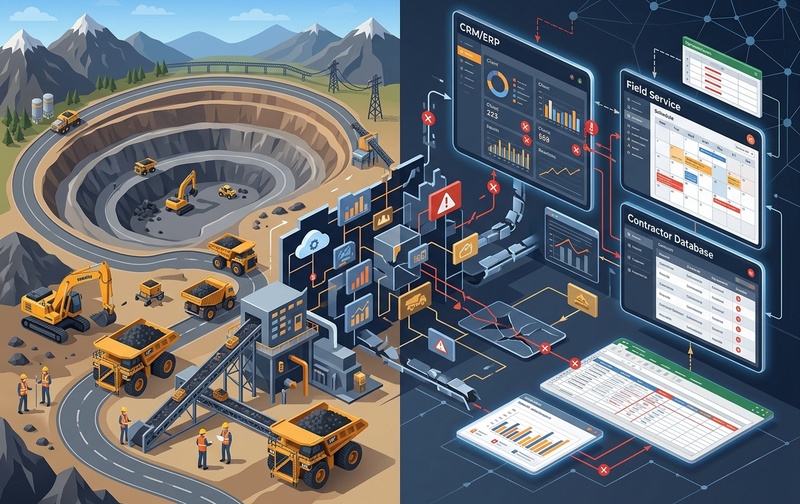
Mining organizations may maintain contact details, contract information, communication histories, service records, and commercial documents across spreadsheets, email accounts, legacy CRM applications, and ERP systems.
This fragmentation can create uncertainty about which record is current. Employees may repeat data entry, contact the wrong stakeholder, or spend additional time verifying information before making decisions.
Salesforce CRM implementation should begin by identifying the records that teams need, the applications that currently store them, and the authoritative source for each data category. The objective is to establish consistent customer and contractor information without unnecessarily duplicating records across platforms.
Limited Visibility Across Sites and Business Units
Different mining sites and business units may follow different processes for customer communication, service coordination, and commercial reporting. Without agreed workflows and shared reporting definitions, managers may struggle to compare performance consistently.
A centralized CRM environment can help teams access relevant customer interactions, assigned activities, opportunities, and service-related information according to their roles. However, visibility depends on suitable permissions, data quality, connectivity, and integration design.
Implementation planning should therefore distinguish between information that every authorized team needs and information that must remain restricted to specific functions, projects, or locations.
Manual Updates Between Business Applications
Employees may copy customer details, contract references, service updates, or transaction information from one application into another. Manual transfers introduce opportunities for omissions, inconsistent formats, duplicate entries, and delays.
The problem becomes more significant when the same information supports multiple workflows. A change to a customer account, for example, may need to be reflected in sales records, billing systems, service processes, and management reports.
A well-designed integration identifies which updates should move automatically, which require validation, and which should remain subject to human approval. Automation should reduce avoidable work while preserving accountability for important business decisions.
Mining Workflows Salesforce CRM Can Support
Salesforce should be configured around the business processes that create value for the mining organization. The platform is not a replacement for every operational application. Its role should be defined according to the organization’s customer relationship, commercial coordination, and service-management requirements.
Customer Relationship and Account Management
Mining companies often maintain long-running relationships with industrial customers, equipment manufacturers, distributors, service providers, and project stakeholders. These relationships may involve multiple contacts, sites, agreements, and communication histories.
Salesforce can organize account information, contact records, activities, opportunities, and relevant customer interactions in a structured environment. Teams can use this information to coordinate follow-ups, maintain relationship histories, and reduce reliance on individual employees’ inboxes or spreadsheets.
The implementation must define account structures carefully. For example, the business may need to distinguish a corporate customer from its individual mine sites, subsidiaries, project teams, or purchasing entities. Poorly designed account relationships can undermine reporting and create duplicate records.
Sales Pipeline and Tender Coordination
Mining-related sales and service contracts may involve technical discussions, tender submissions, commercial reviews, approvals, and extended decision cycles. Tracking these activities through disconnected spreadsheets can make ownership and next steps unclear.
Salesforce can support opportunity tracking, activity management, pipeline reporting, and agreed sales stages. Teams can define the information required at each stage, record relevant stakeholder interactions, and establish reminders for follow-ups.
Tender documents, pricing approvals, and contract files may still reside in specialist document-management, finance, or enterprise systems. Integration should provide appropriate access or references without assuming that every document must be stored directly in the CRM.
Service Requests and Customer Communication
Mining customers may raise equipment-related queries, maintenance requests, delivery questions, or other service issues. Depending on the organization’s requirements, Salesforce service capabilities can help teams record requests, assign responsibility, track progress, and maintain communication histories.
The CRM may also need to exchange information with field-service platforms, asset systems, or ERP applications. For instance, a service coordinator may require relevant customer details and a reference to equipment or service history held elsewhere.
The implementation should specify which team owns each request, how priority is determined, what information is required for escalation, and how the resolution is communicated. These rules help make service workflows more consistent without implying that CRM alone manages every technical maintenance activity.
Management Reporting and Commercial Visibility
Decision-makers need dependable information about customer relationships, opportunities, overdue activities, service workloads, and commercial performance. Reports become less useful when teams use inconsistent definitions or rely on incomplete records.
Salesforce dashboards can summarize information available within the platform, while integrations with ERP systems or business-intelligence tools may be required for broader financial and operational reporting.
Before configuring dashboards, organizations should agree on definitions for pipeline stages, account ownership, service status, reporting periods, and other relevant measures. A dashboard cannot compensate for unclear processes or unreliable source data.
Salesforce CRM Implementation Requirements for Mining Businesses
A successful implementation begins with business requirements rather than a predetermined list of software features. Mining organizations should understand how information moves between teams, where delays occur, and which operational gaps have the greatest commercial impact.
Map Existing Processes and Information Flows
Document the current workflow from the first customer interaction through opportunity management, contract coordination, service delivery, and follow-up. Include the systems used at each stage, the people responsible, the data exchanged, and the approvals required.
The mapping exercise should identify repeated data entry, unnecessary handoffs, missing ownership, inconsistent records, and delays caused by waiting for information. It should also distinguish process problems from technical integration problems.
For example, a delayed service update may result from a disconnected application, but it could also occur because no team has clear responsibility for recording the update. Connecting systems without resolving ownership may automate an incomplete process.
Define System and Data Ownership
Every important data category should have a clearly identified authoritative source. Customer account details, commercial terms, financial transactions, equipment records, and service information may be managed by different applications.
Salesforce may own selected customer relationship and sales records, while an ERP system remains authoritative for financial transactions, inventory, purchasing, or billing. Other specialist platforms may control technical asset data, field-service schedules, or engineering documentation.
The implementation plan should specify which system can create or update each record, which fields may be synchronized, and how conflicting updates are handled. These decisions reduce the risk of different applications presenting inconsistent information.
Establish Security and Access Requirements
Mining businesses may manage commercially sensitive customer records, tender details, contractual information, and internal communications. Access should reflect business responsibilities and the sensitivity of the information.
Implementation planning should define user roles, permission requirements, approval processes, integration identities, and procedures for reviewing access. Data transfers between systems should be designed with appropriate authentication, monitoring, and security controls.
Remote-site access also requires practical consideration. Teams may operate under varying connectivity conditions, device constraints, and local procedures. Requirements should be assessed against the actual Salesforce products, applications, and architecture selected for the project.
Set Measurable Acceptance Criteria
The project should define what successful implementation means before configuration and integration work begins. Acceptance criteria may cover data completeness, workflow behavior, synchronization results, access permissions, reporting consistency, and error handling.
Testing should include normal business transactions and realistic exceptions. Examples include incomplete customer records, duplicate accounts, rejected updates, temporary connectivity interruptions, and changes made in an unexpected sequence.
Clear acceptance criteria give business stakeholders a practical basis for approving the solution. They also help prevent a project from being judged solely on whether the software has been installed or configured.
Salesforce CRM Integration With ERP and Field-Service Systems
Integration is one of the most important design considerations when Salesforce must operate alongside established business applications. The objective is not to connect every available system automatically. It is to exchange the right information at the right time, with clear ownership and traceable outcomes.
Connecting Salesforce With ERP Applications
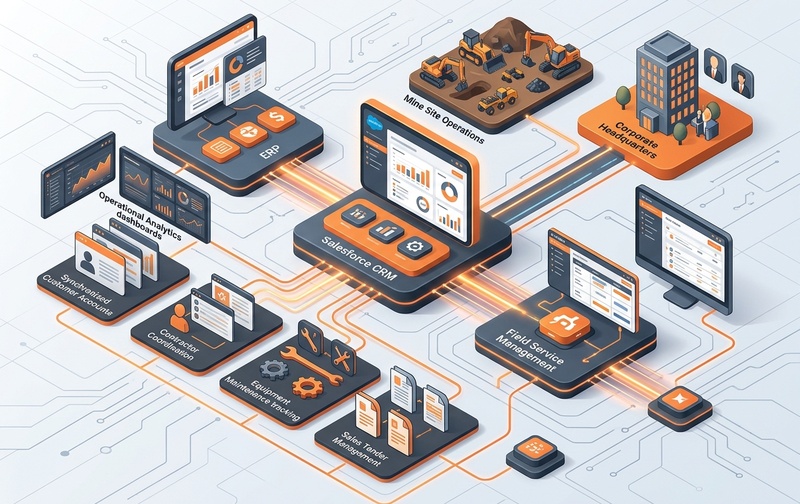
ERP platforms commonly manage financial transactions, purchasing, inventory, billing, and other core business processes. Salesforce may manage customer relationships, opportunities, sales activities, and service interactions.
An integration can connect these processes where business requirements justify it. Depending on the architecture, an authorized user might access selected account information from the CRM while commercial or financial transactions continue to be controlled by the ERP.
The integration design should specify the direction of each data flow, synchronization frequency, required fields, validation rules, and the system responsible for resolving discrepancies. Not every field needs real-time synchronization, and unnecessary data transfers can increase complexity.
Where Emerging Alliance is evaluating a mining organization’s wider business systems, the assessment should establish whether Salesforce-to-ERP integration, ERP customization, middleware, or changes to existing workflows are required. The appropriate design depends on the actual applications, versions, interfaces, and business processes involved.
Integrating Field-Service and Asset Information
Some mining businesses rely on specialist applications for field-service scheduling, equipment records, maintenance activities, or technical support. Salesforce may need access to selected information from these systems to support customer communication and case coordination.
Integration requirements should clarify whether the CRM needs to display equipment references, service status, assigned teams, or selected maintenance updates. Technical work orders and asset histories may remain in their existing specialist systems.
The design should avoid creating multiple competing records for the same asset or service event. Stable identifiers, clear source ownership, and appropriate synchronization rules are important when information is exchanged across platforms.
Selecting the Right Integration Approach
The best integration method depends on the source applications, available interfaces, data volumes, security requirements, update frequency, and support model. Options may include supported APIs, middleware, connectors, scheduled data exchanges, or other approved integration mechanisms.
A direct connection may be suitable for a relatively simple requirement, while a larger environment with several applications may need an integration layer to manage routing, transformation, monitoring, and error handling.
The project team should assess maintainability as well as initial implementation effort. An integration that is difficult to monitor or dependent on undocumented custom code may create ongoing support challenges even if it initially meets the functional requirement.
Data Migration and Customization Risks
Integration cannot deliver dependable results when the information being transferred is incomplete, inconsistent, or poorly structured. Data migration and customization should therefore be treated as controlled project work rather than final-stage technical tasks.
Clean and Validate Data Before Migration
Legacy CRM records, spreadsheets, and contact databases may contain duplicates, obsolete contacts, inconsistent naming conventions, incomplete fields, and conflicting identifiers. Moving this information without review can transfer existing problems into the new environment.
A migration plan should define which records are necessary, which can be archived, how duplicates will be identified, and which fields require validation. Business owners should review representative samples before the complete migration is approved.
The team should also agree on how historical activities, attachments, relationships, and record ownership will be handled. Not every legacy field needs to be migrated; the decision should reflect business use, retention obligations, reporting requirements, and the selected system’s capabilities.
Control Customization Scope
Mining organizations may have specialized commercial processes, approval requirements, and relationships with contractors or equipment suppliers. Some requirements can be supported through standard Salesforce configuration, while others may require custom development or integration with external applications.
Customization should be justified against a documented business need. Adding unnecessary fields, complex workflows, or one-off interfaces can increase testing effort, complicate upgrades, and make future support more difficult.
The project should distinguish mandatory requirements from preferences and evaluate whether a process can be simplified before custom functionality is developed. Where custom development is necessary, the design should include documentation, testing, ownership, and a plan for ongoing maintenance.
Plan for Integration Failures and Exceptions
Even a carefully designed integration needs a way to handle rejected records, unavailable endpoints, validation failures, and unexpected data changes. Without appropriate monitoring, an update may fail silently and leave teams working with outdated information.
The implementation should define error notifications, retry behavior, exception queues, escalation responsibilities, and reconciliation procedures. Logs should provide enough information for authorized support teams to identify the issue without unnecessarily exposing sensitive data.
Business owners should know what happens when synchronization is delayed and which records require manual review. A clear exception process helps prevent temporary technical issues from becoming prolonged operational confusion.
Managing User Adoption Across Mining Sites
A technically correct CRM may still deliver limited value if employees do not use it consistently. Adoption depends on whether the system supports real workflows, whether users understand their responsibilities, and whether management reinforces the agreed processes.
Design Workflows Around Actual Roles
Sales representatives, service coordinators, account managers, and operational support teams may require different information and actions. A single interface that presents every field to every user can make routine tasks unnecessarily difficult.
Role-based layouts, relevant automation, clear task ownership, and practical data-entry requirements can make workflows easier to follow. The objective is to capture the information the business needs without creating avoidable administrative work.
Users from relevant departments should participate in process workshops and testing. Their feedback can reveal practical issues that are not obvious from technical specifications alone.
Provide Role-Specific Training and Support
Training should explain how the CRM supports each employee’s responsibilities, not merely demonstrate where buttons and fields are located. Users should understand how to create accurate records, update activities, manage assigned work, and respond when an integration issue occurs.
Training materials should reflect approved workflows and realistic examples. Site-based teams may need different delivery methods or support arrangements from employees working at a central office.
After launch, organizations should collect user feedback, review recurring errors, and identify areas where additional guidance or configuration changes may be needed. Adoption is an ongoing management responsibility rather than a one-time training event.
Measure Usage and Process Consistency
Useful adoption measures may include record completeness, timely activity updates, workflow completion, duplicate-record frequency, and compliance with agreed data-entry requirements. These measures should be interpreted in context rather than treated as isolated performance targets.
Low usage may indicate a training gap, but it may also reveal an inefficient workflow or missing integration. Managers should investigate the cause before deciding whether the response should be additional training, process redesign, or technical correction.
Salesforce CRM Implementation Costs and Project Planning
Implementation costs depend on the scope of work rather than the platform name alone. Mining organizations should assess the full delivery requirement before comparing proposals or approving a budget.
Key cost factors include the number of users, required Salesforce products and licenses, data migration, integration complexity, customization, reporting, testing, training, deployment, and ongoing support. Existing systems may also impose constraints that affect the delivery approach.
A project involving a limited number of customer workflows and one supported integration will have different requirements from a multi-site environment with several legacy applications, complex data structures, and extensive approval processes. An accurate estimate requires discovery of the specific environment.
Build a Phased Implementation Plan
A phased approach can help organizations validate requirements and manage delivery risk. A typical plan includes discovery, process design, solution architecture, configuration, integration development, migration, testing, user preparation, deployment, and post-launch support.
The sequence and scope should reflect business priorities. A company may begin with customer account management and opportunity tracking before extending the solution to more complex service or reporting workflows.
Each phase should have defined deliverables, responsible owners, dependencies, and approval criteria. The project plan should also include time for data cleanup, stakeholder reviews, integration testing, and remediation of issues identified before launch.
Evaluate Total Cost of Ownership
The initial project estimate does not represent the full cost of operating the solution. Organizations should also consider license renewals, integration monitoring, support, future enhancements, training for new employees, and maintenance of custom components.
The business case should compare these costs with measurable process objectives, such as reducing duplicate entry, improving information availability, clarifying activity ownership, or making commercial reporting more consistent.
Benefits should be treated as targets to validate, not guaranteed outcomes. Establishing a baseline before implementation makes it easier to determine whether the changes have delivered the expected operational improvement.
How to Evaluate a Salesforce CRM Implementation Partner
Choosing an implementation partner requires more than confirming platform familiarity. Mining businesses should assess whether a partner can understand their workflows, identify integration dependencies, manage delivery risks, and support the solution after deployment.
Assess Business and Integration Expertise
Ask the partner to explain how it would map customer, contractor, sales, and service processes before recommending a design. The response should identify system ownership, data flows, exception handling, access requirements, and testing responsibilities.
The partner should also explain how it will assess existing ERP and specialist applications, including the availability of supported interfaces and the need for middleware or custom development. Recommendations should be based on the actual environment rather than assumed compatibility.
Review Delivery Governance and Testing
A credible proposal should identify project responsibilities, deliverables, dependencies, decision points, testing activities, and change-control procedures. It should explain how business stakeholders will review the design and approve readiness for deployment.
Ask how data migration will be validated, how integration failures will be monitored, and how unresolved issues will be prioritized. The response should make ongoing ownership clear instead of treating launch as the end of the engagement.
Confirm Support and Documentation Arrangements
Before approving a proposal, clarify who will support configuration, integrations, custom components, user issues, and future enhancements. Confirm what documentation will be provided and how the organization will access relevant technical knowledge.
The business should also understand how support requests will be logged, escalated, and resolved under the agreed service arrangement. Clear support boundaries help avoid uncertainty when a problem affects multiple systems or requires coordination between vendors.
Evaluating Salesforce CRM for Mining Operations
Mining CRM integration problems are often symptoms of broader gaps in process ownership, information quality, system connectivity, and operational governance. Salesforce can support customer-facing workflows, but its contribution depends on how well the implementation fits the organization’s existing applications and responsibilities.
A practical evaluation should establish which workflows require improvement, where information is duplicated or delayed, which applications remain authoritative, and how success will be measured. It should also assess the technical and organizational effort required to maintain reliable integrations after deployment.
The next step is to document current-state challenges and prioritize the gaps that affect customer communication, commercial coordination, service visibility, and management reporting. This creates a more useful basis for selecting implementation scope, estimating costs, and assessing potential partners.
Frequently Asked Questions
Evaluate Salesforce CRM Integration for Your Mining Operations
Disconnected customer records and gaps between business applications can disrupt coordination across mining operations. Emerging Alliance can help you evaluate Salesforce CRM implementation, integration, and customization based on your existing systems, workflows, and reporting needs.
Book a Salesforce CRM Demo for Mining Operations.