

Odoo ERP for Shipbuilding: Improving Project Cost and Operational Control
Quick Answer
Odoo ERP for Shipbuilding can help shipyards coordinate project budgets, purchasing, inventory, manufacturing activities, work orders, and financial reporting through connected business processes. Its suitability depends on vessel complexity, engineering requirements, material traceability, subcontractor coordination, and integration needs. Shipyards should evaluate standard functionality, required customization, implementation effort, and reporting requirements before selecting Odoo for operational use.
Shipbuilding Operational Challenges That Require Better ERP Visibility
Shipbuilding involves long project timelines, high-value materials, changing engineering requirements, multiple suppliers, subcontractors, and coordination across departments. Even when individual teams maintain accurate records, disconnected systems can make it difficult for management to understand the complete status of a vessel project.
For shipyards and marine manufacturing businesses, the challenge is not simply recording transactions. Management needs to understand how procurement, material availability, production progress, labour, project expenditure, and financial commitments affect delivery schedules and overall project profitability.
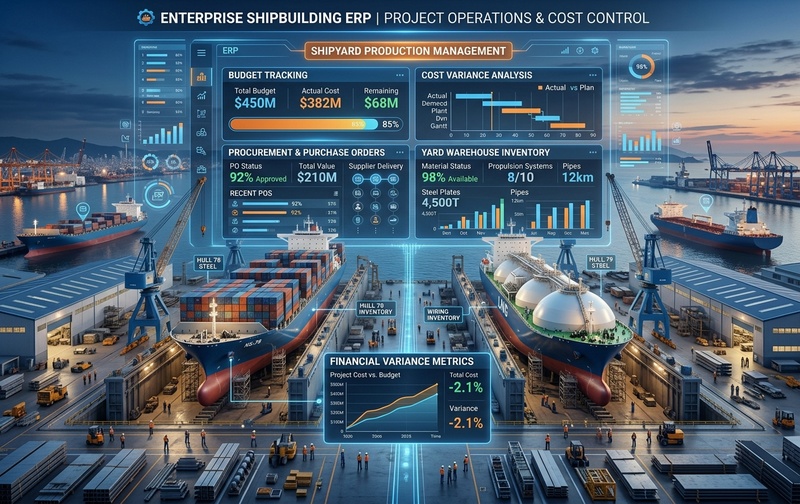
Odoo ERP connects shipyard operations with project costing to track commitments, material availability, and financial variance in real time.
When operational information is distributed across spreadsheets, standalone applications, emails, and departmental systems, several problems can develop:
- Limited project-cost visibility: Actual expenditure may not be compared consistently with budgets, commitments, and revised forecasts.
- Material availability issues: Purchasing teams may not have timely visibility into available stock, reserved materials, pending receipts, and project demand.
- Production coordination gaps: Work may be delayed when materials, work orders, engineering information, or subcontracted activities are not aligned.
- Unplanned purchasing: Incomplete demand information can lead to duplicate orders, excess inventory, or urgent procurement.
- Delayed management reporting: Teams may spend considerable time consolidating operational data before identifying exceptions.
- Difficult project comparisons: Inconsistent cost structures and reporting methods can make it harder to compare vessel projects or identify recurring cost variances.
| Operational Challenge | Root Operational Weakness | Odoo ERP Impact |
|---|---|---|
| Limited project-cost visibility | Actual expenditure isolated in standalone accounting tools without live link to PO commitments or revised forecasts. | Unified analytic accounting linking purchase commitments, stock issues, timesheets, and live variance dashboards. |
| Material availability issues | Purchasing operates blind to warehouse reservations, incoming deliveries, and vessel production milestones. | Real-time multi-location stock visibility, automated reservations per work package, and scheduled replenishment rules. |
| Production coordination gaps | Work orders issued without verified drawing revisions, material staging, or subcontractor readiness. | Integrated manufacturing orders, work center routing, bill of materials synchronization, and subcontractor tracking. |
| Unplanned purchasing | Lack of consolidated project material requirements, causing duplicate rush orders and scrap accumulation. | Centralized purchase requisition workflows tied to vessel BOM demand, supplier price lists, and approval tiers. |
| Delayed management reporting | Weeks spent stitching together spreadsheets from dry docks, procurement, stores, and subcontractor teams. | Dynamic executive reporting dashboards reflecting real-time project milestones, cost variances, and inventory metrics. |
| Difficult project comparisons | Inconsistent Work Breakdown Structures (WBS) and cost accounts across different vessel builds. | Standardized project hierarchy and analytical account templates across all ongoing and historical vessel builds. |
These problems do not automatically mean a shipyard needs a new ERP platform. They indicate where process standardization, data integration, and stronger operational controls may be necessary.
An ERP evaluation should begin by documenting the business processes that create delays, cost overruns, reporting gaps, and inventory discrepancies. The selected system should then be assessed against those requirements rather than against a general list of software features.
Odoo ERP for Shipbuilding Project Cost and Budget Control
Project-cost visibility is a critical consideration when evaluating ERP for shipbuilding. Vessel construction can involve materials, equipment, labour, subcontracted work, engineering changes, logistics, and other expenses distributed across a long delivery cycle.
If these costs are recorded in separate systems, management may struggle to establish the current financial position of a project. A useful ERP configuration should help authorized users review planned expenditure, recorded costs, purchasing commitments, and available financial information using consistent project references.
Establishing a Consistent Project-Cost Structure
Before configuring Odoo, the shipyard should define how project costs will be categorized and reported. Depending on the business model, this structure may include vessel projects, project phases, cost categories, departments, work packages, or other approved dimensions.
A consistent structure helps management compare budgeted amounts with recorded expenditure. It also creates a basis for identifying cost variances and investigating their causes.
For example, a vessel project may experience an increase in equipment costs because of supplier price changes or an engineering revision. If purchasing, inventory, and financial transactions are connected through an appropriate process, the responsible team can investigate the impact more efficiently than when the information must be assembled manually.
The exact reporting capability depends on the Odoo applications, configuration, accounting setup, and any required extensions.
Monitoring Commitments and Actual Expenditure
Recorded expenditure does not always represent the complete financial exposure of a project. Open purchase orders, outstanding supplier commitments, and anticipated additional work may also affect the forecast.
Shipyards should determine whether the proposed solution can report these categories separately and reconcile them with actual financial transactions. Where standard reports do not provide the required view, additional configuration or development may be necessary.
Management reporting should make it easier to identify:
- Projects approaching approved budget limits.
- Cost categories with recurring variances.
- Purchase commitments that may affect future expenditure.
- Changes that require revised forecasts or authorization.
- Projects where financial reporting is incomplete or delayed.
The objective is not merely to produce more reports. It is to establish timely, reliable information that supports corrective action before cost problems become more difficult to control.
Inventory and Procurement Control for Shipyard Materials
Shipbuilding requires coordination of structural materials, machinery, electrical components, specialist equipment, consumables, and other items. Their availability can influence production schedules, project expenditure, and delivery commitments.
Inventory problems often arise when stock balances, material reservations, purchase orders, supplier deliveries, and project requirements are maintained independently. An ERP system should be evaluated for its ability to connect these activities through controlled workflows.
Improving Inventory Visibility
Odoo Inventory may support stock movements, warehouse operations, product tracking, and replenishment workflows, depending on the selected configuration and version. Shipyards must determine how these functions would apply to their own storage locations, project materials, and operational controls.
A practical evaluation should establish whether users can identify:
- Available quantities by warehouse or storage location.
- Materials reserved for specific projects or operations.
- Expected receipts and outstanding supplier deliveries.
- Stock movements, adjustments, and transaction history.
- Items requiring replenishment or further review.
Where materials need lot or serial tracking, the business should define the traceability rules and test them against real operational scenarios. Requirements may differ between standard consumables, high-value equipment, and components subject to specific inspection or documentation controls.
Barcode scanning may also be relevant where warehouses need faster identification and transaction recording. However, scanning devices, label formats, application workflows, and any specialized hardware integration must be assessed before assuming that a proposed process will work as required.
Connecting Procurement With Project Demand
Procurement teams need reliable demand information to avoid unnecessary purchases and material shortages. A structured purchasing process should connect approved requirements, supplier quotations, purchase orders, receipts, and supplier invoices wherever appropriate.
For shipbuilding operations, evaluation scenarios should include long-lead equipment, partial deliveries, supplier substitutions, urgent material requirements, and changes to project specifications.
Consider a situation in which a vessel project requires a particular component, but the supplier changes the confirmed delivery date. Management needs to understand whether the delay affects a planned production activity, whether an alternative supplier is acceptable, and whether the revised delivery creates additional costs.
An ERP workflow can improve coordination when the required records, responsibilities, and exception notifications are properly configured. It cannot eliminate supplier delays or guarantee that every dependency will be managed automatically.
The implementation team should therefore document the purchasing approval process, expected delivery controls, exception handling, and the reports managers need to review.
Production Planning, Bills of Materials and Work Orders
Manufacturing-related processes can form an important part of shipyard ERP requirements. These may include material requirements, bills of materials, work orders, production scheduling, component availability, and tracking the progress of manufacturing activities.
Odoo Manufacturing provides manufacturing-related functionality, but shipbuilding businesses should not assume that every vessel-construction process can be handled through standard settings without adaptation.
The appropriate design depends on how the organization plans and executes work. A shipyard manufacturing prefabricated sections may have different requirements from a business assembling specialist marine equipment or coordinating construction across several subcontractors.
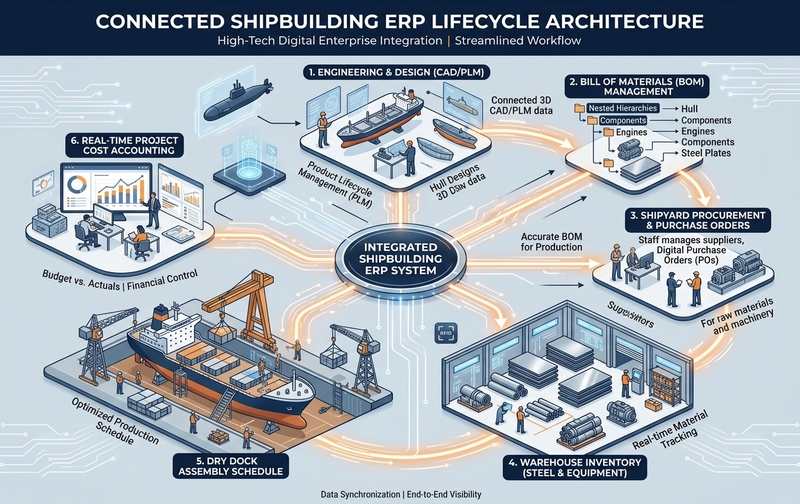
End-to-end shipbuilding project control requires seamless data flow between CAD/PLM engineering, procurement, yard inventory, dry dock scheduling, and project cost accounting.
Aligning Materials With Production Activities
A production plan is only useful when the required materials, equipment, resources, and approved instructions are available at the right time.
The shipyard should examine how planned demand is translated into material requirements and how shortages are identified. It should also determine whether changes in quantities, specifications, or schedules can be reflected in the relevant records without creating inconsistent versions of the plan.
Bills of materials and manufacturing orders may support defined production processes. More complex vessel construction may also require engineering systems, detailed scheduling tools, project-management workflows, or specialist manufacturing applications.
These requirements should be mapped explicitly rather than treated as an assumed feature of an ERP package.
Managing Changes to Production Requirements
Engineering revisions and design changes can affect purchasing, material reservations, production instructions, and project budgets. The ERP design must establish how an approved change is communicated to the teams and records it affects.
For example, if a component specification changes after a purchase order has been issued, the business may need to review supplier commitments, stock already received, production orders, and the financial effect.
A controlled process should identify who approves the revision, which records must be updated, and how affected departments are informed. Where engineering data is maintained in a separate system, the shipyard must define whether integration is required and which system remains authoritative for each type of information.
These controls are essential to preventing inconsistent data from spreading across the project.
Connecting Shipyard Departments Through Integrated Business Data
ERP value depends on more than the number of applications installed. The system must support consistent information flow between departments and provide management with a dependable view of business activity.
For a shipyard, relevant departments may include project management, procurement, warehouse operations, manufacturing, finance, quality, engineering, and subcontractor coordination.
When each department uses different codes, document references, approval rules, or reporting definitions, integration becomes difficult even if software connections exist. A successful implementation must therefore address process alignment and data ownership alongside technical integration.
Defining the Role of Each System
Shipbuilding businesses may already use specialized applications for computer-aided design, product lifecycle management, engineering documentation, vessel design, scheduling, maintenance, or quality management.
Replacing all these systems with one ERP platform may not be practical or desirable. The evaluation should identify which activities belong in Odoo, which remain in specialist applications, and where information needs to move between them.
An integration plan should specify:
- Which system owns each critical data field.
- Which transactions or records must be exchanged.
- How often data must be synchronized.
- How failed or incomplete exchanges are detected.
- Who resolves integration errors.
- How duplicate records and inconsistent updates are prevented.
- How access permissions and sensitive business information are protected.
Integration requirements should be tested using realistic transaction volumes and exception scenarios. A connection that works for a simple demonstration may still fail to meet production requirements.
Establishing Reliable Management Reporting
Senior leaders need reporting that supports decisions rather than merely displaying historical transactions.
Useful reporting priorities may include project budget variance, material availability, outstanding procurement commitments, delayed deliveries, inventory valuation, production progress, and outstanding approvals.
The exact dashboards should reflect the organization’s operating model. A shipyard managing several vessel projects may require consolidated reporting across projects, while a smaller specialist manufacturer may prioritize order profitability, material planning, and delivery performance.
Before implementation, stakeholders should define each metric, its source, calculation method, update frequency, and responsible owner. This reduces the risk of different departments presenting conflicting figures for the same business outcome.
Odoo Standard Functionality, Customization and Integration Requirements
One of the most important decisions in evaluating Odoo ERP for shipbuilding is determining which requirements can be supported through standard applications and configuration, and which require customization or integration.
Odoo includes business applications for areas such as inventory, purchasing, manufacturing, project management, and accounting. The availability and suitability of specific functions depend on the version, edition, installed applications, configuration, and business requirements.
Shipyards should not assume that the standard product automatically covers every industry-specific workflow.
Where Standard Applications May Be Suitable
Standard functionality may be a reasonable starting point for defined business processes such as purchase-order management, stock transactions, financial recording, project task management, and supported manufacturing workflows.
The implementation team should demonstrate each required process using the shipyard’s own scenarios. Demonstrations should include normal transactions and exceptions, such as partial receipts, changed delivery dates, cancelled requirements, and approval rejections.
A successful demonstration should prove that the process meets the requirement without relying on undocumented manual workarounds.
Where Customization May Be Required
Additional development or integration may be necessary when the shipyard requires specialized capabilities, including:
- Complex vessel-specific costing and reporting structures.
- Advanced scheduling across interdependent work packages.
- Engineering revision controls across multiple systems.
- Specialized material traceability or inspection workflows.
- Detailed subcontractor progress and cost reporting.
- Data exchange with engineering or design applications.
- Industry-specific approval rules or management dashboards.
These are assessment areas, not a claim that every shipyard will need custom development for each one.
Customization can improve process fit, but it also introduces cost, testing, documentation, upgrade, and maintenance considerations. The business should distinguish essential requirements from preferences and avoid modifying standard workflows where a simpler, controlled process would meet the need.
| Shipyard Operational Area | Supported by Standard Odoo | Likely Customization / Integration Need |
|---|---|---|
| Project Costing & Accounting | Analytic accounts, timesheets, vendor bills, and standard project-level budget tracking. | Multi-tiered vessel WBS hierarchy, earned value management (EVM), and dry dock milestone billing. |
| Inventory & Traceability | Multi-warehouse locations, lot/serial numbering, barcode tracking, and stock scrap operations. | Marine class certificate archiving, heat number mill test traceability, and project-dedicated quarantine. |
| Procurement & Supplier Control | Requests for Quotation (RFQs), Purchase Orders, 3-way matching, and vendor price lists. | Long-lead equipment milestone tracking, maritime shipping logistics, and multi-tier requisition approvals. |
| Production & Work Orders | Manufacturing Orders, multi-level Bills of Materials (BOM), and work center scheduling. | Engineering change notices (ECN), CAD/PLM bi-directional sync, and complex subcontractor staging. |
| Subcontractor Coordination | Subcontracted manufacturing orders with dropship material components. | Yard access control, safety certification compliance, and progress certification against work packages. |
Evaluating the Total Cost of Ownership
Software subscription or licensing costs are only one part of the implementation budget. The full financial assessment may include discovery, process design, configuration, development, integration, data migration, testing, training, support, hosting, and future upgrades.
A useful comparison should consider both initial implementation expenditure and the recurring cost of maintaining the solution. It should also identify assumptions that could change the budget, such as additional interfaces, poor source-data quality, or changes to project scope.
Decision-makers should request a clear breakdown of included services, exclusions, dependencies, and ongoing responsibilities before approving the implementation.
Evaluating Odoo ERP for Complex Shipbuilding Projects
A software demonstration is not sufficient to determine whether Odoo is suitable for a particular shipyard. The evaluation should be based on operational scenarios, measurable acceptance criteria, and the consequences of a process failing.
A structured assessment helps stakeholders identify gaps before they become expensive implementation issues.
Step 1: Document Operational Requirements
Start by mapping the current workflow from project planning through procurement, receipt, inventory allocation, production, subcontractor activity, cost reporting, and financial closure.
Record where information is created, who approves changes, and which systems are involved. Include recurring exceptions rather than documenting only the ideal process.
Step 2: Separate Essential Requirements From Optional Improvements
Classify requirements according to operational importance, compliance obligations, financial impact, and implementation priority.
For example, accurate material traceability may be essential for a particular category of equipment, while a customized dashboard may be a later improvement. This distinction helps prevent project scope from expanding without a clear business justification.
Step 3: Demonstrate Complete Workflows
Ask the implementation team to demonstrate how a project requirement becomes a purchase order, how the material is received and recorded, how it becomes available for the relevant activity, and how the associated costs are reflected in management reporting.
Use realistic data and include failed deliveries, quantity discrepancies, revised specifications, and approval exceptions. The aim is to test the complete workflow, not isolated screens.
Step 4: Assess Integration and Data Migration
Identify the information that must be transferred from existing systems, including products, suppliers, stock balances, open purchase orders, financial records, and active project data where applicable.
The migration plan should define data owners, cleansing responsibilities, validation rules, reconciliation procedures, and acceptance criteria. Integrations should be assessed for data consistency, security, error handling, and maintainability.
Step 5: Confirm Ownership and Support Arrangements
Every critical process should have an accountable business owner. The implementation plan should also define responsibilities for configuration, custom code, integration monitoring, user access, documentation, issue resolution, and future upgrades.
These decisions are particularly important when multiple departments and external providers participate in the implementation.
Implementation Decisions That Affect ERP Project Outcomes
ERP implementation risks often originate in decisions made before configuration and development begin. Unclear requirements, incomplete data, unrealistic schedules, and undefined responsibilities can affect cost, adoption, and operational continuity.
Shipbuilding organizations should address these risks through a phased, measurable implementation plan.
Establishing a Realistic Project Scope
The project scope should identify business processes, locations, user groups, applications, integrations, reports, and required customizations. It should also state which requirements are excluded from the initial rollout.
Without this definition, teams may continue adding requests without evaluating their effect on budget, schedule, and testing. A formal change-control process should assess each proposed change before it is approved.
Preparing Data Before Migration
Duplicate suppliers, inconsistent product codes, incomplete descriptions, inaccurate stock balances, and outdated project records can undermine the reliability of a new ERP system.
Data preparation should begin early. Business owners should validate critical records, agree on naming conventions, and reconcile opening balances before the production cutover.
Migration should be tested more than once where the project’s complexity warrants it. Final reconciliation should confirm that important records and balances are consistent between the old and new environments.
Testing Realistic Operating Conditions
Testing should cover normal workflows, exceptions, user permissions, integration failures, reporting accuracy, and recovery procedures. Business users should confirm that the system supports their actual responsibilities.
Acceptance criteria should be agreed before testing begins. Examples include the ability to trace a selected material transaction, reconcile a defined project-cost report, complete an approval workflow, and identify a failed integration.
Preparing Users and Managing Change
An ERP system changes how employees record transactions, approve activities, and access information. Training should be based on user roles and practical tasks rather than a generic overview of the software.
Management should explain why the process is changing, what users are expected to do, and where they can report problems. Adoption should be monitored after launch so that recurring errors, workarounds, and training gaps can be addressed.
Measuring Business Outcomes After Launch
Implementation completion does not automatically prove that business objectives have been achieved. The organization should compare agreed baseline measures with post-launch results.
Potential measures include the time required to prepare project reports, inventory-record accuracy, procurement cycle time, the frequency of manual corrections, overdue approvals, and the visibility of project-cost variances.
Targets should be defined using the organization’s actual starting position rather than assumed industry benchmarks. Reviewing results regularly helps management distinguish genuine improvements from issues that still require corrective action.
| Shipyard KPI | Operational Metric | Expected Business Improvement |
|---|---|---|
| Project Cost Variance Visibility | Days required to detect and report budget variances by vessel work package. | Real-time variance identification preventing unbudgeted overrun accumulation. |
| Inventory Record Accuracy | Match percentage between physical yard stock and system inventory balances. | Significant reduction in dry dock stockouts, rush orders, and duplicate material purchases. |
| Procurement Cycle Time | Turnaround duration from vessel requisition approval to purchase order release. | Accelerated purchasing workflows for critical equipment and raw steel plates. |
| Work Order Adherence | Percentage of fabrication and assembly orders executed on schedule. | Minimized dry dock idle time and tighter alignment between trades and subcontractors. |
| Management Reporting Speed | Hours spent consolidating cross-departmental project status summaries. | On-demand reporting allowing executive corrective action during active vessel builds. |
How Shipbuilding Businesses Can Evaluate ERP Suitability
The right ERP solution is the one that meets the shipyard’s defined business requirements with an acceptable balance of functionality, cost, implementation risk, and long-term maintainability.
Odoo may be worth evaluating when a shipbuilding business needs connected processes across purchasing, inventory, manufacturing, project management, and finance. However, businesses with complex engineering, detailed vessel scheduling, specialized traceability, or extensive subcontractor requirements should validate those needs carefully before selecting the platform.
A practical decision should consider five areas:
- Operational fit: Can the proposed workflows support the shipyard’s actual processes and exceptions?
- Financial control: Can management obtain reliable visibility into budgets, commitments, recorded costs, and variances?
- Material control: Can the system support the required inventory, procurement, reservation, and traceability processes?
- Technical fit: Can required integrations, reporting, access controls, and future upgrades be maintained effectively?
- Implementation feasibility: Are the scope, budget, timeline, data readiness, responsibilities, and success measures realistic?
| Evaluation Dimension | Core Shipyard Validation Question | Decision Criteria |
|---|---|---|
| Operational Fit | Can standard Odoo applications handle yard-level transactions and workflow exceptions? | Demonstration on actual yard scenarios without undocumented manual workarounds. |
| Financial Control | Does the system separate PO commitments from recorded expenditure per project phase? | Clear audit trail connecting purchase requisitions to general ledger balance sheets. |
| Material Control | Are long-lead items, certificates, and material reservations tracked reliably? | Full lot/serial traceability and reservation locking to dedicated vessel work orders. |
| Technical Fit | Can Odoo integrate smoothly with CAD/PLM, nesting software, and legacy systems? | Robust REST/XML-RPC API compatibility, data integrity guards, and upgrade maintainability. |
| Implementation Feasibility | Are implementation milestones, user adoption plans, and data migration realistic? | Clear change-management strategy, verified baseline data, and accountable process ownership. |
The decision should be based on documented evidence from process demonstrations, fit-gap analysis, integration assessments, and cost estimates. This approach gives leadership a stronger basis for deciding whether to proceed, modify the scope, or consider an alternative solution.
Frequently Asked Questions
Evaluate Odoo ERP for Your Shipbuilding Operations
Shipyards evaluating ERP need more than a software feature list. They need to understand how project costing, procurement, inventory, production workflows, financial reporting, and existing business applications will work together in practice.
Emerging Alliance supports businesses evaluating ERP implementation, customization, integration, and operational requirements. A structured consultation can help identify process gaps, clarify standard-versus-custom requirements, and establish the priorities that should guide a solution evaluation.
Request a consultation to evaluate Odoo ERP requirements for your shipbuilding operations.