
Best ERP for Pharma Manufacturing: What to Evaluate Before You Choose
Quick Answer
The best ERP for pharmaceutical manufacturing is not determined by the number of features or AI capabilities alone. A suitable pharmaceutical manufacturing ERP should connect batch and lot traceability, formulation, production planning, quality control, inventory, expiry management, costing, procurement, sales and reporting while supporting the manufacturer’s operational and regulatory requirements.
For small and mid-sized pharmaceutical manufacturers, SAP Business One can be evaluated when its standard ERP capabilities, configuration options, industry-specific extensions and required integrations align with the company’s processes. SAP Business One provides functionality across financials, purchasing, inventory, sales, reporting and analytics, while its manufacturing capabilities include production orders, bills of materials and material requirements planning.
The right selection should therefore be based on manufacturing complexity, batch traceability, quality workflows, inventory control, integration requirements, scalability, implementation approach and total cost of ownership rather than choosing an ERP simply because it advertises AI.
What Makes Pharmaceutical Manufacturing ERP Different?
Pharmaceutical manufacturing has requirements that extend beyond basic accounting, purchasing and inventory management.
A manufacturer may need to control raw materials, batches, formulations, production orders, quality checks, quarantine stock, finished goods, expiry dates and distribution records within connected processes.
The ERP therefore needs to provide reliable information across the manufacturing lifecycle.
A typical pharmaceutical manufacturing flow can involve:
➔
➔
➔
➔
➔
➔
➔
➔
➔
➔
➔
The exact workflow varies by manufacturer, product type and regulatory environment. However, the underlying requirement remains the same: business, production, inventory and quality information should remain connected.
For example, if a finished batch needs investigation, the business should be able to identify the relevant production records, material lots and inventory movements rather than searching through disconnected spreadsheets and systems.
This is why pharmaceutical companies should evaluate ERP based on actual manufacturing processes rather than a generic feature checklist.
Pharmaceutical Manufacturing Processes an ERP Should Connect
An ERP evaluation should begin with the manufacturer’s operating model.
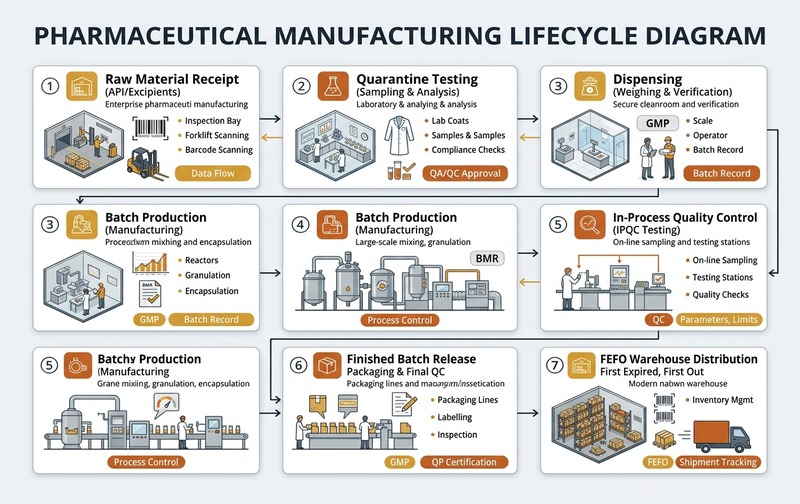
Enterprise diagram illustrating the connected pharmaceutical manufacturing lifecycle, connecting raw material intake, quarantine testing, dispensing, batch production, in-process quality control, finished batch release, and FEFO warehouse distribution.
Raw Material and Supplier Management
Pharmaceutical production depends on the availability and controlled use of raw materials such as APIs, excipients, packaging materials and other production inputs.
The ERP should help manage:
- Supplier information
- Purchase orders
- Goods receipts
- Material quantities
- Batch or lot information
- Inventory locations
- Quality status
- Purchase costs
- Supplier performance information
This provides the foundation for downstream production and inventory control.
Production Planning and Material Requirements
Production planning becomes difficult when demand, inventory, procurement and manufacturing schedules are managed separately.
Material requirements planning can help manufacturers determine material requirements based on inventory, demand, supply, production orders, forecasts and planning parameters.
SAP Business One includes MRP functionality that calculates material requirements through bill-of-material structures and considers factors such as inventory, sales orders, purchase orders, production orders and forecasts.
For pharmaceutical manufacturers, the important question is not simply whether an ERP has MRP.
The question is whether the planning process reflects the company’s:
- Batch sizes
- Lead times
- Material availability
- Production capacity
- Procurement cycles
- Demand patterns
- Manufacturing constraints
Batch Manufacturing and Production Control
Batch production requires stronger traceability than ordinary inventory management.
The ERP should help connect the production order with relevant materials, quantities, batches, production dates and inventory movements.
Where appropriate, manufacturers should also evaluate how the ERP handles:
- Bill of materials
- Production orders
- Material consumption
- Production output
- Batch identification
- Production quantities
- Yield information
- Production variances
- Rework or rejected quantities
SAP Business One supports production data and bills of materials, while its production functionality can be configured around different manufacturing processes.
However, pharmaceutical-specific requirements should be assessed during solution design rather than assumed to be available as standard functionality.
Pharmaceutical ERP Requirements for Batch and Lot Traceability
Batch traceability should be one of the highest-priority areas in a pharmaceutical ERP evaluation.
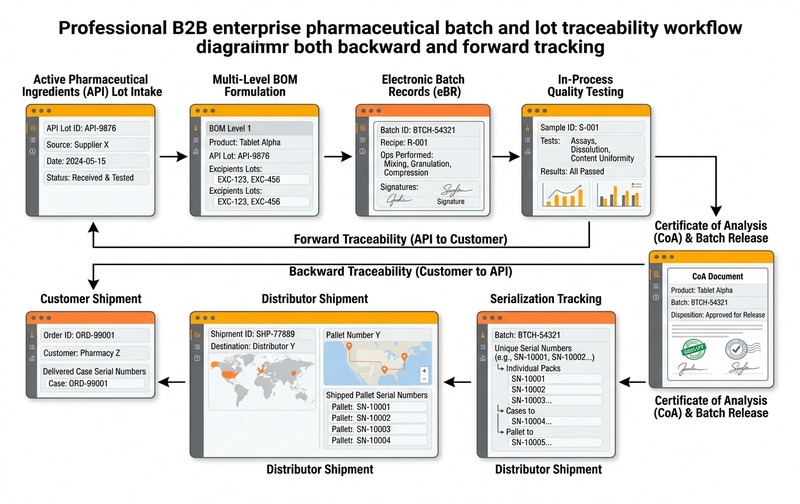
Detailed enterprise workflow illustrating bidirectional batch and lot traceability, connecting API raw material lots, multi-level BOM formulation, electronic batch records, quality testing, and customer delivery.
A manufacturer may need to answer questions such as:
- Which raw-material batches were used in a finished product?
- Which finished batches contain a particular raw-material lot?
- When was a batch manufactured?
- Where is the batch currently located?
- What is its expiry date?
- Which customers received the batch?
- What quantity remains in inventory?
- What happened to the batch during production and distribution?
SAP Business One provides batch and serial-number management within its inventory functionality. SAP documentation also supports batch details such as manufacturing date, expiration date, location and batch quantities.
For a pharmaceutical implementation, however, traceability should be evaluated across the complete business process rather than simply checking whether a “batch management” feature exists.
Formulation, BOM and Recipe Management
Pharmaceutical manufacturers often work with controlled formulations, product structures and material relationships.
The ERP evaluation should consider whether the proposed solution can support:
- Multi-level bills of materials
- Formulation structures
- Version control requirements
- Material quantities
- Production resources
- Batch-size changes
- Approved production structures
- Controlled master-data changes
SAP Business One supports multi-level BOMs and production planning.
Where pharmaceutical processes require additional formulation controls, specialized functionality may need to be added through configuration, extensions or integrations.
This distinction is important because an ERP should not be presented as having a pharmaceutical capability simply because the underlying platform can be customized to support it.
Quality Control and Batch Release
Quality should be evaluated as part of the ERP process rather than treated as a separate reporting activity.
Pharmaceutical manufacturing quality requirements can involve raw-material testing, in-process controls, finished-product testing, release decisions and investigation of quality issues.
FDA guidance describes CGMP as requiring systems that control manufacturing processes and facilities and emphasizes reliable quality systems, appropriate raw materials, procedures, testing and investigation of deviations.
An ERP evaluation should therefore consider how the solution interacts with:
- Incoming quality inspection
- In-process quality checks
- Finished-product testing
- Quarantine inventory
- Approved inventory
- Rejected material
- Batch release
- Certificates of analysis
- Deviations
- Corrective and preventive actions
- Quality documentation
The ERP may not perform every quality-management function itself. Integration with a dedicated QMS or laboratory system may be more appropriate depending on the manufacturer’s requirements.
Inventory, Expiry and FEFO Management
Pharmaceutical inventory requires more than knowing how many units are available.
Manufacturers may need visibility into:
- Batch numbers
- Lot numbers
- Manufacturing dates
- Expiry dates
- Warehouse locations
- Quality status
- Available quantities
- Reserved quantities
- Quarantine quantities
- Rejected stock
- Inventory valuation
SAP Business One supports inventory management, batch and serial numbers, multiple warehouses and inventory transactions.
Its inventory functionality can also provide visibility into inventory quantities and turnover, with an Inventory Status dashboard available for supported SAP HANA deployments or SAP Business One analytics powered by SAP HANA.
For pharmaceutical manufacturers, the implementation should additionally determine how expiry management and FEFO processes will be configured within the complete warehouse workflow.
Pharmaceutical Manufacturing ERP and Compliance
An ERP can support controlled processes, traceability and documentation, but software alone does not make a pharmaceutical manufacturer compliant.
This distinction is critical.
FDA’s CGMP framework establishes minimum requirements for methods, facilities and controls used in pharmaceutical manufacturing, processing and packing.
In India, CDSCO has also issued requirements and guidance relating to Schedule M and GMP, including quality-management and manufacturing controls.
Therefore, ERP selection should ask:
Does the proposed system support the processes and controls required by our quality and regulatory framework?
Rather than:
Does this ERP automatically make us compliant?
The second question can lead to unrealistic expectations.
The implementation team should map applicable requirements to actual system controls, procedures, integrations, documentation and validation activities.
What Should a Pharmaceutical Manufacturing ERP Include?
A practical evaluation framework should cover the following areas.
| ERP capability | Why it matters in pharmaceutical manufacturing |
|---|---|
| Batch and lot management | Supports material and finished-product traceability |
| Production management | Connects manufacturing orders with materials and output |
| BOM/formulation management | Defines production structures and material requirements |
| MRP | Supports material planning based on demand and supply |
| Quality workflows | Helps manage inspection, status and release processes |
| Inventory management | Provides visibility across warehouses and stock statuses |
| Expiry management | Helps control shelf-life-sensitive inventory |
| Procurement | Connects material requirements with purchasing |
| Warehouse management | Tracks storage locations and stock movements |
| Costing | Supports production and inventory cost analysis |
| Financial management | Connects operational transactions with finance |
| Reporting and analytics | Supports operational and management decisions |
| Integration | Connects ERP with external systems and equipment |
| Security and controls | Supports role-based access and controlled processes |
| Scalability | Accommodates future business and operational growth |
This framework can be used before comparing individual ERP vendors.
How SAP Business One Fits Pharmaceutical Manufacturing
SAP Business One is an ERP platform designed for small and midsize businesses. SAP describes the solution as covering accounting and financials, purchasing, inventory, sales and customer relationships, reporting and analytics, with SAP HANA integration and customization options.
For a pharmaceutical manufacturer, its relevance should be evaluated based on the actual operating model.
Potentially relevant areas include:
SAP Business One’s MRP functionality can plan material requirements using inventory, demand and supply information, while its inventory functionality supports batch and serial-number management.
The important qualification is that a pharmaceutical implementation may require additional configuration, industry-specific extensions or integrations.
SAP Business One for Pharma: Standard, Configuration, Add-On or Integration?
One of the most important questions during an ERP evaluation is:
Which requirements are available in the standard ERP, and which require additional development or integration?
A practical assessment can use four categories.
Standard ERP Capability
These are functions available within the standard platform, such as core financials, purchasing, inventory and manufacturing capabilities.
Configuration
Some business requirements can be addressed by configuring workflows, master data, permissions, warehouses, planning parameters or other system settings.
Industry Add-On
Specialized pharmaceutical requirements may require an industry-specific extension or partner solution.
Integration
Some processes may be better handled by connecting the ERP with external applications such as LIMS, QMS, barcode systems, weighing equipment or other operational technologies.
This model helps prevent one of the most common ERP-selection mistakes: assuming that every requirement must either be “standard” or that the ERP cannot support it.
The actual solution architecture should be documented before implementation.
Can SAP Business One Support Batch and Lot Traceability?
Yes, SAP Business One supports batch and serial-number management within its inventory functionality. Its documentation includes batch information such as batch IDs, manufacturing dates, expiration dates, warehouse locations and quantities.
For pharmaceutical manufacturers, however, the evaluation should go further.
Ask the implementation partner to demonstrate a complete traceability scenario:
Raw material batch → purchase receipt → quality status → production order → finished batch → warehouse → customer delivery
A demonstration using the manufacturer’s actual workflow is more useful than a generic product presentation.
Can SAP Business One Support Production Planning?
SAP Business One includes MRP functionality that calculates material requirements based on demand, inventory, supply and planning parameters. It also supports production structures through BOMs and production orders.
The key evaluation question is whether these capabilities can be configured to reflect the manufacturer’s actual planning process.
A pharmaceutical company should test scenarios involving:
- Forecast changes
- Material shortages
- Lead-time changes
- Batch-size requirements
- Production priorities
- Purchase requirements
- Existing inventory
- Multiple production orders
What Integrations Should Pharma Manufacturers Consider?
ERP rarely operates in isolation in a modern pharmaceutical manufacturing environment.
Depending on the operation, integration requirements may include:
ERP + LIMS
For laboratory and testing processes.
ERP + QMS
For quality-management workflows.
ERP + Barcode
For warehouse and material identification.
ERP + Weighing Systems
For controlled material handling where applicable.
ERP + CRM
For customer and sales processes.
ERP + E-Commerce or Distribution Platforms
For connected order and fulfilment processes.
ERP + Business Intelligence
For advanced management reporting and analytics.
The correct integration architecture depends on the existing technology environment and process requirements.
AI in Pharmaceutical Manufacturing ERP
AI can be useful in pharmaceutical manufacturing, but it should be evaluated as a capability rather than treated as the definition of a good ERP.
Potential use cases include:
- Demand forecasting
- Inventory analysis
- Production analytics
- Anomaly detection
- Management reporting
- Procurement insights
- Cost analysis
- Predictive maintenance where suitable data and systems exist
The value depends on the quality, availability and structure of the underlying data.
A manufacturer should therefore ask:
What business problem will the AI capability solve?
For example, “AI forecasting” is less useful as an evaluation criterion than:
Can the system improve demand visibility using our historical sales, inventory and production data?
This keeps the ERP evaluation focused on measurable business requirements.
ERP Implementation Considerations for Pharmaceutical Manufacturers
Choosing the ERP is only the beginning.
A pharmaceutical ERP implementation should evaluate:
Process Mapping
Document the current manufacturing, inventory, procurement, quality and distribution processes before configuration.
Master Data
Review item masters, BOMs, suppliers, customers, warehouses, batches, units of measure and other critical data.
Data Migration
Determine what historical data should move to the new ERP and how data quality will be validated.
Integration
Document every external system that must exchange information with the ERP.
Roles and Access
Define who can create, modify, approve and release transactions.
Testing
Test normal, exception and quality-related scenarios before go-live.
Training
Train users according to their operational roles rather than providing only generic ERP training.
Validation and Compliance Activities
Where regulated processes require documented validation or qualification activities, these should be addressed as part of the implementation methodology.
Post-Go-Live Support
The implementation plan should include support, issue resolution, optimization and future enhancements.
Questions to Ask an ERP Vendor Before Buying
Before selecting a pharmaceutical manufacturing ERP, ask the vendor or implementation partner:
- How does the system manage raw-material and finished-product batches?
- Can you demonstrate backward and forward batch traceability?
- How are expiry dates and inventory statuses managed?
- How does production planning work with our BOMs and batch sizes?
- Which pharmaceutical requirements are standard?
- Which requirements need configuration?
- Which requirements require an add-on?
- Which external systems can be integrated?
- How are quality holds and batch-release processes handled?
- How is production and inventory costing calculated?
- How are user roles and approvals controlled?
- What data needs to be migrated?
- What implementation activities are required from our team?
- What ongoing support is included?
- What is the expected total cost of ownership?
These questions help shift an ERP discussion from a software demonstration to an operational evaluation.
How to Compare ERP Options for Pharmaceutical Manufacturing
Do not compare ERP platforms only by counting features.
Instead, evaluate each option against the same business requirements.
| Evaluation area | Questions to ask |
|---|---|
| Manufacturing | Does it support our production model? |
| Traceability | Can we trace materials and finished batches? |
| Quality | Can quality processes connect with inventory and production? |
| Inventory | Can we manage batches, expiry and warehouse stock? |
| Planning | Does MRP reflect our actual supply and demand process? |
| Integration | Can it connect with required systems? |
| Data | Can existing master and transactional data be migrated reliably? |
| Scalability | Can the architecture support planned growth? |
| Implementation | What configuration, customization and integration are required? |
| Support | Who will provide post-go-live support? |
| Cost | What is the complete implementation and ownership cost? |
This approach allows pharmaceutical manufacturers to compare SAP Business One and other ERP options against their own requirements rather than relying on generic “best ERP” lists.
Is SAP Business One Suitable for Every Pharmaceutical Manufacturer?
No single ERP should be assumed to fit every pharmaceutical manufacturer.
SAP Business One is positioned by SAP for small and midsize businesses and provides a broad ERP foundation across financials, purchasing, inventory, sales, reporting and analytics.
Whether it is suitable for a particular pharmaceutical company depends on factors such as:
- Number of manufacturing locations
- Production complexity
- Product portfolio
- Batch requirements
- Quality processes
- Regulatory environment
- Required integrations
- Geographic operations
- Customization requirements
- Growth plans
- Internal IT capabilities
A structured fit-gap assessment should therefore happen before the final ERP decision.
Why a Pharma ERP Evaluation Should Start With Business Processes
A common mistake is starting with software demonstrations.
A better approach is:
Business process → requirement → control → ERP capability → configuration → integration → validation → user acceptance
For example, instead of asking:
“Does the ERP support batch management?”
ask:
“Show us how a raw-material batch received from a supplier moves through quality status, production consumption, finished-batch creation, warehouse storage and customer delivery.”
The second question produces much more useful information for an ERP selection decision.
Evaluate SAP Business One for Your Pharmaceutical Manufacturing Operations
Selecting pharmaceutical manufacturing ERP software requires more than comparing feature lists.
The right evaluation should consider your production processes, batch requirements, inventory model, quality workflows, integrations, reporting requirements, data migration, deployment model and future growth.
SAP Business One can provide an ERP foundation across financials, purchasing, inventory, production, planning, sales and analytics, while additional configuration, extensions and integrations can be considered for pharmaceutical-specific requirements.
If you are evaluating SAP Business One for pharmaceutical manufacturing, the next step should be a process-focused assessment rather than a generic product demo.
Conclusion
The best ERP for pharmaceutical manufacturing is the system that fits the manufacturer’s operational requirements, quality processes, traceability needs, integration architecture and growth plans.
A strong evaluation should examine batch and lot traceability, production planning, formulation and BOMs, quality workflows, inventory and expiry control, costing, procurement, integrations, analytics, implementation requirements and total cost of ownership.
SAP Business One can be part of that evaluation for small and mid-sized pharmaceutical manufacturers. Its standard ERP capabilities cover areas such as financial management, purchasing, inventory, production, MRP, sales and reporting, while pharmaceutical-specific requirements may require configuration, extensions or integrations.
The most reliable way to assess the fit is to map the ERP against real pharmaceutical manufacturing scenarios and demonstrate how each critical process will work before implementation.
FAQs
Evaluate the Best ERP for Pharma Manufacturing
Evaluate SAP Business One for your pharmaceutical manufacturing needs, including production, batch management, inventory, quality and reporting.
Book a demo to explore the right ERP approach for your business.