
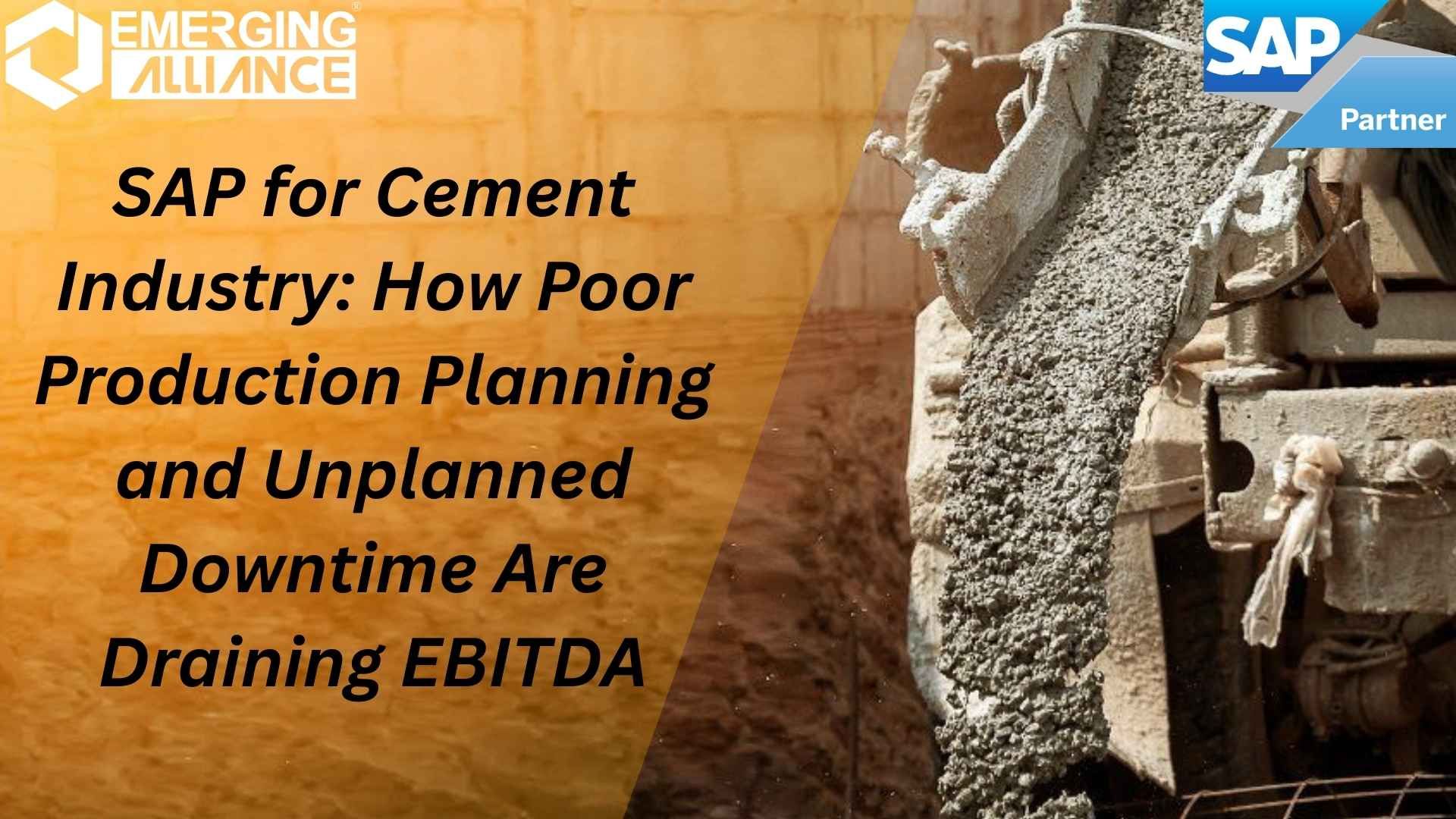
SAP for Cement Industry: How Poor Production Planning and Unplanned Downtime Are Draining EBITDA
SAP for Cement Industry – The EBITDA Impact of Poor Production Planning, Limited Visibility, and Unplanned Downtime
The cement sector is one of the most capital-intensive manufacturing industries in the world. Margins are thin, energy costs are volatile, logistics are complex, and even a few hours of unplanned downtime can erode profitability. In this environment, SAP for Cement Industry has become a strategic enabler rather than just an IT system.
Yet many cement manufacturers still struggle with disconnected systems, reactive planning, and limited real-time insight. The result? EBITDA leakage driven by poor production planning, inefficient supply chains, and avoidable shutdowns. This is where a well-designed SAP landscape—implemented by an experienced partner like Emerging Alliance—can transform operations.
The EBITDA Challenge in Cement Operations Powered by SAP-Based Cement Manufacturing Systems
In cement plants, EBITDA is directly influenced by kiln utilization, fuel efficiency, maintenance discipline, and on-time delivery. When production planning is weak, plants overproduce low-demand grades, underproduce high-margin products, or run kilns inefficiently.
Modern SAP in Cement Manufacturing environments address this by integrating demand forecasting, capacity planning, and plant-level execution. With SAP ERP for Cement Industry and specialized SAP Cement Manufacturing Software, manufacturers gain end-to-end control—from limestone quarry to dealer dispatch—reducing cost per ton and improving contribution margins.
Why Production Planning Breaks Down at Scale
Ineffective planning is one of the biggest hidden drains on EBITDA. Manual spreadsheets and siloed tools cannot manage the complexity of multiple plants, variable fuel mixes, and fluctuating market demand.
Advanced SAP production planning for cement industry capabilities allow planners to simulate scenarios, balance clinker and grinding capacity, and align production with sales forecasts. Using SAP modules for cement industry, plants can synchronize production schedules with maintenance windows, ensuring higher uptime and predictable output.
The benefits of SAP for cement manufacturing become visible quickly: reduced changeover losses, optimized kiln runs, and better working capital utilization.
Eliminating Unplanned Downtime with SAP-Driven Visibility in Cement Plants
Unplanned downtime doesn’t just stop production—it increases energy consumption, impacts quality, and delays customer deliveries. Many cement plants still rely on reactive maintenance due to lack of asset visibility.
With SAP Solutions for Cement Plants, manufacturers can move toward predictive maintenance. Integrated plant data and SAP real-time reporting cement industry dashboards help maintenance teams identify early warning signs. Combined with SAP dashboards for cement plants, decision-makers gain instant insight into equipment, shutdown causes, and performance trends.
Supply Chain Inefficiencies and the Role of SAP ERP Cement Manufacturing
Cement supply chains are uniquely complex, involving bulk transportation, multiple depots, and dealer networks. Poor coordination between production and logistics leads to high freight costs and lost sales.
Using SAP supply chain for cement industry, manufacturers can optimize inventory positioning, route planning, and dealer replenishment. SAP dealer management cement industry features further improve order fulfillment and channel visibility. When supported by SAP Cloud Solutions for Cement Industry, these capabilities scale across regions and plants with consistent performance.
Quality and Cost Control with SAP in Cement Manufacturing Operations
Quality deviations result in rework, customer complaints, and regulatory risk. At the same time, rising fuel and raw material costs demand tighter control.
SAP Quality Management Cement Industry capabilities ensure consistent product standards through automated checks and approvals. Integrated SAP quality control cement manufacturing processes reduce variability while improving compliance. Meanwhile, SAP Cost Optimization Cement Industry tools help finance teams track cost drivers in real time, linking operational decisions directly to EBITDA outcomes.
The Importance of the Right SAP Partner for Cement Sector Transformation
Technology alone doesn’t deliver results—execution does. A successful SAP Implementation for Cement Industry requires deep industry knowledge, proven templates, and ongoing optimization.
Emerging Alliance acts as a trusted SAP Partner for Cement Industry, offering SAP Consulting for Cement Industry, tailored implementations, and long-term SAP Support for Cement Industry. With experience across SAP Cement Industry Solutions and global best practices, Emerging Alliance helps cement manufacturers unlock measurable ROI from their SAP investments.
Notably, Emerging Alliance also brings cross-industry expertise, delivering advanced ERP solutions such as enabling regulated manufacturers to achieve compliance, traceability, and operational excellence. This cross-domain capability strengthens their approach to complex SAP environments in cement manufacturing.
Why Cement Market in India Is Becoming a Competitive Necessity
India’s cement market is highly competitive, capacity-driven, and logistics-intensive. To remain profitable, manufacturers are rapidly adopting SAP for Cement Industry in India to standardize processes, gain transparency, and support growth through acquisitions and capacity expansions.
From quarry management to dispatch optimization, Best SAP solution for cement industry deployments are helping Indian cement producers scale sustainably while protecting EBITDA.
Turning ERP Investments into Sustainable EBITDA Gains
When implemented strategically, SAP for Cement Industry becomes more than an ERP—it becomes a performance management platform. By addressing poor production planning, reducing unplanned downtime, and enabling real-time decision-making, SAP directly impacts profitability.
With the right partner like Emerging Alliance, cement manufacturers can transform SAP into a long-term EBITDA engine while building a future-ready digital foundation.
FAQs About SAP for Cement Industry
1. How does SAP improve production efficiency for cement manufacturers?
SAP integrates planning, execution, and plant operations, enabling cement producers to reduce losses, improve kiln utilization, and increase overall throughput.
2. Which SAP solutions are most useful for cement manufacturing businesses today?
SAP ERP, production planning, quality management, and supply chain applications are widely adopted by cement producers to manage end-to-end operations.
3. Can SAP help reduce unplanned downtime in cement plants?
Yes, SAP provides real-time asset visibility and predictive insights that allow plant teams to prevent breakdowns and improve equipment reliability.
4. How does SAP support cost control in cement manufacturing operations?
SAP tracks energy consumption, maintenance spend, and logistics costs, helping cement companies identify savings opportunities and protect margins.
5. Is SAP suitable for multi-location cement production environments?
SAP is designed to manage complex, multi-plant cement operations with centralized governance and local operational flexibility.
6. How long does SAP implementation typically take for cement producers?
Implementation timelines vary by scope and scale, but experienced SAP partners can phase deployments to deliver faster business value.
7. Does SAP support quality management in cement production?
Yes, SAP enables quality checks, compliance tracking, and process standardization across cement manufacturing workflows.
8. Can SAP integrate dealers and distributors for cement businesses?
SAP supports dealer and channel integration, improving order visibility, dispatch planning, and customer service for cement brands.
9. Why is SAP critical for cement manufacturers operating in India?
SAP helps Indian cement producers manage logistics complexity, scale operations efficiently, and remain competitive in a high-volume market.
10. How do SAP partners add value to cement manufacturing transformations?
SAP partners bring domain expertise, proven accelerators, and ongoing support tailored to the needs of cement production enterprises.