
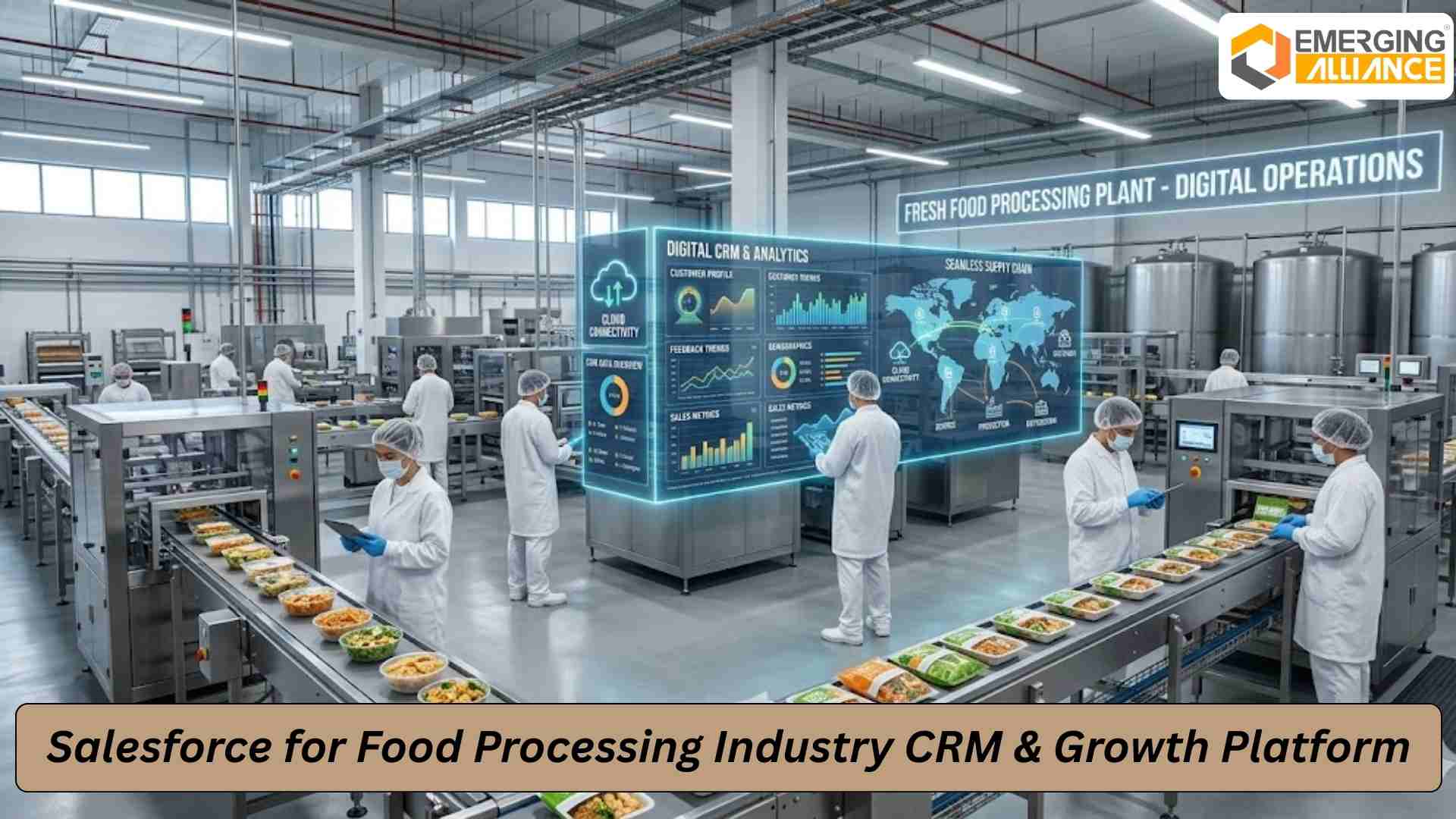
Salesforce for Food Processing Industry CRM & Growth Platform
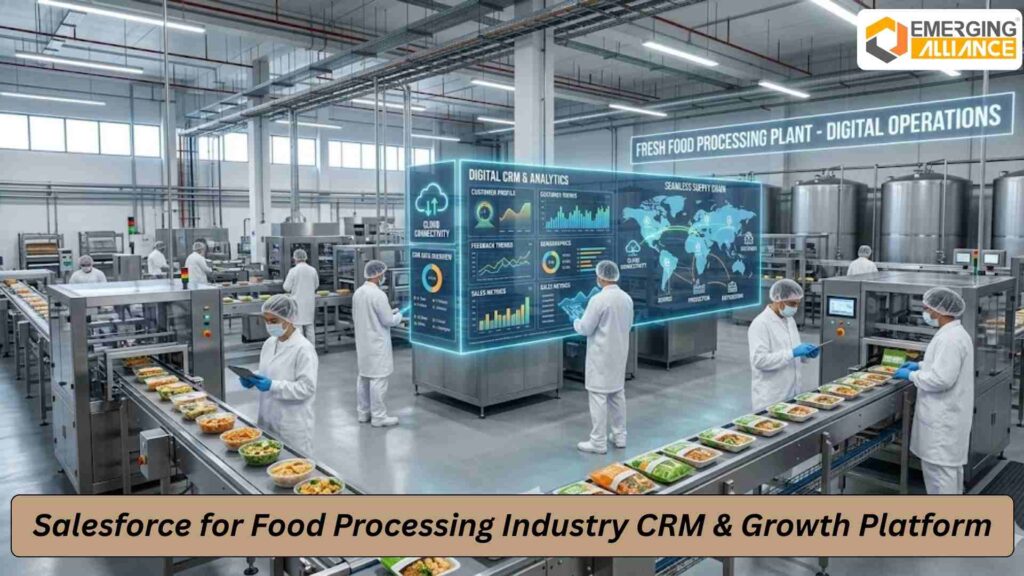
Salesforce for Food Processing Industry: Smart CRM Solution for Sales, Distribution & Customer Management
The food processing sector is becoming more competitive, customer-driven, and compliance-focused than ever before. Managing distributors, retailers, bulk orders, service requests, and customer relationships using disconnected tools slows growth and increases risk. Salesforce for Food Processing Industry provides a unified CRM platform that helps food processors manage sales, distribution networks, customer engagement, and long-term growth from a single system.
Salesforce Role in the Food Processing Industry
Food processors operate across complex supply chains with multiple stakeholders. Salesforce plays a critical role by centralizing customer data and improving coordination across sales, service, and distribution teams.
Customer data visibility
Sales teams gain a 360-degree view of distributors, retailers, and key accounts, enabling informed decision-making.
Process automation
Routine tasks such as follow-ups, order tracking, and service case handling are automated to reduce manual effort.
Scalable growth platform
Salesforce adapts easily as food processing companies expand into new markets or product lines.
Why Food Processing Companies Choose Salesforce Solutions
Food processing companies choose Salesforce because it aligns with industry-specific challenges such as demand volatility, regulatory pressure, and multi-channel distribution.
Improved distributor relationships
Salesforce enables better collaboration with distributors through shared insights and communication history.
Enhanced customer experience
Consistent and personalized engagement improves customer trust and retention.
Data-driven decisions
Real-time analytics help leadership track sales performance and forecast demand accurately.
Benefits of Salesforce for Food Processing Industry
Salesforce delivers measurable business value across departments in food processing organizations.
Sales performance optimization
Sales teams track leads, opportunities, and contracts more efficiently.
Customer service excellence
Service teams resolve complaints, quality issues, and support requests faster.
Operational transparency
Management gains clear visibility into pipelines, service metrics, and customer satisfaction levels.
Compliance support
Centralized records help food processors maintain audit trails and regulatory documentation.
Salesforce Integration for Food Processing
Salesforce becomes even more powerful when integrated with existing systems used by food processors.
ERP systems connectivity
Integration with ERP systems ensures seamless data flow between sales, inventory, billing, and production.
Supply chain alignment
Sales forecasts align with production and distribution planning.
Data accuracy
Eliminates duplicate data entry and reduces operational errors.
Salesforce Integration with ERP Systems
Many food processing companies already rely on ERP platforms for manufacturing and finance. Salesforce integration bridges the gap between front-end CRM and back-end ERP.
Order lifecycle visibility
Sales teams can track order status without switching systems.
Inventory awareness
Real-time inventory data helps prevent over-promising to customers.
Financial transparency
Invoices, credit limits, and payment status are visible to sales and service teams.
Salesforce Support for Small and Mid-Sized Food Processing Companies
Salesforce is not only for large enterprises. It offers flexible solutions tailored for small and mid-sized food processing companies.
Affordable scalability
Companies can start small and add features as they grow.
User-friendly interface
Teams adopt Salesforce faster due to its intuitive design.
Cloud accessibility
Access data securely from anywhere, supporting remote sales and service teams.
Salesforce Implementation for Food Processing Companies
Successful Salesforce adoption depends on a structured implementation approach.
Business requirement mapping
Processes are aligned with Salesforce capabilities.
Data migration
Legacy customer and sales data are migrated securely.
User training
Employees receive role-based training to maximize adoption.
Go-live support
Ensures smooth transition without disrupting daily operations.
Salesforce Managed Services for Continuous Improvement
After implementation, managed services ensure Salesforce continues to deliver value.
System optimization
Regular enhancements improve performance and usability.
Ongoing support
Quick resolution of issues and user queries.
Feature expansion
New Salesforce features are implemented as business needs evolve.
Salesforce Consulting Partner for Food Processing Industry
Choosing the right Salesforce consulting partner is critical for long-term success.
Industry expertise
Partners understand food processing workflows and compliance needs.
Customization capability
Solutions are tailored to match real business processes.
Strategic guidance
Partners help align CRM strategy with growth goals.
Salesforce Strategy Partner for Long-Term Growth
A Salesforce strategy partner focuses on more than just technology.
Growth roadmap
CRM strategy supports expansion and diversification plans.
Customer-centric approach
Improves lifetime value and brand loyalty.
Digital transformation
Salesforce becomes a foundation for broader digital initiatives.
Conclusion: Salesforce as a Growth Engine for the Food Processing Industry
Salesforce enables food processing companies to streamline sales operations, strengthen distributor and channel partner relationships, enhance customer service, and scale with confidence in a competitive market. By centralizing customer data, automating workflows, and providing real-time insights, Salesforce helps food processors improve efficiency, ensure compliance, and respond faster to market demand. With the right implementation strategy, seamless integration with ERP systems, and ongoing expert support, Salesforce becomes a powerful long-term growth engine—driving smarter decisions, stronger customer relationships, and sustainable business growth in the food processing industry.
Emerging Alliance is a trusted Salesforce implementation partner helping food processing businesses unlock the full value of Salesforce. With deep industry knowledge, proven integration expertise, and a results-driven approach, Emerging Alliance delivers tailored Salesforce solutions that streamline sales, improve distributor management, enhance customer engagement, and support scalable growth. From strategy and implementation to customization and ongoing support, Emerging Alliance ensures your Salesforce platform drives real business impact and long-term success.
FAQs About Salesforce CRM, Features, Benefits, and Implementation
1. What is Salesforce for the Food Processing Industry?
Salesforce for the Food Processing Industry is a cloud-based CRM platform that helps food processors manage sales pipelines, distributor networks, key accounts, customer service, and growth initiatives from a single system. It provides real-time visibility into customer interactions, order lifecycles, and market performance while supporting scalability, traceability, and compliance requirements common in food manufacturing and processing.
2. Can Salesforce handle distributor and channel management for food processors?
Yes. Salesforce offers robust distributor and channel management capabilities, including distributor onboarding, performance tracking, incentive management, territory mapping, and communication history. Food processors can monitor distributor sales trends, identify underperforming regions, and strengthen channel relationships using data-driven insights.
3. Is Salesforce suitable for small and mid-sized food processing companies?
Absolutely. Salesforce is highly scalable and modular, making it suitable for small, mid-sized, and enterprise-level food processing companies. Businesses can start with core CRM features and gradually add automation, analytics, AI-driven insights, and integrations as operations grow—without replacing the system.
4. How does Salesforce integrate with ERP systems in food processing?
Salesforce integrates seamlessly with ERP systems to synchronize critical business data such as orders, inventory levels, invoices, pricing, and customer master data. This integration creates a unified view of operations, enabling sales and service teams to work with accurate, real-time information while finance and operations remain aligned.
5. What are the key benefits of Salesforce for food processors?
Salesforce helps food processors gain end-to-end sales visibility, improve customer and distributor engagement, automate manual processes, and leverage advanced analytics for better decision-making. Additional benefits include faster sales cycles, improved service response times, scalable growth, and enhanced collaboration across departments.
6. How long does Salesforce implementation typically take?
Salesforce implementation timelines depend on business complexity, customization requirements, integrations, and data migration needs. For food processing companies, implementations typically range from a few weeks for basic CRM deployments to a few months for advanced, fully integrated solutions.
7. Does Salesforce support regulatory compliance in the food processing industry?
Yes. Salesforce supports compliance by centralizing customer, distributor, and transaction data, maintaining detailed audit trails, and enabling structured reporting. This helps food processors maintain documentation, support regulatory audits, and improve traceability across sales and service operations.
8. What role does a Salesforce consulting partner play in implementation?
A Salesforce consulting partner ensures the platform is configured to match food industry workflows. Partners handle solution design, customization, ERP integration, data migration, user training, and ongoing optimization—ensuring faster adoption, higher ROI, and long-term CRM success.
9. Can Salesforce be customized for food industry–specific workflows?
Salesforce is highly customizable and can be tailored to support food industry–specific workflows such as distributor approvals, trade promotions, pricing controls, customer complaints handling, and demand forecasting. Custom objects, automation rules, and dashboards ensure the system aligns with real-world operations.
10. What support options are available after Salesforce implementation?
Post-implementation support includes Salesforce managed services, system monitoring, performance optimization, feature enhancements, and ongoing user training to ensure the CRM system continues to meet evolving business needs.s, user training, and ongoing consulting. This ensures the platform evolves with changing business needs and continues delivering measurable value.