
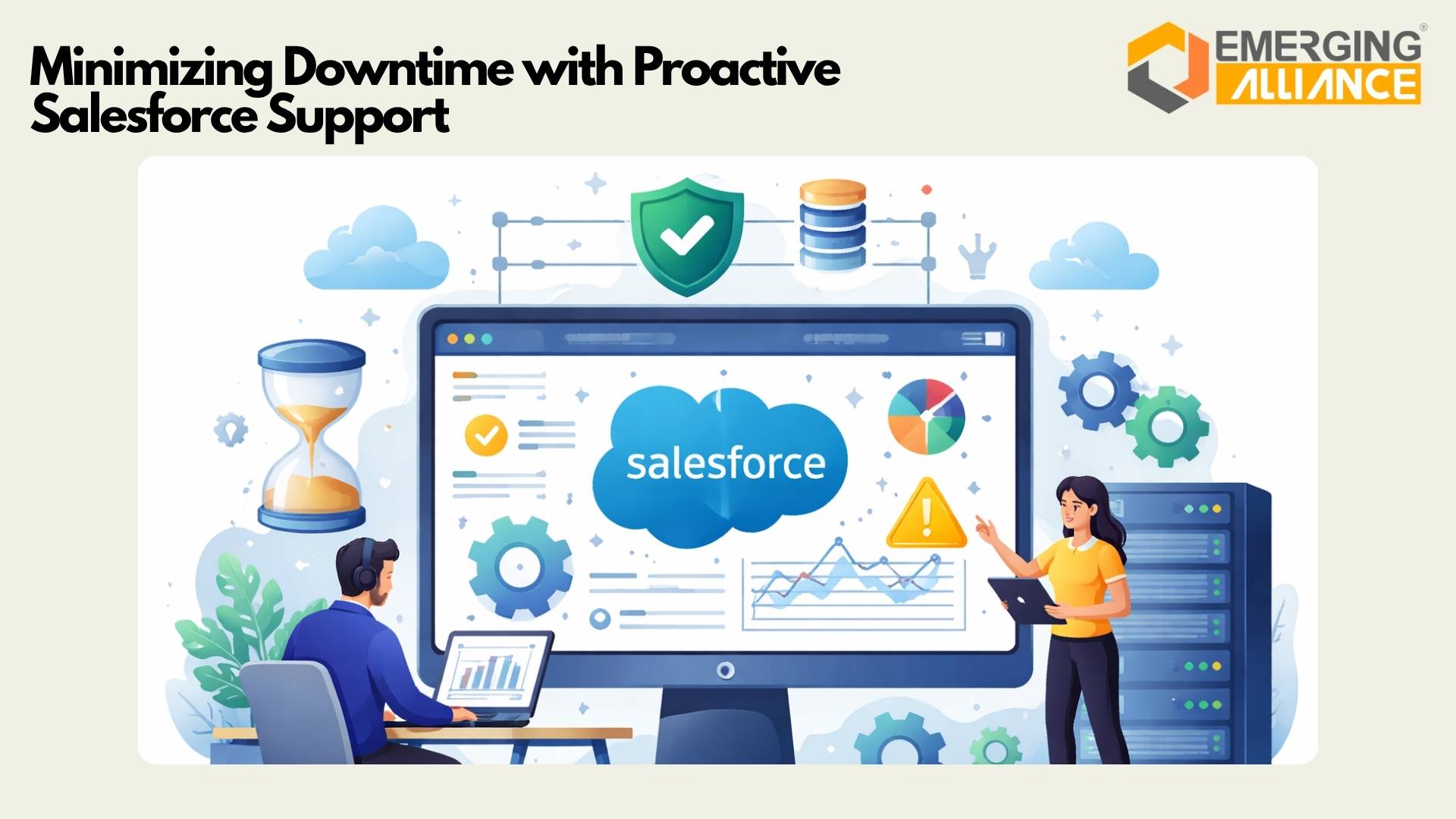
Minimizing Downtime with Proactive Salesforce Support
Never miss a beat Salesforce Support keeps CRM running
For most enterprises, Salesforce CRM systems are no longer just operational tools they are revenue engines. Every delayed case resolution, failed API call, or system slowdown directly impacts pipeline velocity, customer experience, and decision-making accuracy. Yet, many organizations still rely on reactive Salesforce support services, where issues are addressed only after disruption occurs.
This approach creates a dangerous gap:
- Revenue teams operate with inconsistent data
- Service teams face delays and SLA breaches
- Leadership lacks real-time visibility
The reality is simple downtime is not an IT issue anymore; it is a business continuity risk.
To address this, enterprises are shifting toward proactive Salesforce support, where prevention, monitoring, and optimization replace firefighting.
The Hidden Cost of Reactive Salesforce Support
Traditional Salesforce support and maintenance services often revolve around ticket-based models. While this ensures issues are eventually resolved, it fails to prevent them.
For decision-makers, this leads to measurable inefficiencies:
- Increased MTTR (Mean Time to Resolution) impacting SLAs
- Repeated integration failures across Salesforce systems
- Post-deployment disruptions due to weak governance
- Low user confidence in Salesforce CRM implementation services
Even organizations that have invested heavily in enterprise Salesforce implementation or partnered with a certified Salesforce implementation partner often struggle not because of poor implementation, but due to lack of continuous optimization.
This is where Salesforce managed services and proactive monitoring become critical.
Moving from Reactive to Predictive Salesforce Support
A modern Salesforce support model is built on anticipation not reaction.
Instead of waiting for issues, enterprises adopt Salesforce issue detection and resolution frameworks that continuously monitor system health.
What Changes in a Proactive Model?
1. Continuous System Health Monitoring
Real-time tracking of:
- Apex performance
- Workflow execution
- API usage limits
- Integration latency
This ensures that potential failures are identified before they impact business operations.
2. Predictive Issue Detection
Using logs, alerts, and performance analytics, Salesforce consulting partners can identify patterns that signal upcoming failures.
3. Uptime Engineering
Structured governance ensures:
- Zero disruption releases
- Controlled deployments
- Regression-tested updates
4. Integrated Ecosystem Monitoring
Modern Salesforce solutions are deeply connected with ERP, marketing, and third-party systems. Monitoring these integrations is essential for uninterrupted workflows.
Key Areas Where Proactive Salesforce Support Drives ROI
1. Case Handling & Service Continuity
With optimized Salesforce Service Cloud, enterprises can:
- Automate routing and escalation rules
- Reduce backlog through intelligent prioritization
- Maintain consistent SLA adherence
Result: Faster case resolution and improved customer satisfaction.
2. Data Reliability & Governance
A proactive Salesforce CRM implementation consultant ensures:
- Deduplication frameworks
- Validation rules
- Data governance policies
This enhances trust in reporting and enables accurate executive decision-making.
3. Performance Optimization & API Stability
Through Salesforce development services and monitoring:
- API limits are managed proactively
- Performance bottlenecks are resolved early
- Integration downtime is minimized
Result: Higher system stability and uninterrupted business operations.
4. Release & Change Management
With structured Salesforce deployment services:
- Sandbox testing ensures safe releases
- CI/CD pipelines accelerate feature rollout
- Risk of production issues is minimized
This transforms Salesforce into a continuously evolving platform aligned with business goals.
5. End-User Productivity & Adoption
A strong Salesforce admin support framework ensures:
- Faster issue resolution (L1/L2 support)
- Knowledge base-driven onboarding
- Continuous user enablement
Result: Increased adoption and reduced dependency on IT teams.
Business Impact: What CXOs Actually Gain
For leadership teams, proactive Salesforce support services translate into tangible business outcomes:
- Near-zero downtime across critical CRM functions
- Reduced SLA breaches and faster resolution cycles
- Improved CSAT and customer retention
- Increased agent productivity and operational efficiency
- Reliable data for strategic decision-making
- Higher ROI from Salesforce implementation cost and pricing investments
More importantly, it aligns Salesforce capabilities with evolving business needs turning CRM into a strategic asset.
Real-World Scenarios Where Proactive Support Delivers Value
Scenario 1: Preventing Integration Failures
A multi-system environment integrating Salesforce Marketing Cloud, ERP, and service platforms often experiences API bottlenecks.
With proactive monitoring:
- API thresholds are tracked
- Alerts are triggered before failure
- System continuity is maintained
Scenario 2: Stabilizing High-Volume Service Operations
Organizations using Salesforce Service Cloud for customer support face peak load challenges.
Through predictive analytics:
- Case spikes are anticipated
- Routing rules are optimized
- Performance is stabilized
Scenario 3: Ensuring Safe Feature Deployments
Enterprises leveraging Salesforce CRM implementation for continuous innovation often face deployment risks.
With structured governance:
- Releases are tested in sandbox environments
- Rollbacks are pre-defined
- Downtime is eliminated
Why a Strategic Salesforce Partner Matters
The difference between average and high-performing organizations lies in their choice of partner.
A certified Salesforce partner offering Salesforce support and maintenance partner services brings:
- Deep expertise across Salesforce clouds
- Proven Salesforce implementation process knowledge
- Scalable support frameworks for global enterprises
- Continuous improvement through automation and AI insights
Unlike traditional vendors, a strategic Salesforce consulting partner focuses not just on support but on long-term transformation.
Our Approach: Proactive, Predictive, Performance-Driven
As a certified Salesforce implementation partner, we deliver:
- 24/7 Salesforce technical support services with real-time alerts
- Comprehensive system health audits (code, integrations, performance)
- Structured incident management with defined SLAs
- Advanced Salesforce application support and optimization
- Continuous roadmap aligned with your business strategy
Our model ensures that your Salesforce CRM systems are not just operational but continuously improving.
Conclusion: From Stability to Strategic Advantage
In today’s digital-first environment, downtime is not acceptable it is preventable.
Organizations that invest in proactive Salesforce support move beyond operational stability to achieve:
- Predictable performance
- Scalable growth
- Competitive advantage
The question is no longer whether you need support but how advanced your support model is.
Take the Next Step
If your organization is still operating on reactive support, it’s time to evolve.
Get a personalized Salesforce system health assessment from Emerging Alliance and uncover hidden risks before they impact your business.
FAQs About Salesforce support
1. How does proactive Salesforce support reduce downtime compared to traditional support?
Proactive Salesforce support uses monitoring, alerts, and predictive analytics to identify and resolve issues before they impact operations, unlike reactive models that address problems only after failure.
2. What is included in Salesforce support and maintenance services?
It includes system monitoring, incident management, performance optimization, data governance, release management, and ongoing enhancements.
3. Why is data governance critical in Salesforce CRM systems?
Poor data quality leads to inaccurate reporting and decision-making. Governance frameworks ensure data consistency, reliability, and compliance.
4. How do Salesforce managed services improve ROI?
They reduce downtime, improve system efficiency, enhance user productivity, and maximize returns from Salesforce implementation investments.
5. What role does a Salesforce implementation partner play in ongoing support?
A partner ensures continuous optimization, manages deployments, monitors system health, and aligns Salesforce capabilities with business needs.
6. How can Salesforce Service Cloud performance be optimized?
Through proactive monitoring, automation of case routing, performance tuning, and regular system audits.
7. What are common causes of Salesforce downtime?
API limit breaches, integration failures, inefficient code, poor release management, and lack of monitoring.
8. How does proactive support improve SLA adherence?
By reducing resolution times, preventing incidents, and ensuring faster response through structured escalation frameworks.
9. What is the importance of sandbox testing in Salesforce deployment services?
Sandbox testing ensures that new features and changes are validated before production deployment, minimizing risks.
10. How do certified Salesforce consultants ensure system stability?
They apply best practices in architecture, governance, monitoring, and continuous optimization to maintain high system performance.
👉 Speak to our experts today and build a future-ready Salesforce ecosystem.