

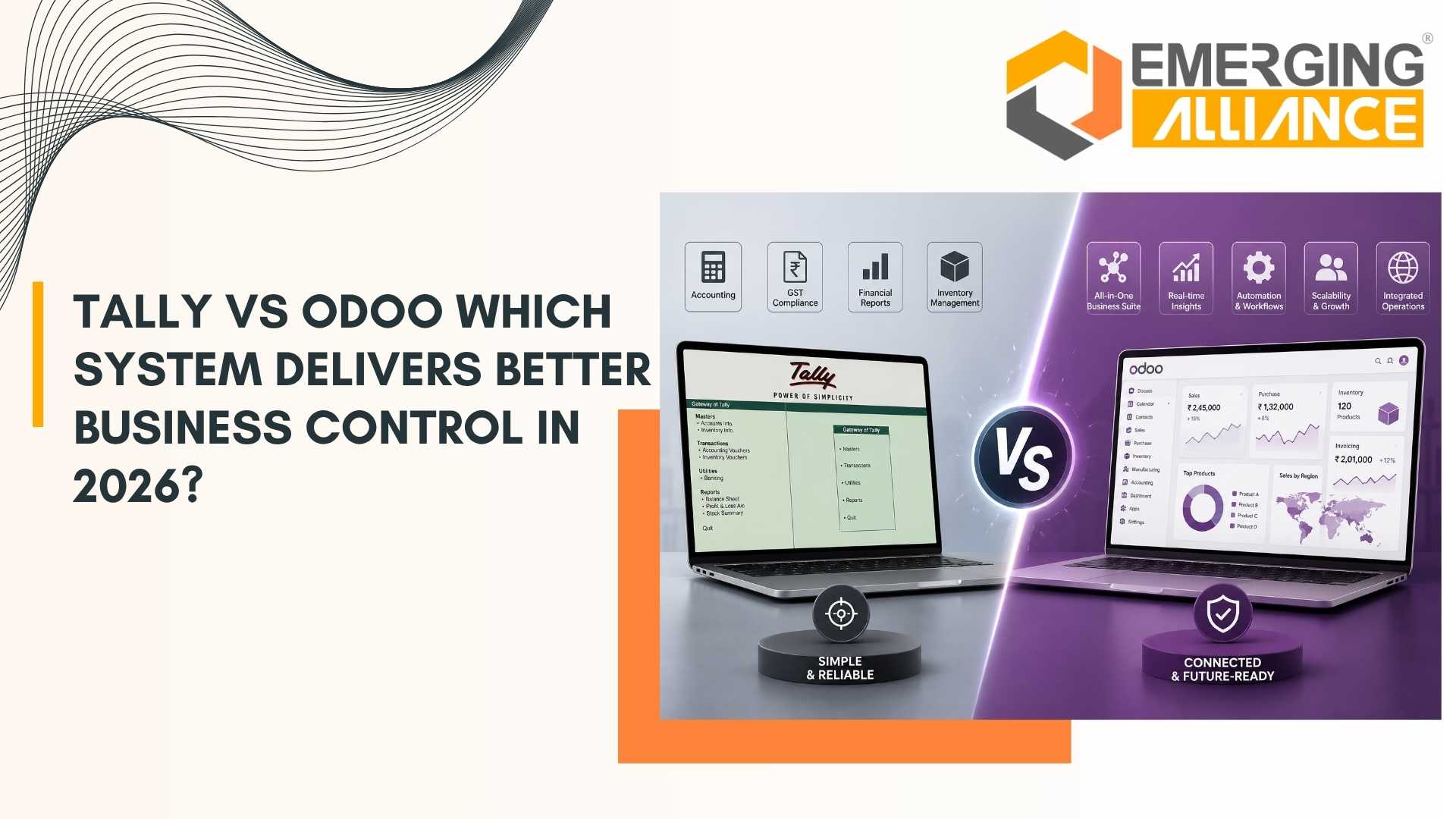
Tally vs Odoo Which System Delivers Better Business Control in 2026?
Compare Tally and Odoo for automation, inventory visibility, integration, and executive-level operational control
For many growing businesses, ERP is no longer just an accounting system. It has become the operational backbone that determines how efficiently a company scales, controls costs, manages inventory, and makes decisions.
This is why the discussion around Tally vs Odoo ERP has become increasingly important for CEOs, CIOs, Operations Heads, and Finance leaders in 2026.
Most companies do not replace ERP because accounting fails.
They replace ERP because:
- Inventory visibility becomes unreliable
- Departments operate in silos
- Reporting takes too long
- Manual processes increase operational risk
- Leadership lacks real-time business visibility
At a certain stage of growth, spreadsheets, disconnected software, and accounting-centric systems begin slowing the organization down.
The real executive question is:
Which ERP system gives complete operational control—not just financial reporting?
Why Businesses Compare Tally vs Odoo ERP in 2026
Both Tally and Odoo are widely used systems, but they serve very different business maturity levels.
Tally Primarily Focuses On:
- Accounting
- GST compliance
- Financial entries
- Basic inventory management
Odoo ERP Focuses On:
- End-to-end business operations
- Process automation
- Department integration
- Real-time reporting
- Scalable workflows
This distinction becomes critical when businesses expand across:
- Multiple warehouses
- Multiple business units
- Growing sales teams
- Service operations
- Manufacturing environments
- Multi-location inventory
The more complex operations become, the more businesses require a connected ERP ecosystem rather than isolated accounting software.
Tally vs Odoo ERP for Inventory Control and Warehouse Visibility
Inventory management is one of the biggest operational pain points for scaling businesses.
Poor inventory visibility creates:
- Excess stock holding
- Stock-outs
- Delayed fulfillment
- Revenue leakage
- Working capital pressure
Tally Inventory Capabilities
Tally supports basic inventory functionality, but operational limitations begin appearing as businesses scale.
Common Challenges in Tally
- Manual stock reconciliation
- Limited warehouse intelligence
- Weak batch and serial tracking
- Minimal automation
- Heavy Excel dependency
For growing organizations, inventory tracking often becomes reactive instead of predictive.
Odoo ERP Inventory Advantages
Odoo provides a far more operationally connected inventory framework.
Odoo ERP Supports:
- Real-time inventory visibility
- Multi-warehouse tracking
- Automated replenishment
- Batch and serial number tracking
- Barcode integration
- Demand forecasting
- Procurement automation
This enables leadership teams to make faster and more accurate inventory decisions.
Executive Impact
- Reduced inventory carrying cost
- Faster order fulfillment
- Improved warehouse accuracy
- Better working capital utilization
Tally vs Odoo ERP for Business Process Automation
One of the biggest hidden costs in growing businesses is operational fragmentation.
Departments often use disconnected systems for:
- Sales
- Inventory
- Finance
- CRM
- HR
- Procurement
This creates duplicate work, delayed approvals, and reporting inconsistency.
Tally Workflow Limitations
Tally is primarily finance-centric.
As a result:
- Operational workflows remain disconnected
- Teams rely heavily on spreadsheets
- Reporting requires manual consolidation
- Automation capabilities remain limited
Most businesses eventually add multiple external tools around Tally just to manage operations.
This increases:
- Data inconsistency
- Operational complexity
- Integration challenges
- IT overhead
Odoo ERP Workflow Integration
Odoo operates as a unified ERP ecosystem.
Departments Work Inside One Platform
- Sales integrates with inventory
- Inventory connects with procurement
- Finance syncs with operations
- CRM aligns with customer workflows
Automated Business Flows Include:
- Sales order → Inventory reservation
- Purchase request → Vendor procurement
- Invoice → Accounting update
- CRM opportunity → Sales forecasting
This reduces manual intervention across the organization.
Business Outcome
- Faster process execution
- Reduced human error
- Higher operational efficiency
- Better cross-functional coordination
Real-Time Reporting: Tally vs Odoo ERP for Executive Decision-Making
Executives today do not need delayed reports.
They need real-time operational intelligence.
Tally Reporting Challenges
Tally provides strong accounting reports but limited operational analytics.
Leadership teams often face:
- Delayed reporting cycles
- Static data views
- Manual report compilation
- Limited dashboard visibility
This slows decision-making.
Odoo ERP Executive Visibility
Odoo provides live operational dashboards across departments.
Real-Time Insights Include:
- Inventory movement
- Sales pipeline
- Procurement status
- Production efficiency
- Cash flow visibility
- Customer analytics
Leadership gains access to centralized business intelligence from a single platform.
Strategic Benefit
Businesses move from reactive management to proactive operational control.
Tally vs Odoo ERP for Scalability and Long-Term Growth
ERP scalability becomes critical once businesses grow beyond basic accounting operations.
Where Tally Often Becomes a Bottleneck
Businesses usually outgrow Tally when:
- Multiple branches are added
- Warehouse complexity increases
- Approval workflows expand
- Reporting needs become dynamic
- Automation requirements grow
At this stage, operational dependency on manual processes becomes risky.
Why Odoo Supports Growth Better
Odoo is modular and scalable.
Businesses can gradually expand functionality across:
- CRM
- Inventory
- Manufacturing
- HR
- Helpdesk
- Procurement
- Ecommerce
- Field service
This allows ERP evolution without rebuilding the entire system later.
Executive Advantage
The ERP grows alongside operational complexity.
Tally vs Odoo ERP ROI Comparison
ERP ROI is often misunderstood.
The true cost of ERP is not software licensing alone.
It includes:
- Manual operational effort
- Reporting inefficiencies
- Inventory errors
- Delayed decisions
- Process duplication
- Revenue leakage
Hidden Costs of Staying on Tally
Many businesses continue using Tally because the initial cost appears lower.
However, hidden operational costs increase over time:
- Higher manpower dependency
- Multiple disconnected tools
- Manual reconciliation effort
- Slow reporting cycles
- Limited automation
The long-term operational cost becomes significantly higher.
Odoo ERP ROI Advantages
Odoo improves ROI through:
- Process automation
- Better operational visibility
- Faster reporting
- Improved inventory accuracy
- Reduced manual workload
- Higher productivity
Long-Term Business Impact
- Lower operational friction
- Faster scalability
- Better executive control
- Improved profitability
When Should a Business Move from Tally to Odoo ERP?
Most businesses delay ERP transition until operational pain becomes severe.
However, transition should happen before inefficiencies become expensive.
Signs Your Business Has Outgrown Tally
You likely need Odoo ERP if:
- Inventory mismatches are frequent
- Reporting depends on Excel
- Departments use disconnected software
- Approval processes are manual
- Leadership lacks real-time visibility
- Operational errors are increasing
- Multi-location management is difficult
If business decisions are delayed because data is fragmented, the ERP system is already limiting growth.
Why Businesses Choose Emerging Alliance for ERP Transformation
At Emerging Alliance, we help businesses move beyond accounting-centric systems into scalable operational ERP environments.
Our approach focuses on:
- ERP strategy alignment
- Operational process mapping
- Scalability planning
- Workflow automation
- Inventory optimization
- Executive reporting visibility
We do not simply implement software.
We build ERP ecosystems that improve operational control, scalability, and decision-making.
Frequently Asked Questions
1. Which is better for growing businesses: Tally or Odoo ERP?
Odoo ERP is generally better for growing businesses because it supports automation, department integration, and real-time operational visibility beyond accounting.
2. Why do companies move from Tally to Odoo ERP?
Businesses usually migrate due to inventory challenges, reporting delays, limited automation, and disconnected operational workflows.
3. Is Odoo ERP suitable for inventory-heavy businesses?
Yes. Odoo supports multi-warehouse management, barcode integration, batch tracking, and automated replenishment workflows.
4. Can Odoo ERP automate business operations?
Yes. Odoo automates workflows across sales, procurement, finance, inventory, CRM, and approvals.
5. Is Tally mainly accounting software?
Tally is primarily designed for accounting and compliance management, though it includes basic inventory functionality.
6. Does Odoo ERP provide real-time dashboards?
Yes. Odoo includes live dashboards and KPI tracking across multiple departments for executive visibility.
7. Which ERP is better for multi-location businesses?
Odoo ERP is better suited for multi-location operations because of its centralized and integrated architecture.
8. Is Odoo ERP scalable for future growth?
Yes. Odoo’s modular structure allows businesses to expand ERP functionality as operations grow.
9. What are the hidden operational costs of staying on Tally?
Hidden costs often include manual reconciliation, disconnected systems, reporting delays, inventory inefficiencies, and higher manpower dependency.
10. How do I know if my business has outgrown Tally?
If your business struggles with operational visibility, inventory mismatches, Excel dependency, or delayed reporting, it may be time to evaluate Odoo ERP.
Book Your Free ERP Strategy Consultation with Emerging Alliance