
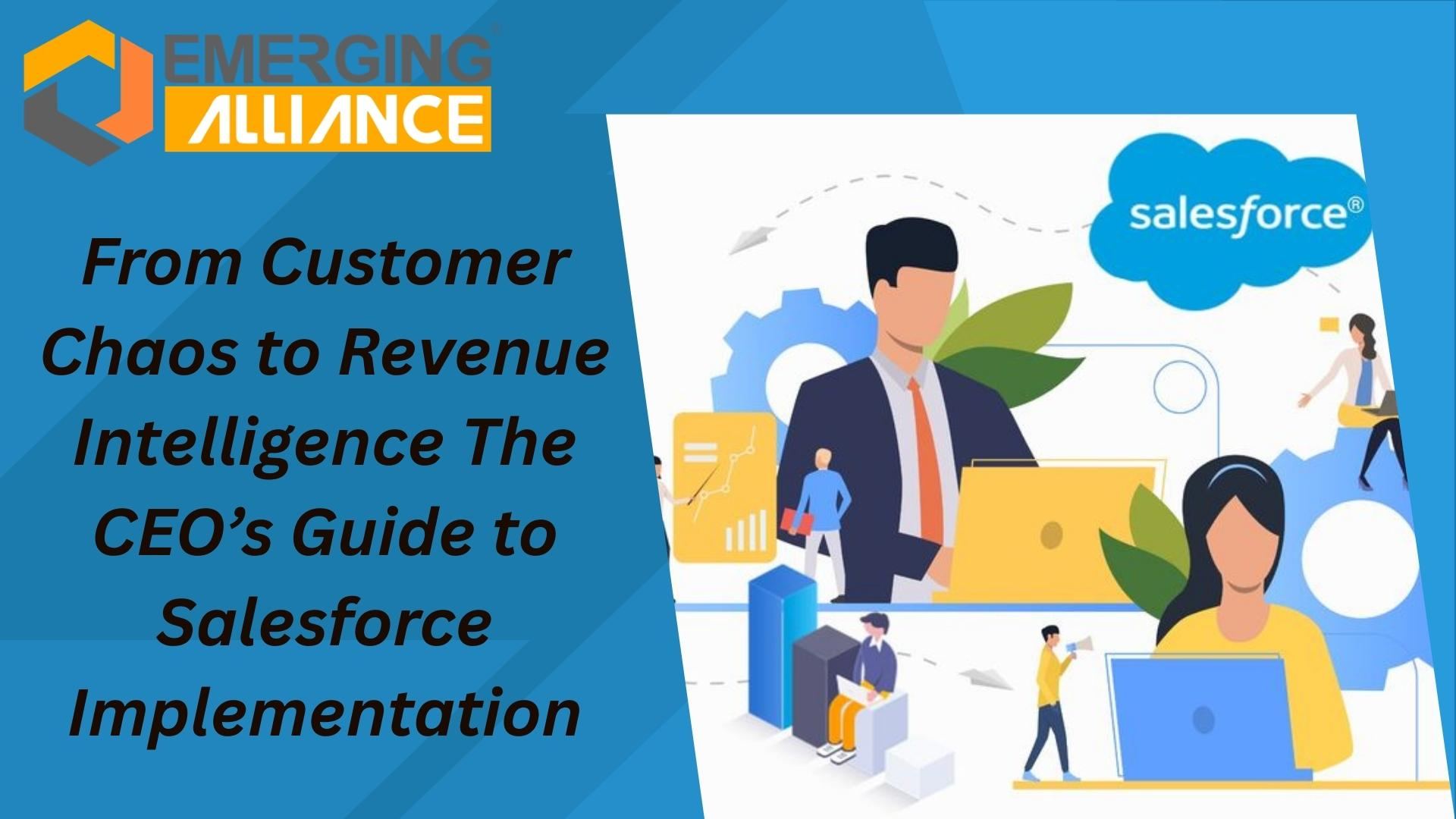
From Customer Chaos to Revenue Intelligence the CEO’s Guide to Salesforce Implementation
How Salesforce implementation transforms fragmented CRM systems into a growth-driving platform
In many organizations, customer data exists everywhere but insight exists nowhere. Sales teams manage pipelines in spreadsheets or disconnected CRM tools. Marketing teams run campaigns using separate automation platforms. Customer service teams track support cases in entirely different systems. Meanwhile, ERP systems such as SAP hold critical financial and operational data that rarely connects with the customer journey. This is why Salesforce implementation has become a strategic priority for modern enterprises. When executed correctly, it transforms disconnected systems into a unified platform that converts customer data into revenue intelligence.
The Hidden Business Risks of Fragmented Customer Data
Many organizations underestimate the financial impact of fragmented CRM systems.
Customer information is often scattered across sales tools, marketing systems, ERP platforms, and service management software. Without integration and governance, this data fragmentation creates operational blind spots.
Common symptoms include:
• Sales teams working with outdated customer information
• Leadership struggling with unreliable revenue forecasts
• Manual reporting processes consuming hours of executive time
• Dealer and distributor networks operating without visibility
• Compliance and audit reporting becoming complex and time-consuming
For enterprises operating across multiple regions or partner ecosystems, these problems grow exponentially.
A properly executed Salesforce CRM implementation addresses these challenges by creating a centralized customer intelligence platform.
Why Salesforce Implementation Has Become a Boardroom-Level Priority
CRM systems are no longer operational tools used only by sales teams. Today they play a central role in enterprise growth strategy.
The Salesforce Platform enables organizations to unify customer engagement across sales, service, marketing, and partner ecosystems. This creates a single environment where every interaction contributes to a deeper understanding of customer behavior.
Modern enterprises increasingly rely on multiple Salesforce Clouds, including:
• Salesforce Sales Cloud for pipeline and opportunity management
• Salesforce Service Cloud for customer support and case management
• Salesforce Marketing Cloud for marketing automation and customer engagement
• Salesforce Platform Data Model for structured enterprise data architecture
Together, these solutions create a Salesforce-based CRM solution that supports real-time decision making.
However, the success of such an ecosystem depends on a well-planned Salesforce implementation process led by experienced Salesforce consultants.
The Strategic Impact of Enterprise Salesforce Implementation
A strategic enterprise Salesforce implementation goes far beyond deploying CRM software. It creates a platform for operational intelligence across the organization.
Unified Customer Intelligence
Through Salesforce integrations, organizations consolidate customer information across departments and business units. Sales, marketing, and service teams operate from the same data foundation.
This unified view allows leadership teams to analyze the full customer lifecycle, from first engagement to long-term retention.
Predictable Revenue Forecasting
Accurate forecasting is one of the most valuable outcomes of Salesforce CRM implementation.
Centralized opportunity data, automated sales workflows, and analytics tools allow executives to monitor pipeline health in real time. This visibility is essential for organizations facing investor pressure or aggressive growth targets.
Operational Efficiency Through Salesforce Automation
Manual processes often slow down enterprise operations. Using Salesforce automation, organizations streamline workflows such as:
• Lead assignment and qualification
• Opportunity tracking and deal management
• Customer onboarding processes
• Service case routing and resolution
Automation not only improves productivity but also ensures consistency across teams.
Scalable Digital Infrastructure
As companies expand globally or enter new markets, their CRM architecture must scale accordingly.
The Salesforce Platform offers flexibility to support new business models, partner ecosystems, and digital channels without requiring constant system redesign.
Salesforce Implementation Process for Enterprise Transformation
A successful Salesforce implementation process requires a structured approach that aligns technology with business objectives.
Strategic CRM Assessment
The process begins with a detailed assessment of existing systems, customer data structures, and organizational goals. This stage identifies inefficiencies and opportunities for transformation.
Architecture and Data Model Design
Experts design the Salesforce Platform Data Model to ensure consistent data governance across sales, marketing, and service operations.
Salesforce Deployment and Integration
The platform is configured, integrated with ERP systems and third-party applications, and deployed through proven Salesforce deployment services.
User Adoption and Governance
CRM success depends heavily on user adoption. Training programs, governance frameworks, and executive sponsorship play a critical role in ensuring long-term success.
Ongoing Salesforce Support and Managed Services
After deployment, organizations rely on Salesforce support and managed services to optimize performance, implement enhancements, and maintain system security.
Evaluating Salesforce Implementation Cost Through an ROI Lens
Many executives initially focus on Salesforce implementation cost or Salesforce license pricing when evaluating CRM investments.
While these factors are important, a strategic evaluation considers the broader return on investment.
Key value drivers include:
• Increased sales productivity through automation
• Improved forecasting accuracy and pipeline visibility
• Higher customer retention rates
• Reduced operational inefficiencies
• Lower compliance and reporting risk
When viewed through this lens, Salesforce implementation pricing represents a long-term investment in enterprise growth rather than a short-term technology expense.
Selecting the Right Salesforce Implementation Partner for Long-Term Success
Technology alone does not guarantee transformation. Many CRM projects fail because organizations underestimate the importance of implementation expertise.
Choosing a Salesforce implementation partner with strategic consulting capabilities is critical.
An experienced Salesforce consulting partner typically provides:
• End-to-end Salesforce implementation services
• Certified Salesforce consultants with enterprise experience
• Expertise in Salesforce customization and integrations
• Industry-specific solution design
• Long-term Salesforce support and optimization services
Rather than acting as a software vendor, the right partner functions as a strategic transformation advisor.
FAQs About Salesforce Implementation
1. How long does a typical Salesforce CRM implementation take?
The timeline depends on system complexity, integrations, and customization requirements. Small deployments may take a few weeks, while enterprise Salesforce implementations with multiple integrations and workflows can take several months.
2. What does a Salesforce implementation partner do?
A Salesforce implementation partner helps organizations plan, design, deploy, and optimize the platform. Their services typically include CRM strategy consulting, Salesforce customization, data migration, system integrations, user training, and ongoing Salesforce support.
3. How much does Salesforce implementation cost?
Salesforce implementation cost depends on several factors such as the number of users, Salesforce Clouds used (Sales Cloud, Service Cloud, Marketing Cloud), customization requirements, integration complexity, and the experience of the implementation partner.
4. What are the key stages in the Salesforce implementation process?
The process usually includes business analysis, CRM strategy design, Salesforce configuration, customization and integrations, data migration, user training, system testing, and post-deployment support.
5. Can Salesforce integrate with ERP systems like SAP?
Yes, Salesforce can integrate with ERP systems such as SAP to synchronize customer data, orders, financial information, and inventory details. Salesforce SAP integration helps organizations create a unified view of both customer engagement and operational processes.
6. What are the benefits of enterprise Salesforce implementation?
Enterprise Salesforce implementation provides benefits such as unified customer data, improved sales forecasting, automated workflows, enhanced customer service, better partner management, and real-time business insights for leadership teams.
7. What is the role of Salesforce customization in CRM implementation?
Salesforce customization allows organizations to tailor the platform to their specific business processes. This includes custom workflows, automation rules, industry-specific modules, dashboards, partner portals, and compliance tracking features.
8. Why do some Salesforce implementations fail?
Salesforce implementations may fail due to poor planning, lack of user adoption, weak data governance, insufficient integration with existing systems, or the absence of experienced Salesforce consultants guiding the project.
9. How can companies ensure successful Salesforce adoption after implementation?
Successful adoption requires structured user training, executive sponsorship, clear governance policies, continuous system optimization, and ongoing Salesforce support through managed services.
10. How does Salesforce help improve customer retention?
Salesforce provides a unified customer view that allows companies to track interactions, service history, and engagement patterns. This visibility helps businesses proactively address customer issues, personalize engagement, and reduce customer churn.
To learn more about our services and solutions, visit us at: Emerging Alliance