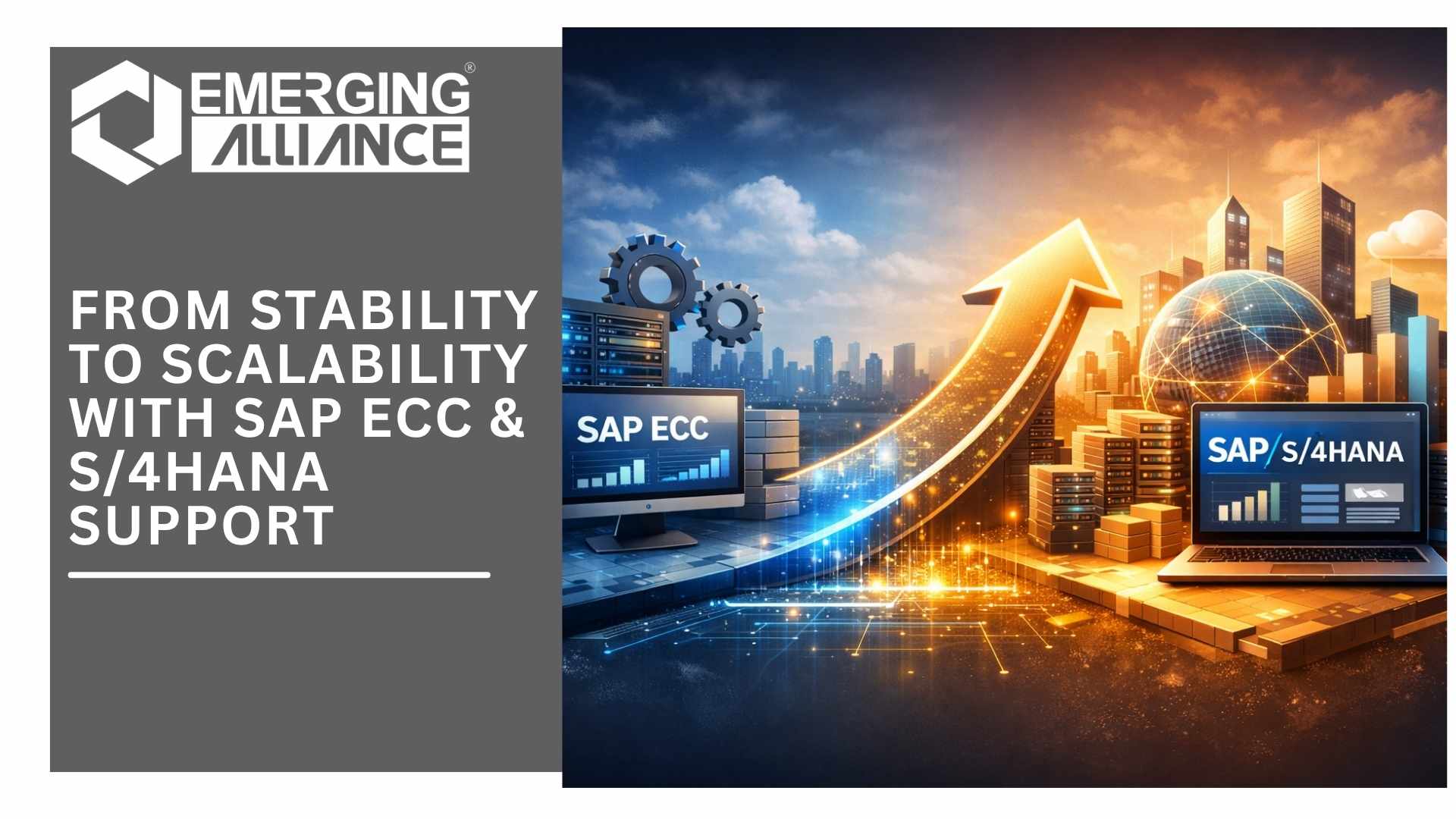
From Stability to Scalability with SAP ECC & S/4HANA Support
Drive continuous growth with reliable, high-performing SAP ECC & S/4HANA Support
For most enterprises running SAP ERP (On-Premise) environments, the challenge is no longer just keeping systems running—it’s about evolving without disruption. SAP ECC & S/4HANA Support has emerged as a strategic layer that ensures operational stability in legacy systems while enabling a structured transition toward intelligent, scalable platforms powered by S/4HANA’s advanced HANA architecture.
Executives today are not asking whether to move—they are asking:
- How do we protect current operations?
- How do we reduce risk during transition?
- How do we unlock ROI faster?
The answer lies in aligning SAP ECC maintenance support with a forward-looking transformation roadmap toward SAP ECC to SAP S/4HANA.
Why SAP ECC Alone Is No Longer Enough
While SAP ERP Central Component (SAP ECC) has been a reliable backbone for decades, it was never designed for the speed, intelligence, and integration demands of today’s digital enterprises.
Organizations relying solely on SAP ECC maintained environments are facing structural limitations:
- Aging architecture limiting innovation
- High dependency on manual processes
- Difficulty integrating with cloud, AI, and modern applications
- Increasing SAP ECC Maintenance costs without proportional value
- Performance bottlenecks impacting business-critical workflows
In the ecc vs s4 hana debate, the difference is no longer incremental—it is transformational.
Without a structured approach to SAP ECC & Migrating to S/4 HANA, organizations risk stagnation while competitors accelerate.
From ECC to S/4HANA: A Controlled, Value-Driven Transition
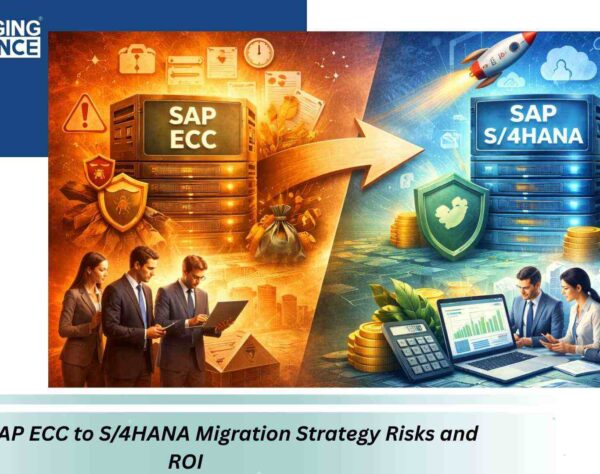
Transitioning from SAP ECC to SAP S/4HANA is not a technical upgrade—it is a business transformation initiative.
The real challenge is not migration itself, but executing it without disrupting operations, data integrity, or revenue streams.
A structured ECC to S/4HANA strategy ensures:
- Business continuity during transition
- Data consistency across legacy and new environments
- Custom code adaptation aligned with S/4 architecture
- Minimal downtime and controlled risk exposure
Key transition approaches include:
- Brownfield: System conversion preserving existing processes
- Greenfield: Fresh implementation for process re-engineering
- Hybrid: Selective transformation balancing speed and innovation
For decision-makers, the priority is clear:
Move from SAP ECC supports to scalable ecosystems without compromising operational stability.
SAP ECC & S/4HANA Support: From Maintenance to Strategic Enablement
Traditional SAP maintenance and support models focus on issue resolution.
Modern enterprises require something far more advanced—proactive, transformation-driven support.
An effective Support for SAP ECC and SAP S/4HANA framework delivers:
1. Stability in SAP ECC Environments
- Continuous monitoring of SAP ECC customers systems
- Performance tuning and workload optimization
- SLA-driven incident management
- Custom code maintenance and risk mitigation
2. Transition Readiness for S/4HANA
- Landscape assessment and transformation planning
- Identification of risks in SAP ECC vs SAP S/4HANA migration
- Data preparation and validation strategies
3. High-Performance S/4HANA Operations
- Leveraging sap s/4hana high performance capabilities
- Real-time analytics and faster processing
- Optimization of sap s 4 finance modules for better financial visibility
4. Continuous Innovation Enablement
- Integration with cloud ecosystems (RISE, AI, automation)
- Advanced reporting and predictive insights
- Scalability aligned with business growth
This is where SAP ECC and SAP S/4HANA support evolves from cost center to value driver.
Reducing Risk While Accelerating ROI
Executives evaluating Migrating to SAP S/4HANA often hesitate due to perceived risks—downtime, cost overruns, and unclear ROI.
However, with the right support strategy, these risks become manageable—and measurable.
A well-executed SAP ECC to SAP S/4HANA transition delivers:
- Lower Total Cost of Ownership (TCO) through optimized infrastructure
- Improved margins via better financial control and analytics
- Faster decision-making with real-time visibility
- Reduced operational risks through system standardization
- Enhanced compliance readiness across industries
The key is aligning SAP ECC and SAP S/4HANA support with measurable business outcomes—not just technical milestones.
Building a Future-Ready SAP Landscape
Future-ready enterprises are not choosing between stability and innovation—they are achieving both.
By integrating SAP ECC supports with forward-looking transformation services, organizations can:
- Extend the life of existing systems while preparing for S/4
- Enable phased transformation without business disruption
- Ensure alignment with Maintenance Timelines for SAP S/4HANA
- Create a scalable, intelligent ERP ecosystem
This dual approach ensures that your ERP evolves in sync with your business—not behind it.
Why Strategic SAP Support Matters More Than Ever
In today’s environment, ERP is not just infrastructure—it is a competitive advantage.
Organizations that treat SAP maintenance and support as a strategic function gain:
- Faster innovation cycles
- Greater operational control
- Improved executive decision-making
- Stronger resilience against market disruptions
The shift from SAP ECC and SAP S/4HANA coexistence to full transformation is inevitable.
The only variable is how efficiently—and profitably—you execute it.
Ready to Transition from Stability to Scalability?
Your SAP landscape should not limit your growth—it should accelerate it.
If you’re currently operating on SAP ECC or planning SAP ECC & SAP S/4HANA transformation, the right support strategy can make the difference between disruption and acceleration.
FAQs About SAP ECC & S/4HANA Support
1. What is the biggest risk when moving from SAP ECC to SAP S/4HANA?
The biggest risk is unplanned disruption to business operations due to poor data preparation and lack of transition strategy.
2. How long does an ECC to S/4HANA migration typically take?
It varies based on system complexity, but most enterprises take between 6 to 18 months for a structured migration.
3. Can SAP ECC and SAP S/4HANA run in parallel?
Yes, hybrid environments allow phased transformation while maintaining operational continuity.
4. What is the role of support during SAP migration?
Support ensures system stability, data integrity, and minimal downtime throughout the migration process.
5. How does SAP S/4HANA improve financial operations?
With sap s 4 finance, organizations gain real-time financial insights, faster closing cycles, and improved compliance.
6. Is it mandatory to move to SAP S/4HANA immediately?
No, but aligning with Maintenance Timelines for SAP S/4HANA is critical to avoid future risks.
7. What happens to custom code during migration?
Custom code must be analyzed, adapted, or optimized to align with S/4HANA architecture.
8. How can companies reduce migration costs?
Through phased implementation, workload optimization, and strategic planning.
9. What industries benefit most from SAP S/4HANA?
Manufacturing, pharma, retail, and logistics benefit significantly due to real-time data and process optimization.
10. Why is SAP ECC maintenance becoming expensive?
Because legacy systems require higher effort for maintenance, integration, and compliance compared to modern platforms.
Get a tailored SAP transformation roadmap aligned with your business goals.
👉 Fill out the form to connect with our SAP experts and unlock a risk-free transition strategy.