
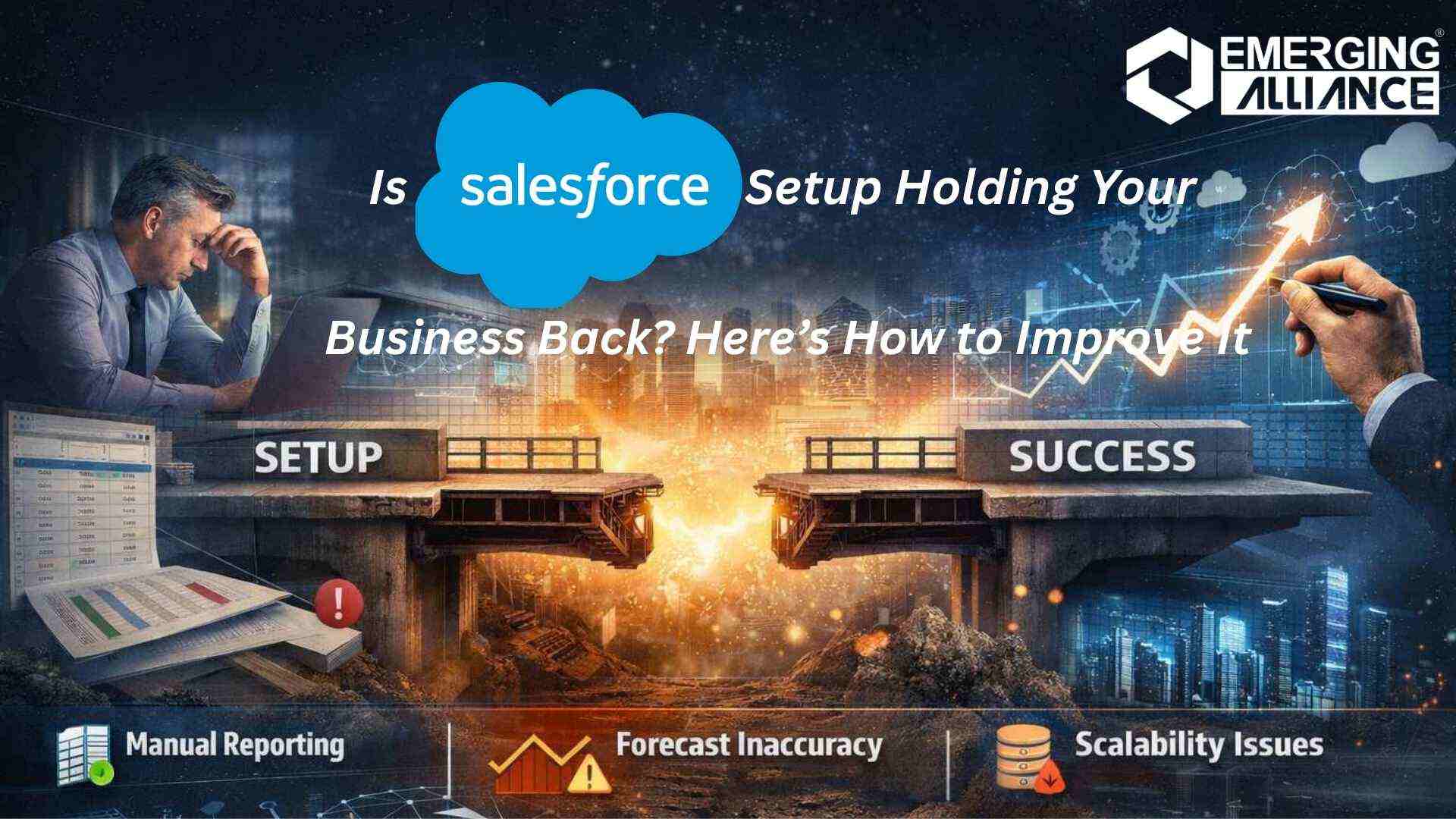
Is Salesforce Implementation Setup Holding Your Business Back? Here’s How to Improve It
Don’t settle for standard settings customize your Salesforce implementation to outpace competitors and scale faster
Enterprise organizations across industries have invested heavily in Salesforce. Licenses are active, users are onboarded, dashboards exist—yet leadership still asks the same question: “Why aren’t we seeing real business impact?” For many CTOs, the problem isn’t Salesforce itself. It’s the gap between deployment and true implementation maturity. A basic setup delivers system access. A strategic Salesforce implementation delivers revenue growth, forecast accuracy, and operational efficiency.
Closing this gap is now a board-level priority.
The Enterprise Reality: Salesforce Installed vs Salesforce Working
Across global enterprises in India, Middle East, and US markets, a common pattern emerges:
- CRM adoption remains inconsistent
- Manual reporting persists
- Forecast accuracy is low
- Customer data is fragmented
- Automation is underused
- Integration gaps exist
This happens when Salesforce is configured generically rather than aligned to enterprise operating models.
A Salesforce-based CRM solution must reflect how your business actually sells, serves, and scales—not how the software is shipped out-of-the-box.
Why Standard Salesforce Implementations Fail Enterprises
Most large organizations begin with a “vanilla” deployment approach:
- Default objects and fields
- Minimal workflow automation
- Limited integrations
- Generic reports
- Basic user roles
This creates a functional CRM—but not a strategic platform.
The result:
- Sales teams revert to spreadsheets
- Leaders distrust forecasts
- Reporting cycles remain manual
- Customer visibility is incomplete
- Decision speed slows
Over time, the system becomes underutilized despite high license investment.
This is the hidden cost of weak Salesforce implementation maturity.
Manual Reporting: The Signal of a Broken CRM Architecture
Manual reporting is one of the clearest indicators that Salesforce is not fully implemented.
In mature Salesforce environments, reporting should be:
- Automated
- Real-time
- Unified across business units
- Role-specific
- Forecast-ready
When teams still export data into Excel, it typically means:
- Data models don’t reflect business structure
- Integrations are missing
- Processes aren’t automated
- Adoption is low
- Governance is weak
For CTOs, this signals architecture misalignment—not user behavior failure.
What True Salesforce Implementation Maturity Looks Like
A mature Salesforce CRM implementation transforms from a database into an operating system for growth.
Key characteristics include:
1. Business-Aligned Data Model
Objects, relationships, and fields reflect actual enterprise processes, revenue streams, and customer lifecycle stages.
2. Automated Revenue Workflows
Lead-to-opportunity-to-order processes run through Salesforce automation, reducing manual steps and increasing velocity.
3. Unified Cross-Cloud Architecture
Sales Cloud, Service Cloud, and other Salesforce Clouds operate on a shared Salesforce Platform Data Model.
4. Integrated Enterprise Systems
ERP, marketing platforms, support tools, and analytics connect through Salesforce integrations.
How Salesforce Implementation Drives Revenue Growth
For CTOs and executive leadership, the ultimate question is business impact.
A well-executed improves revenue through:
Pipeline visibility – Accurate opportunity tracking
Sales velocity – Automated workflows
Win rates – Better customer intelligence
Forecast accuracy – Real-time data
Cross-sell insights – Unified customer view
Customer retention – Service integration
CRM maturity directly correlates with predictable revenue growth.
The Role of a Salesforce Implementation Partner
Enterprise Salesforce transformation requires more than technical deployment.
It requires business architecture expertise.
A strong Salesforce implementation partner provides:
- Process mapping
- Data model design
- Integration architecture
- Automation strategy
- Adoption planning
- Governance frameworks
- Scalability planning
This ensures Salesforce evolves with the business—not against it.
Signs Your Salesforce Implementation Is Holding You Back
CTOs should reassess implementation if:
- Reporting still relies on Excel
- Forecasts are inaccurate
- Adoption is inconsistent
- Data is duplicated across systems
- Integrations are limited
- Customization is minimal
- Leaders distrust CRM metrics
These signals indicate Salesforce is installed—but not fully implemented.
Conclusion: From Setup to Success
Enterprises that treat Salesforce as a basic CRM tool rarely achieve strategic impact.
Those that execute mature Salesforce implementations gain:
- Higher revenue predictability
- Faster sales cycles
- Better customer experience
- Operational efficiency
- Scalable growth infrastructure
If your organization still relies on manual reporting or disconnected systems, the issue is not Salesforce capability—it is implementation maturity.
Bridging the gap between setup and success is now essential for competitive advantage.
Book a 30-Minute Salesforce Implementation Strategy Call
If your enterprise Salesforce environment is underperforming, our certified Salesforce consultants can assess your current architecture and define a roadmap to full implementation maturity.
Book a 30-minute strategy call to transform your Salesforce platform into a scalable revenue engine, or message us directly on WhatsApp at 90039 40560
FAQs
1. What is the difference between Salesforce setup and Salesforce implementation?
Salesforce setup typically refers to basic configuration—activating licenses, creating users, and enabling standard objects. A mature Salesforce implementation goes further by aligning the Platform with business processes, designing a scalable data model, enabling automation, and integrating enterprise systems to drive measurable outcomes.
2. Why do enterprises still rely on manual reporting after Salesforce implementation?
Manual reporting usually indicates architectural gaps. Common causes include misaligned data models, limited Salesforce integrations, weak automation, inconsistent adoption, or poorly defined governance structures.
3. How does Salesforce implementation impact revenue growth?
A strategic Salesforce implementation improves pipeline visibility, forecasting accuracy, sales velocity, and cross-sell intelligence. These factors collectively increase predictability and accelerate revenue growth.
4. What are the signs that a Salesforce implementation is underperforming?
Indicators include Excel-dependent reporting, inaccurate forecasts, inconsistent user adoption, duplicated data across systems, limited automation, and executive distrust in CRM dashboards.
5. What is the typical Salesforce implementation cost for enterprises?
Salesforce cost varies based on complexity, number of users, integrations, customizations, and global governance requirements. Enterprises should evaluate total cost of ownership, not just Salesforce license fees.
6. Why are Salesforce integrations critical in enterprise environments?
Enterprises operate across ERP, finance, marketing, and service systems. Without robust Salesforce integrations, data silos persist, reducing visibility and slowing decision-making.
7. How important is the Salesforce Platform Data Model in implementation success?
The Salesforce Platform Data Model defines how objects and relationships reflect business structure. If misaligned, reporting, forecasting, and automation become unreliable, undermining strategic value.
8. Should enterprises work with a Salesforce implementation partner?
Yes. A qualified Salesforce implementation partner provides architectural design, integration planning, governance frameworks, and long-term scalability strategy capabilities that internal teams often lack at enterprise scale.
9. How long does a mature CRM implementation take?
Timelines depend on complexity, integrations, data migration volume, and global governance needs. Enterprise implementations typically follow phased rollouts rather than single-stage deployments.
10. What happens after go-live in a Salesforce implementation?
Go-live is not the end. Mature implementations require ongoing optimization, performance audits, data governance refinement, automation enhancement, and continuous Salesforce support to maintain scalability and competitive advantage.