

Reduce IT Costs with SAP ECC to S/4HANA Cloud Migration
How Cloud ERP Helps CTOs Reduce Costs, Improve Efficiency, and Drive Innovation
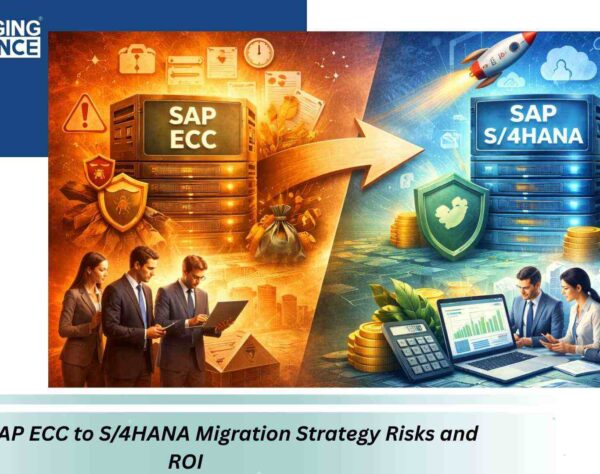
Across industries are facing a critical technology inflection point. Many enterprises still operate on SAP ECC (Enterprise Central Component) systems designed for a different era of enterprise computing an era before real-time analytics, AI-driven automation, and cloud-native infrastructure became essential for competitiveness. Maintaining legacy SAP on-premises systems is increasingly expensive and operationally complex. Infrastructure costs continue to rise, customizations accumulate technical debt, and fragmented systems create data silos that slow decision-making. As a result, SAP ECC to SAP S/4HANA Migration has moved beyond a technical upgrade. It has become a strategic transformation initiative that enables enterprises to modernize operations, control IT costs, and unlock the full potential of cloud-based enterprise resource planning. Organizations that execute a structured SAP-ECC/S4-cloud Migration strategy are not just modernizing ERP they are fundamentally redesigning how business intelligence, automation, and digital processes operate across the enterprise.
Cost Pressure Driving SAP On-Premises to SAP S/4HANA Cloud Migration
For many enterprises, the decision to pursue SAP on premises to cloud migration is driven by rising operational costs associated with legacy systems.
Traditional SAP ECC systems require extensive infrastructure management. Servers, storage, database administration, disaster recovery environments, and ongoing maintenance consume significant IT budgets. Over time, these costs compound as systems grow more complex.
Key cost challenges enterprises face with legacy SAP environments include:
- Expensive hardware infrastructure and maintenance
- Growing support costs for aging SAP ECC systems
- Complex customization layers that increase maintenance effort
- High operational overhead for system monitoring and upgrades
- Limited scalability when business demand fluctuates
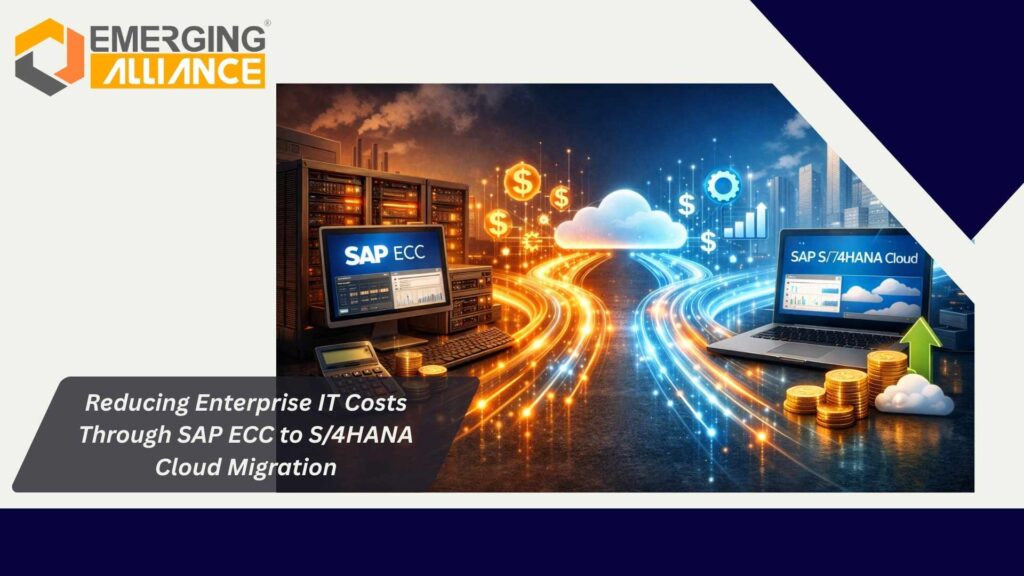
In contrast, SAP S/4HANA Cloud introduces a fundamentally different economic model. Infrastructure is optimized through hyperscale cloud environments, operational overhead is reduced through automation, and system updates become streamlined.
This shift allows enterprises to focus their IT investments on innovation rather than system maintenance.
Why SAP S/4HANA Cloud Changes the SAP Migration Cost Equation
The transition from SAP ECC to SAP S/4HANA Migration is not just about moving systems to the cloud. It involves adopting a modern ERP architecture designed for real-time business operations.
SAP S/4HANA Cloud integrates advanced in-memory computing, modern data models, and intelligent automation capabilities that dramatically improve system performance and business visibility.
Depending on strategic needs, organizations can choose from several deployment options:
- SAP S/4HANA Cloud, Public Edition – Ideal for organizations seeking rapid innovation and standardized processes.
- SAP S/4HANA Cloud, Private Edition – Suitable for enterprises requiring greater customization flexibility.
- SAP S/4HANA On-Premises – For organizations maintaining strict infrastructure control while modernizing ERP architecture.
Among these, S/4HANA Cloud, Private Edition and SAP S/4HANA Cloud, Public Edition are increasingly popular because they balance innovation speed with operational control.
These deployment models enable enterprises to implement a scalable cloud-based ERP solution while maintaining governance and compliance standards.
Key Business Problems Solved Through SAP ECC to SAP S/4HANA Migration
Modern enterprises rarely migrate ERP systems purely for technology reasons. The most compelling drivers relate to business performance and operational visibility.
1. Eliminating Data Silos Across Business Functions
Many legacy SAP ECC systems evolved through years of customizations and integrations. As a result, financial, operational, and supply chain data often exist in disconnected environments.
SAP S/4HANA Cloud integrates these data sources within a unified digital core, enabling real-time visibility across departments.
Executives gain instant access to consolidated dashboards for revenue performance, operational metrics, and financial insights.
2. Accelerating Real-Time Decision Making
Traditional reporting cycles often delay strategic decisions because enterprise data requires extensive processing before insights become available.
The in-memory architecture of SAP S/4HANA allows enterprises to run complex analytics directly on transactional data.
This capability transforms ERP from a transactional system into a strategic intelligence platform for leadership teams.
3. Reducing Technical Debt from Legacy Customizations
Many organizations running SAP ECC systems accumulate extensive custom code over time. These customizations increase system complexity and make upgrades difficult.
A structured SAP ECC to S4 HANA migration initiative enables enterprises to rationalize legacy customizations, simplify business processes, and adopt standardized digital workflows.
The result is a cleaner, more maintainable ERP architecture that supports future innovation.
4. Strengthening Security and Compliance
Regulatory environments continue to evolve across industries. Legacy ERP systems often struggle to keep pace with modern compliance requirements.
SAP S/4HANA Cloud introduces enhanced security frameworks, improved governance capabilities, and stronger compliance controls.
For global enterprises operating across regions such as India, the Middle East, and the United States, these capabilities significantly reduce compliance risks.
Controlling Costs with the Right SAP S/4HANA Migration Strategy
While the benefits of SAP ECC to SAP S/4HANA Migration are clear, the success of the initiative depends heavily on selecting the right SAP S/4HANA migration strategy.
A poorly planned migration can introduce operational disruptions, unexpected costs, and project delays.
Successful enterprises approach SAP migration cost optimization through structured planning and risk mitigation.
Key principles include:
Conducting a Comprehensive Readiness Assessment
A SAP S/4HANA readiness assessment evaluates the current SAP ECC system, identifies compatibility gaps, and analyzes customizations.
This step allows organizations to define a realistic migration roadmap and prevent costly surprises during implementation.
Designing a Clear Migration Roadmap
A strategic SAP migration strategy determines whether the enterprise should pursue:
- System conversion (Brownfield approach)
- Landscape transformation
- New implementation (Greenfield approach)
Each option has different cost implications, timelines, and operational impacts.
Managing SAP Data Migration Effectively
One of the most complex components of SAP Data migration is ensuring data quality, consistency, and integrity.
A structured SAP migration risk management framework ensures that data transformation and validation processes maintain operational continuity.
Testing and Cutover Planning
Comprehensive testing ensures business processes function correctly within the new SAP S/4HANA Cloud environment.
Testing phases typically include system integration testing, user acceptance testing, and performance validation.
A carefully designed cutover strategy ensures a smooth transition from the legacy SAP ECC system to the new ERP environment.
The Competitive Advantage of SAP S/4HANA Cloud Migration
Enterprises that successfully complete SAP ECC to SAP S/4HANA Migration gain a significant competitive advantage.
They move from reactive IT operations to a modern digital core capable of supporting innovation, agility, and data-driven decision-making.
With SAP S/4HANA Cloud, organizations can scale operations globally, integrate emerging technologies, and maintain real-time visibility across complex business ecosystems.
In a market where speed and intelligence define competitive advantage, modern ERP architecture is no longer optional—it is foundational.
Reduce IT Costs and Modernize Your Business with SAP S/4HANA Cloud Migration
A well-planned SAP-ECC/S4-cloud Migration can significantly reduce operational costs while enabling enterprise-wide digital transformation. If your organization is evaluating SAP ECC to S/4HANA Migration, the first step is understanding your system readiness, migration options, and cost optimization opportunities.
Make the smart choice today and take your business to the next level with S/4HANA Cloud Migration!
For more information visit Emerging Alliance.
FAQs about SAP ECC to S/4HANA Cloud Migration
1 Why are enterprises prioritizing SAP ECC to SAP S/4HANA migration now?
Enterprises are prioritizing SAP ECC to SAP S/4HANA migration to reduce legacy system costs, enable real-time insights, and modernize operations with a scalable cloud-based ERP platform.
2 Why are companies moving from SAP ECC to SAP S/4HANA Cloud?
To reduce infrastructure costs, gain real-time insights, and support scalable digital transformation.
3 What are the main benefits of SAP ECC to SAP S/4HANA migration?
Real-time analytics, faster processes, lower IT costs, and better system integration.
4 What are the common challenges in SAP ECC to S/4HANA migration?
Complex customizations, data migration issues, legacy integrations, and process redesign.
5 How can organizations control SAP migration costs?
Through readiness assessment, structured migration planning, and strong data governance.
6 What deployment options are available for SAP S/4HANA?
SAP S/4HANA Cloud Public Edition, Private Edition, and S/4HANA On-Premises.
7 What is the difference between SAP ECC and SAP S/4HANA?
SAP ECC uses traditional databases, while SAP S/4HANA runs on in-memory technology for real-time processing.
8 What role does data migration play in SAP ECC to S/4HANA migration?
It ensures accurate transfer and validation of business data into the new system.
9 How long does SAP ECC to SAP S/4HANA migration take?
It can take a few months to over a year depending on system complexity.
10 Why should companies work with experienced SAP consultants for migration?
They help reduce risks, optimize migration strategy, and ensure smooth implementation.