
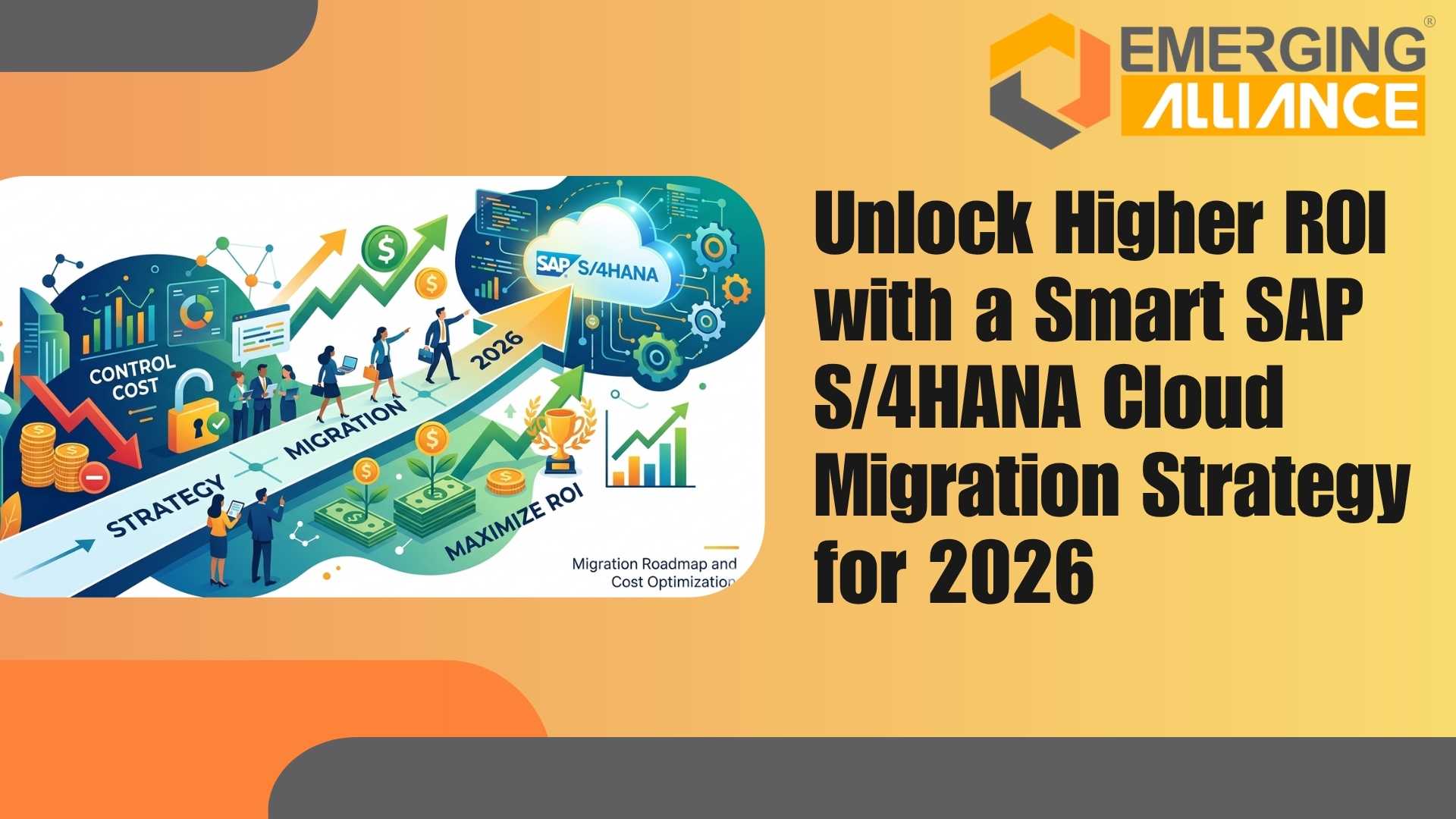
Unlock Higher ROI with a Smart SAP S/4HANA Cloud Migration Strategy for 2026
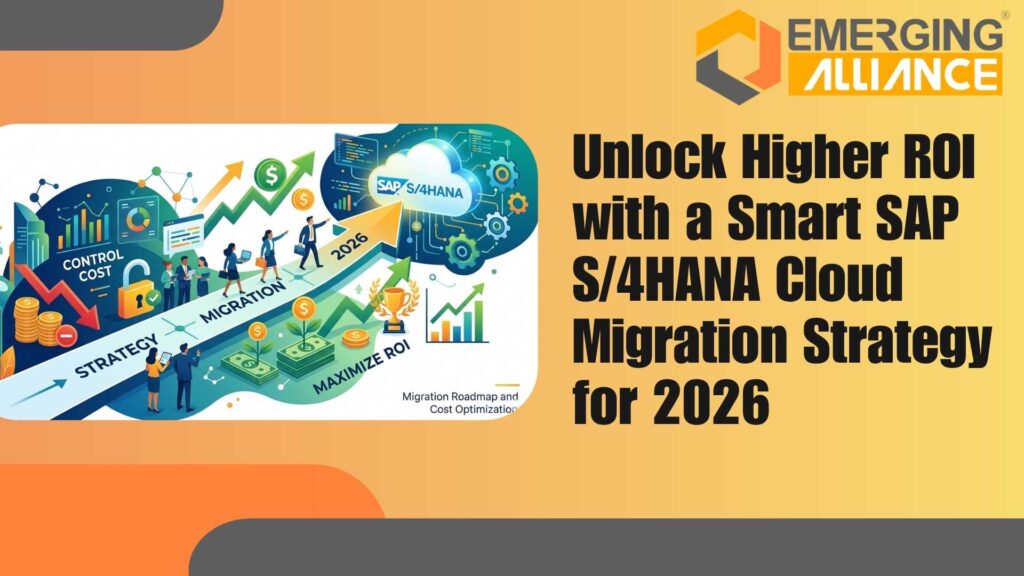
How SAP S/4HANA cloud Migration restores budget control, reduces TCO, and accelerates enterprise transformation ROI
SAP S/4HANA cloud migration strategy to control costs, reduce risk, and ensure predictable ROI with the right implementation approach in 2026.
Growing enterprises don’t struggle to decide whether to move to SAP S/4HANA. That decision is already made. The real uncertainty begins after that—when budgets start stretching, timelines begin shifting, and the promised ROI becomes difficult to quantify.
Most SAP S/4HANA migration programs are approved with a clear business case. But somewhere between ECC complexity, data inconsistencies, and evolving scope, that clarity starts to fade. What begins as a strategic modernization initiative often turns into a prolonged, expensive transformation with unclear outcomes.
For CIOs, CTOs, and CFOs, the real question is not migration—it is control.
Control over cost. Control over risk. Control over business continuity.
A well-structured SAP S/4HANA Cloud migration strategy is not just about moving systems. It is about ensuring that every phase of the transformation is predictable, measurable, and aligned with business value.
Why SAP ECC to S/4HANA Migration Costs Spiral Without Warning
Cost overruns in SAP migrations rarely come from a single decision. They build gradually, often unnoticed until the program is too deep to recalibrate.
One of the most common causes is the assumption that existing SAP ECC environments can be carried forward as they are. Over the years, most ECC systems accumulate layers of customization—many of which no longer serve a real business purpose. When these are blindly migrated, they increase both complexity and cost.
At the same time, data becomes another hidden challenge. Inconsistent master data, duplicate records, and outdated structures don’t just slow down migration—they create rework, delays, and operational risks post go-live.
Integration complexity adds another layer. Enterprises today operate in interconnected ecosystems, and underestimating how SAP S/4HANA will interact with existing applications often leads to unexpected effort and cost escalation.
These issues don’t appear as major risks in the beginning. But collectively, they create a situation where cost, timeline, and outcome become increasingly unpredictable.
What a Cost-Controlled SAP S/4HANA Migration Actually Looks Like
A successful migration is not defined by speed or technical completion. It is defined by how well cost, scope, and outcomes are controlled throughout the journey.
The foundation of this control begins before migration even starts. Instead of treating SAP ECC as a system to be moved, it must be treated as a system to be simplified. Every customization, every workflow, and every data structure must be evaluated for relevance. What doesn’t contribute to business value should not move forward.
Equally important is the concept of a clean core. SAP S/4HANA is designed to operate on standardized processes. Attempting to recreate legacy complexity defeats its purpose and increases long-term maintenance cost. A clean core approach ensures that the system remains scalable, adaptable, and easier to manage over time.
Data readiness plays a defining role in this process. Clean, structured, and validated data ensures that migration is not just faster, but also more reliable. It eliminates the need for repeated corrections and reduces the risk of operational disruptions after go-live.
Another critical decision is the deployment model. Whether an enterprise chooses SAP S/4HANA Cloud, Private Edition, or a hybrid architecture should depend on business complexity, regulatory needs, and long-term scalability—not just immediate cost considerations. The wrong choice at this stage can significantly impact total cost of ownership over time.
The Hidden Layer of SAP Migration: Financial Governance
What separates a controlled migration from a costly one is not technology—it is governance.
In many organizations, SAP migration is treated as an IT initiative. But in reality, it is a financial transformation program. Every decision—from customization to deployment model—has a direct impact on cost and ROI.
Without structured governance, scope tends to expand. Additional requirements are introduced. Integrations become more complex. Over time, these incremental changes compound into significant cost overruns.
A well-governed SAP S/4HANA migration introduces checkpoints at every stage. It ensures that decisions are evaluated not just from a technical perspective, but also from a financial and business impact standpoint. This creates visibility for leadership teams and prevents uncontrolled escalation.
Managing Risk Without Slowing Down the Transformation
Risk in SAP migration is often misunderstood. It is not just about system failure—it is about business disruption.
If production slows down, if billing is delayed, or if reporting becomes unreliable during or after migration, the impact is immediate and measurable. This is why risk management must be embedded into the migration strategy itself, not treated as a separate layer.
A phased migration approach often provides better control. Instead of attempting a large, high-risk transformation, organizations can move in structured phases, validating outcomes at each step. This reduces uncertainty and allows for course correction without major disruption.
At the same time, integration planning must be handled with precision. Modern enterprises rely on multiple systems, and ensuring seamless interaction between SAP S/4HANA and these systems is critical for maintaining operational continuity.
SAP On-Premise to Cloud Migration: Moving Without Breaking Operations
For most enterprises, the journey to SAP S/4HANA is not a clean break from the past. It is a transition.
A hybrid approach allows organizations to modernize gradually while maintaining stability. Critical operations can continue on existing systems while new capabilities are introduced through SAP S/4HANA Cloud.
This approach not only reduces risk but also allows businesses to align transformation with their operational priorities. Instead of forcing change, it enables controlled evolution.
Why the Right SAP S/4HANA Partner Changes Everything
Technology does not determine the success of a migration. Execution does.
An experienced SAP S/4HANA implementation partner brings structure, clarity, and accountability to the process. They ensure that decisions are aligned with business outcomes, not just technical feasibility.
Emerging Alliance approaches SAP transformation with a focus on control. Cost control, risk control, and outcome control. Instead of treating migration as a one-time project, it is positioned as a long-term business enabler.
This includes aligning migration strategy with financial goals, ensuring architectural scalability, and maintaining visibility across every stage of the transformation.
Before You Start Migration, Fix the Cost Equation
If you are evaluating an SAP ECC to SAP S/4HANA migration, the most important decisions are the ones made before the project begins.
Once execution starts, flexibility reduces and cost exposure increases.
👉 Engage Emerging Alliance for a SAP S/4HANA migration readiness assessment to identify:
- Where your costs will increase
- Where your risks are hidden
- How your migration can be controlled from day one
FAQs SAP S/4HANA Cloud Migration
1. What drives SAP S/4HANA migration cost the most?
The biggest cost drivers are system complexity, data quality issues, and the extent of customization carried forward from SAP ECC.
2. How can enterprises avoid SAP migration cost overruns?
By simplifying ECC systems before migration, adopting a clean core strategy, and implementing strong financial governance throughout the project.
3. Is SAP S/4HANA Cloud better than on-premise?
It depends on business needs. Cloud offers scalability and faster deployment, while private or hybrid models provide flexibility for complex environments.
4. What is a clean core strategy in SAP S/4HANA?
It focuses on keeping the core ERP system standardized while handling custom requirements through extensions.
5. How long does SAP S/4HANA migration take?
It typically ranges from 6 to 18 months depending on system size, complexity, and migration approach.
6. What are the biggest risks in SAP migration?
Data inconsistency, integration failures, and business disruption during transition are the most critical risks.
7. Can SAP S/4HANA integrate with existing systems?
Yes, it supports integration with both SAP and non-SAP systems through APIs and middleware.
8. Do all ECC customizations need to be migrated?
No. Most should be evaluated and removed or redesigned to reduce complexity and cost.
9. What is the ROI of SAP S/4HANA migration?
ROI comes from improved efficiency, real-time insights, reduced operational cost, and better decision-making.
10. Why is partner selection critical in SAP migration?
Because execution quality directly impacts cost control, risk management, and long-term system scalability.
Fill out the form to connect with our experts now