
Salesforce Implementation in 2026 That Turns CRM Disorder into Predictable Revenue Growth
Why most CRM systems fail at execution and how the right Salesforce Implementation turns data into revenue predictability
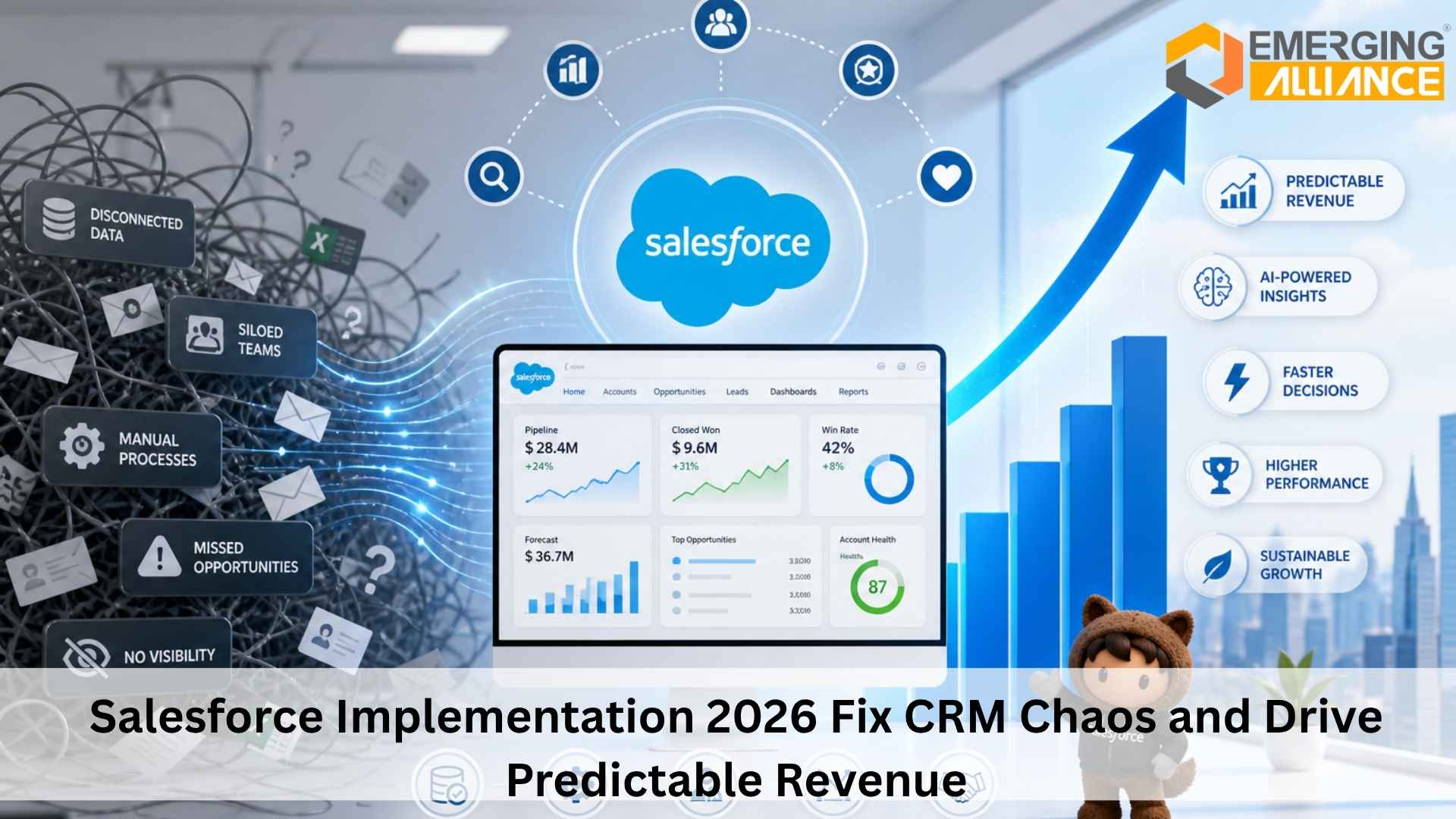
Salesforce Implementation is where most enterprises assume the problem is already solved—but that assumption is precisely where execution begins to break down. At a surface level, organizations have done everything right: deployed Salesforce, onboarded sales and marketing teams, and built reporting dashboards. Structurally, the CRM environment appears mature. However, when you interrogate the system more rigorously, systemic inefficiencies emerge—data fragmentation across modules, inconsistent user adoption, and forecast models that lack statistical reliability.
This disconnect is not a technology failure. It is an execution failure.
What distinguishes high-performing enterprises in 2026 is not CRM ownership, but CRM operationalization. There is a material difference between using a CRM as a passive system of record and leveraging it as an active system of execution. In the former, data is logged; in the latter, data drives behavior, decision-making, and revenue predictability.
A well-architected Salesforce Implementation enforces process discipline, standardizes data capture at every revenue touchpoint, and aligns cross-functional workflows. It transforms CRM from a reporting tool into a control system—one where pipeline velocity, conversion rates, and revenue outcomes are not just visible, but engineered.
Without that level of precision, even the most sophisticated CRM platform will continue to produce noise instead of insight.
Why Most Salesforce Implementations Quietly Break Down
CRM failure rarely happens suddenly. It erodes over time. It begins when sales teams start relying on memory instead of system inputs. It grows when leadership realizes that dashboards don’t reflect reality. And it becomes critical when forecasts turn into assumptions rather than data-backed projections.
At its core, the issue is misalignment.
Sales processes inside CRM often do not reflect how customers actually buy. Data flows are fragmented across marketing platforms, ERP systems, and support tools. Automation exists, but it is either underutilized or disconnected from real business outcomes.
Over time, the system becomes heavier, but not smarter.
This is why many organizations find themselves in a paradox—they have a powerful CRM platform, yet they lack clarity, speed, and control.
Salesforce Implementation in 2026: From System Deployment to Revenue Architecture
Modern Salesforce Implementation is no longer about configuring modules or enabling features. It is about building a revenue architecture that aligns people, processes, and data into a single operating model.
This shift requires a fundamental change in approach.
Instead of designing workflows based on internal assumptions, high-performing organizations map CRM processes directly to revenue stages. Every action—from lead qualification to deal closure—is structured, measurable, and aligned with financial outcomes.
At the same time, data architecture becomes a critical priority. CRM cannot operate in isolation. It must function as the central intelligence layer that connects ERP, marketing, and customer service systems into a unified ecosystem.
When this alignment is achieved, CRM stops being a reporting tool. It becomes a decision-making system.
Leadership no longer reacts to numbers—they operate with clarity.
The Strategic Role of a Salesforce Consulting Partner
This level of transformation cannot be achieved through internal configuration alone. It requires a Salesforce consulting partner who understands both technology and business dynamics.
A capable partner does not begin with features. They begin with questions: How does revenue flow through your organization? Where does visibility break? What decisions are being made without reliable data?
From there, the implementation evolves into a structured transformation.
This is where Emerging Alliance positions itself differently. The focus is not on deploying Salesforce, but on aligning it with business outcomes.
Every workflow, integration, and customization is evaluated against one metric—its impact on revenue predictability. That is what separates implementation from transformation.
How Salesforce Implementation Directly Impacts Revenue Outcomes
When Salesforce is implemented correctly, its impact is not limited to operational efficiency. It directly influences revenue performance.
Sales cycles become shorter because follow-ups are structured and automated. Pipeline visibility improves because data is captured consistently across stages. Conversion rates increase because bottlenecks are identified and resolved in real time.
More importantly, leadership gains confidence in forecasting.
Instead of relying on fragmented updates or manual reports, decisions are driven by live, system-backed insights. This shift reduces risk, improves planning accuracy, and strengthens financial control.
The result is not just better CRM usage—it is a more predictable business.
Data Integration: The Turning Point for CRM Effectiveness
One of the most critical turning points in any Salesforce Implementation is data integration.
Without it, CRM operates in isolation. Sales sees one version of reality, finance sees another, and marketing operates on assumptions.
With proper integration, the entire organization aligns.
Customer interactions, financial data, and operational metrics converge into a single source of truth. This eliminates inconsistencies and enables faster, more accurate decision-making.
A strong Salesforce system integrator ensures that this foundation is built correctly—not as an afterthought, but as a core design principle.
Because without unified data, CRM cannot deliver strategic value.
Customization That Drives Adoption—Not Complexity
Customization is often misunderstood in CRM environments.
Many organizations equate customization with adding more features. In reality, excessive customization is one of the fastest ways to reduce system usability and adoption.
A strategic approach to Salesforce customization services focuses on simplification.
The goal is to design an interface and workflow structure that aligns with how users actually work. When the system becomes intuitive, adoption increases naturally. When adoption increases, data quality improves. And when data quality improves, the entire CRM ecosystem becomes more valuable.
This is how customization should function—not as an enhancement layer, but as an enabler of efficiency.
The Hidden Cost of Poor Salesforce Implementation
The cost of a weak Salesforce Implementation is rarely visible on a balance sheet—but its impact is significant.
Deals are lost because follow-ups are missed. Revenue slows because pipeline visibility is unclear. Costs increase because licenses are underutilized and redundant tools continue to exist.
Over time, teams begin to work outside the system, creating shadow processes that further weaken control.
This is not just inefficiency—it is revenue leakage.
And the longer it continues, the more difficult it becomes to correct.
Why Long-Term Salesforce Optimization Is Non-Negotiable
Even the best implementation will degrade without continuous optimization.
Markets evolve, customer expectations shift, and business models change. CRM must adapt to these changes in real time.
This is why organizations need an ongoing execution partner—not just for implementation, but for continuous refinement.
A structured optimization approach ensures that Salesforce remains aligned with business goals, supports new growth strategies, and continues to deliver measurable ROI.
Without this, CRM slowly returns to its original state—complex, underutilized, and disconnected.
Why Emerging Alliance is Built for Revenue-Focused Salesforce Transformation
Emerging Alliance approaches Salesforce with a clear philosophy—CRM should drive revenue, not just manage data.
Their methodology combines deep technical expertise with business-first thinking. Every implementation is structured around scalability, integration, and measurable outcomes.
Rather than treating Salesforce as a standalone system, they position it as the central engine for revenue operations.
This ensures that organizations move beyond CRM usage—and toward CRM-driven growth.
Fix the System Before It Costs You Growth
If your CRM is not trusted, not adopted, or not delivering measurable ROI, the issue is not the platform.
It is the way it has been implemented.
A strategic Salesforce Implementation can correct that—by aligning systems with revenue, simplifying processes, and restoring visibility.
Emerging Alliance works with leadership teams to rebuild CRM as a revenue system—designed for clarity, control, and scalability.
FAQs About Salesforce Implementation
1. How do I know if my current Salesforce Implementation is underperforming?
If your forecasts are inconsistent, sales teams rely on offline tracking, or leadership dashboards don’t reflect actual pipeline movement, your implementation is misaligned with revenue processes.
2. What is the difference between Salesforce deployment and Salesforce Implementation?
Deployment focuses on system setup, while Salesforce Implementation aligns CRM architecture with sales processes, data flows, and revenue outcomes.
3. How does Salesforce Implementation impact revenue predictability?
A structured implementation ensures consistent data capture, standardized deal stages, and real-time visibility, enabling accurate forecasting and predictable revenue planning.
4. What are the biggest risks in a poorly executed Salesforce Implementation?
The major risks include revenue leakage from missed follow-ups, inaccurate forecasts, low user adoption, and increased operational costs due to fragmented systems.
5. How long does it take to see ROI from Salesforce Implementation?
Most organizations begin seeing measurable improvements in pipeline visibility and deal velocity within 3–6 months, with full ROI typically achieved within 6–12 months.
6. Why is data integration critical in Salesforce Implementation?
Without integration, CRM operates in isolation, leading to inconsistent data across departments. Integration ensures a single source of truth for accurate decision-making.
7. Can Salesforce replace multiple business tools after proper implementation?
Yes, a well-implemented Salesforce ecosystem can consolidate sales, marketing, and customer support tools, reducing redundancy and improving operational efficiency.
8. How does customization affect Salesforce performance and adoption?
Strategic customization simplifies workflows and improves usability, which increases user adoption and ensures better data quality across the system.
9. What should I expect from a Salesforce consulting partner during implementation?
A strong partner will focus on aligning CRM with revenue goals, designing scalable architecture, ensuring data integration, and delivering measurable ROI outcomes.
10. How often should Salesforce be optimized after implementation?
Salesforce should be continuously optimized with quarterly reviews to adapt to changing sales processes, market conditions, and business growth strategies.
Fill out the form to connect with our experts now