
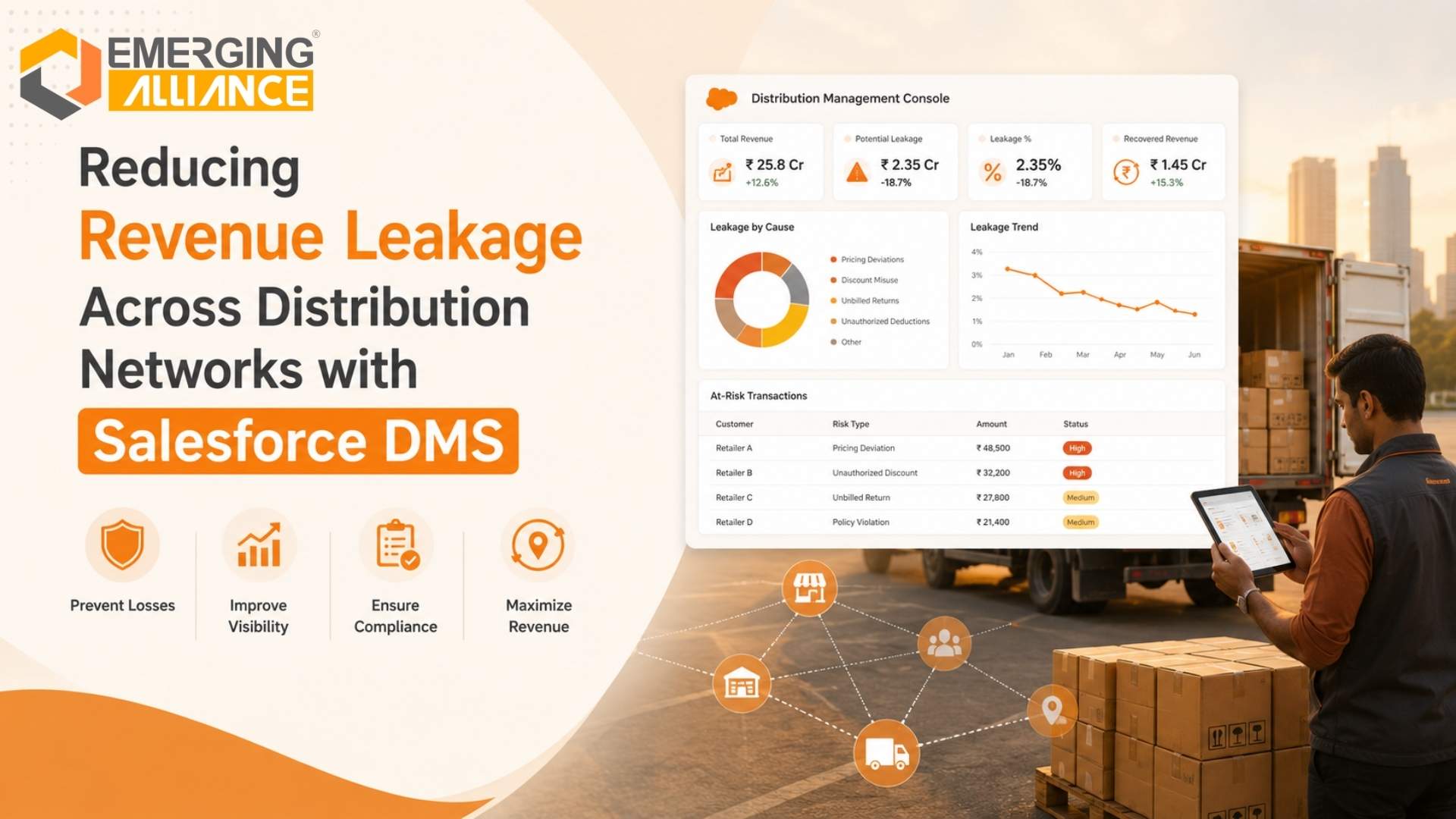
Reducing Revenue Leakage Across Distribution Networks with Salesforce DMS
Salesforce DMS Improves Compliance, Order Accuracy, and Operational Governance
Salesforce Dealer Management System (DMS) helps organizations reduce revenue leakage across complex distribution networks by improving visibility, standardizing processes, and strengthening operational control. As dealer ecosystems grow, challenges such as pricing inconsistencies, inventory inaccuracies, order errors, and compliance gaps can quietly impact profitability.
By providing real-time insights, workflow automation, and centralized dealer management, Salesforce DMS enables businesses to improve governance, protect margins, and drive more efficient distribution operations.
This blog explores how organizations can reduce revenue leakage and improve distribution performance with Salesforce Dealer Management System (DMS).
Why Revenue Leakage Is Becoming a Strategic Priority for Dealer and Distribution Networks
Rising Pressure on Margins Across Distribution Networks
For distribution-driven organizations, revenue growth alone is no longer the primary indicator of business health. Increasing operating costs, competitive pricing pressures, supply chain disruptions, and evolving customer expectations have shifted executive focus toward profitability and margin protection.
As distribution ecosystems expand, even small inefficiencies can accumulate into significant financial losses. Organizations may continue reporting strong sales numbers while simultaneously losing revenue through operational gaps that remain hidden within day-to-day activities.
The Growing Complexity of Managing Dealers, Distributors, and Field Teams
Modern distribution networks involve multiple stakeholders operating across regions, channels, and product categories. Dealers, distributors, sales representatives, service teams, and finance departments often rely on different processes and systems.
Without centralized visibility, maintaining consistency becomes increasingly difficult. Decision-makers frequently struggle to monitor pricing compliance, inventory movement, order fulfillment, dealer performance, and customer engagement across the entire network.
Why Revenue Leakage Often Goes Unnoticed
Revenue leakage rarely appears as a single operational issue. Instead, it develops gradually through:
- Unapproved discounts and pricing deviations
- Order processing inaccuracies
- Inventory mismatches
- Delayed dealer reporting
- Inefficient claims management
- Poor lead follow-up
- Manual reconciliation processes
Because these issues occur across multiple locations and teams, they often remain invisible until profitability is impacted.
The Need for Greater Visibility and Governance
Today’s business leaders require more than operational reports. They need real-time visibility into network performance, dealer compliance, inventory health, and revenue generation activities.
Organizations that establish stronger governance frameworks and centralized operational control are better positioned to protect margins, improve accountability, and support sustainable growth.
The Business Impact of Revenue Leakage Across Modern Dealer Management System Environments
Pricing Inconsistencies Directly Affect Profitability
One of the most common sources of revenue leakage is inconsistent pricing execution across distribution channels.
When dealers apply unauthorized discounts, promotions, or pricing structures, organizations lose control over margin protection strategies. Even minor pricing deviations across hundreds of transactions can significantly reduce profitability over time.
Order Errors Create Hidden Revenue Loss
Manual order processing and disconnected workflows increase the likelihood of errors.
Common issues include:
- Incorrect product quantities
- Duplicate orders
- Delayed approvals
- Shipment discrepancies
- Missed fulfillment commitments
These challenges not only impact revenue recognition but also increase operational costs associated with correction and customer support.
Inventory Discrepancies Impact Working Capital
Inventory remains one of the largest financial assets within distribution businesses.
Limited visibility into inventory movement can result in:
- Overstocking
- Stock shortages
- Excess carrying costs
- Lost sales opportunities
- Emergency procurement expenses
Without accurate inventory intelligence, organizations struggle to optimize working capital and maintain service levels.
Enterprise Scenario: How Revenue Leakage Develops
Consider a manufacturing company operating through hundreds of dealers across multiple regions. If inventory information is delayed, dealers may continue selling products that are no longer available while warehouses simultaneously hold excess inventory elsewhere. Combined with inconsistent discount approvals, manual order processing, and disconnected reporting, revenue leakage can occur despite strong overall sales performance. Without centralized visibility, leadership teams often discover these issues only after profitability has been affected.
Compliance and Governance Challenges
As distribution networks grow, maintaining policy compliance becomes increasingly complex.
Organizations must ensure:
- Consistent pricing execution
- Approval adherence
- Dealer accountability
- Accurate transaction records
- Regulatory compliance
Without standardized controls, governance risks increase significantly.
Long-Term Impact on Customer Experience and Growth
Revenue leakage ultimately extends beyond financial performance.
Customers experience:
- Delayed deliveries
- Order inaccuracies
- Inconsistent pricing
- Reduced service quality
Over time, these issues affect customer trust, dealer relationships, and long-term market competitiveness.
How Leading Organizations Are Modernizing Distribution Operations with Dealer Management System Solutions
Moving from Reactive Management to Real-Time Visibility
Traditional distribution management often relies on periodic reports and manual reviews.
Leading organizations are replacing this reactive approach with real-time operational visibility that enables faster decision-making and immediate issue resolution.
Instead of discovering problems after they occur, management teams gain continuous insight into dealer activities, inventory movement, sales performance, and order fulfillment.
Standardizing Processes Across Distribution Networks
Operational consistency is essential for scalability.
Successful enterprises are implementing standardized processes that ensure every dealer, distributor, and sales team follows approved operating procedures.
Standardization improves:
- Process accuracy
- Operational efficiency
- Compliance adherence
- Customer experience consistency
Leveraging Automation to Improve Accuracy
Manual processes create unnecessary risk.
Organizations increasingly deploy Salesforce automation for dealers to eliminate repetitive administrative tasks and reduce human error across critical workflows.
Automation helps improve:
- Order processing
- Inventory tracking
- Lead management
- Claims approvals
- Dealer onboarding
- Performance reporting
Establishing Stronger Governance Controls
Modern distribution strategies prioritize accountability.
Businesses are implementing governance frameworks that provide clear approval structures, audit trails, compliance monitoring, and operational transparency across the dealer ecosystem.
Using Analytics to Drive Channel Performance
Advanced analytics allow organizations to move beyond historical reporting.
Executives can identify:
- High-performing dealers
- Revenue leakage trends
- Inventory risks
- Pricing anomalies
- Sales opportunities
- Regional performance variations
These insights support more informed and proactive decision-making.
How Salesforce Dealer Management System (DMS) Helps Reduce Revenue Leakage and Improve Distribution Performance
End-to-End Visibility Across Distribution Operations
A modern Salesforce Dealer Management System software provides a unified view of dealer activities, field operations, inventory movement, customer interactions, and sales performance.
This centralized visibility allows management teams to identify issues early and respond quickly.
Automated Order, Pricing, and Inventory Management
Salesforce DMS automates critical operational workflows that directly impact revenue protection.
Key Salesforce DMS modules include:
- Order management automation
- Pricing governance controls
- Salesforce DMS inventory control
- Dealer performance monitoring
- Salesforce lead tracking system capabilities
- Claims processing workflows
Automation reduces manual intervention while improving consistency and accuracy.
Improved Compliance Through Standardized Workflows
Salesforce DMS enables organizations to establish standardized workflows that guide users through approved business processes.
Benefits include:
- Controlled pricing approvals
- Consistent dealer operations
- Enhanced audit readiness
- Policy enforcement
- Reduced compliance risk
Real-Time Insights for Faster Decisions
Executives gain access to real-time dashboards and reporting tools that provide visibility into operational performance across the distribution network.
This enables faster responses to:
- Inventory shortages
- Sales fluctuations
- Dealer performance issues
- Pricing exceptions
- Customer service challenges
Enhanced Governance and Revenue Protection
Salesforce DMS strengthens accountability by ensuring that transactions, approvals, inventory movements, and dealer activities are recorded within a centralized platform.
The result is greater operational transparency, stronger governance, and improved protection against revenue leakage.
Evaluating the Right Salesforce DMS Platform for Long-Term Distribution Growth
Selecting a distribution management platform should be viewed as a strategic business decision rather than a technology purchase.
Visibility and Reporting Capabilities
Decision-makers should evaluate whether the solution provides:
- Real-time dashboards
- Dealer performance visibility
- Salesforce inventory management insights
- Revenue analytics
- Executive reporting
Visibility is essential for proactive management.
Governance and Compliance Controls
The platform should support:
- Approval workflows
- Audit trails
- Pricing governance
- Compliance monitoring
- Policy enforcement
Strong governance reduces operational and financial risk.
Integration with Existing Business Systems
Modern distribution environments require seamless connectivity.
Organizations should assess how effectively the solution integrates with:
- ERP platforms
- CRM systems
- Finance applications
- Supply chain systems
- Inventory management tools
Salesforce DMS with ERP systems creates a connected environment that eliminates data silos and improves decision-making.
Scalability for Future Growth
As dealer networks expand, technology must scale alongside the business.
Leaders should evaluate:
- Multi-region support
- Dealer onboarding capabilities
- Performance at scale
- Workflow flexibility
- Future expansion requirements
Ability to Improve Profitability and Channel Performance
The right Dealer Management System should contribute directly to business outcomes, including:
- Reduced revenue leakage
- Higher order accuracy
- Improved inventory utilization
- Better dealer accountability
- Faster decision-making
- Enhanced customer satisfaction
Why Salesforce DMS Supports Long-Term Distribution Transformation
As the future of Dealer Management Systems evolves toward automation, analytics, and cloud scalability, Salesforce DMS provides a flexible platform capable of supporting long-term business growth.
With extensive Salesforce DMS customization capabilities, organizations can customize Salesforce for dealer workflow requirements, integrate existing systems, and create a scalable operating model that supports evolving distribution strategies.
Conclusion
As dealer and distributor networks become larger and more complex, revenue leakage becomes increasingly difficult to identify and control. Pricing inconsistencies, inventory inaccuracies, order fulfillment gaps, and compliance challenges can quietly reduce profitability despite strong sales performance.
Organizations that invest in visibility, automation, governance, and standardized dealer operations are better positioned to protect revenue and scale efficiently. Salesforce Dealer Management System (DMS) provides the foundation needed to modernize distribution management, improve accountability, and support sustainable business growth.
Frequently Asked Questions
1. How does a Dealer Management System help reduce revenue leakage across dealer networks?
A Dealer Management System helps organizations improve visibility, standardize processes, enforce pricing controls, and automate workflows that reduce revenue leakage across the distribution ecosystem.
2. How does Salesforce DMS help prevent revenue leakage?
Salesforce DMS helps organizations reduce revenue leakage by centralizing dealer operations, automating approvals, enforcing pricing policies, improving inventory visibility, and providing real-time insights into dealer performance.
3. How can pricing controls in Salesforce DMS improve profitability?
Salesforce DMS enables organizations to standardize pricing structures, monitor dealer discounts, and automate approval workflows for pricing exceptions, helping protect margins and improve profitability.
4. How does Salesforce DMS inventory control improve dealer network performance?
Salesforce DMS inventory control provides real-time inventory visibility across dealers and warehouses, helping reduce stock discrepancies, prevent shortages, and improve inventory utilization.
5. How does Salesforce DMS help identify underperforming dealers?
Through dashboards, reports, and analytics, Salesforce DMS enables organizations to monitor dealer sales, inventory turnover, fulfillment performance, and compliance metrics.
6. Why is dealer compliance important for reducing revenue leakage?
Unauthorized pricing, delayed reporting, inaccurate claims, and inventory mismanagement can directly affect profitability. Salesforce DMS helps enforce consistent compliance standards across the network.
7. How does Salesforce automation for dealers improve operational efficiency?
Salesforce automation for dealers streamlines order approvals, inventory updates, claims processing, lead management, and dealer onboarding while reducing manual effort and errors.
8. How does Salesforce DMS with ERP systems improve operational visibility?
Integrating Salesforce DMS with ERP systems creates a unified view of orders, inventory, finance, and dealer operations, enabling more informed business decisions.
9. Why is real-time visibility important for distribution businesses?
Real-time visibility helps organizations monitor inventory, dealer activities, sales performance, and pricing compliance, allowing issues to be identified and addressed before they affect revenue.
10. What should organizations evaluate before Salesforce DMS implementation?
Organizations should evaluate dealer processes, integration requirements, reporting needs, governance controls, scalability goals, and revenue leakage challenges to ensure a successful Salesforce DMS implementation.
Book Your Salesforce DMS Consultation with Emerging Alliance Today and discover how a modern dealer management platform can improve profitability, compliance, operational visibility, and channel performance.