
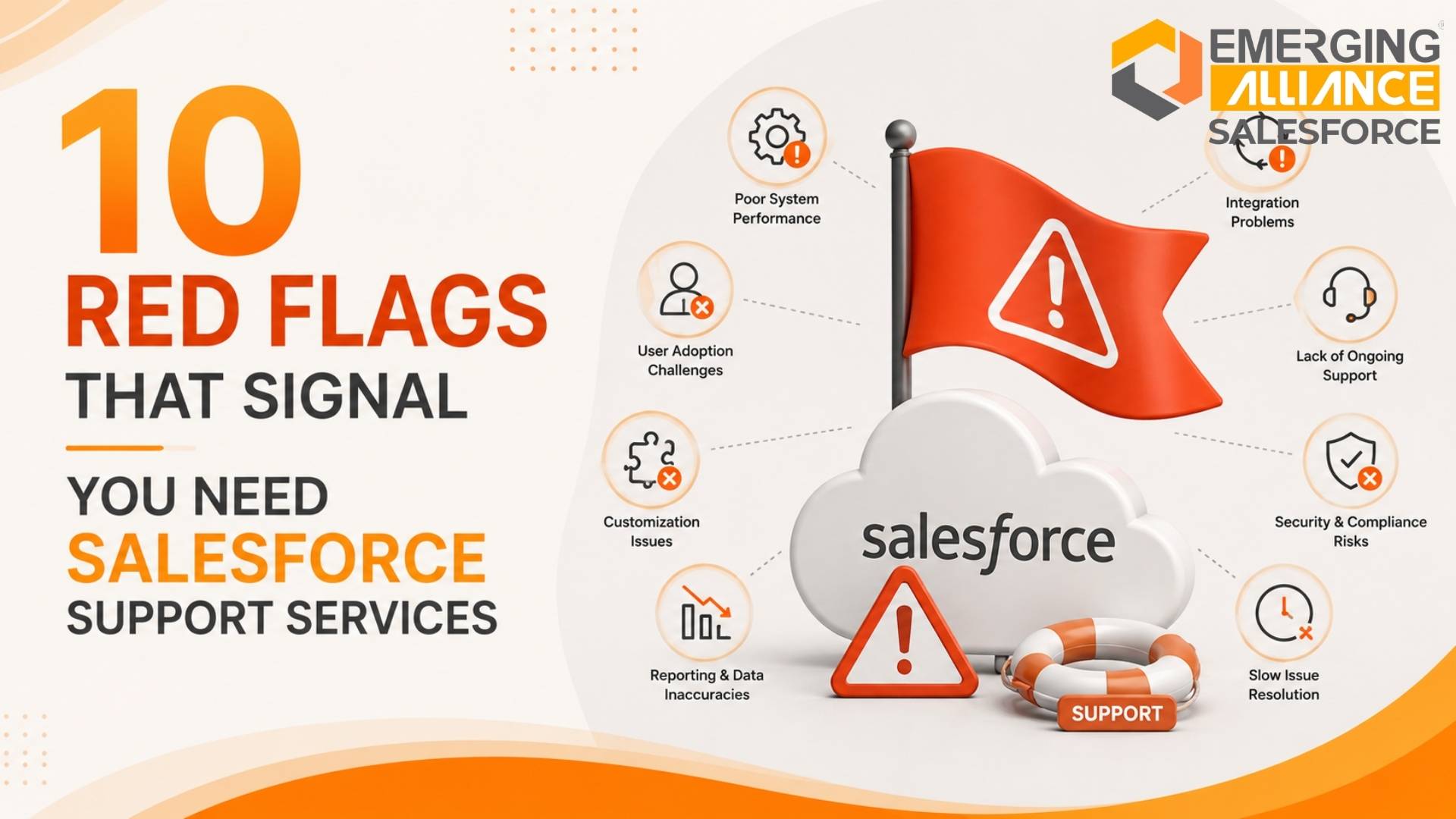
10 Red Flags That Signal You Need Salesforce Support Services
Discover how Salesforce Support Services prevent costly CRM failures
Modern enterprises invest heavily in the Salesforce platform to improve customer engagement, sales performance, service delivery, and operational visibility. Yet many organizations fail to realize the expected return because their CRM environment slowly deteriorates after implementation. This is where Salesforce Support Services become critical.
A successful CRM strategy is not defined by deployment alone. As business processes evolve, customer expectations change, and operational complexity increases, Salesforce requires continuous optimization, governance, support, and enhancement.
Ignoring early warning signs can result in declining user adoption, inaccurate reporting, workflow bottlenecks, compliance risks, and revenue leakage.
If any of the following red flags sound familiar, it may be time to engage professional Salesforce support and maintenance services before minor issues become major business challenges.
1. Salesforce Cloud CRM Adoption Is Declining Across Teams
One of the earliest indicators of CRM failure is decreasing user engagement.
When employees stop relying on Salesforce CRM systems, they often return to spreadsheets, emails, and disconnected applications. As a result, leadership loses visibility into customer interactions, pipeline health, and operational performance.
Common warning signs include:
- Sales teams maintaining external spreadsheets
- Customer information stored outside Salesforce
- Incomplete opportunity updates
- Inconsistent data entry practices
- Reduced login frequency across departments
Strong Salesforce Admin Support and ongoing user enablement help organizations maintain adoption while ensuring Salesforce remains the central source of truth.
2. Reporting Accuracy Is Becoming a Leadership Concern
Enterprise leaders depend on CRM data to make strategic decisions.
When reports become unreliable, forecasting accuracy declines and decision-making slows.
A lack of Salesforce application support often causes reporting inconsistencies because business processes evolve while CRM configurations remain unchanged.
Typical indicators include:
- Different departments reporting conflicting numbers
- Inaccurate sales forecasts
- Missing customer lifecycle data
- Delayed executive reporting
- Low confidence in dashboards
Professional Salesforce CRM support services ensure reporting structures remain aligned with business objectives and operational realities.
3. Business Workflows Are Filled With Manual Processes
Organizations typically implement Salesforce to automate business operations.
However, over time, automation gaps emerge.
Manual approvals, repetitive data entry, duplicate records, and disconnected workflows reduce productivity while increasing operational costs.
Enterprise leaders should investigate when:
- Teams spend excessive time on administrative tasks
- Customer onboarding requires manual intervention
- Service requests involve multiple handoffs
- Approval cycles become lengthy
- Customer communications are inconsistent
Experienced Salesforce Development Services teams continuously identify automation opportunities that improve efficiency and scalability.
4. Salesforce Technical Issues Are Increasing
As enterprises expand, Salesforce environments become more complex.
Custom integrations, multiple Salesforce clouds, third-party applications, and evolving business requirements create new support challenges.
Without proactive Salesforce technical support service capabilities, small issues can quickly impact customer experience and business operations.
Warning signs include:
- Frequent system errors
- Integration failures
- Data synchronization issues
- Workflow disruptions
- Slow system performance
Managed Salesforce support services help organizations identify and resolve issues before they affect revenue-generating processes.
5. Your Salesforce Platform No Longer Supports Business Growth
Many organizations initially configure Salesforce around their current business model.
The problem emerges when growth outpaces system capabilities.
New products, additional business units, geographic expansion, acquisitions, and evolving customer expectations often expose scalability limitations.
Key indicators include:
- Difficulty onboarding new teams
- Increasing customization requests
- Limited process flexibility
- Challenges supporting multiple business models
- Delayed implementation of new initiatives
A strategic Salesforce consulting partner can assess scalability risks and align CRM architecture with long-term growth objectives.
Why Salesforce Support and Maintenance Services Matter Beyond Issue Resolution
Many executives mistakenly view Salesforce support as a reactive service.
Modern Salesforce Support and Maintenance Services are far more strategic.
The right support model continuously evaluates how Salesforce contributes to revenue growth, customer experience, operational efficiency, and organizational agility.
Leading enterprises leverage Salesforce managed services to:
- Improve process automation
- Enhance customer journey visibility
- Strengthen governance
- Accelerate user adoption
- Reduce operational risk
- Increase CRM ROI
Support is no longer an IT function alone. It has become a business performance initiative.
6. Compliance and Data Governance Risks Are Growing
Data quality and governance have become board-level concerns.
Poorly governed Salesforce systems can create compliance challenges, audit risks, security concerns, and reporting inaccuracies.
Organizations often discover governance issues only after significant business impact occurs.
Potential red flags include:
- Duplicate customer records
- Inconsistent security permissions
- Missing audit trails
- Uncontrolled data access
- Lack of data ownership
A Salesforce Support and Maintenance Partner helps establish governance frameworks that protect both operational integrity and compliance objectives.
7. Customer Experience Is Becoming Inconsistent
Customers expect seamless interactions across every touchpoint.
When Salesforce systems fail to provide complete visibility, customer-facing teams struggle to deliver consistent experiences.
This often results in:
- Delayed responses
- Repeated customer requests
- Service inefficiencies
- Missed opportunities
- Reduced customer satisfaction
Salesforce cloud support services help ensure that sales, service, marketing, and operations teams work from a unified customer view.
8. Internal Teams Depend on External Consultants for Every Small Change
A mature CRM environment should enable agility.
If every report modification, workflow update, user request, or dashboard enhancement requires lengthy external engagement, business responsiveness suffers.
This dependency often indicates:
- Insufficient internal governance
- Poor system documentation
- Lack of administrative support
- Overly complex configurations
Salesforce managed support services establish sustainable operational models that improve responsiveness while reducing long-term support costs.
9. Salesforce Investments Are Not Delivering Expected ROI
Executives frequently invest in Salesforce implementation and support services with clear business objectives.
However, without continuous optimization, ROI often stagnates.
Common signs include:
- Flat productivity gains
- Limited process improvements
- Poor user adoption
- Low automation utilization
- Underused platform capabilities
A Certified Salesforce Partner can help organizations uncover unrealized value across the Salesforce platform and identify opportunities for optimization.
10. There Is No Proactive Salesforce Issue Detection and Resolution Strategy
Many organizations operate in a reactive support model.
Problems are addressed only after users report them.
Unfortunately, by that stage, productivity losses and operational disruptions have already occurred.
Modern Salesforce support solutions focus on proactive monitoring and continuous improvement.
This approach enables organizations to:
- Detect issues earlier
- Minimize downtime
- Improve user experience
- Reduce business disruption
- Strengthen operational resilience
For enterprises pursuing digital transformation, proactive support is often the difference between CRM success and CRM stagnation.
The Strategic Value of Salesforce Managed Services
Enterprise CRM environments require ongoing alignment with changing business priorities.
Whether the focus is revenue growth, customer retention, operational efficiency, or compliance, Salesforce systems must continuously evolve.
Organizations that leverage Salesforce system support services gain:
- Greater operational visibility
- Faster process execution
- Improved customer engagement
- Better decision-making
- Enhanced scalability
- Reduced technology risk
The most successful companies treat Salesforce as a strategic business platform rather than a software application.
Partner With Emerging Alliance for Enterprise Salesforce Support Services
Salesforce success does not end after implementation.
As organizations scale, the need for continuous optimization, governance, automation, and performance management becomes increasingly important.
Emerging Alliance works with enterprises to deliver strategic Salesforce Support Services that go beyond troubleshooting. Our team helps organizations improve CRM adoption, strengthen governance, optimize workflows, enhance reporting accuracy, and unlock greater business value from their Salesforce investments.
Whether you require Salesforce Admin Support, Salesforce Development Services, Salesforce managed services, or long-term Salesforce support and maintenance services, Emerging Alliance serves as a transformation partner focused on measurable business outcomes.
Frequently Asked Questions
1. How can Salesforce Support Services help when CRM adoption remains low despite user training?
Low adoption is often a process design issue rather than a training issue. Salesforce Support Services can identify workflow friction, unnecessary manual steps, poor page layouts, automation gaps, and reporting challenges that discourage users from working inside the CRM.
2. At what point does a growing enterprise need managed Salesforce support services instead of ad-hoc consulting?
When Salesforce becomes critical to sales operations, customer service, forecasting, compliance reporting, or multi-department collaboration, reactive consulting is no longer enough. Managed Salesforce support services provide continuous monitoring, governance, optimization, and enhancement aligned with business growth.
3. What business risks emerge when Salesforce CRM support services are not in place after implementation?
Organizations often experience declining data quality, inconsistent reporting, automation failures, user adoption challenges, compliance exposure, and increasing operational inefficiencies. Over time, these issues can directly impact forecasting accuracy, customer experience, and revenue performance.
4. How do Salesforce Support and Maintenance Services reduce revenue leakage?
Support teams continuously monitor lead management, opportunity progression, approval workflows, customer onboarding processes, and service operations. This helps identify bottlenecks, missed follow-ups, data gaps, and process failures that can result in lost revenue opportunities.
5. Can Salesforce managed services improve executive reporting and forecasting accuracy?
Yes. Salesforce managed services help maintain data integrity, reporting consistency, and dashboard relevance. This ensures leadership teams receive reliable information for pipeline forecasting, revenue planning, operational reviews, and strategic decision-making.
6. Why do enterprises struggle with Salesforce Cloud CRM adoption after initial success?
As organizations evolve, business processes change while CRM configurations often remain static. New departments, products, approval structures, and customer journeys can create misalignment between the Salesforce platform and actual business operations, leading to declining adoption.
7. What should CIOs evaluate when selecting a Salesforce Support and Maintenance Partner?
Beyond technical capability, CIOs should evaluate industry expertise, governance frameworks, proactive issue management, scalability planning, security practices, business process understanding, and the partner’s ability to support long-term digital transformation initiatives.
8. How does Salesforce Issue Detection and Resolution impact customer experience?
Undetected CRM issues can delay customer responses, interrupt sales workflows, create service backlogs, and impact communication accuracy. Proactive issue detection ensures business-critical processes continue operating without affecting customer satisfaction.
9. Can Salesforce application support help organizations preparing for expansion or acquisitions?
Absolutely. Salesforce application support helps assess system readiness, optimize architecture, standardize processes, improve data governance, and ensure the CRM can support new business units, regions, products, or acquired entities without disruption.
10. How do Salesforce implementation and support services work together to maximize ROI?
Implementation establishes the initial platform foundation. Ongoing Salesforce support services continuously optimize workflows, improve automation, enhance reporting, strengthen governance, and align the platform with evolving business objectives, ensuring long-term return on investment.
If your organization is experiencing any of these warning signs, now is the time to assess your Salesforce ecosystem.
Connect with Emerging Alliance and discover how a proactive support strategy can improve adoption, reduce risk, increase operational efficiency, and maximize CRM ROI.