
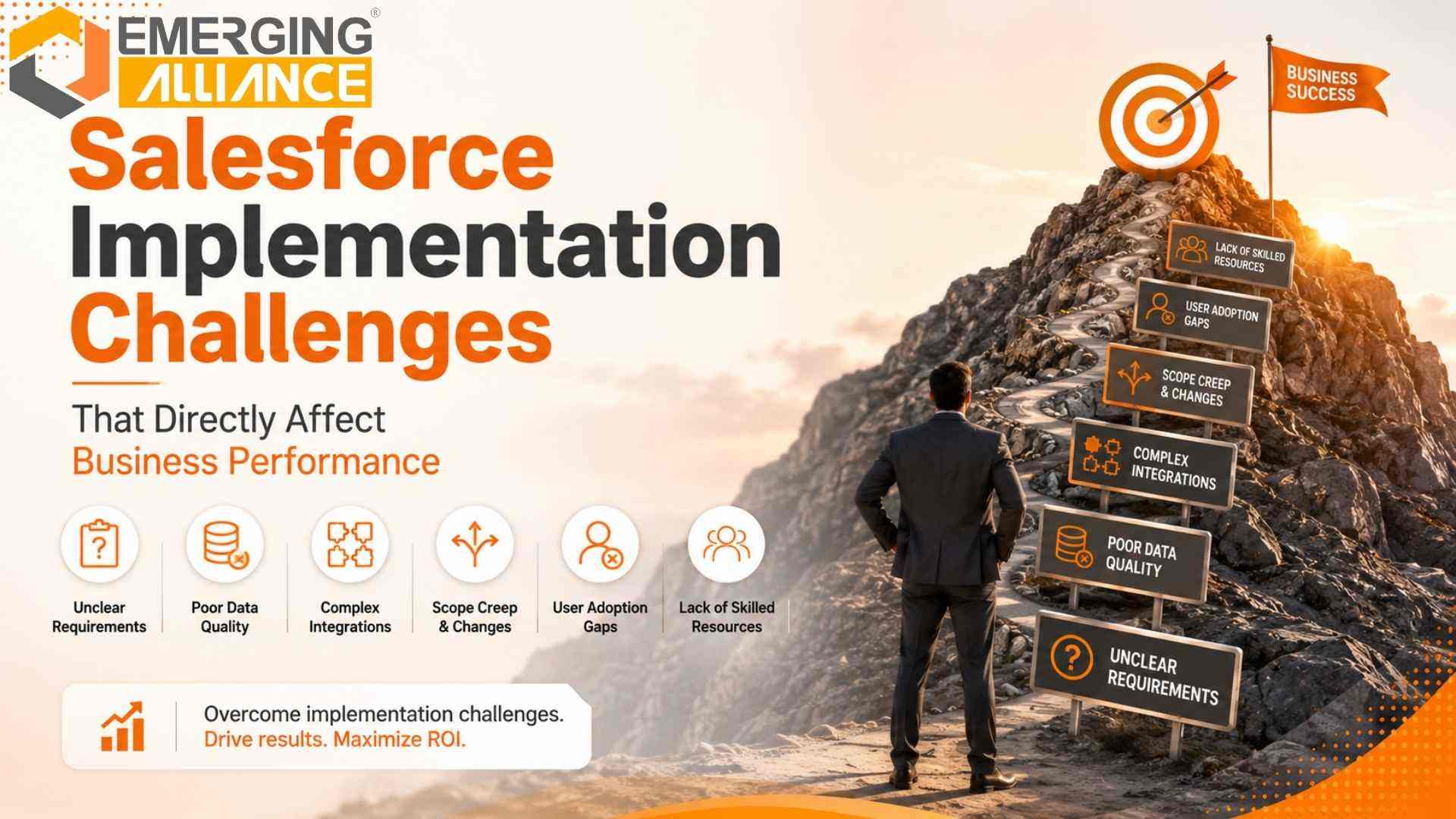
Salesforce Implementation Challenges That Directly Affect Business Performance
Learn How Salesforce Implementation Removes CRM Bottlenecks and Drives Growth
Salesforce implementation is often viewed as a technology initiative. In reality, it is a business transformation project that directly influences revenue performance, operational efficiency, customer experience, and enterprise scalability.
Many organizations invest heavily in CRM technology yet continue to struggle with fragmented customer data, inconsistent sales processes, limited visibility, and low user adoption. These challenges rarely originate from the Salesforce Platform itself. They are usually the result of implementation decisions that fail to align technology with business objectives. The real question is not whether Salesforce can support growth. The question is whether the implementation strategy is designed to eliminate operational bottlenecks and create measurable business outcomes.
When implemented strategically, Salesforce becomes more than a CRM system. It becomes a unified platform for customer engagement, workflow automation, analytics, and enterprise-wide decision-making.
How Poor Salesforce Implementation Creates Enterprise Bottlenecks
A Salesforce-based CRM solution can deliver significant value, but implementation gaps often create hidden operational inefficiencies.
Many enterprises deploy Salesforce quickly to meet immediate requirements while overlooking process design, data governance, and integration planning. As the organization grows, these gaps become increasingly visible.
Common business impacts include:
- Duplicate and inconsistent customer records
- Manual sales and service processes
- Delayed management reporting
- Low CRM adoption across departments
- Limited visibility into pipeline performance
- Inefficient customer support workflows
- Revenue leakage caused by process inconsistencies
A CRM platform should simplify operations. When implementation challenges remain unresolved, the platform can unintentionally add complexity instead of reducing it.
Organizations frequently discover these issues only after expansion, mergers, new product launches, or geographic growth initiatives expose weaknesses in their CRM foundation.
Why Salesforce CRM Implementation Must Align With Business Processes
Technology alone cannot solve process inefficiencies.
One of the most common implementation mistakes is replicating outdated workflows inside a new CRM environment. This often results in expensive Salesforce customizations that automate inefficient processes rather than improving them.
Successful Salesforce CRM implementation starts with business process evaluation.
Key Areas That Require Alignment
Sales Operations
- Lead qualification workflows
- Opportunity management
- Forecasting processes
- Territory planning
Customer Service
- Case management
- Escalation workflows
- SLA monitoring
- Customer communication tracking
Management Reporting
- Executive dashboards
- KPI visibility
- Revenue tracking
- Performance analytics
For example, a manufacturing company may have separate teams managing distributors, direct customers, and service operations. If Salesforce implementation does not accommodate these unique workflows, reporting becomes fragmented and customer experiences become inconsistent.
The objective should be process transformation, not system migration.
Salesforce Integrations and Data Visibility Determine Long-Term ROI
Many CRM projects struggle because Salesforce operates independently from the rest of the enterprise ecosystem.
Customer information often resides across ERP systems, finance applications, marketing platforms, support systems, and third-party applications.
Without effective Salesforce integrations, organizations face:
- Multiple versions of customer data
- Reporting inaccuracies
- Manual reconciliation efforts
- Delayed decision-making
- Poor customer experiences
A robust Salesforce implementation partner focuses on creating a connected business environment rather than deploying isolated CRM functionality.
Strategic Integration Priorities
Organizations should prioritize integration with:
- ERP platforms
- Finance systems
- Customer support applications
- Marketing automation platforms
- E-commerce solutions
- Dealer and partner management systems
When Salesforce Sales Cloud, Salesforce Service Cloud, and Salesforce Marketing Cloud operate as part of an integrated ecosystem, leadership gains real-time visibility into customer relationships, operational performance, and revenue opportunities.
This visibility becomes increasingly important as organizations scale.
Salesforce Automation Eliminates Operational Friction
Manual processes remain one of the largest barriers to enterprise growth.
As transaction volumes increase, organizations often experience workflow delays, approval bottlenecks, data entry errors, and reporting challenges.
This is where Salesforce automation creates measurable business value.
A properly designed Salesforce solution can automate critical business processes while maintaining governance and compliance.
High-Impact Automation Opportunities
Sales Automation
- Lead routing
- Opportunity progression
- Quote approvals
- Forecast updates
Service Automation
- Case assignment
- Escalation management
- SLA monitoring
- Customer notifications
Management Automation
- Executive reporting
- Performance dashboards
- Exception alerts
- Compliance monitoring
For leadership teams, automation is not simply about efficiency. It improves consistency, reduces operational risk, and enables employees to focus on higher-value activities.
Organizations that automate effectively are often better positioned to support growth without proportional increases in operational overhead.
Choosing the Right Salesforce Implementation Partner Matters More Than Technology
The success of Salesforce implementation is often determined by the quality of strategic guidance provided throughout the project lifecycle.
Many businesses focus primarily on Salesforce license selection and implementation cost while overlooking the importance of implementation expertise.
A qualified Salesforce consultant should understand more than platform functionality.
They should understand:
- Business process transformation
- Change management
- Enterprise architecture
- Data governance
- Industry-specific requirements
- Scalability planning
- User adoption strategies
What to Look for in a Salesforce Implementation Services Provider
A strong implementation partner should offer:
- Business process assessment
- Salesforce Platform Data Model design
- Integration architecture planning
- CRM adoption strategies
- Governance frameworks
- Post-go-live Salesforce support
- Continuous optimization services
Certified Salesforce consultants can configure a system.
Strategic Salesforce consulting partners help organizations achieve measurable business outcomes.
This distinction becomes increasingly important for enterprises pursuing aggressive growth, digital transformation initiatives, or operational modernization programs.
Salesforce Implementation Is a Business Strategy, Not an IT Project
Executives often evaluate Salesforce implementation through a technology lens.
The more effective perspective is to evaluate it through a business performance lens.
A successful implementation helps organizations:
- Improve revenue visibility
- Increase sales productivity
- Strengthen customer retention
- Enhance operational efficiency
- Improve forecasting accuracy
- Reduce process bottlenecks
- Support enterprise scalability
- Enable data-driven decision-making
When CRM strategy aligns with business objectives, Salesforce becomes a platform for growth rather than another enterprise application requiring maintenance.
The organizations that generate the highest ROI are typically those that treat Salesforce as a strategic business initiative supported by technology—not a technology initiative searching for business value.
Many organizations already own powerful Salesforce capabilities but are not fully leveraging them.
Whether you are planning a new Salesforce CRM implementation, modernizing an existing deployment, integrating multiple systems, or improving user adoption, the right strategy can significantly improve business performance.
Emerging Alliance helps organizations align Salesforce solutions with operational goals, process optimization initiatives, automation requirements, and long-term growth strategies.
Frequently Asked Questions
1. Why do Salesforce projects fail to deliver expected ROI?
Most projects struggle because of poor process alignment, limited user adoption, inadequate integrations, and unclear business objectives rather than platform limitations.
2. How does a Salesforce implementation partner reduce business risk?
An experienced Salesforce implementation partner helps align technology, processes, governance, and adoption strategies to support long-term business goals.
3. What factors influence Salesforce implementation cost?
Implementation cost depends on business complexity, integrations, custom development requirements, data migration scope, and user training needs.
4. How important are Salesforce integrations for enterprise organizations?
Integrations are critical because they eliminate data silos, improve visibility, reduce manual effort, and support accurate decision-making.
5. When should an organization invest in Salesforce customization?
Salesforce customization should be considered when standard platform capabilities cannot adequately support unique business processes or industry requirements.
6. What role does Salesforce Sales Cloud play in revenue growth?
Salesforce Sales Cloud helps improve lead management, opportunity tracking, forecasting accuracy, and sales productivity across teams.
7. How can Salesforce Service Cloud improve customer experience?
Service Cloud enables faster case resolution, automated service workflows, SLA management, and improved customer engagement.
8. What should executives evaluate during the Salesforce implementation process?
Leadership teams should assess business alignment, scalability, integration readiness, governance frameworks, adoption strategies, and measurable success metrics.
9. Why is Salesforce support important after deployment?
Ongoing Salesforce support helps organizations optimize workflows, address evolving business requirements, improve adoption, and maximize platform value.
10. How do certified Salesforce consultants contribute to implementation success?
Certified Salesforce consultants provide platform expertise, architecture guidance, best practices, and implementation governance that help reduce project risks and improve outcomes.,
As a digital transformation and enterprise solutions partner, we help businesses move beyond system deployment to achieve measurable business outcomes.
Speak with our Salesforce specialists today to assess your CRM environment, identify performance gaps, and build a roadmap for scalable growth