
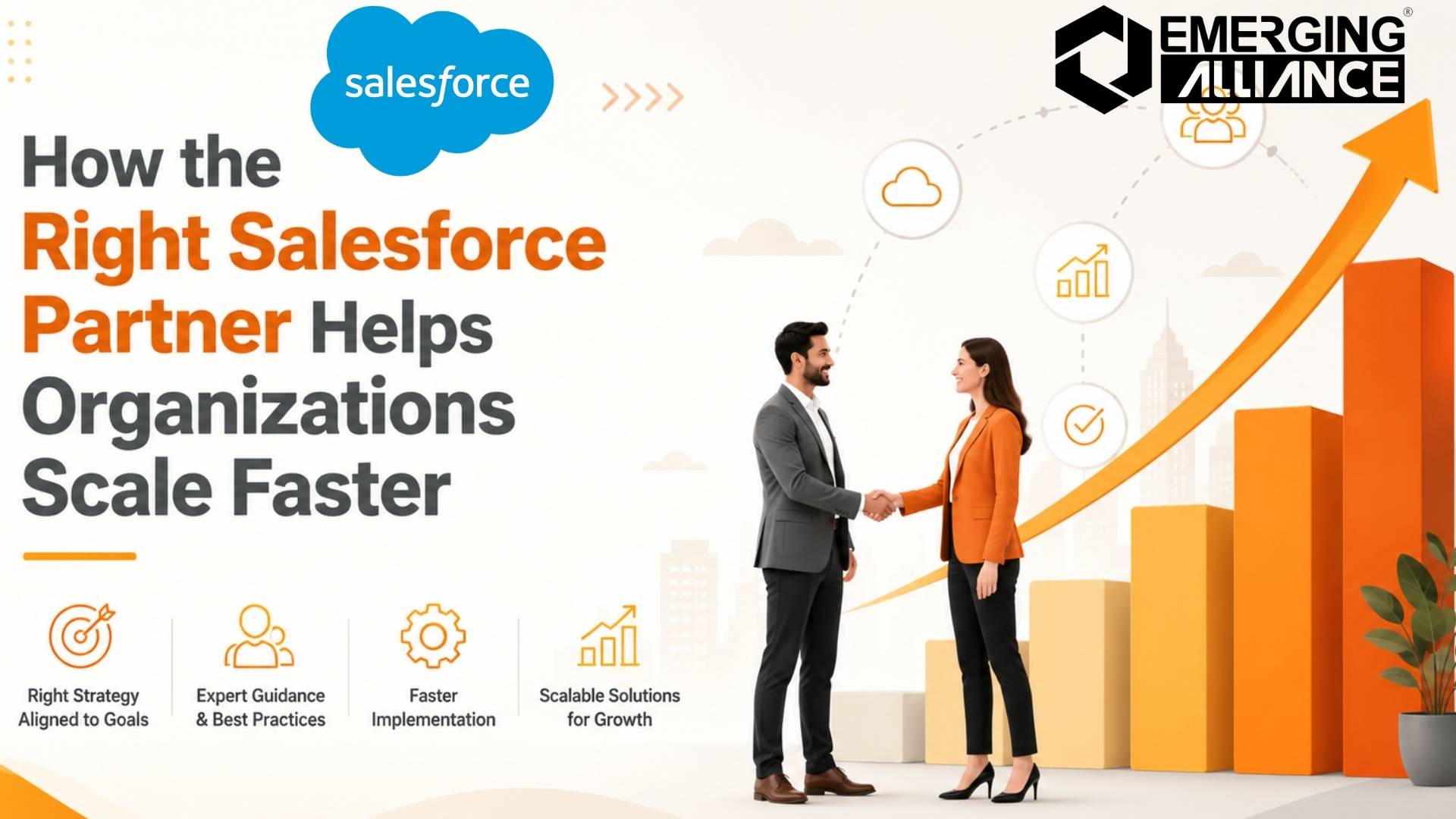
How the Right Salesforce Partner Helps Organizations Scale Faster

A Salesforce Partner Supports Growth Without Complexity
Growth creates opportunity. It also creates operational complexity. As organizations expand into new markets, launch new products, onboard more customers, and manage larger teams, existing processes often struggle to keep pace. Sales teams operate with fragmented data, service teams face workflow bottlenecks, leadership lacks real-time visibility, and manual processes begin to slow decision-making. This is where a strategic Salesforce Partner becomes critical.
Many organizations invest in Salesforce expecting immediate transformation. However, technology alone does not eliminate inefficiencies. The real value comes from aligning CRM capabilities with business objectives, operational processes, governance frameworks, and long-term growth strategies.
The right Salesforce Partner helps organizations scale faster by transforming Salesforce into a business growth platform rather than just another technology investment.
Why Salesforce Implementation Success Depends on the Right Salesforce Partner
Many enterprises underestimate the complexity involved in scaling a CRM ecosystem.
A standard deployment may solve immediate requirements, but long-term growth requires a scalable architecture capable of supporting evolving business needs.
A strategic Salesforce implementation partner helps organizations avoid common challenges such as:
- Fragmented customer data across departments
- Poor user adoption
- Inconsistent reporting structures
- Workflow bottlenecks
- Excessive manual processes
- Limited operational visibility
- Revenue leakage caused by process gaps
- Compliance and governance risks
The difference between a successful Salesforce implementation and a struggling one often comes down to whether the implementation was designed for future growth.
Organizations that treat Salesforce as a business transformation platform gain significantly more value than those treating it as a standalone CRM project.
Salesforce Consulting Partners Help Build Scalable Business Processes
Growth becomes difficult when operational processes rely on manual intervention.
As organizations scale, small inefficiencies become enterprise-wide problems.
For example:
A sales team may manage opportunities effectively with 20 users. The same process can become chaotic with 200 users operating across multiple regions.
Similarly, finance teams may struggle with inconsistent forecasting when sales data lacks standardization.
A skilled Salesforce consulting partner helps redesign processes to support scale through:
Business Process Standardization
Consistent workflows ensure every department operates using the same rules, approvals, and reporting structures.
Salesforce Business Process Automation
Automation eliminates repetitive administrative work and improves execution speed.
Examples include:
- Lead assignment automation
- Approval workflows
- Contract management automation
- Service escalation workflows
- Customer onboarding automation
- Renewal management processes
Enterprise Governance Frameworks
As organizations grow, governance becomes increasingly important.
A certified Salesforce Partner helps establish:
- Data governance policies
- Role-based access controls
- Compliance workflows
- Audit-ready reporting structures
- Change management frameworks
This creates a foundation for sustainable growth without operational disruption.
How Salesforce Solutions Improve Visibility Across the Enterprise
Many executives struggle to make strategic decisions because critical information is scattered across multiple systems.
Leadership teams often face questions such as:
- Which sales opportunities are most likely to close?
- Where are customer service bottlenecks occurring?
- Which regions are underperforming?
- What factors are impacting revenue forecasts?
- Which business processes are slowing growth?
Without real-time visibility, decisions become reactive rather than proactive.
Modern Salesforce solutions address these challenges by centralizing customer, operational, and performance data.
A Salesforce consultant can help organizations create dashboards and reporting frameworks that provide visibility across:
- Sales performance
- Pipeline health
- Customer service operations
- Marketing effectiveness
- Partner ecosystems
- Revenue forecasting
- Executive performance metrics
When leadership gains access to trusted, real-time information, decision-making becomes faster and more accurate.
Salesforce Managed Services Keep Growth Sustainable
Many organizations focus heavily on implementation while overlooking post-deployment optimization.
The reality is that business requirements continuously evolve.
New products launch.
Markets expand.
Compliance regulations change.
Customer expectations increase.
Without ongoing optimization, Salesforce environments often become inefficient over time.
This is why many enterprises engage a Salesforce managed services partner after implementation.
Salesforce Support and Maintenance Services Provide Long-Term Value
A dedicated support model helps organizations maintain platform performance while continuously improving business outcomes.
Key areas include:
- Salesforce Issue Detection and Resolution
- Salesforce Admin Support
- Performance optimization
- Security monitoring
- User adoption enhancement
- Workflow refinement
- Integration management
- Release management
Rather than reacting to issues after they impact operations, proactive support helps organizations stay ahead of challenges.
This approach protects ROI while supporting continuous growth.
The Role of Salesforce Development Services in Enterprise Expansion
No two enterprises scale in exactly the same way.
As business models evolve, organizations often require capabilities beyond standard platform functionality.
A Salesforce customization partner can build solutions tailored to specific operational requirements, including:
- Complex approval workflows
- Dealer management processes
- Distribution network automation
- Field service operations
- Customer self-service portals
- Industry-specific compliance workflows
- Integrated ERP and CRM environments
The goal is not customization for its own sake.
The goal is enabling business agility without creating unnecessary technical complexity.
Organizations that align development initiatives with business objectives are better positioned to scale efficiently.
Why Salesforce Implementation ROI Depends on Business Alignment
One of the most common misconceptions about CRM projects is that technology automatically creates value.
In reality, ROI comes from business alignment.
A successful Salesforce implementation ROI strategy focuses on:
- Process efficiency improvements
- Faster sales cycles
- Improved customer retention
- Better forecasting accuracy
- Reduced operational costs
- Enhanced employee productivity
- Increased visibility across departments
- Stronger governance controls
Organizations that align CRM investments with measurable business outcomes consistently achieve stronger results than those focused solely on system deployment.
The right Salesforce Partner ensures every initiative contributes directly to business objectives.
Choosing a Salesforce Digital Transformation Partner Instead of a Technology Vendor
Enterprise leaders are no longer looking for software vendors.
They are looking for transformation partners.
A Salesforce partner for enterprise business should understand more than technology. They should understand operational models, business strategy, industry challenges, governance requirements, and growth objectives.
The ideal Salesforce consulting partner helps organizations:
- Modernize customer engagement models
- Eliminate workflow inefficiencies
- Improve enterprise visibility
- Accelerate automation initiatives
- Reduce operational risk
- Support scalable growth strategies
This creates long-term value far beyond implementation.
How Emerging Alliance Helps Organizations Scale with Salesforce
At Emerging Alliance, we believe Salesforce should be more than a CRM platform.
It should become the foundation for enterprise growth, automation, visibility, and operational excellence.
Our team works closely with leadership stakeholders to align Salesforce modernization strategy with business objectives, helping organizations overcome implementation challenges, improve adoption, and maximize long-term ROI.
From Salesforce CRM implementation services and business process automation to managed services, support, governance, and continuous optimization, we help enterprises build scalable digital ecosystems that grow alongside the business.
Conclusion
A Salesforce Partner does far more than deploy technology.
The right partner helps organizations eliminate inefficiencies, improve visibility, automate operations, reduce risk, and create a scalable foundation for growth.
As enterprises navigate increasing complexity, evolving customer expectations, and competitive pressure, choosing the right Salesforce Partner becomes a strategic business decision—not simply a technology decision.
Organizations that prioritize long-term business alignment, operational excellence, and continuous optimization position themselves to scale faster while maintaining control and profitability.
Frequently Asked Questions
1. How does a Salesforce Partner help enterprises scale faster?
A strategic partner aligns Salesforce with business processes, automation goals, governance requirements, and growth objectives to improve operational efficiency and scalability.
2. What should businesses look for in certified Salesforce partners?
Organizations should evaluate industry expertise, implementation experience, support capabilities, governance knowledge, and long-term transformation consulting capabilities.
3. Why do Salesforce implementation projects fail?
Common Salesforce implementation challenges include poor requirements planning, low user adoption, weak governance, inadequate training, and lack of executive alignment.
4. What is the difference between a Salesforce consultant and a Salesforce implementation partner?
A Salesforce consultant typically focuses on strategy and optimization, while implementation partners manage deployment, integration, configuration, and execution activities.
5. How do Salesforce managed services improve long-term ROI?
Salesforce managed services provide continuous optimization, proactive support, platform governance, security monitoring, and performance improvements that maximize business value.
6. Why is Salesforce business process automation important for growing organizations?
Automation reduces manual effort, improves consistency, accelerates workflows, minimizes errors, and enables teams to focus on higher-value activities.
7. What are Salesforce Support and Maintenance Services?
These services include issue resolution, platform monitoring, release management, user support, security oversight, and ongoing optimization.
8. How can Salesforce CRM Systems improve executive decision-making?
Salesforce CRM Systems provide centralized data, real-time dashboards, forecasting capabilities, and performance visibility that support faster and more informed decisions.
9. When should organizations engage a Salesforce managed services partner?
Businesses should consider managed services after implementation to ensure continuous improvement, platform health, and alignment with changing business needs.
10. How does a Salesforce digital transformation partner support enterprise modernization?
A Salesforce digital transformation partner helps redesign processes, automate workflows, improve customer experiences, integrate business systems, and create scalable operating models for growth.
If your organization is evaluating Salesforce modernization, struggling with adoption, facing workflow bottlenecks, or preparing for enterprise-scale growth, Emerging Alliance can help.
Talk to Emerging Alliance today and discover how a strategic Salesforce Partner can accelerate your digital transformation journey.