Downtime Affecting Business Performance? Salesforce Support for Higher Uptime
Salesforce Support for Reliable Performance and Faster Issue Resolution
Business leaders rarely lose revenue because Salesforce fails entirely. More often, business performance suffers from slow response times, integration failures, user access issues, automation errors, or data inconsistencies that quietly disrupt daily operations. These seemingly isolated incidents accumulate into delayed sales cycles, reduced employee productivity, dissatisfied customers, and increased operational costs. This is why Salesforce Support has evolved beyond reactive troubleshooting. It has become an operational strategy that protects business continuity, maintains system performance, and enables organizations to scale confidently. Whether your organization depends on Sales Cloud, Service Cloud, Experience Cloud, or complex integrations across enterprise applications, ongoing support determines how reliably those investments perform every day.
The question is no longer whether Salesforce is implemented correctly. The more important question is whether it continues delivering value without interruptions as the business grows.
Why Salesforce Downtime Is a Business Problem, Not Just an IT Issue
Salesforce downtime directly affects revenue generation, customer service, employee productivity, and executive decision-making. Effective Salesforce Support minimizes operational disruption before it becomes a business risk.
Many organizations think of system issues as technical incidents. In reality, every minute of Salesforce Downtime affects multiple departments simultaneously.
A delayed approval workflow may prevent orders from moving forward. A broken integration may stop invoices from syncing with ERP. Sales representatives may lose visibility into opportunities, while customer service teams struggle to access account histories.
The impact extends well beyond IT.
Common business consequences include:
- Reduced sales productivity
- Delayed customer response times
- Interrupted order processing
- Inaccurate reporting and dashboards
- Poor user adoption
- Compliance risks due to incomplete or inconsistent data
- Increased operational costs caused by manual workarounds
When these issues become frequent, executives begin questioning the return on their CRM investment—even though the platform itself may not be the root cause.
Common Salesforce Issues That Quietly Reduce Business Performance
Most Salesforce issues develop gradually rather than appearing as major system failures. Continuous monitoring and Salesforce Support Services identify and resolve these problems before they affect business operations.
Organizations commonly experience recurring issues such as:
Performance degradation
Reports become slower, dashboards take longer to load, and users experience delays throughout the day.
Automation failures
Flows, Process Builder automations, Apex jobs, or scheduled tasks may stop functioning correctly after configuration changes or platform updates.
Integration failures
Connections between Salesforce systems, ERP applications, finance platforms, marketing automation, or third-party applications can fail unexpectedly, creating inconsistent business data.
Security and access problems
Incorrect permission changes can prevent employees from accessing critical information or expose sensitive business data unnecessarily.
Data quality issues
Duplicate records, incomplete customer information, inconsistent validation rules, and synchronization failures reduce reporting accuracy and decision confidence.
Release-related disruptions
Platform updates or custom deployments occasionally introduce unexpected errors that interrupt normal business processes.
These challenges rarely occur in isolation. They often compound over time, creating operational friction that becomes increasingly expensive to resolve.
Executive Insight: Many organizations schedule a periodic Salesforce health assessment before these issues affect revenue. A proactive review is significantly less costly than recovering from prolonged business disruption.
How Salesforce Support Services Reduce Downtime
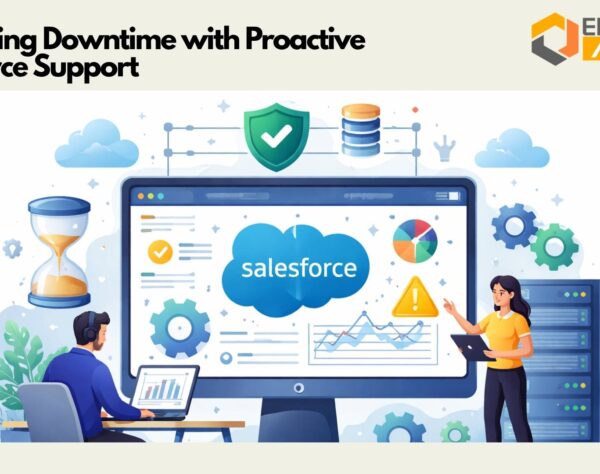
Salesforce Support Services reduce downtime through proactive monitoring, preventive maintenance, faster incident response, and continuous platform optimization rather than waiting for failures to occur.
The objective is operational resilience—not simply fixing technical tickets.
An effective support model typically includes several ongoing disciplines.
Proactive system monitoring
Continuous observation helps identify abnormal behavior before users experience service interruptions.
Preventive Salesforce Maintenance
Routine reviews of configurations, integrations, workflows, storage utilization, and custom developments reduce future failures while improving long-term platform stability.
Faster incident resolution
Clearly defined support processes reduce response times and accelerate root-cause analysis whenever business-critical issues arise.
Change management
Configuration updates, new feature releases, and business enhancements are evaluated carefully to minimize operational risk.
User assistance
Employees receive timely assistance when encountering functional issues, improving adoption and reducing productivity losses.
Together, these activities enable Salesforce Support Services to reduce downtime while improving business continuity across departments.
Why Reactive Support Is No Longer Enough
Reactive support resolves problems after business disruption occurs. Modern Salesforce Ongoing Support Services focus on preventing issues before they impact operations.
Many organizations continue relying on a break-fix approach:
- Users report a problem.
- IT investigates.
- The business waits.
- Productivity declines.
This approach becomes increasingly risky as Salesforce supports more customer-facing and operational processes.
Modern enterprises instead adopt continuous operational support that includes:
- Regular platform health reviews
- Performance optimization
- Release readiness assessments
- Security reviews
- Integration monitoring
- Capacity planning
- Business continuity planning
Instead of responding to failures, organizations build resilience into daily operations.
Practical Consideration: If recurring Salesforce issues consume increasing IT resources each month, it may be time to evaluate whether your current support approach is aligned with business growth rather than simply maintaining system availability.
Choosing the Right Salesforce Support Model for Enterprise Growth
The right Salesforce Support model depends on business complexity, integration requirements, system criticality, and internal IT capacity. As Salesforce becomes central to daily operations, support must evolve from technical assistance to operational governance.
Many organizations begin with internal administrators managing day-to-day requests. As the platform grows, customizations increase, integrations expand, and multiple business units rely on Salesforce, making specialized support essential.
When evaluating Salesforce Support plans, executives should consider:
- Business-critical processes running on Salesforce
- Number of users and departments
- Level of customization
- Integration with ERP, finance, marketing, or customer service platforms
- Internal Salesforce expertise
- Required response and resolution times
- Business continuity expectations
The objective is not simply purchasing support—it is ensuring predictable platform performance that aligns with business growth.
Internal Team vs. Salesforce Partner: Which Delivers Better Long-Term Value?
Internal teams understand business processes, while an experienced Salesforce Partner provides specialized expertise, proactive optimization, and scalable support. Many enterprises achieve the best results by combining both approaches.
An internal administrator can effectively handle routine configuration changes and user management. However, enterprise environments often require broader technical capabilities, including architecture reviews, integration management, security optimization, release planning, and performance tuning.
A dedicated Salesforce Partner typically brings:
- Certified Salesforce specialists
- Proven implementation experience across industries
- Best practices for governance and scalability
- Faster diagnosis of complex issues
- Knowledge of new Salesforce releases and feature impacts
- Established incident management processes
Rather than replacing internal teams, external experts strengthen them by providing skills that are difficult to maintain in-house.
Strategic Consideration: Many organizations benefit from an independent Salesforce health assessment before expanding CRM capabilities. Identifying technical debt early reduces future implementation costs and operational risks.
How Salesforce Support Improves Executive-Level Business Outcomes
For executive leaders, Salesforce Support delivers measurable business value through improved uptime, lower operational risk, faster issue resolution, and greater organizational visibility.
Reliable CRM performance influences nearly every customer-facing function. When the platform operates consistently, organizations spend less time resolving technical issues and more time executing growth initiatives.
Key business outcomes include:
Lower operational costs
Proactive support reduces emergency fixes, minimizes manual workarounds, and improves IT resource utilization.
Higher employee productivity
Users work with stable systems, faster response times, and fewer interruptions.
Reduced business risk
Continuous monitoring and governance decrease the likelihood of critical failures affecting revenue-generating activities.
Faster decision-making
Reliable dashboards, accurate reporting, and consistent data improve executive confidence.
Greater scalability
As the business grows, structured Salesforce Ongoing Support Services enable the platform to support new users, processes, and integrations without sacrificing performance.
For CEOs, CIOs, CTOs, and Operations Leaders, these outcomes translate directly into stronger business resilience and a higher return on CRM investment.
Conclusion
Implementing Salesforce is only the beginning of the journey. Sustaining business value requires continuous monitoring, structured maintenance, proactive optimization, and rapid issue resolution.
A mature Salesforce Support strategy helps organizations reduce downtime, improve user confidence, protect business continuity, and maximize the long-term value of their Salesforce investment.
Frequently Asked Questions
1. How can Salesforce Support reduce recurring operational issues?
Recurring issues usually indicate underlying configuration, integration, or governance problems rather than isolated technical incidents. Salesforce Support addresses root causes through proactive monitoring, maintenance, and continuous optimization, reducing repeat incidents over time.
2. When should an organization upgrade its Salesforce Support plan?
Organizations should reassess their support model when user numbers grow, new business units adopt Salesforce, integrations increase, or response times begin affecting business performance. Expanding platform complexity often requires more structured support capabilities.
3. How does proactive Salesforce Maintenance differ from reactive support?
Reactive support focuses on resolving incidents after they occur. Proactive Salesforce Maintenance emphasizes monitoring, optimization, release planning, and preventive actions that reduce the likelihood of business disruption.
4. Can Salesforce Support improve CRM adoption across departments?
Yes. Faster issue resolution, better system performance, user assistance, and ongoing optimization improve employee confidence in the platform. Higher adoption typically results in more accurate data and greater business value.
5. What are the warning signs of unplanned Salesforce downtime?
Slow application performance, failed integrations, broken automation, delayed reporting, frequent user complaints, and unexpected permission issues are common indicators that Unplanned Salesforce downtime risks are increasing.
6. Why is a Salesforce Partner valuable after implementation?
A Salesforce Partner provides specialized expertise for optimization, architecture reviews, release management, integration support, and governance. Their experience helps organizations maintain performance as business requirements evolve.
7. How do Salesforce Data Recovery Services support business continuity?
These services help organizations recover critical business information following accidental deletion, configuration errors, or data corruption. Combined with backup strategies, they strengthen overall business resilience.
8. How frequently should enterprise organizations review their Salesforce environment?
Most organizations benefit from quarterly health assessments, while highly regulated or rapidly growing businesses may require monthly reviews of performance, security, integrations, and platform governance.
9. Does Salesforce Support only benefit large enterprises?
No. Mid-sized organizations also benefit from structured support because CRM increasingly manages critical sales, service, and operational processes. Preventing downtime is generally more cost-effective than resolving major disruptions later.
10. What should executives prioritize when selecting Salesforce Support Services?
Decision-makers should evaluate technical expertise, response times, proactive monitoring capabilities, governance processes, scalability, security practices, industry experience, and the provider’s ability to align support with long-term business objectives rather than simply resolving technical tickets.
Book your Salesforce demo today and explore how proactive Salesforce Support enhances reliability, efficiency, and business continuity.