
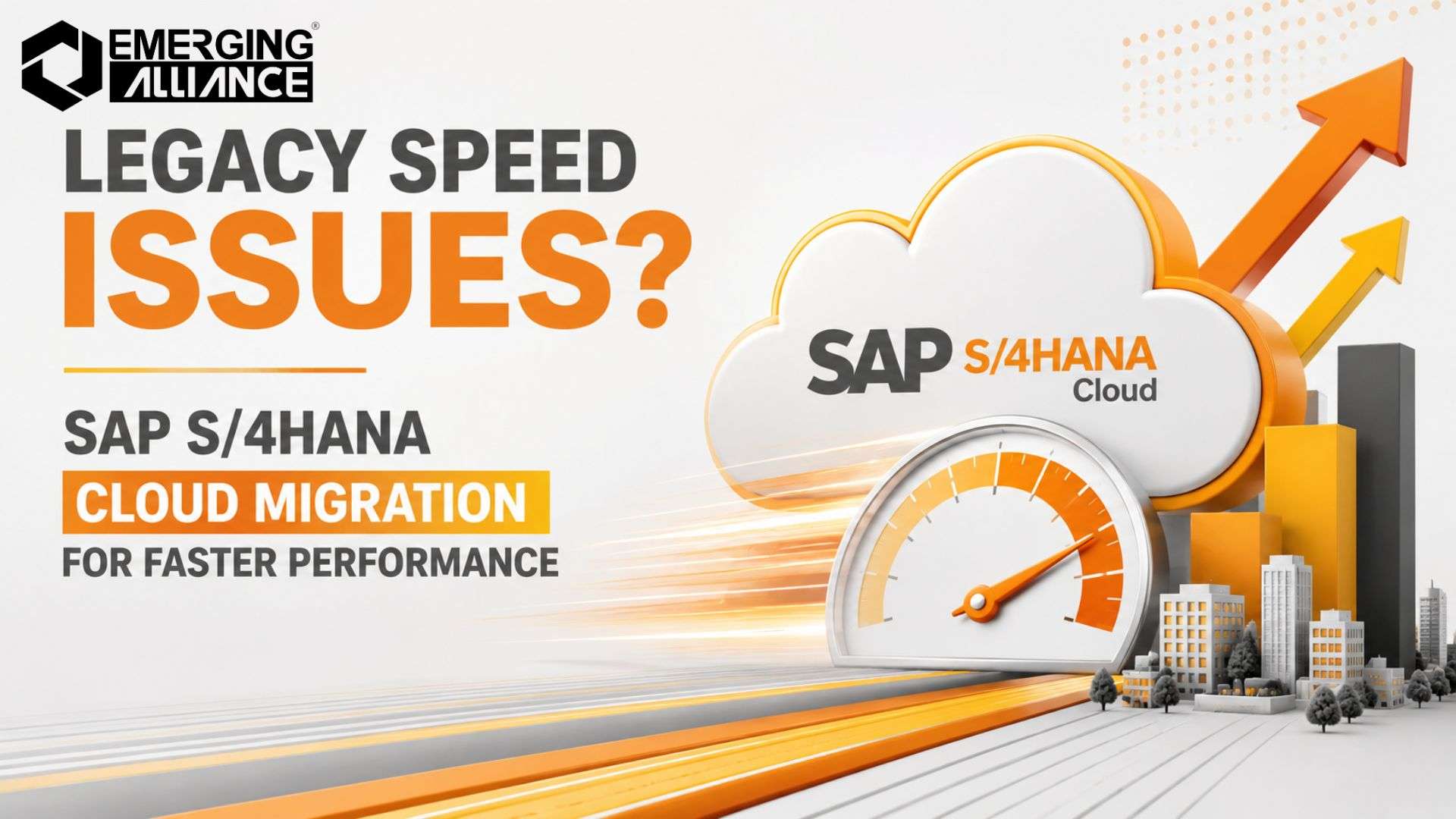
Legacy Speed Issues? SAP S/4HANA Cloud Migration for Faster Performance
SAP S/4HANA Cloud Migration for Faster, Lower-Risk ERP Modernization
Organizations running aging ERP environments often experience slower reporting, increasing maintenance costs, complex customizations, and limited scalability. While these issues may appear to be infrastructure problems, they are frequently symptoms of an ERP platform that has reached its practical limits. SAP S/4HANA Cloud Migration provides a structured path to modernizing enterprise operations. By moving from legacy SAP ECC environments to the intelligent SAP S/4HANA platform, organizations gain faster transaction processing, real-time analytics, simplified architecture, and a foundation that supports future digital initiatives.
For CEOs, CIOs, COOs, and digital transformation leaders, migration is no longer simply an IT upgrade—it is a business transformation initiative that directly impacts operational efficiency, decision-making, customer experience, and long-term competitiveness.
Why Legacy ERP Performance Becomes a Business Problem
Legacy ERP systems gradually become more expensive and less responsive as businesses grow. Years of custom developments, increasing transaction volumes, fragmented integrations, and aging databases create operational bottlenecks that affect every department.
Typical business symptoms include:
- Slow financial closing
- Delayed operational reporting
- Lengthy inventory reconciliation
- Inefficient production planning
- Higher infrastructure costs
- Increased dependency on manual workarounds
- Difficult integration with modern cloud applications
These challenges reduce organizational agility and limit the ability to respond quickly to changing market conditions.
SAP S/4HANA Cloud Migration addresses these limitations by modernizing both the ERP platform and the underlying business processes.
How SAP S/4HANA Cloud Migration Improves Enterprise Performance
The primary objective of SAP S/4HANA Cloud Migration is not simply replacing one ERP system with another. It modernizes the digital core of the business while improving performance, scalability, and operational visibility.
Key improvements include:
In-Memory Processing
SAP HANA processes large datasets in memory instead of relying on traditional disk-based databases, dramatically reducing reporting and transaction times.
Simplified Data Structures
The new architecture eliminates unnecessary database redundancies, making business processes faster and easier to maintain.
Real-Time Analytics
Executives gain instant visibility into financial, operational, procurement, manufacturing, and inventory data without waiting for overnight batch processing.
Improved User Experience
Modern SAP interfaces simplify navigation and improve employee productivity across departments.
Understanding SAP ECC to SAP S/4HANA Migration
Moving from SAP ECC to SAP S/4HANA involves more than technical conversion. It includes evaluating business processes, preparing data, redesigning integrations, and selecting the appropriate migration strategy.
Most organizations choose one of three approaches:
Greenfield Migration
A completely new implementation with redesigned business processes.
Best suited for organizations seeking major operational transformation.
Brownfield Migration
A system conversion that retains existing business processes while upgrading the ERP platform.
Ideal for companies with stable operations and limited process changes.
Selective Data Transition
A hybrid approach combining process optimization with selective migration of historical data.
Often preferred by enterprises balancing innovation with business continuity.
Selecting the right migration strategy significantly influences project duration, cost, and future flexibility.
Common SAP S/4HANA Migration Challenges—and How to Reduce Risk
Every enterprise migration introduces complexity. The objective is not to eliminate risk but to manage it through structured planning.
Common SAP S/4HANA migration challenges include:
Poor Data Quality
Outdated master data, duplicate records, and inconsistent structures increase migration complexity.
A comprehensive SAP Data Migration assessment should identify and cleanse data before migration begins.
Excessive Customization
Many legacy SAP systems contain years of custom code that may no longer deliver business value.
Organizations should evaluate which customizations should be retained, redesigned, or eliminated.
Business Downtime
Poor migration planning can interrupt critical operations.
Phased migration, testing cycles, and rollback planning significantly reduce operational disruption.
Integration Complexity
Modern ERP environments interact with CRM, HR, manufacturing, procurement, banking, and third-party applications.
Successful SAP Cloud Integration ensures these systems continue operating seamlessly after migration.
Planning an SAP S/4HANA Cloud Migration?
A migration readiness assessment can identify performance bottlenecks, custom code risks, and data quality issues before project execution—often reducing both cost and implementation time.
The Importance of SAP Data Migration
Technology migrations succeed only when business data remains accurate, complete, and trustworthy.
SAP Data Migration typically includes:
- Customer master data
- Vendor records
- Material masters
- Bills of Materials
- Financial transactions
- Inventory balances
- Production information
- Historical business documents
Successful SAP S/4HANA data migration combines technical migration with business validation.
Organizations should avoid migrating unnecessary historical data simply because it exists. Instead, migrate information that delivers ongoing operational or compliance value.
Why SAP Cloud Integration Matters During Migration
Modern enterprises rarely operate with ERP alone.
An SAP ecosystem often includes:
- CRM platforms
- Warehouse systems
- Manufacturing execution systems
- E-commerce applications
- Banking integrations
- HR platforms
- Business intelligence tools
Without proper SAP Cloud Integration, organizations risk broken workflows, inconsistent reporting, and manual reconciliation after migration.
Integration planning should begin during the assessment phase—not after implementation.
SAP S/4HANA Cloud Implementation Best Practices
Successful SAP S/4HANA Cloud implementation follows a structured roadmap rather than a technology-first approach.
Recommended best practices include:
Define Business Objectives First
Migration should solve measurable business problems—not simply replace software.
Assess Current SAP Systems
Evaluate custom developments, integrations, performance bottlenecks, and technical debt.
Cleanse Business Data
Removing duplicate or obsolete information improves migration quality and future reporting.
Test Extensively
Functional, integration, security, and user acceptance testing reduce deployment risk.
Train End Users Early
User adoption significantly influences project success and long-term ROI.
Many organizations discover that migration complexity is lower than expected after a structured assessment. Reviewing system readiness before committing to implementation helps leadership make informed investment decisions and establish realistic timelines.
SAP S/4HANA Cloud Solutions Beyond ERP Modernization
Modern SAP S/4HANA Cloud solutions support broader digital transformation initiatives.
Organizations benefit from:
- Intelligent automation
- Embedded analytics
- AI-assisted business processes
- Predictive planning
- Improved financial control
- Faster procurement
- Enhanced manufacturing visibility
- Better supply chain responsiveness
Rather than operating as isolated technology projects, these capabilities create measurable business improvements across the enterprise.
Business Outcomes That Matter to Executive Leadership
For CEOs, CIOs, and Operations Heads, the success of SAP S/4HANA Cloud Migration is measured by business outcomes rather than technical milestones.
Key executive benefits include:
Faster Decision-Making
Real-time analytics replace delayed reporting, enabling leadership to respond quickly to changing business conditions.
Lower Operational Costs
Simplified architecture reduces infrastructure, maintenance, and administrative overhead.
Reduced Business Risk
Modern security, standardized processes, and improved compliance reduce operational and regulatory exposure.
Greater Scalability
Cloud architecture supports business growth without requiring frequent infrastructure upgrades.
Higher Organizational Productivity
Employees spend less time waiting for reports, correcting data issues, or managing manual processes.
These improvements collectively strengthen competitiveness while creating a future-ready ERP foundation.
Conclusion
Legacy ERP performance problems rarely improve through infrastructure upgrades alone. As business complexity increases, organizations require an ERP platform designed for real-time operations, cloud scalability, and continuous innovation.
SAP S/4HANA Cloud Migration enables organizations to modernize operations while reducing long-term costs, improving business visibility, and creating a scalable digital core. With the right migration strategy, disciplined SAP Data Migration, and effective SAP Cloud Integration, enterprises can achieve faster performance with significantly lower implementation risk.
Book a Free SAP S/4HANA Cloud Migration Demo and Start Your ERP Modernization Journey.