
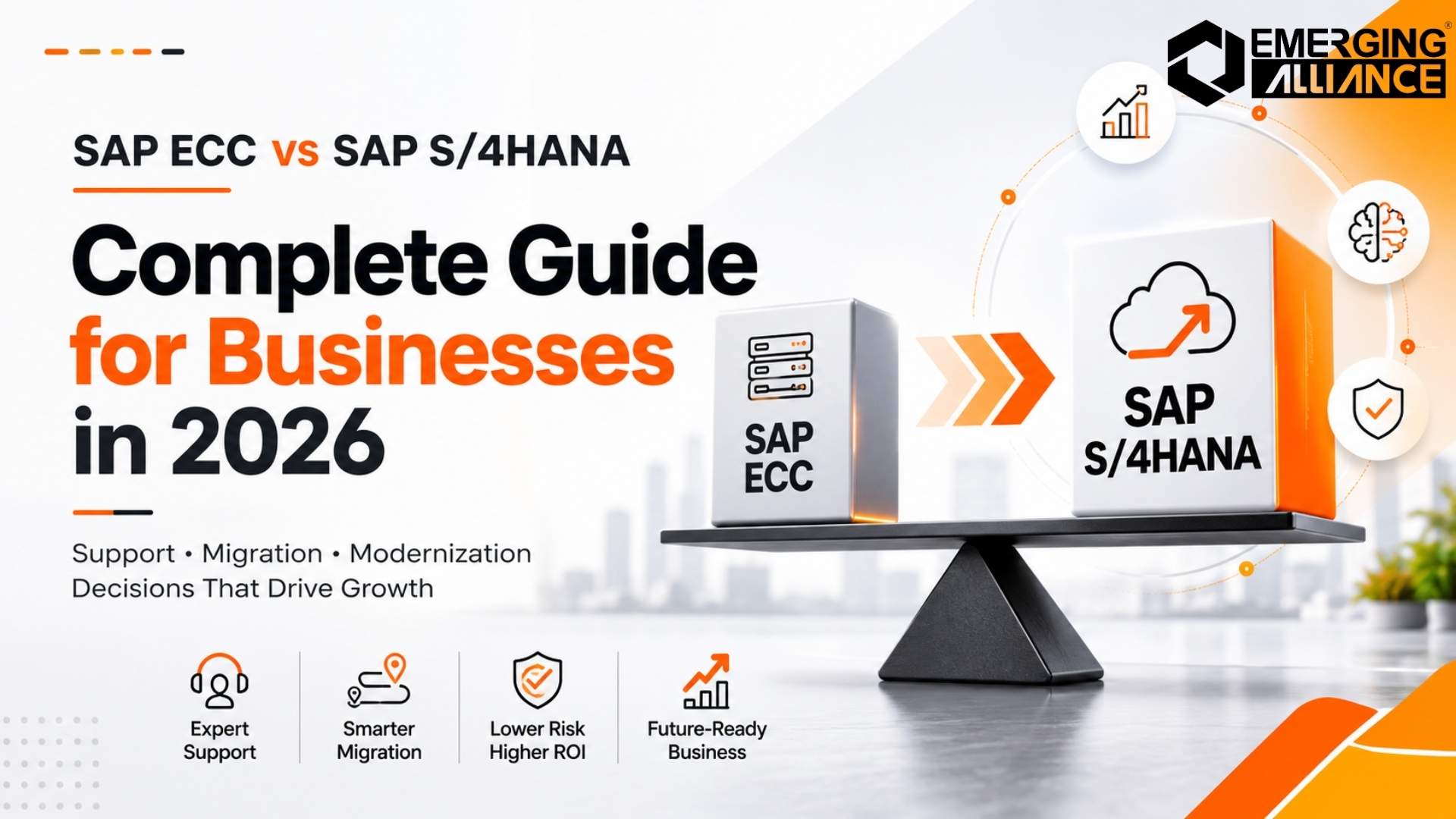
SAP ECC vs SAP S/4HANA Support: Complete Guide for Businesses in 2026
SAP ECC and SAP S/4HANA Support for Smarter ERP Decisions
Choosing between continuing SAP ECC support and investing in SAP S/4HANA support is no longer simply an IT discussion. It is a strategic business decision that affects operational continuity, cybersecurity, compliance, innovation, and long-term competitiveness.
For many organizations, the question is no longer whether SAP S/4HANA is the future—it is determining the right timing, migration strategy, and support approach. Businesses must balance existing investments with future growth while minimizing disruption.
This guide explains SAP ECC vs SAP S/4HANA, compares support models, highlights business risks, and helps executive teams determine the best path forward in 2026.
SAP ECC vs SAP S/4HANA at a Glance
The primary difference between SAP ECC vs SAP S/4HANA lies in architecture, innovation capability, and long-term support. SAP ECC remains a proven ERP platform, while SAP S/4HANA is SAP’s next-generation intelligent ERP designed for real-time operations, automation, and AI-driven business processes.
| SAP ECC | SAP S/4HANA |
| Traditional ERP architecture | Built exclusively for SAP HANA |
| Batch-based processing | Real-time processing |
| Higher customizations | Simplified data model |
| Limited innovation | AI, automation, analytics |
| Legacy support model | Continuous innovation |
| Traditional reporting | Embedded analytics |
While SAP ECC continues supporting critical business operations, SAP S/4HANA enables organizations to modernize processes without relying on multiple disconnected systems.
Understanding SAP ECC Support in 2026
SAP ECC support continues to help organizations maintain system stability, resolve incidents, apply security updates, and ensure business continuity. However, it is becoming increasingly focused on sustaining legacy operations rather than enabling innovation.
Most organizations running SAP ECC today prioritize:
- System health monitoring
- Performance optimization
- Security patch management
- Compliance updates
- Custom code maintenance
- Integration support
- User assistance
Businesses should also consider the implications of SAP ECC end of support timelines when planning long-term ERP investments. Delaying modernization can increase operational risk and technical debt over time.
Organizations with stable operations and limited transformation initiatives may continue investing in SAP ECC support for the short term, but long-term planning should already be underway.
How SAP S/4HANA Support Differs
SAP S/4HANA support extends far beyond issue resolution. It focuses on helping organizations continuously optimize business processes while taking advantage of new SAP innovations.
Typical SAP S/4HANA support includes:
- Continuous feature adoption
- Performance optimization
- Security and compliance management
- Release management
- Integration monitoring
- Process optimization
- AI and automation enablement
- Business analytics improvements
Instead of maintaining legacy ERP functionality, SAP S/4HANA support helps organizations continuously improve operations as new capabilities become available.
SAP ECC End of Support—What It Means for Business Leaders
The approaching SAP ECC end of support should be viewed as a business planning milestone rather than just a technical deadline.
Executive teams should evaluate:
- Business process risks
- Compliance requirements
- Cybersecurity exposure
- Cost of maintaining legacy systems
- Availability of skilled SAP ECC resources
- Future scalability
Organizations waiting until the final stages often face compressed project timelines, resource shortages, and higher migration costs.
A structured readiness assessment provides better visibility into the effort, investment, and timeline required for modernization.
Planning an ERP roadmap? A SAP readiness assessment can identify technical dependencies, custom developments, and business risks before they become migration blockers.
SAP ECC to SAP S/4HANA Migration Strategy
A successful SAP ECC to SAP S/4HANA migration begins with business objectives—not technology.
Before migration, organizations should evaluate:
Current ERP Landscape
Understand:
- Custom developments
- Integrations
- Interfaces
- Business-critical processes
- Third-party applications
Data Readiness
Legacy systems often contain duplicate, outdated, or inconsistent master data.
Cleaning data before migration reduces implementation complexity and improves reporting accuracy.
Business Process Review
Migration provides an opportunity to simplify workflows instead of recreating legacy inefficiencies.
Many organizations redesign finance, procurement, manufacturing, sales, and supply chain processes during migration.
Change Management
User adoption often determines project success more than technology.
Training, communication, and phased rollouts significantly reduce implementation risks.
Comparing SAP ECC Support and SAP S/4HANA Support
| Area | SAP ECC Support | SAP S/4HANA Support |
| Focus | System maintenance | Continuous optimization |
| Innovation | Limited | Continuous |
| Analytics | External reporting | Embedded analytics |
| Automation | Limited | Extensive |
| AI capabilities | Minimal | Built-in |
| Future roadmap | Legacy | Strategic platform |
| Scalability | Moderate | High |
| Cloud readiness | Limited | Native support |
The comparison demonstrates that SAP S/4HANA support is designed around business transformation rather than system preservation.
SAP S/4HANA by Module—Why Modern Support Matters
Organizations rarely modernize every department simultaneously. Understanding SAP S/4HANA by Module helps businesses prioritize investments based on operational needs.
Common modernization areas include:
Finance
- Faster financial close
- Real-time profitability reporting
- Embedded analytics
Procurement
- Automated purchasing
- Better supplier visibility
- Improved compliance
Manufacturing
- Production planning
- Shop-floor visibility
- Capacity optimization
Supply Chain
- Inventory optimization
- Demand forecasting
- Logistics visibility
Sales
- Order processing
- Customer insights
- Revenue visibility
Supporting individual modules effectively allows businesses to realize incremental value while progressing toward a full ERP transformation.
Choosing the Right SAP S/4HANA Implementation Partner
Selecting an experienced SAP S/4HANA implementation partner can significantly reduce project risk.
Look for partners that provide:
- Business process consulting
- Industry expertise
- Migration experience
- Data migration capabilities
- Integration knowledge
- Post-go-live support
- User training
- Long-term optimization services
The right partner focuses not only on technical implementation but also on measurable business outcomes.
Unsure whether your organization is ready to migrate? A migration readiness workshop can help quantify effort, identify high-risk customizations, and build a phased roadmap aligned with your business priorities.
Business Outcomes That Matter Most in SAP ECC vs SAP S/4HANA
For CEOs, CIOs, COOs, and Operations Leaders, ERP decisions ultimately come down to measurable business value.
Organizations that transition strategically from SAP ECC to SAP S/4HANA often achieve:
- Reduced operational complexity
- Faster decision-making through real-time insights
- Improved cybersecurity posture
- Better regulatory compliance
- Higher process automation
- Lower long-term maintenance costs
- Greater scalability for acquisitions and expansion
- Improved business agility
Rather than viewing migration as an IT expense, successful organizations treat it as an investment in operational resilience and long-term competitiveness.
Conclusion
The discussion around SAP ECC vs SAP S/4HANA is no longer about choosing between two ERP systems—it is about preparing your business for the next decade of growth.
While SAP ECC continues to support many organizations today, its long-term strategic value is diminishing as SAP’s innovation roadmap centers on SAP S/4HANA. Businesses that begin planning early gain greater flexibility, lower migration risk, and stronger control over costs and timelines.
A structured roadmap, supported by experienced advisors and a phased implementation strategy, allows organizations to modernize with confidence while protecting existing business operations.
Frequently Asked Questions
1. Should businesses continue investing in SAP ECC support in 2026?
Yes, if the system remains business-critical and migration cannot happen immediately. However, organizations should simultaneously develop a modernization roadmap because maintaining legacy systems indefinitely increases operational and support risks.
2. What is the biggest advantage of SAP S/4HANA support over SAP ECC support?
SAP S/4HANA support emphasizes continuous optimization, innovation, and access to new SAP capabilities. Unlike SAP ECC support, it enables organizations to adopt new features, automation, and analytics as part of ongoing operations.
3. How should organizations prepare for SAP ECC end of support?
Preparation should begin with a technical and business readiness assessment. This includes reviewing custom developments, integrations, infrastructure, business processes, and data quality to build a phased migration strategy.
4. Is SAP ECC to SAP S/4HANA migration always a complete system replacement?
No. Organizations can choose different migration approaches, including system conversion, selective data transition, or a new implementation, depending on business objectives and existing system complexity.
5. Which departments benefit most from SAP S/4HANA by Module?
Finance, procurement, manufacturing, supply chain, and sales typically see the fastest operational improvements. Organizations often prioritize modules that deliver measurable ROI or address existing process bottlenecks.
6. How long does a typical SAP ECC to SAP S/4HANA migration take?
The timeline varies based on organization size, customizations, data quality, and project scope. Mid-sized organizations may complete migration within several months, while large enterprises often require phased programs over a longer period.
7. Does moving to SAP S/4HANA reduce long-term ERP costs?
Although migration requires upfront investment, many organizations reduce long-term operational costs through simplified architecture, lower maintenance effort, improved automation, and more efficient business processes.
8. Why is choosing the right SAP S/4HANA implementation partner important?
An experienced partner helps minimize project risk through structured planning, proven migration methodologies, effective change management, and post-go-live optimization. Strong implementation governance also improves user adoption and business outcomes.
9. Can businesses migrate gradually instead of all at once?
Yes. Many organizations adopt a phased approach by modernizing selected business functions or deploying SAP S/4HANA by module. This reduces disruption while allowing teams to realize value incrementally.
10. What should executives evaluate before deciding between SAP ECC and SAP S/4HANA?
Decision-makers should assess business growth plans, support timelines, technical debt, compliance requirements, integration complexity, total cost of ownership, and the organization’s readiness for digital transformation. These factors provide a more complete basis for deciding whether to extend SAP ECC support or accelerate migration to SAP S/4HANA.
Schedule a SAP ERP Readiness Assessment to identify migration risks, estimate project scope, and build a practical roadmap aligned with your business goals.
Book your SAP ERP consultation today.