
Hidden Benefits of a Salesforce Dealer Management System
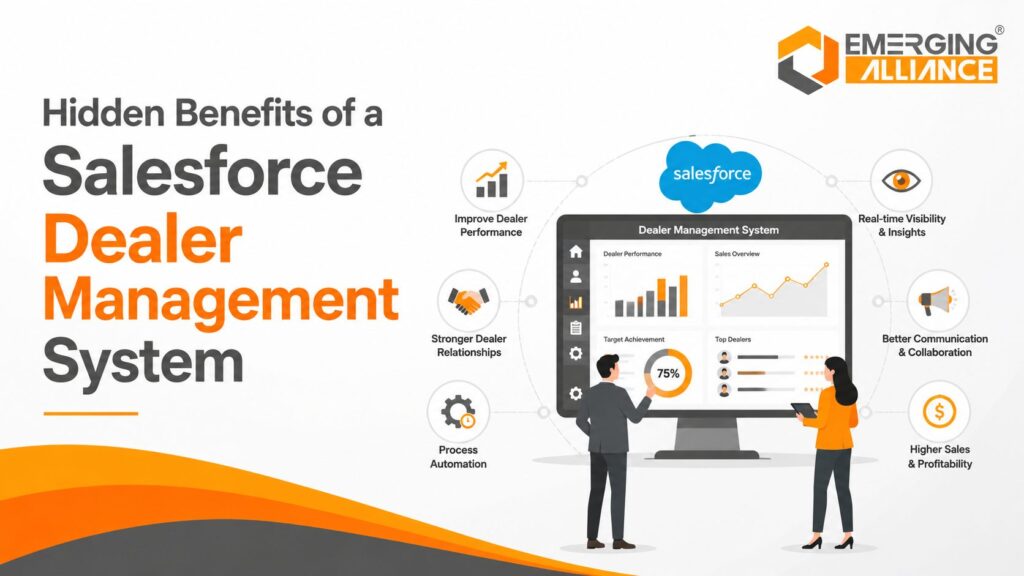
Salesforce Dealer Management System for dealer visibility, automation, and measurable business growth
Managing a growing dealer network requires more than collecting monthly sales reports and communicating through emails.
Automotive manufacturers, OEMs, distributors, equipment manufacturers, and multi-location businesses must coordinate dealer onboarding, lead distribution, opportunity management, inventory availability, warranty claims, customer service, and performance tracking across multiple locations.
When these processes operate through disconnected spreadsheets, inboxes, legacy applications, and dealer-specific databases, the business loses visibility. Leads receive slower responses, reporting becomes unreliable, dealers work with inconsistent information, and customers receive different experiences across locations.
A Salesforce Dealer Management System addresses these challenges by connecting dealer relationships, sales activities, service processes, customer information, and performance data within a centralized Salesforce environment.
Rather than functioning as a standalone replacement for every operational system, the solution can combine Salesforce Automotive Cloud, Sales Cloud, Service Cloud, Experience Cloud, analytics, automation, and integrations based on the organization’s requirements.
The result is a more connected dealer ecosystem that helps headquarters and dealers make faster decisions, improve customer engagement, and support sustainable business growth.
What Is a Salesforce Dealer Management System?
A Salesforce Dealer Management System is a configurable dealer and partner management solution built on the Salesforce platform.
It can help manufacturers and distributors manage dealer onboarding, lead distribution, opportunities, partner communication, customer interactions, service cases, warranty processes, and performance analytics from a connected platform.
Depending on the implementation, the solution may include:
- A secure Salesforce Dealer Portal
- Automated lead assignment
- Opportunity and pipeline tracking
- Customer and asset information
- Service and warranty workflows
- Dealer scorecards
- Reports and dashboards
- Mobile access
- ERP and inventory integrations
- AI-assisted recommendations
The exact solution architecture depends on the company’s operating model, Salesforce licences, dealer structure, integration landscape, and business priorities.
Hidden Challenges of Traditional Dealer Management
Dealer operations may appear functional while underlying inefficiencies continue to reduce revenue, productivity, and customer satisfaction.
The following problems often remain unnoticed until the dealer network begins to scale.
Limited Dealer Network Visibility
Headquarters may depend on weekly reports, spreadsheet updates, or manual submissions from individual dealers.
By the time decision-makers receive the data, it may no longer reflect current market conditions.
This makes it difficult to answer important questions:
- Which dealers are converting the most leads?
- Which territories are underperforming?
- Where are opportunities becoming delayed?
- Which dealers need additional support?
- How much qualified pipeline exists by region?
- Which customer or service issues require immediate attention?
A connected Dealer Management CRM replaces delayed reporting with more timely dealer, sales, and service visibility.
Slow and Manual Communication
Dealer communication often occurs through emails, calls, spreadsheets, and messaging platforms.
As a result, important information such as pricing revisions, campaign updates, product launches, warranty policies, and sales targets can become fragmented or outdated.
A secure dealer portal gives authorized partners one place to access current information, submit requests, review opportunities, and communicate with headquarters.
Fragmented Customer Information
Individual dealers may maintain customer data in different formats and systems.
This can create duplicate records, missing service histories, inconsistent follow-ups, and limited visibility into the customer lifecycle.
When sales, service, marketing, and dealer teams cannot access the same customer context, the business struggles to provide a consistent experience.
Delayed Lead Assignment
Manual lead distribution is one of the most expensive hidden weaknesses in a dealer network.
A lead may remain in a shared inbox, be sent to the wrong dealer, or receive no follow-up because ownership is unclear.
Salesforce can support lead assignment to partner users or queues using defined assignment rules. Experience Cloud can also support partner lead distribution and deal registration. The specific process must be configured around territory, product, dealer capability, capacity, availability, or other business criteria.
Inconsistent Dealer Performance
Without common metrics, dealer performance reviews often depend on incomplete reports or subjective assessments.
This makes it difficult to:
- Compare dealers fairly
- Identify high-performing practices
- Address low conversion rates
- Evaluate service quality
- Track target achievement
- Manage dealer incentives
- Improve accountability
Standardized dashboards provide a consistent basis for dealer coaching and performance discussions.
Reporting Limitations
Traditional reporting may require data from CRM, ERP, inventory systems, service databases, dealer files, and warranty applications.
Teams spend hours assembling reports instead of interpreting them.
A connected Salesforce environment can reduce this reporting effort by presenting relevant sales, service, partner, and customer data through role-based dashboards.
Limited Inventory Context
A CRM does not automatically become the inventory system of record.
However, when Salesforce is appropriately integrated with ERP, warehouse, order management, or dealer inventory systems, sales and dealer users can receive relevant availability information within their workflow.
This helps reduce inaccurate commitments, unnecessary stock enquiries, missed sales, and slow customer responses.
Inconsistent Customer Experience
Customers evaluate the brand through every dealer interaction.
Different response times, disconnected service histories, repeated requests for information, and inconsistent communication can weaken customer trust.
Centralized customer and service context helps authorized teams deliver more consistent engagement across the dealer network.
Difficult Dealer Onboarding
Dealer onboarding frequently involves document collection, compliance checks, approvals, contracts, user access, product training, and territory assignment.
When these activities are handled manually, new dealers take longer to become productive.
Workflow automation can standardize onboarding steps, route approvals, track required documents, and provide clear ownership.
Hidden Benefits of a Salesforce Dealer Management System
The most valuable outcomes extend beyond basic contact management. A well-designed solution can change how manufacturers and dealers collaborate, respond to customers, and manage growth.
Complete Dealer Network Visibility
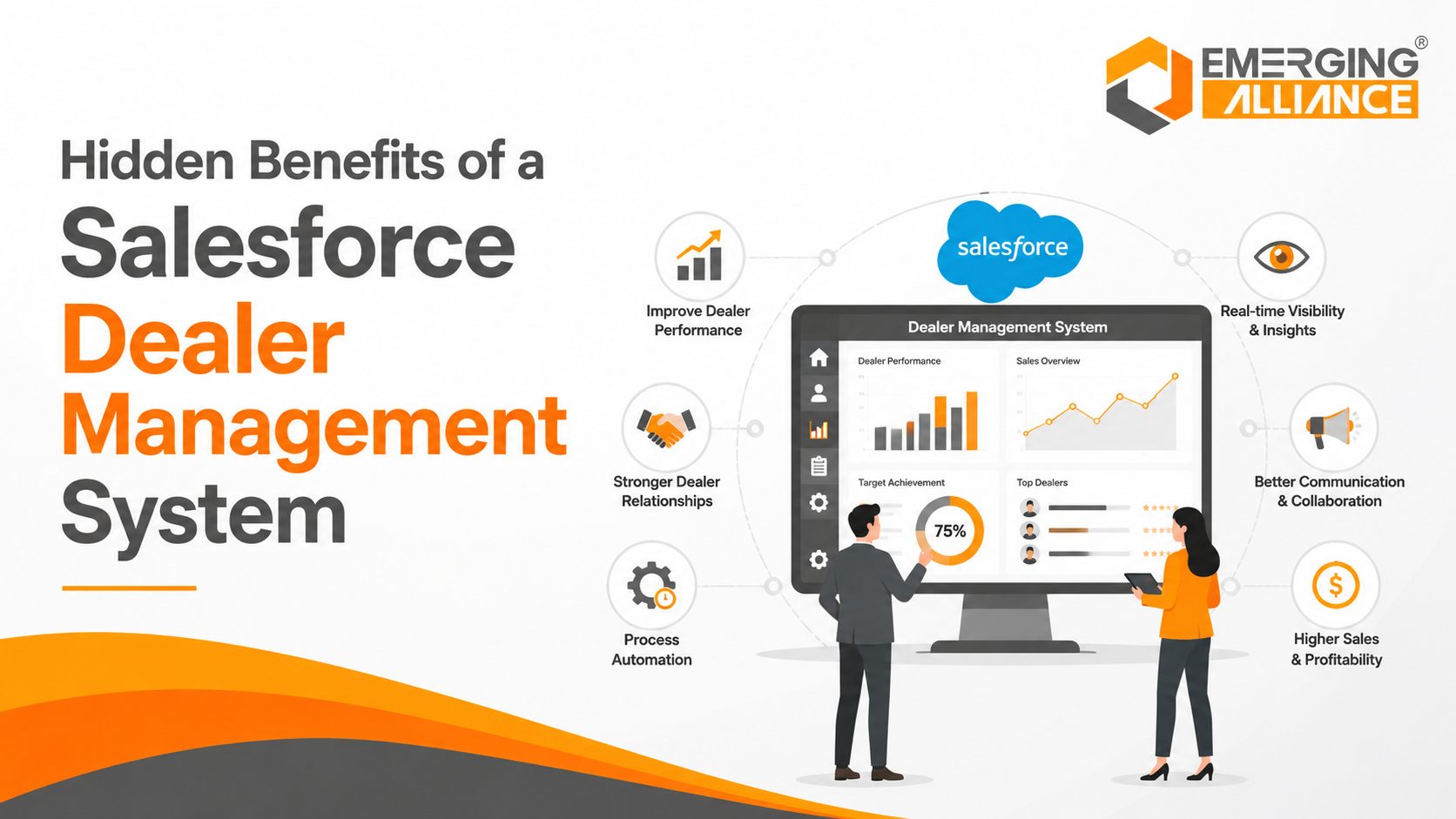
A Salesforce Dealer Management System can provide a centralized view of dealers, territories, sales activities, opportunities, customer interactions, service cases, targets, and performance measures.
Executives and dealer managers can monitor information such as:
- Lead acceptance and response times
- Lead-to-opportunity conversion
- Opportunity value and stage
- Dealer-wise revenue
- Target achievement
- Service case volumes
- Warranty turnaround
- Customer satisfaction
- Regional performance
This visibility helps leaders identify problems earlier and direct support where it can have the greatest business impact.
Practical Scenario
Suppose one territory generates a high volume of enquiries but a low number of qualified opportunities.
A dealer performance dashboard may reveal slow lead acceptance, limited follow-up, or weak conversion at a specific stage. Management can then investigate the cause, provide training, adjust assignment rules, or review dealer capacity.
The value comes from detecting the issue before it significantly affects revenue.
Automated Lead Distribution
Salesforce can route leads using predefined criteria and assignment rules.
Depending on the business model, leads may be distributed according to:
- Geography
- Dealer territory
- Product category
- Preferred dealer
- Dealer capacity
- Inventory context
- Customer preference
- Dealer specialization
- Performance criteria
This reduces manual coordination and gives every lead a defined owner.
The business outcomes can include:
- Faster response times
- Clearer accountability
- More consistent lead handling
- Reduced lead leakage
- Better pipeline visibility
- Improved customer engagement
Automation should not simply send leads faster. It should also include acceptance rules, follow-up expectations, reassignment logic, and escalation for inactive leads.
Faster Dealer Onboarding
A digital onboarding workflow can coordinate registration, due diligence, documentation, approvals, training, certification, and account activation.
Instead of relying on multiple email threads, teams can track onboarding status in one process.
This helps businesses:
- Reduce administrative effort
- Improve process consistency
- Clarify ownership
- identify missing documents
- Accelerate dealer readiness
- Create an auditable onboarding record
For an equipment manufacturer entering a new territory, this can mean activating new dealers with fewer manual handovers and better control over mandatory requirements.
Better Headquarters–Dealer Collaboration
A Salesforce Dealer Portal built through Experience Cloud can provide dealers with controlled access to relevant CRM information and self-service capabilities.
Dealers may be able to:
- Review assigned leads
- Register opportunities
- Access sales resources
- Submit support requests
- Track cases
- Review agreements and targets
- View approved product information
- Participate in campaigns
- Access training materials
- Submit warranty-related information
The portal creates a shared operational environment while preserving appropriate data access and security.
Real-Time Sales and Inventory Context
Salesforce can centralize sales pipeline information and present inventory context when connected with the relevant operational systems.
This helps sales teams and dealers understand:
- What customers are requesting
- Which products are available
- Where stock may be located
- Which opportunities need inventory confirmation
- Which regions have demand gaps
- Which products are moving slowly or quickly
For automotive organizations, Automotive Cloud can support dealer and inventory-related data and help users search across dealer or product locations. The implementation design determines which data is synchronized and how frequently it is updated.
Improved Customer Lifecycle Management
A connected dealer platform can provide a more complete view of the customer relationship across sales and service.
Authorized users may see:
- Enquiries
- Preferred products
- Opportunity history
- Purchases or owned assets
- Appointments
- Warranty information
- Service cases
- Communication history
- Follow-up activities
This context reduces repeated questions and helps dealers provide more relevant service.
A customer who contacts a different dealer location should not need to rebuild the entire history of the relationship from the beginning.
Workflow Automation
Salesforce automation can support repetitive dealer processes such as:
- Lead routing
- Lead escalation
- Opportunity approvals
- Discount approvals
- Dealer onboarding
- Case assignment
- Service scheduling
- Warranty review
- Document approvals
- Customer notifications
Automation improves speed, but governance remains important.
Each workflow should have clear rules, exceptions, ownership, and escalation paths. Poorly designed automation can accelerate an inefficient process rather than improve it.
Dealer Performance Dashboards
Dealer performance analytics turn raw activity into management insight.
Dashboards may track:
- Lead conversion
- Pipeline value
- Sales target attainment
- Response times
- Revenue trends
- Forecast accuracy
- Service performance
- Warranty activity
- Customer satisfaction
- Dealer engagement
Salesforce Automotive Cloud supports dealer performance analysis through CRM Analytics, including visibility into sales metrics, inventory availability, target compliance, and lead conversion.
These insights allow managers to differentiate between a temporary decline and a persistent performance issue.
Stronger Dealer Engagement
Dealers are more likely to engage when the manufacturer provides transparent processes, useful resources, timely support, and clear expectations.
A connected portal can strengthen engagement through:
- Shared goals
- Dealer scorecards
- Campaign resources
- Incentive visibility
- Training content
- Opportunity registration
- Self-service support
- Faster issue resolution
This shifts dealer relationship management from reactive administration to structured partner development.
Scalable Dealer Operations
Manual processes become harder to control as the business adds dealers, products, territories, and service models.
A scalable Salesforce solution can help the organization:
- Add dealer accounts and users
- Apply standardized processes
- Configure territory-specific workflows
- Support regional reporting
- Maintain data access controls
- Extend integration capabilities
- Introduce new service models
- Adapt dashboards and automation
Scalability does not mean every region must use an identical process. It means the organization can maintain common governance while accommodating justified local variations.
Key Features That Deliver Business Value
Features only matter when they improve a business process or decision.
The following capabilities form the foundation of an effective Salesforce DMS.
Salesforce Dealer Portal
A dealer portal provides secure, role-based access to information and actions relevant to each partner.
Potential use cases include:
- Lead management
- Deal registration
- Opportunity tracking
- Case submission
- Document access
- Training resources
- Dealer scorecards
- Warranty-related requests
- Campaign collaboration
Business value: fewer email dependencies, faster self-service, improved communication, and stronger dealer participation.
Lead and Opportunity Management
Salesforce can capture leads from digital campaigns, websites, call centres, events, referrals, and third-party sources.
The solution can then assign, prioritize, monitor, and escalate those leads.
Once qualified, the opportunity record gives both headquarters and the appropriate dealer visibility into deal status, value, product interest, expected close date, and next actions.
Business value: faster follow-up, reduced lead leakage, and more reliable pipeline forecasting.
Service and Warranty Processes
A dealer solution can connect customer support, assets, appointments, work orders, warranty terms, claims, and service history where the required Salesforce products and configurations are in place.
Automotive Cloud includes capabilities relevant to warranty programmes, claims, vehicle and asset records, and dealer service use cases.
Business value: improved service visibility, more consistent case handling, and better customer lifecycle management.
Case Management
Cases provide a structured way to manage dealer and customer enquiries.
Assignment and escalation rules can route cases according to issue type, urgency, dealer, product, or support team.
Business value: clearer ownership, measurable service levels, and faster resolution.
Mobile Access
Salesforce mobile capabilities allow authorized users to access relevant CRM information while working away from the office.
Field users may update opportunities, record visits, review tasks, respond to customers, and access dashboards.
Business value: faster updates, reduced reporting delays, and improved field productivity.
AI-Assisted Insights
Salesforce AI capabilities may support lead prioritization, forecasting, next-best actions, summaries, recommendations, or anomaly identification, depending on the products, data quality, licensing, and implementation.
AI results are only as reliable as the underlying data and governance.
Business value: more focused selling, faster analysis, and improved prioritization.
Reports and Dashboards
Role-based dashboards help executives, dealer managers, sales teams, and service teams focus on the metrics relevant to their responsibilities.
Business value: less time compiling reports and more time acting on performance insights.
ERP and Third-Party Integration
Salesforce can integrate with ERP, finance, inventory, order management, marketing, e-commerce, telephony, and other business applications through APIs, middleware, and integration platforms.
The integration design should define:
- The system of record for each data domain
- Synchronization frequency
- Error-handling processes
- Data ownership
- Security controls
- Duplicate prevention
- Monitoring responsibilities
Business value: more consistent data, reduced re-entry, and smoother cross-functional processes.
Business Impact Across the Organization
A Salesforce Dealer Management System affects more than the dealer management team.
Sales Teams
Sales teams gain faster lead assignment, clearer ownership, customer context, opportunity visibility, and structured follow-up.
Expected impact: higher productivity, reduced lead leakage, and better forecasting.
Dealer Network Managers
Dealer managers gain standardized scorecards, dealer activity data, target tracking, onboarding visibility, and performance trends.
Expected impact: more focused coaching and better dealer accountability.
Customer Service Teams
Service teams gain access to customer records, case history, assets, warranty context, and dealer interactions.
Expected impact: faster issue resolution and a more consistent customer experience.
Executives
Executives gain consolidated visibility into revenue, pipeline, regional performance, dealer productivity, service trends, and operational risks.
Expected impact: faster and better-supported strategic decisions.
Operations Teams
Operations teams can coordinate onboarding, approvals, documentation, compliance steps, dealer requests, and cross-system workflows.
Expected impact: lower administrative effort and greater process consistency.
Channel Partners
Dealers gain self-service access, clearer lead ownership, shared opportunity visibility, faster communication, and relevant performance information.
Expected impact: stronger partner engagement and improved collaboration.
Salesforce Dealer Management System vs. Traditional Dealer Management
| Business Area | Traditional Approach | Salesforce-Enabled Approach |
|---|---|---|
| Lead distribution | Manual forwarding and shared inboxes | Rules-based routing, queues, and escalation |
| Dealer communication | Emails, calls, and disconnected files | Secure Experience Cloud dealer portal |
| Performance reporting | Periodic spreadsheet reports | Role-based dashboards and analytics |
| Customer information | Separate records across dealers | Connected customer and interaction context |
| Opportunity management | Limited headquarters visibility | Shared pipeline and deal registration |
| Dealer onboarding | Manual documents and approvals | Guided workflows and status tracking |
| Service requests | Unstructured email follow-up | Case assignment and escalation |
| Warranty processes | Separate manual workflows | Configured warranty and claim processes |
| Inventory context | Repeated calls to operational teams | ERP or inventory data surfaced through integration |
| Scalability | More administration as the network grows | Standardized, configurable cloud processes |
Dealer Network Readiness Checklist
Your organization may need a Salesforce Dealer Management System when:
- Dealer information is stored across spreadsheets and separate applications.
- Leads are assigned manually.
- Headquarters cannot see dealer pipeline in real time.
- Dealers lack secure self-service access.
- Customer records differ across departments or locations.
- Inventory confirmation requires repeated calls or emails.
- Warranty and service requests are handled manually.
- Dealer onboarding takes longer than expected.
- Performance reports require extensive consolidation.
- CRM, ERP, and dealer systems do not exchange data reliably.
Answering “yes” to several of these statements indicates that disconnected dealer operations may be limiting growth.
Salesforce Dealer Management Implementation Priorities
Before implementation, define the business outcomes the solution must deliver.
1. Establish the Operating Model
Document dealer tiers, territories, responsibilities, ownership rules, approval processes, service models, and escalation paths.
2. Prioritize High-Value Use Cases
Start with processes that create measurable value, such as lead distribution, opportunity visibility, dealer onboarding, or case management.
3. Define the Data Architecture
Determine which information belongs in Salesforce and which systems remain the source of truth for inventory, orders, finance, pricing, and warranty transactions.
4. Design Dealer Access Carefully
Dealer users should only see the information required for their roles. Sharing rules, permission sets, licences, and partner account structures must be planned correctly.
5. Plan for Adoption
Dealer participation is essential. The portal must be easy to use, mobile-accessible where required, and supported by role-based training.
6. Measure Business Outcomes
Track baseline and post-implementation metrics such as:
- Lead response time
- Lead acceptance rate
- Lead conversion rate
- Dealer onboarding duration
- Pipeline visibility
- Case resolution time
- Warranty turnaround
- Dealer portal adoption
- Forecast accuracy
- Customer satisfaction
Build a More Connected Dealer Network
Disconnected dealer processes make it difficult to respond quickly, measure performance, and provide a consistent customer experience.
A well-designed Salesforce Dealer Management System can connect dealer relationships, lead management, sales pipelines, customer service, performance analytics, and relevant operational data within one governed ecosystem.
The most important benefit is not simply automation. It is the ability to create a more visible, accountable, collaborative, and scalable dealer network.
Frequently Asked Questions
Is Salesforce Dealer Management System an official standalone Salesforce product?
Not necessarily. Organizations typically build the solution using relevant Salesforce products and capabilities, such as Automotive Cloud, Sales Cloud, Service Cloud, Experience Cloud, automation, analytics, and integrations. The architecture depends on the required use cases.
How does Salesforce improve dealer visibility?
Salesforce centralizes dealer, lead, opportunity, customer, service, and performance information. Dashboards then present the relevant data to executives, sales teams, and dealer managers.
Can Salesforce automatically assign leads to dealers?
Yes. Salesforce supports partner lead assignment using users, queues, assignment rules, and Experience Cloud lead distribution. Rules can be configured around business criteria such as territory, product, or preferred dealer.
Can dealers access Salesforce through a portal?
Yes. Experience Cloud can provide secure partner access to selected CRM data and processes, including leads, opportunities, cases, resources, and deal registration.
Can Salesforce support warranty and service management?
Salesforce can support service cases, assets, work orders, warranty information, claims, and related workflows when the appropriate products, licences, configurations, and integrations are implemented.
Can Salesforce show inventory availability?
Salesforce can present inventory information when integrated with ERP, inventory, order management, or dealer systems. Automotive Cloud also includes vehicle and dealer inventory-related capabilities. Data accuracy depends on the integration and source system.
Is Salesforce DMS suitable only for automotive businesses?
No. The architecture can also support equipment manufacturers, industrial businesses, consumer product companies, medical equipment suppliers, and other organizations that sell or service products through dealer and distributor networks.
How long does implementation take?
The timeline depends on the number of use cases, integrations, dealer users, data migration requirements, custom workflows, licences, and rollout strategy. A phased implementation can reduce risk and deliver value sooner.
Why choose Emerging Alliance for Salesforce Dealer Management?
Emerging Alliance combines Salesforce consulting, solution design, integration, training, and ongoing support to create dealer management solutions aligned with specific business processes and growth goals.,
Ready to Modernize Your Dealer Operations?
Connect with Emerging Alliance to design a personalized Salesforce Dealer Management solution that improves visibility, automates critical workflows, strengthens dealer relationships, and supports measurable business growth.
Book a consultation to assess your dealer processes, Salesforce requirements, and integration priorities.