
Salesforce Dealer Management System: Close Visibility Gaps Before Revenue Loss
Salesforce dealer management system for Real-Time Dealer KPIs, Revenue Control, and Forecasting Accuracy
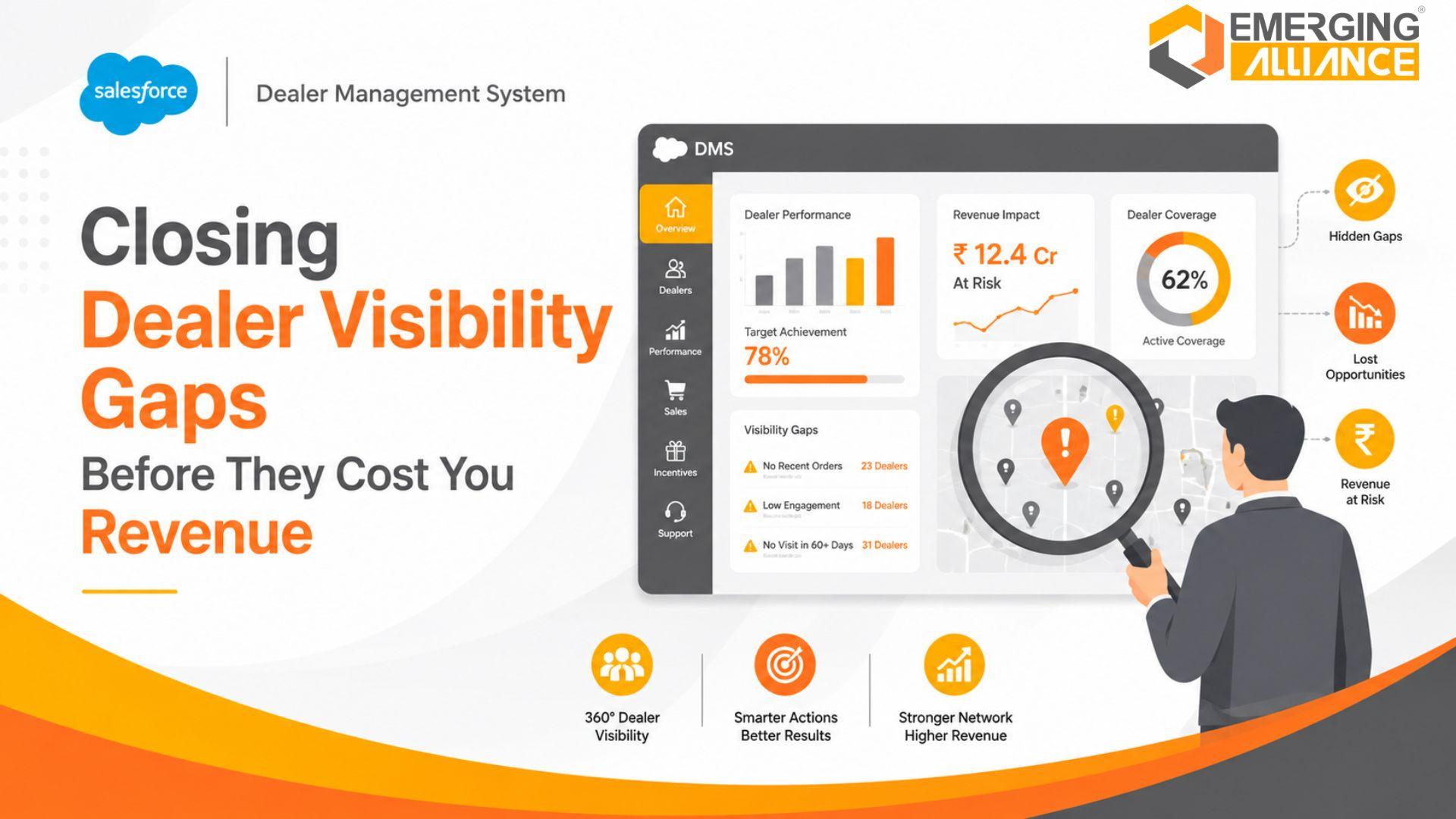
Dealer visibility is a revenue-control issue, not simply a reporting issue. When dealer activity, pipeline, targets, orders, and territory performance are spread across spreadsheets, email, ERP records, and disconnected CRM processes, leadership cannot see where revenue is being created, delayed, or at risk. A well-designed Salesforce dealer management system approach can centralize dealer records, opportunities, activities, KPIs, and partner-facing processes. Salesforce’s Partner Relationship Management (PRM) and Experience Cloud capabilities can support channel sales processes such as lead sharing, deal registration, partner performance tracking, and forecasting. The business value comes from combining those capabilities with clear data ownership, consistent definitions, integration, and adoption.
For executives, the key question is simple: can the business identify a dealer, pipeline, territory, or order risk early enough to change the revenue outcome?
Where Dealer Visibility Breaks Down as the Network Grows
Dealer networks become harder to manage as the number of dealers, territories, products, sales teams, and transactions increases. Processes that work for a small network often become unreliable once management depends on information from dozens or hundreds of channel partners.
Delayed dealer reporting: Weekly or monthly updates can hide fast-moving changes in demand, pipeline, inventory requirements, and competitive activity.
Fragmented pipeline data: Dealers may track opportunities independently while internal teams maintain quotations, orders, or follow-ups elsewhere.
Limited order visibility: Pending approvals, stock constraints, pricing issues, documentation, or follow-up gaps can delay revenue without a clear management view.
Weak territory insight: A regional total may show whether a target was achieved without explaining which dealers are driving growth, stalling, or leaving market coverage gaps.
These gaps force leadership to manage from historical totals instead of current operating signals. CEOs need to connect dealer performance to revenue. CIOs and CTOs need a reliable information architecture rather than another collection of disconnected reports.
How Poor Dealer Data Creates Revenue Leakage
Revenue leakage in a dealer network is not always an obvious accounting error. It often begins with an inactive dealer, a missed follow-up, an untracked opportunity, an unresolved order, or a territory that is not receiving enough attention.
A dealer with strong historical revenue may begin to lose activity before the decline appears in financial results. An active opportunity may remain untouched because the internal team cannot see its status. Sales operations may spend hours reconciling inconsistent dealer submissions instead of acting on revenue signals.
A useful dealer-management model should make the following questions easy to answer:
Which dealers are contributing to current revenue?
Which opportunities require immediate action?
Which dealers are becoming inactive?
Where are orders delayed and why?
Which territories are underperforming?
Which dealer relationships require management intervention?
If these answers depend on manual consolidation, the business is operating reactively. Centralized dealer data should shorten the time between a warning signal and a management decision.
Why Dealer Sales Forecasting Fails Without Current Pipeline Data
Forecast quality depends on the information entering the forecast. A large pipeline total can still be misleading when opportunities are stale, duplicated, poorly qualified, missing recent activity, or interpreted differently by each dealer.
A Salesforce dealer management system can provide a structured environment for dealer accounts, opportunities, stages, activities, ownership, targets, and forecast categories. But technology alone does not create forecast accuracy.
Before forecasting can become reliable, the organization should define:
- What qualifies as a real dealer opportunity
- When pipeline information must be updated
- Who validates stage and value changes
- How forecast categories are interpreted
- How stale or inactive opportunities are handled
Once those rules are consistent, leaders can compare pipeline conditions with targets, historical conversion, territory expectations, and dealer activity. That makes it easier to distinguish between a pipeline shortage, weak conversion, inactive dealers, delayed orders, and poor data quality.
A Single Dealer View: What Salesforce Should Bring Together
The strongest dealer-management design is not a dashboard project. It is a data and process model that gives the business one governed view of the dealer relationship.
Salesforce can be configured around the dealer lifecycle, including onboarding, territory ownership, lead and opportunity management, dealer engagement, targets, performance reviews, and partner-facing workflows. Experience Cloud and Salesforce PRM can also support secure partner access where external dealers need to work with shared CRM data.
A decision-ready dealer view may include:
- Dealer profile, ownership, status, and territory
- Revenue and target achievement
- Open opportunities and pipeline stage
- Recent activity and next action
- Order or fulfillment status where integrated
- Performance trends and inactive-dealer indicators
- Forecast contribution and risk signals
The strategic advantage is not having more screens. It is having a defined source of information behind the screens.
Dealer KPIs That Actually Support Executive Decisions
Dealer KPI tracking should answer three questions: what happened, what is likely to happen next, and where should management intervene?
Dealer revenue: Shows current commercial contribution and becomes more meaningful when compared with target and historical performance.
Target achievement: Highlights dealers or territories that are ahead, on track, or falling behind.
Qualified pipeline value: Provides a forward-looking view when opportunity stages and qualification rules are consistently applied.
Conversion rate: Helps reveal sales effectiveness differences across dealers, products, or territories.
Order status: Surfaces revenue that may be blocked by operational issues rather than weak demand.
Inactive dealer count: Identifies relationships that may need reactivation, support, restructuring, or replacement.
Territory performance: Reveals geographic coverage gaps and concentration risk.
Forecast accuracy: Tests whether the forecasting process itself is dependable.
Reducing Spreadsheet Reporting Without Creating Another Data Silo
Manual reporting usually expands because sales, finance, operations, and leadership each need different views of the same dealer information. When each team maintains a separate file, the business loses time reconciling definitions, duplicates, ownership, and update timing.
A Salesforce dealer management solution should replace this fragmentation with common records, validation rules, workflow ownership, dashboards, and controlled access. The design should also specify which platform is the system of record for customer, order, product, finance, and sales data.
For technology leaders, that means defining:
- Authoritative data sources
- Required integration flows
- Synchronization frequency
- Data-quality and validation rules
- Access and security controls
- Error handling and ownership
The goal is not to move every spreadsheet field into Salesforce. The goal is to remove redundant reporting and create a governed information flow that supports decisions.
Using Dealer Performance Data to Find Growth Opportunities
Dealer performance management should do more than identify weak performers. It should help leadership understand why performance differs and where the network has additional growth capacity.
High-performing dealers can reveal repeatable practices, stronger territory coverage, better product penetration, or more effective customer engagement. Underperforming dealers may need training, commercial support, territory changes, or closer opportunity management.
Inactive dealers require separate analysis. Some may represent dormant relationships that can be reactivated. Others may indicate that the territory needs a different channel strategy. Salesforce reporting can support segmentation by revenue contribution, activity, territory, pipeline, or performance tier so that each group receives the right management response.
What CEOs, Sales Leaders, CIOs, and CTOs Should Evaluate Before Implementation
A Salesforce dealer management implementation should begin with operating requirements rather than feature selection.
CEO / business leadership: Can leadership explain dealer performance before month-end? Are revenue risks visible early? Is dealer activity connected to commercial outcomes?
Sales leadership: Are opportunity stages consistent? Are dealer updates timely? Do managers use pipeline and KPI data to trigger action?
CIO / CTO: Where does dealer data reside? Which system owns each record? What integrations, security controls, governance, and scalability requirements exist?
A practical assessment should cover:
- Dealer data sources and data quality
- Dealer lifecycle and sales process
- KPI and dashboard requirements
- Pipeline and forecasting rules
- User roles and access
- Integration and synchronization
- Reporting ownership and governance
- Dealer and employee adoption
- Future network growth
A Scalable Salesforce Dealer Management Roadmap
1. Define the business outcome — Clarify whether the priority is revenue visibility, forecast quality, dealer productivity, territory control, reporting efficiency, or a combination of these.
2. Map the dealer journey — Document onboarding, engagement, lead/opportunity handling, order progression, performance review, and relationship development.
3. Standardize dealer data and KPI definitions — Decide what information is required, who owns it, and how each metric is calculated.
4. Design system ownership and integration — Define where customer, product, order, finance, and pipeline records should originate and how Salesforce should exchange data with other systems.
5. Simplify the user experience — Use automation, alerts, workflows, and dashboards to reduce unnecessary manual entry and reporting.
6. Implement in phases — Start with the visibility and forecasting capabilities that create the clearest management value, then expand into additional dealer workflows.
When Dealer Management Becomes a Business Priority
The case for a structured dealer management system becomes stronger when the business sees recurring signs such as:
- Spreadsheet consolidation before every review
- Inconsistent dealer reports
- Unclear or stale pipeline data
- Frequent manual requests for updates
- Delayed performance reviews
- Unexplained revenue gaps
- Low confidence in channel forecasts
- Growing dealer counts without scalable management processes
The investment decision should be based on the cost and risk of the current operating model, not dealer count alone. Technology should solve a defined visibility, forecasting, or channel-management problem.
Conclusion: Turn Dealer Visibility Into Revenue Control
Dealer visibility gaps become expensive when management discovers them after revenue has already been affected. Fragmented data, delayed reporting, weak pipeline discipline, inactive relationships, territory blind spots, and inconsistent forecasting all reduce the time available to intervene.
Salesforce Dealer Management can provide a structured foundation for dealer records, pipeline, KPIs, partner collaboration, performance tracking, and revenue-related reporting. Salesforce’s PRM and Experience Cloud capabilities are particularly relevant where businesses need to extend controlled CRM access and channel-sales processes to external partners.
The strongest implementation starts with a visibility assessment: identify what leadership cannot currently see, where the data is fragmented, which decisions are delayed, and which processes must become consistent. Then design Salesforce around those requirements.
Discuss your dealer visibility gaps with a Salesforce expert and map the data, KPI, integration, process, and forecasting requirements needed for a scalable dealer-management operation.
Frequently Asked Questions
Can Salesforce improve visibility across a large dealer network?
Yes. With the right data model and adoption, Salesforce can centralize dealer records, opportunities, activities, targets, performance information, and partner-facing processes. Management can then compare dealer and territory performance using standardized data rather than disconnected submissions.
Can Salesforce improve dealer sales forecasting accuracy?
It can improve the data foundation for forecasting by standardizing opportunity stages, ownership, activities, target data, and forecast categories. Accuracy still depends on timely updates, qualification discipline, data quality, and regular management review.
Which dealer KPIs should executives monitor?
Common decision-oriented KPIs include dealer revenue, target achievement, qualified pipeline, conversion rate, order status, inactive dealers, territory performance, dealer contribution, and forecast accuracy.
How can Salesforce reduce spreadsheet-based dealer reporting?
Salesforce can replace multiple reporting files with common records, validation rules, workflows, dashboards, and controlled access. Businesses should first identify which spreadsheets are authoritative and remove duplicate or unnecessary data collection.
Can dealers use a Salesforce dealer portal?
Yes. Salesforce Experience Cloud can provide secure external access for partners. Salesforce PRM supports partner-oriented processes such as lead sharing, deal registration, onboarding, performance tracking, and channel sales collaboration, subject to the selected Salesforce products and licenses.
Can Salesforce integrate with ERP and other business systems?
Yes. Integration can connect relevant dealer, customer, order, product, or finance data, but the architecture should clearly define system ownership, synchronization rules, frequency, access, and error handling.
When is a Salesforce dealer management system worth evaluating?
It is worth evaluating when dealer complexity creates recurring reporting delays, fragmented information, stale pipeline data, low forecast confidence, weak territory visibility, or difficulty identifying performance problems early.
Build Better Control Across Your Dealer Network
Evaluate how Salesforce Dealer Management can improve dealer visibility, performance tracking, and revenue forecasting.
Schedule a Salesforce Demo