
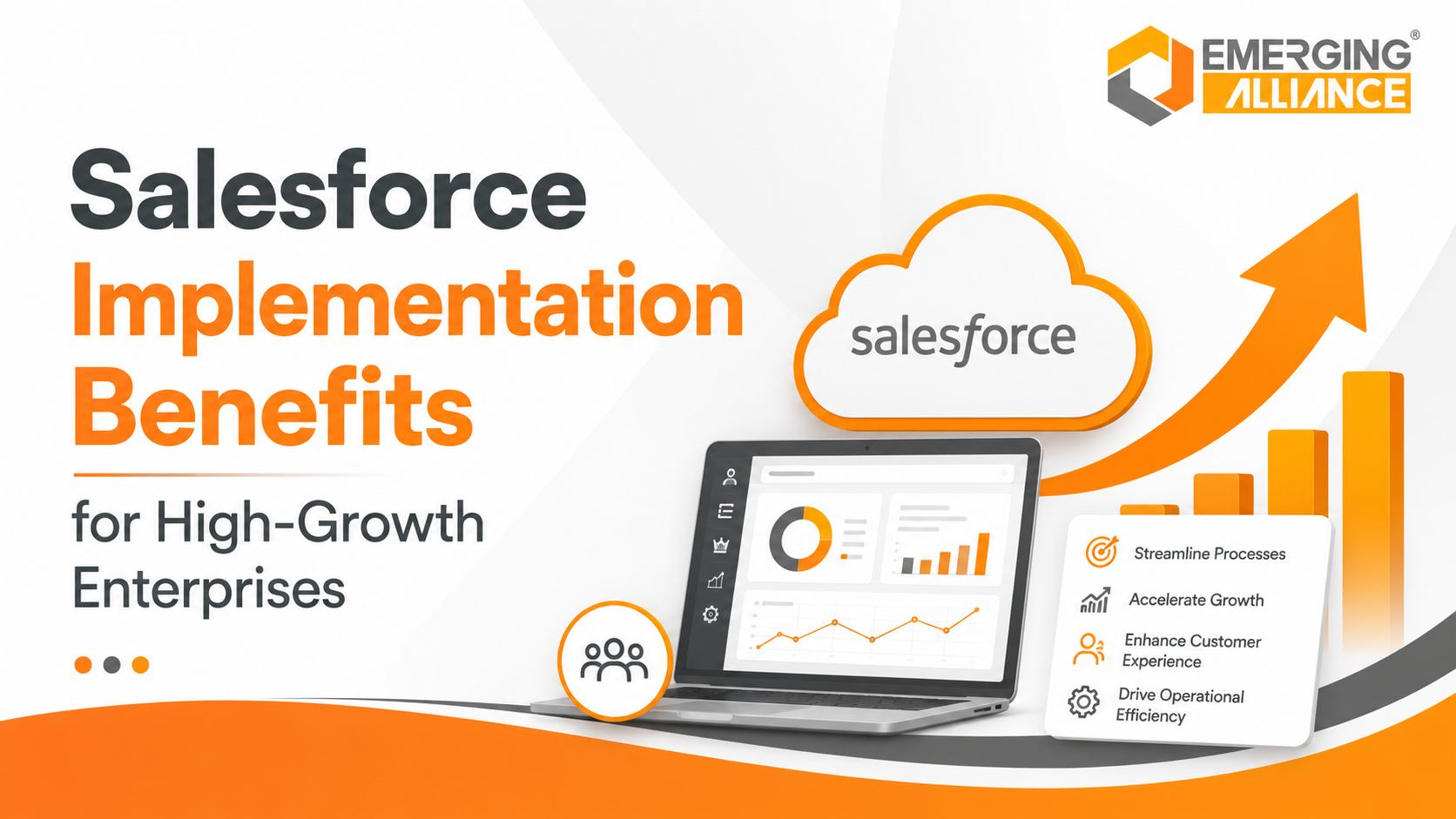
Salesforce Implementation Benefits for High-Growth Enterprises
Salesforce Implementation driving automation, productivity, and measurable business value
Rapid business growth can expose weaknesses in customer data, sales processes, reporting, collaboration, and service delivery. Processes that worked for a smaller organization may become inefficient when customer volumes increase, teams expand, and management requires faster decisions.
Disconnected spreadsheets, manual approvals, isolated applications, and inconsistent workflows can slow growth rather than support it.
A strategic Salesforce implementation addresses these challenges by creating a unified CRM environment for customer data, sales activities, service processes, workflow automation, reporting, and cross-functional collaboration.
For high-growth enterprises, Salesforce is not simply a system for recording contacts. It can become a scalable business platform that improves employee productivity, strengthens customer engagement, and provides the operational visibility required for sustainable expansion.
What Is Salesforce Implementation?
Salesforce implementation is the structured process of aligning Salesforce CRM with an organization’s business objectives, customer journeys, data, workflows, integrations, reporting requirements, and user roles.
A successful implementation typically includes:
- Business process assessment
- CRM strategy and solution design
- Data cleansing and migration
- Workflow configuration and automation
- Integration with ERP and other applications
- User testing and training
- Performance measurement
- Continuous CRM optimization
The objective is not merely to deploy software. It is to create a CRM environment that produces measurable improvements in revenue operations, customer service, productivity, and decision-making.
Why Salesforce Implementation Matters for Growing Enterprises
Scalable Support for Business Growth
As an enterprise grows, it must manage larger pipelines, more customer interactions, new territories, additional employees, and increasingly complex approval processes.
A properly planned Salesforce CRM implementation provides a scalable foundation for this expansion. Businesses can add teams, processes, markets, customer segments, and integrations without rebuilding their entire CRM environment.
This scalability helps organizations avoid fragmented systems and inconsistent processes as they grow.
Centralized Customer Information
Customer information is often distributed across spreadsheets, inboxes, marketing tools, support systems, finance applications, and ERP platforms.
This fragmentation prevents employees from seeing the complete customer relationship.
Salesforce centralizes relevant customer information, including:
- Contact and account details
- Lead and opportunity history
- Sales activities
- Service requests
- Communication records
- Contracts and orders
- Marketing engagement
- Customer preferences
A centralized customer view helps teams respond faster, reduce duplication, and deliver more consistent experiences.
Greater Operational Visibility
High-growth enterprises need real-time visibility into performance. Manual reporting delays decisions and may introduce data inconsistencies.
Salesforce dashboards can provide decision-makers with current information on:
- Pipeline value
- Sales stages
- Conversion rates
- Revenue forecasts
- Lead sources
- Service performance
- Customer engagement
- Team activity
This visibility helps leaders identify risks, allocate resources, and respond to changes earlier.
Data-Driven Decision-Making
Growth decisions should be based on reliable information rather than assumptions.
Salesforce reporting and business intelligence capabilities help management evaluate customer behaviour, sales performance, employee activity, campaign effectiveness, and service outcomes.
With more reliable data, enterprises can improve:
- Revenue forecasting
- Territory planning
- Sales capacity decisions
- Customer segmentation
- Resource allocation
- Performance management
Key Benefits of Salesforce Implementation
Automated Business Processes
Manual processes create delays, inconsistent execution, and unnecessary administrative work.
Salesforce can automate activities such as:
- Lead routing
- Follow-up reminders
- Opportunity approvals
- Quote approvals
- Customer notifications
- Task creation
- Contract renewals
- Service escalations
- Management alerts
For example, a growing enterprise receiving hundreds of leads each week can automatically assign each enquiry according to geography, product interest, account size, or sales representative availability.
This reduces response time and limits the risk of qualified opportunities being overlooked.
Improved Sales Productivity
Sales representatives often lose productive time searching for customer information, updating spreadsheets, preparing reports, and manually tracking follow-ups.
A well-designed Salesforce CRM environment gives sales teams a structured view of accounts, contacts, opportunities, activities, and next actions.
It can help representatives:
- Prioritize high-value opportunities
- Track every sales interaction
- Schedule timely follow-ups
- Identify inactive opportunities
- Access relevant customer information
- Maintain consistent sales stages
- Reduce administrative work
Sales managers also gain better visibility into pipeline quality, activity levels, and potential revenue risks.
Stronger Customer Relationship Management
Customers expect businesses to understand their history, preferences, requirements, and previous interactions.
Salesforce helps teams build a more complete customer profile and coordinate engagement across sales, marketing, and service departments.
This supports:
- More relevant communication
- Faster responses
- Consistent service
- Personalized engagement
- Better account planning
- Proactive customer support
When employees have access to accurate customer context, customers do not need to repeat the same information every time they contact the business.
Real-Time Reporting and Forecasting
Spreadsheet-based reporting is often time-consuming and outdated by the time it reaches management.
Salesforce enables real-time dashboards and reports based on current CRM data.
Executives can monitor:
- Pipeline coverage
- Forecast categories
- Sales conversion rates
- Average sales cycle length
- Customer retention
- Case resolution times
- Sales representative performance
- Campaign contribution
Real-time reporting helps management detect performance gaps and take corrective action sooner.
Better Cross-Team Collaboration
Sales, marketing, service, operations, and management teams frequently maintain separate records and follow different processes.
Salesforce provides a shared customer environment that improves coordination across departments.
For example:
- Marketing can see which campaigns produce qualified opportunities.
- Sales can view prospect engagement before contacting a lead.
- Service teams can review purchase and communication history.
- Management can assess performance across the entire customer lifecycle.
This reduces information silos and creates greater accountability.
Standardized Workflows
Rapidly expanding organizations may develop different processes across teams, locations, or business units.
Salesforce can standardize:
- Lead qualification
- Opportunity stages
- Approval processes
- Customer onboarding
- Case escalation
- Activity tracking
- Management reporting
Standardization improves process consistency, data quality, compliance, training, and operational control.
Scalable CRM Architecture
A scalable CRM must support more than current requirements.
Salesforce can be extended to accommodate:
- Additional users
- New sales territories
- New business units
- Multiple customer segments
- More complex approval rules
- ERP and third-party integrations
- Additional automation
- New reporting requirements
A carefully designed architecture protects long-term CRM value and reduces the need for disruptive system changes.
Enhanced Customer Experience
Customer experience is shaped by the speed, relevance, and consistency of every interaction.
Salesforce helps enterprises coordinate customer journeys by providing teams with timely information and automated actions.
This can contribute to:
- Faster lead response
- Shorter service resolution times
- More consistent communication
- Personalized customer interactions
- Proactive renewal management
- Better customer retention
Salesforce Implementation Benefits and Business Outcomes
| Salesforce capability | Operational improvement | Potential business outcome |
|---|---|---|
| Lead and workflow automation | Less manual routing and follow-up | Faster lead response |
| Centralized customer data | Fewer data silos and duplicate records | Better customer visibility |
| Sales process standardization | More consistent opportunity management | Improved conversion control |
| Real-time dashboards | Faster access to performance information | Better executive decisions |
| CRM integration | Reduced duplicate data entry | Greater operational efficiency |
| Service automation | Faster routing and escalation | Improved customer satisfaction |
| Scalable architecture | Easier expansion across teams and markets | Sustainable business growth |
The actual results depend on business readiness, data quality, process design, integration requirements, user adoption, and ongoing optimization.
How Salesforce Creates Measurable Business Value
Faster Return on Investment
A phased Salesforce implementation can prioritize high-impact processes first.
For example, automating lead allocation, follow-up tasks, and approval workflows may create visible value before more advanced capabilities are introduced.
Faster value realization is more likely when the implementation is connected to defined business KPIs rather than broad technology goals.
Higher Employee Productivity
CRM automation reduces repetitive work and provides employees with faster access to relevant information.
Productivity improvements may come from:
- Fewer manual updates
- Reduced spreadsheet dependency
- Faster reporting
- Simplified approvals
- Better task prioritization
- Easier access to customer records
This allows employees to spend more time on selling, customer engagement, service delivery, and strategic work.
Improved Sales Conversion Management
Salesforce does not automatically increase conversion rates. However, it gives teams the processes, visibility, and automation needed to manage conversions more effectively.
Sales leaders can identify:
- Uncontacted leads
- Delayed follow-ups
- Stalled opportunities
- Weak pipeline stages
- Inconsistent sales activity
- Common reasons for lost deals
These insights enable more targeted coaching and process improvement.
Greater Forecasting Accuracy
Reliable forecasting requires accurate opportunity data, standardized sales stages, and consistent CRM usage.
Salesforce supports forecasting by giving leaders visibility into:
- Opportunity value
- Expected close dates
- Deal stages
- Pipeline movement
- Representative commitments
- Historical conversion patterns
Better forecasting helps finance, sales, operations, and management coordinate planning more effectively.
Reduced Manual Work
Salesforce workflow automation can reduce manual activities such as data routing, task assignment, reminders, approvals, notifications, and report preparation.
The value is not only time savings. Automation also improves process consistency and reduces the likelihood of missed actions.
Increased Customer Retention
Centralized customer information and service workflows can help organizations identify unresolved issues, renewal opportunities, inactive customers, and changes in engagement.
This supports more proactive account management and customer retention initiatives.
Improved Operational Efficiency
When Salesforce is connected with ERP, marketing, finance, service, or other enterprise systems, businesses can reduce duplicate data entry and improve information flow.
For example, integrating Salesforce with an ERP system may allow sales teams to access relevant order, inventory, invoice, or account information without switching between disconnected applications.
Best Practices for Successful Salesforce Implementation
Define Measurable Business Objectives
Implementation objectives should be linked to measurable outcomes.
Examples include:
- Reduce lead response time
- Improve sales forecast accuracy
- Increase qualified lead conversion
- Shorten approval turnaround time
- Improve user adoption
- Reduce duplicate customer records
- Increase customer retention
Clear objectives help control project scope and establish implementation priorities.
Build a Phased Roadmap
Attempting to transform every business process at once may increase risk and delay value.
A phased roadmap can begin with the highest-priority workflows and expand after users and processes stabilize.
A typical sequence may include:
- Process assessment and CRM planning
- Core sales and customer data implementation
- Data migration and system integration
- Workflow automation
- Reporting and dashboards
- User training and adoption
- Continuous optimization
Improve Data Quality Before Migration
Migrating inaccurate or duplicated data into Salesforce transfers existing problems into the new CRM.
Before migration, organizations should:
- Remove duplicates
- Standardize fields and formats
- Validate important records
- Define data ownership
- Archive obsolete information
- Establish data governance rules
Clean data improves reporting accuracy and user confidence.
Avoid Unnecessary Customization
Customization should solve a genuine business requirement.
Excessive customization can create complexity, increase maintenance effort, and make future changes more difficult.
Organizations should use standard Salesforce capabilities where appropriate and customize only when the expected business value justifies the additional complexity.
Prioritize User Adoption
A technically successful Salesforce deployment can still fail when employees do not use it consistently.
Effective adoption requires:
- Role-based training
- Clear process ownership
- Practical user documentation
- Leadership involvement
- User feedback
- Ongoing support
- Adoption measurement
Users should understand how Salesforce makes their work easier, not merely how to enter information.
Monitor KPIs and Optimize Continuously
Salesforce implementation should be treated as an ongoing business improvement programme.
Relevant KPIs may include:
- Lead response time
- Lead-to-opportunity conversion
- Opportunity win rate
- Sales cycle duration
- Forecast accuracy
- CRM adoption rate
- Case resolution time
- Customer retention
- Data completeness
- Automation usage
Regular reviews help ensure the platform continues to support changing business requirements.
Salesforce Implementation Readiness Checklist
Before starting the project, confirm that the organization has:
- Defined measurable CRM objectives
- Documented current sales and service processes
- Identified process bottlenecks
- Assigned internal project owners
- Reviewed customer data quality
- Identified required integrations
- Defined user roles and permissions
- Prioritized reporting requirements
- Created a user adoption plan
- Established implementation KPIs
- Selected a qualified Salesforce implementation partner
- Planned post-launch support and optimization
Why Partner with Emerging Alliance?
Choosing the right Salesforce implementation partner can significantly influence CRM adoption, scalability, integration quality, and long-term return on investment.
Emerging Alliance provides business-focused Salesforce consulting and implementation services aligned with operational priorities and growth objectives.
Our Salesforce capabilities include:
- Certified Salesforce consultants
- Business process assessment
- CRM strategy and roadmap development
- End-to-end Salesforce implementation services
- Sales and service process automation
- ERP and third-party system integration
- Data migration and quality planning
- Role-based user training
- Post-implementation support
- Continuous CRM optimization
Rather than approaching Salesforce as an isolated technology deployment, Emerging Alliance aligns the CRM platform with business processes, users, customer journeys, reporting requirements, and future scalability.
Build a Scalable CRM Foundation for Growth
High-growth enterprises need a CRM platform that can support increasing customer volumes, expanding teams, complex workflows, and faster management decisions.
A successful Salesforce implementation can centralize customer information, automate repetitive processes, improve sales productivity, strengthen collaboration, and provide real-time business visibility.
The greatest value comes from aligning Salesforce with measurable business objectives, reliable data, practical workflows, strong user adoption, and continuous improvement.
Frequently Asked Questions
What are the main benefits of Salesforce implementation?
The main benefits include process automation, centralized customer data, improved sales productivity, real-time reporting, standardized workflows, better collaboration, enhanced customer experiences, and scalable CRM operations.
How long does Salesforce CRM implementation take?
The timeline depends on scope, data volume, integrations, customization, testing, and user requirements. A focused implementation may take several weeks, while a complex enterprise programme may require several months.
How much does Salesforce implementation cost?
Salesforce implementation cost depends on the number of users, business processes, Salesforce products, integrations, data migration, customization, training, and support requirements. A discovery assessment is normally required for an accurate estimate.
Why should a business hire a Salesforce implementation partner?
A qualified partner provides process expertise, solution design, integration support, data migration planning, user training, and implementation governance. This reduces project risk and helps align Salesforce with measurable business goals.
Can Salesforce integrate with ERP systems?
Yes. Salesforce can be integrated with ERP, finance, marketing, commerce, customer service, and other enterprise applications through suitable APIs, middleware, and integration architecture.
How does Salesforce improve sales productivity?
Salesforce improves sales productivity by centralizing customer information, automating follow-ups and assignments, standardizing opportunity management, simplifying reporting, and helping representatives prioritize important activities.
Which KPIs should be measured after Salesforce implementation?
Businesses should measure lead response time, conversion rates, sales cycle duration, forecast accuracy, user adoption, data completeness, customer retention, service resolution time, productivity, and CRM-generated ROI.
Plan Your Salesforce Implementation with Emerging Alliance
Speak with Emerging Alliance for a personalized Salesforce implementation consultation, CRM roadmap, and live demonstration.
Our consultants can help you assess current process gaps, identify automation opportunities, define implementation priorities, and build a scalable Salesforce solution aligned with your growth strategy.