
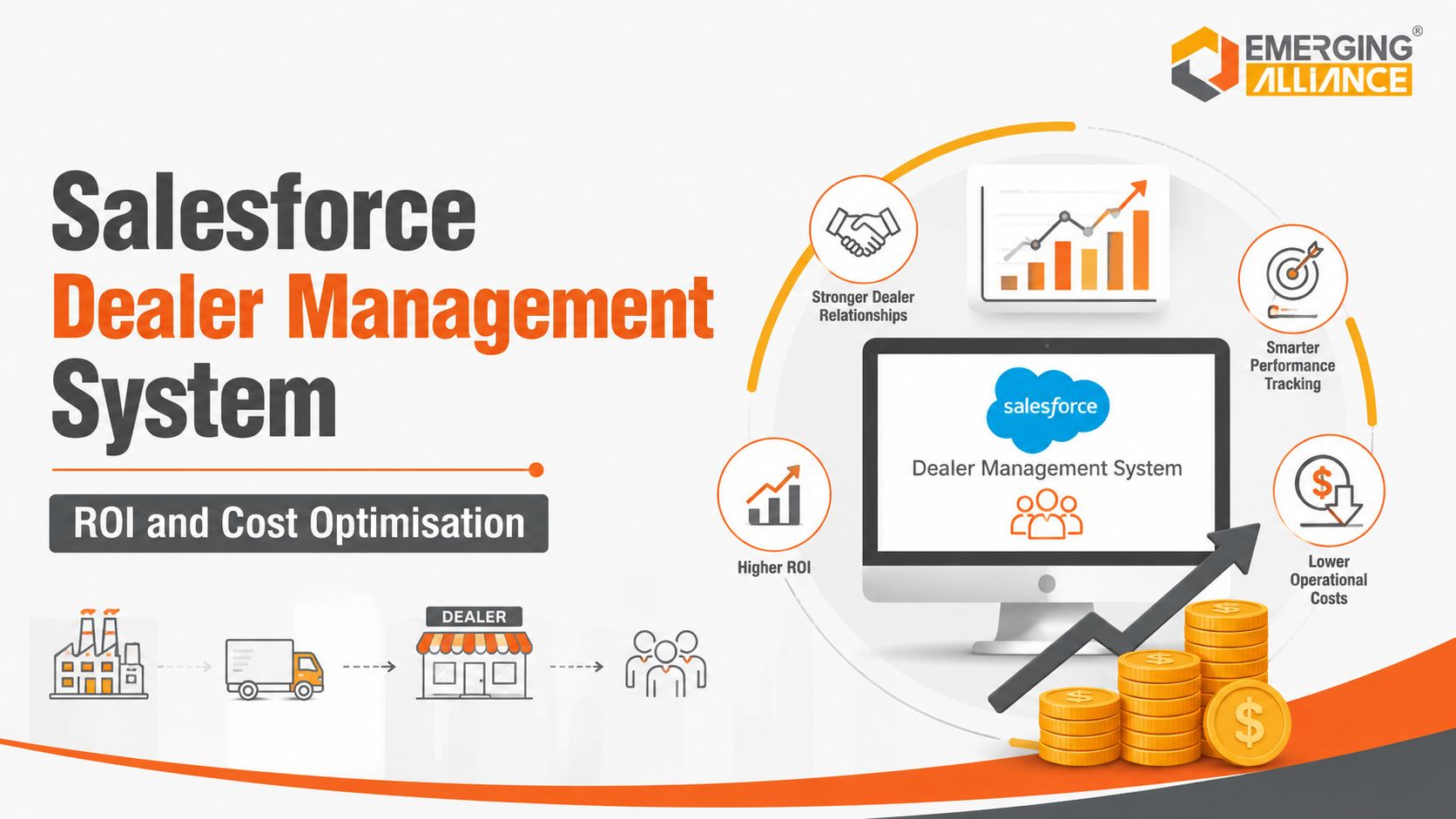
Salesforce Dealer Management System ROI and Cost Optimization
Salesforce Dealer Management System for reducing operational costs, improving margins, and accelerating returns
Dealer networks can create significant revenue opportunities for automotive companies, manufacturers, equipment suppliers, and businesses operating through distributors. However, network growth does not automatically produce higher profitability.
As the number of dealers increases, businesses must manage more leads, orders, approvals, inventory requests, warranty claims, service cases, incentives, and performance reports. When these processes depend on spreadsheets, emails, phone calls, and disconnected applications, administrative costs rise faster than revenue.
A Salesforce Dealer Management System helps businesses centralise dealer operations, automate repetitive workflows, improve network visibility, and give dealers secure self-service access to essential information.
The result is not simply better dealer administration. A well-designed Salesforce DMS can reduce operating costs, increase dealer productivity, shorten transaction cycles, strengthen margins, and support scalable growth.
What Is a Salesforce Dealer Management System?
A Salesforce Dealer Management System is a connected dealer-management environment built on relevant Salesforce products and configured around an organisation’s channel processes.
Depending on the industry and business requirements, the solution may combine Salesforce Automotive Cloud, Manufacturing Cloud, Experience Cloud, Sales Cloud, Service Cloud, analytics, workflow automation, and ERP integrations.
It can provide one environment for managing:
- Dealer onboarding
- Lead distribution
- Opportunity tracking
- Product and pricing information
- Quotes and approvals
- Orders and fulfilment updates
- Inventory visibility
- Warranty claims
- Service requests
- Incentives and rebates
- Dealer performance
- Customer interactions
Salesforce Automotive Cloud supports connected customer, vehicle, warranty, claims, sales, service, and dealer experiences. Manufacturing-focused Salesforce solutions can also provide dealer and distributor portals, product visibility, order capture, rebate management, partner service, and performance insights.
The exact solution should therefore be defined by the dealer operating model rather than treated as a fixed, out-of-the-box DMS package.
Why Dealer Management Requires Digital Transformation
Dealer network efficiency directly affects profitability. Every unnecessary manual step adds cost, slows revenue, and creates more opportunities for error.
Fragmented Dealer Operations
Many organisations manage dealer activities across separate spreadsheets, email threads, messaging applications, CRM records, and ERP reports.
This fragmentation creates several problems:
- Duplicate data entry
- Inconsistent dealer records
- Delayed approvals
- Limited accountability
- Poor status visibility
- Repeated follow-ups
- Reporting delays
Internal employees spend time collecting information instead of supporting dealers and customers.
Rising Administrative Costs
Dealer growth often increases the workload across sales, operations, finance, service, and channel-management teams.
Without process automation, companies may need additional employees simply to manage routine tasks such as onboarding dealers, assigning leads, updating order status, validating claims, or preparing performance reports.
This creates an unfavourable cost-to-serve ratio.
Limited Network Visibility
Leadership teams need to know which dealers are generating revenue, converting leads, maintaining inventory discipline, resolving customer issues, and meeting agreed targets.
Disconnected systems make it difficult to compare:
- Dealer sales performance
- Lead acceptance and conversion
- Order turnaround time
- Inventory movement
- Warranty claim patterns
- Service response times
- Regional demand
- Incentive effectiveness
Salesforce Automotive Cloud can support dealer-performance analysis using dashboards for inventory availability, sales metrics, target compliance, lead conversion, claims, and forecasts.
Inconsistent Dealer Experience
Dealers expect fast access to leads, pricing, product information, inventory availability, order status, service support, and claim updates.
When dealers must repeatedly contact internal employees for this information, both parties lose productive time. A secure dealer portal reduces this dependency and creates a more consistent partner experience.
How Salesforce DMS Reduces Operational Costs
The cost value of a Salesforce Dealer Management System comes from removing unnecessary work, shortening transaction cycles, and improving the quality of operational decisions.
Automated Dealer Onboarding
A manual onboarding process can require repeated email exchanges, document collection, approvals, system access requests, and training coordination.
Salesforce workflow automation can create a standard onboarding journey that:
- Captures dealer information
- Routes applications for approval
- Tracks required documents
- Assigns onboarding tasks
- Provisions appropriate access
- Shares training resources
- Monitors onboarding completion
This reduces administrative effort and helps new dealers become productive faster.
Faster Lead Distribution and Follow-Up
In a disconnected process, channel managers may manually send leads to dealers and wait for status updates.
A Salesforce DMS can assign leads according to geography, product expertise, dealer capacity, performance, or other business rules. Automated reminders and escalation paths can reduce delayed follow-up.
Managers can then measure lead acceptance, response time, conversion, and pipeline value by dealer or region.
Centralized Dealer Communication
A dealer portal creates a shared environment for announcements, inquiries, documents, cases, approvals, and transaction updates.
This reduces reliance on scattered email chains and makes it easier to maintain a complete history of dealer interactions.
Salesforce Experience Cloud can support secure partner access, while Salesforce industry solutions can share relevant vehicle, asset, warranty, visit, claim, agreement, and service information with authorised users.
Better Order and Inventory Visibility
Dealers often contact internal teams to confirm product availability, order progress, shipment status, or expected delivery.
When Salesforce is integrated with the organisation’s ERP or order-management system, selected information can be presented through the dealer portal.
This can help dealers:
- Review product catalogues
- Check appropriate inventory data
- Submit or track orders
- Monitor fulfilment status
- Manage customer expectations
- Reduce avoidable follow-ups
Salesforce Manufacturing Cloud can integrate with ERP and order-management systems through APIs, MuleSoft, or other middleware.
The actual level of real-time inventory visibility depends on integration architecture, source-system quality, refresh frequency, and access rules.
Streamlined Warranty and Claims Management
Warranty administration can become expensive when claims contain missing information, inconsistent codes, unclear coverage, or limited status visibility.
A Salesforce-based process can standardise claim submission, validation, adjudication, communication, and tracking.
Automotive Cloud allows dealers to submit and track warranty claims through an Experience Cloud site. It can capture asset, warranty, expense, repair, labour, and claim-participant details, helping reduce follow-ups for incomplete information.
Faster and more consistent processing can lower administrative effort while improving dealer and customer satisfaction.
Reduced Reporting Effort
When dealer data is centralised, dashboards can replace time-consuming manual reports.
Executives and channel managers can monitor performance without repeatedly requesting spreadsheet consolidation from regional teams.
This improves resource utilisation and gives employees more time for dealer development, exception management, and revenue-generating activities.
Key ROI Benefits of Salesforce Dealer Management System
The return on a Salesforce DMS should be measured through both cost reduction and value creation.
Lower Cost per Dealer
Automation and self-service allow businesses to support a larger network without increasing administrative headcount at the same rate.
A useful metric is:
Cost per dealer = Total dealer-management operating cost ÷ Number of active dealers
The organisation should compare this figure before and after implementation.
Improved Dealer Productivity
Dealers become more productive when they can independently access authorised product, lead, order, warranty, service, and performance information.
Self-service reduces waiting time and enables dealer teams to focus on customer acquisition, sales, and service delivery.
Higher Sales Efficiency
Faster lead routing, better pipeline visibility, standard follow-up, and improved collaboration can help shorten sales cycles.
Businesses can measure:
- Lead response time
- Lead-to-opportunity conversion
- Opportunity-to-order conversion
- Average sales-cycle duration
- Revenue per active dealer
Faster Order Processing
Integrated order workflows reduce re-entry, missing information, approval delays, and manual status checks.
A practical ROI indicator is the reduction in average order-processing time from dealer submission to confirmed fulfilment.
Better Margin Protection
Margin leakage may occur through pricing errors, unmanaged discounts, inefficient incentives, claim overpayments, excessive inventory, and high administrative effort.
A Salesforce DMS can support governed approvals, clearer incentive tracking, claims controls, and performance analysis. The financial benefit depends on how well the solution is connected to pricing, ERP, finance, and warranty processes.
Reduced Operational Risk
Standard workflows and defined data requirements can reduce:
- Duplicate records
- Missed approvals
- Incorrect assignments
- Incomplete claims
- Untracked customer issues
- Inconsistent reports
- Lost dealer opportunities
Audit trails and role-based access can also strengthen process accountability.
Data-Driven Dealer Management
Dealer performance analytics help organisations distinguish high-performing partners from dealers requiring support.
Relevant KPIs may include:
- Revenue by dealer
- Sales target attainment
- Lead conversion
- Order turnaround
- Inventory turnover
- Warranty claim rate
- Claim-processing time
- Service response time
- Customer satisfaction
- Dealer portal adoption
Dealer managers can use these insights to direct training, incentives, visits, marketing funds, and operational support toward the areas with the greatest impact.
Scalable Network Growth
A standardised digital platform makes it easier to onboard new dealers, add territories, introduce new product lines, and support regional expansion.
The aim is to grow transaction volume without allowing administrative complexity to grow at the same pace.
Practical Salesforce DMS Scenarios
Automotive Dealer Network
An automotive company distributes leads manually and receives sales updates through email.
After implementing a Salesforce dealer portal, leads are routed according to territory and dealer rules. Dealers update opportunity progress through the portal, while managers monitor response time and conversion through dashboards.
The potential business outcome is faster lead handling, improved accountability, and better visibility into dealer sales performance.
Industrial Equipment Manufacturer
An equipment manufacturer receives frequent calls from dealers requesting stock, pricing, and order updates.
By integrating Salesforce with its ERP, the company can expose authorised product, order, and inventory information through a dealer portal.
The potential outcome is fewer administrative enquiries, faster quotation cycles, and improved dealer responsiveness.
Warranty-Intensive Business
A manufacturer processes claims using spreadsheets and email attachments. Missing documents and inconsistent claim information create repeated follow-ups.
A structured Salesforce workflow guides dealers through claim submission, applies validation rules, routes claims for review, and provides status visibility.
The potential outcome is shorter claim-processing time, reduced administrative effort, and more consistent warranty decisions.
Measuring Salesforce DMS ROI
A credible business case should establish baseline measurements before implementation.
A simplified ROI calculation is:
ROI percentage = (Annual financial benefit − Annualised solution cost) ÷ Annualised solution cost × 100
Financial benefits may include:
- Administrative labour savings
- Reduced order-processing costs
- Lower support costs
- Reduced warranty leakage
- Improved dealer conversion
- Additional dealer revenue
- Reduced sales-cycle time
- Avoided hiring costs
- Lower reporting effort
Costs may include:
- Salesforce licences
- Implementation services
- Integration development
- Data migration
- Portal configuration
- Training and change management
- Support and optimisation
- Internal project resources
Organisations should avoid relying only on projected revenue growth. Cost savings, risk reduction, adoption, productivity, and cycle-time improvements should also be included.
Recommended ROI Scorecard
| Business Area | KPI | Expected Direction |
|---|---|---|
| Dealer onboarding | Time to activate a dealer | Decrease |
| Lead management | Dealer response time | Decrease |
| Sales | Lead conversion rate | Increase |
| Orders | Order-processing time | Decrease |
| Administration | Manual dealer enquiries | Decrease |
| Warranty | Claim turnaround time | Decrease |
| Productivity | Revenue per active dealer | Increase |
| Service | Case-resolution time | Decrease |
| Adoption | Active dealer-portal users | Increase |
| Profitability | Cost per dealer | Decrease |
Targets should be based on verified baseline data rather than generic industry assumptions.
Best Practices to Maximize Salesforce DMS ROI
Start with Business Outcomes
Define the operational and financial outcomes before selecting features.
Examples include reducing claim turnaround, lowering dealer-support costs, improving lead conversion, or shortening onboarding time.
Standardize Dealer Processes
Technology should not automate inconsistent or unnecessary processes.
Define common rules for:
- Dealer onboarding
- Lead handling
- Pricing approvals
- Orders
- Claims
- Incentives
- Service escalation
- Performance reviews
Standardisation improves adoption, reporting, and scalability.
Priorities High-Value Automation
Begin with workflows that create substantial volume, delay, cost, or risk.
Automating a low-volume process may deliver less value than fixing lead distribution, order enquiries, warranty claims, or dealer onboarding.
Integrate Salesforce with Core Systems
Salesforce should not become a second, disconnected source of operational data.
Define which system owns customer, product, pricing, inventory, order, finance, warranty, and service data. Then design integrations around clear ownership rules.
Build Role-Based Dealer Self-Service
Dealers should only see information relevant to their organisation, role, territory, products, and transactions.
Role-based access protects sensitive data while keeping the portal useful and easy to navigate.
Track Adoption and Performance
A technically complete implementation can still underperform when dealers do not use it.
Monitor:
- Dealer login frequency
- Portal task completion
- Self-service transaction volume
- Lead update compliance
- Data completeness
- User satisfaction
- Support requests
- Process-cycle times
Optimize Continuously
Review analytics, dealer feedback, support tickets, and workflow performance after launch.
Continuous optimisation helps the platform adapt to new products, territories, policies, and dealer expectations.
Common ROI Risks to Avoid
Salesforce DMS returns may be delayed by:
- Unclear business objectives
- Excessive customisation
- Poor ERP integration
- Inaccurate dealer data
- Weak portal adoption
- Inconsistent processes
- Insufficient training
- No baseline KPIs
- Limited executive ownership
- Lack of post-launch optimisation
A phased implementation focused on high-value use cases usually creates a clearer path to measurable returns.
Why Choose Emerging Alliance for Salesforce Dealer Management System?
Emerging Alliance helps businesses design and implement Salesforce dealer-management solutions around practical channel challenges and measurable business outcomes.
Our services include:
- Dealer-process assessment
- Salesforce solution architecture
- Automotive and manufacturing use-case design
- Dealer and distributor portal implementation
- Lead and opportunity automation
- Order and inventory integration
- Warranty and service workflows
- ERP and third-party integration
- Dealer performance dashboards
- Data migration
- User training
- Adoption planning
- Ongoing support and optimisation
The engagement begins by identifying where dealer operations create unnecessary cost, delay, risk, or revenue leakage. The implementation roadmap can then prioritise the workflows most likely to produce measurable value.
Frequently Asked Questions
How does Salesforce DMS improve ROI?
Salesforce DMS can improve ROI by reducing manual work, lowering dealer-support costs, shortening process cycles, improving lead conversion, strengthening claims control, and enabling scalable self-service.
Is Salesforce DMS only for automotive companies?
No. Automotive businesses can use Automotive Cloud capabilities, while manufacturers and equipment suppliers can build dealer or distributor solutions using Manufacturing Cloud, Experience Cloud, Sales Cloud, Service Cloud, and integrations.
Can Salesforce integrate with an ERP system?
Yes. Salesforce can exchange relevant customer, product, pricing, inventory, order, and financial information with ERP systems through APIs, MuleSoft, or other integration platforms. Integration scope depends on the organisation’s architecture.
How long does Salesforce DMS implementation take?
The timeline depends on process complexity, integrations, data quality, portal requirements, user groups, and customisation. A phased rollout can prioritise high-value workflows and reduce implementation risk.
Which KPIs should be used to calculate Salesforce DMS ROI?
Useful KPIs include cost per dealer, dealer onboarding time, lead response time, conversion rate, order-processing time, claim turnaround, support volume, revenue per dealer, and portal adoption.
How does a dealer portal reduce costs?
A dealer portal allows authorised users to access information, submit requests, update opportunities, track orders, manage claims, and resolve routine needs without repeated support from internal employees.
What affects the cost of a Salesforce Dealer Management System?
Cost depends on licenses, Salesforce products, integrations, portal users, implementation scope, data migration, automation, analytics, customisation, training, and ongoing support.
Build a More Profitable Dealer Network
A Salesforce Dealer Management System can help organisations reduce administrative effort, improve dealer productivity, strengthen visibility, accelerate transactions, and manage network growth more efficiently.
The strongest ROI does not come from deploying more features. It comes from selecting the right processes, integrating reliable data, enabling dealer self-service, measuring the correct KPIs, and continuously improving the operating model.
Contact Emerging Alliance for a personalized Salesforce Dealer Management System consultation, solution demonstration, and implementation roadmap aligned with your dealer network, systems, and ROI priorities.