
AI in SAP B1 – Introducing Joule: The Innovative SAP Business One AI Module
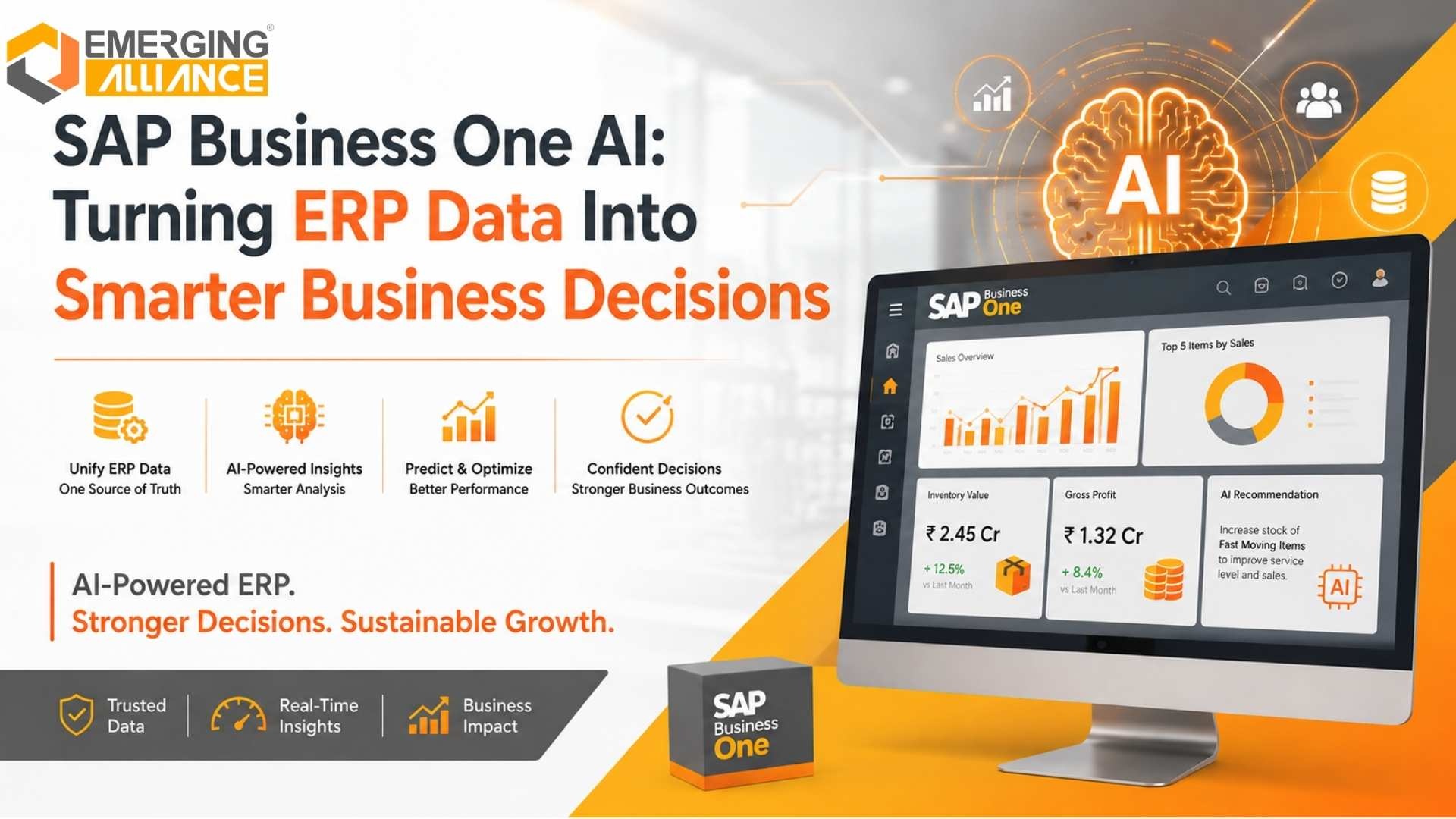
AI in SAP B1 – Introducing Joule: The Innovative SAP Business One AI Module
Quick Answer: What Is SAP Business One AI?
SAP Business One AI refers to the use of artificial intelligence, machine learning, predictive analytics, generative AI, and intelligent automation alongside SAP Business One data and business processes.
SAP’s broader AI portfolio includes SAP Business AI and Joule, SAP’s AI copilot and evolving AI workspace. However, businesses should not assume that every Joule capability is automatically available as a native SAP Business One feature. Availability depends on the SAP solution, architecture, licensing, integration, and supported use case.
For SAP Business One users, the real opportunity is to identify where trusted ERP data can support smarter forecasting, faster analysis, automated workflows, exception detection, and better management decisions.
Why SAP Business One AI Matters for Growing Businesses
Most companies do not suffer from a lack of business data.
They suffer from a lack of actionable intelligence.
SAP Business One may already contain valuable information across:
- Finance
- Sales
- Purchasing
- Inventory
- Production
- Customers
- Suppliers
- Warehouses
- Items
- Service operations
But having data inside an ERP system does not automatically mean decision-makers are extracting its full business value.
Management teams still spend considerable time asking questions such as:
- Why is inventory increasing?
- Which items are at risk of stock-out?
- Which customers are reducing their purchases?
- Which suppliers are affecting procurement performance?
- Why did gross margins decline?
- Which products are moving slowly?
- Where are operational exceptions increasing?
- What requires immediate management attention?
Traditional ERP reports can answer many of these questions.
AI can potentially make the process faster by helping businesses identify patterns, surface exceptions, analyze large amounts of information, generate explanations, and support users with more conversational access to business information.
This is where AI for SAP Business One becomes strategically relevant.
The objective should not be to introduce AI simply because the technology is available.
The objective should be to use AI where it can improve a measurable business outcome.
Does SAP Business One Have AI?
The answer requires an important distinction.
SAP Business One is an ERP platform designed to manage core business processes such as accounting, sales, purchasing, inventory, production, customer management, and reporting.
SAP also has a broader artificial intelligence portfolio called SAP Business AI, with Joule playing an important role in how users interact with AI-supported SAP experiences.
SAP currently describes Joule as an AI experience designed to help users access information and execute supported business processes through conversational interaction. SAP is also expanding its AI strategy through Joule Assistants, Joule Agents, Joule Work, and SAP Business AI Platform.
However, this does not mean every SAP Business One customer automatically receives every SAP Business AI or Joule capability directly inside their existing SAP B1 environment.
Joule availability depends on whether the relevant SAP cloud solution supports Joule integration, along with licensing, entitlements, technical architecture, and configuration requirements. SAP’s Joule pricing documentation specifically identifies an active subscription to an SAP cloud solution with Joule integration as a prerequisite for Joule Base.
For an SAP Business One company, the right question is therefore not simply:
“Does SAP B1 have AI?”
The better question is:
“Which AI capabilities can support our SAP Business One processes, and what architecture is required to deliver them?”
What Is SAP Joule?
Joule is SAP’s AI-powered experience for interacting with business information and supported SAP processes using natural-language requests.
Rather than forcing users to navigate through multiple applications, menus, reports, and screens, the direction of Joule is toward intent-driven work.
A user can express what they want to know or accomplish, and supported Joule capabilities can help find information, navigate applications, perform transactions, or assist with analysis.
SAP’s current AI strategy is broader than a conventional chatbot.
The Joule ecosystem is expanding into several layers.
Joule Base
Joule Base provides foundational capabilities such as conversational navigation, access to trusted SAP information, and supported transactional interactions.
SAP states that Joule Base can provide navigational capabilities, access SAP Help content, and support simple business-object transactions where those scenarios are available.
Joule Assistants
Joule Assistants are designed to provide role- and context-aware AI support for users working across business functions.
The objective is to make AI more relevant to the user’s business context rather than provide generic responses.
Joule Agents
AI agents represent a more advanced model.
Instead of responding only to individual questions, agents can support more complex workflows involving multiple steps, systems, decisions, and actions.
SAP’s current AI direction increasingly emphasizes agents operating within governed enterprise processes and business context.
Joule Work
SAP describes Joule Work as part of its evolving vision for enterprise AI, moving Joule beyond a standalone assistant toward a workspace where AI, assistants, agents, business data, and processes can work together.
For SAP Business One customers, these developments are important because they show where enterprise software is moving.
But companies should still validate which capabilities apply to their specific SAP B1 landscape rather than assuming feature parity across every SAP product.
SAP Business One vs SAP Business AI vs Joule
SAP Business AI Platform is increasingly positioned as the foundation for creating and governing AI agents, applications, and workflows while grounding them in enterprise data and business context.
The practical takeaway is simple:
SAP Business One is the transactional ERP foundation. AI becomes valuable when the business can securely connect that ERP context to the appropriate intelligence, automation, analytics, or AI layer.
7 High-Value SAP Business One AI Use Cases
AI should not start with technology.
It should start with a business problem.
The following use cases illustrate where businesses can investigate AI opportunities around SAP Business One data.
1. Inventory Forecasting and Stock Optimization
Inventory is one of the largest working-capital exposures for manufacturers, distributors, wholesalers, and product-based businesses.
Traditional ERP systems can show:
- Current stock
- Open purchase orders
- Historical consumption
- Sales orders
- Reorder information
- Warehouse availability
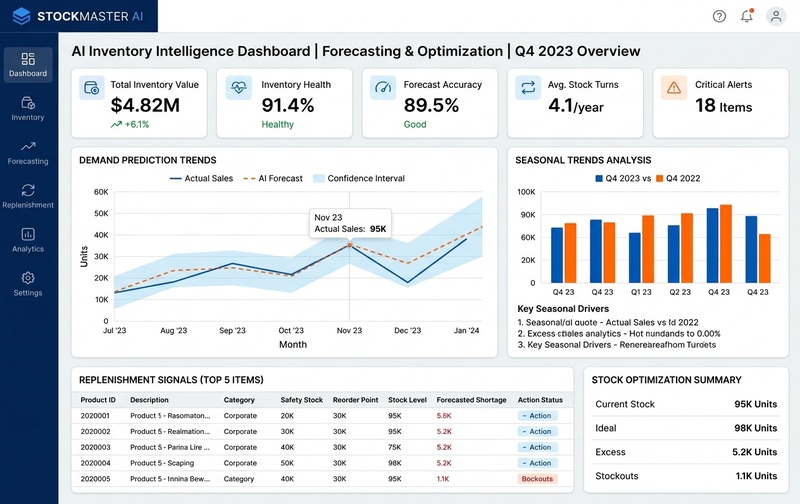
AI-driven demand predictive metrics and stock optimization planning dashboard
AI and predictive models can potentially take the analysis further by identifying patterns across this information.
Businesses could investigate use cases such as:
- Forecasting future demand
- Identifying potential stock-outs
- Highlighting unusual demand changes
- Detecting excess inventory
- Prioritizing slow-moving products
- Identifying unusual warehouse consumption
- Supporting replenishment decisions
Business value
The potential outcome is not simply “better forecasting.”
It is improved:
- Working-capital efficiency
- Inventory availability
- Purchase planning
- Warehouse utilization
- Customer service levels
However, AI forecasting should complement—not blindly replace—MRP, inventory policies, planner judgment, and approved business rules.
2. Procurement and Supplier Intelligence
Procurement teams often have significant historical supplier information but limited time to analyze it.
SAP Business One data may contain information relating to:
- Supplier purchases
- Purchase prices
- Delivery performance
- Purchase quantities
- Returns
- Payment history
- Item sourcing
An AI or analytics solution could potentially help procurement teams surface patterns such as:
- Repeated delivery delays
- Price increases
- Supplier concentration
- Purchase anomalies
- Unusual ordering behavior
- Supplier performance trends
Instead of manually reviewing multiple reports, procurement managers could receive prioritized exceptions requiring attention.
Executive outcome
For CFOs and COOs, the business benefit may include:
- Better cost control
- Reduced supply risk
- Improved supplier negotiation
- Better purchasing discipline
- Faster identification of procurement exceptions
3. Sales Forecasting and Customer Intelligence
Revenue forecasting becomes difficult when decision-makers rely only on historical monthly reports.
AI can potentially help combine historical transactional information with relevant sales variables to identify trends.
Possible use cases include:
- Customer purchase pattern analysis
- Declining account activity
- Product cross-sell opportunities
- Sales forecast support
- Customer segmentation
- Unusual order changes
- Sales-representative performance analysis
For example, management may want to identify customers whose purchase frequency has dropped compared with their historical behavior.
That creates an actionable business signal.
The salesperson can investigate before the account becomes permanently inactive.
Business outcome
The goal is not simply to create more dashboards.
It is to reduce the time between:
Business change → Detection → Management action
4. Finance and Cash-Flow Analysis
Finance teams already use SAP Business One to manage critical financial information.
But management frequently needs answers that go beyond standard accounting reports.
Examples include:
- Why did margins decline?
- Which customers are creating receivables exposure?
- Which cost categories increased unexpectedly?
- Where is working capital being consumed?
- Which business units are deviating from plan?
AI-assisted analysis can potentially help finance teams explore trends and anomalies more quickly.
Potential applications include:
- Receivables-risk analysis
- Cash-flow forecasting support
- Expense anomaly identification
- Margin analysis
- Management commentary generation
- Variance explanation
- Financial exception prioritization
Important consideration
AI-generated financial explanations should be treated as decision support—not as unquestioned financial truth.
Finance teams need:
- Reconciliation
- Source-data validation
- Human review
- Authorization controls
- Auditability
5. Document Processing and Administrative Automation
A significant amount of ERP work still begins with documents.
Examples include:
- Supplier invoices
- Purchase documents
- Customer orders
- Delivery documents
- Statements
- Requests
- Service information
AI technologies can potentially assist with extracting, interpreting, categorizing, validating, or routing information from business documents before that information enters an approved ERP workflow.
The opportunity is particularly relevant where employees spend large amounts of time performing repetitive data-entry or classification activities.
Potential benefits
- Reduced manual entry
- Faster document processing
- Fewer transcription errors
- Better employee productivity
- Faster approval cycles
But document AI must include validation rules.
Automating an incorrect invoice faster does not improve the business.
6. Exception and Anomaly Detection
One of AI’s strongest potential ERP applications is not predicting the future.
It is finding what does not look normal.
Managers cannot manually examine thousands of transactions every day.
AI-assisted anomaly detection can potentially highlight:
- Unexpected discounts
- Unusual purchase quantities
- Abnormal stock movement
- Customer-order deviations
- Supplier-price changes
- Margin anomalies
- Irregular inventory activity
- Exceptional transaction patterns
Instead of reviewing everything, managers can concentrate on exceptions.
This changes management from:
Report-driven monitoring
to:
Exception-driven management
That can be especially valuable in organizations operating across multiple locations, warehouses, divisions, or product categories.
7. Management Reporting and Conversational Insights
A common ERP challenge is that the data exists, but managers still depend on specialists to retrieve it.
A business leader may ask:
“Which products had the biggest margin decline this quarter?”
Traditionally, answering the question may require:
- Opening the correct report.
- Selecting filters.
- Exporting data.
- Performing spreadsheet analysis.
- Interpreting the result.
The long-term value proposition of enterprise conversational AI is to reduce that friction.
A properly governed AI layer connected to trusted business information could make information retrieval more natural.
Instead of learning where a report is stored, the manager focuses on the business question.
This aligns closely with SAP’s broader direction for Joule, which aims to make interaction with supported enterprise applications and information increasingly conversational.
What AI Cannot Fix in SAP Business One
This is one of the most important considerations for any AI project.
AI cannot compensate for fundamentally unreliable ERP data.
If SAP Business One contains poor-quality data, the AI system may simply generate faster conclusions from unreliable information.
Common problems include:
- Duplicate item masters
- Inconsistent item naming
- Incorrect units of measure
- Missing customer information
- Duplicate business partners
- Poor warehouse discipline
- Inaccurate inventory
- Incorrect user permissions
- Uncontrolled manual transactions
- Poorly designed approval processes
- Inconsistent financial coding
Companies should therefore treat AI readiness partly as an ERP data-quality and process-governance exercise.
Before asking:
“Which AI tool should we implement?”
Ask:
“Can we trust the business data that the AI will use?”
That question may determine the success or failure of the entire initiative.
SAP Business One AI Architecture: What Businesses Need to Understand
There is no single architecture that applies to every SAP Business One AI project.
The appropriate design depends on:
- SAP B1 version
- Deployment model
- Database
- Business requirements
- Data sensitivity
- AI use case
- Existing integrations
- Cloud strategy
- Security requirements
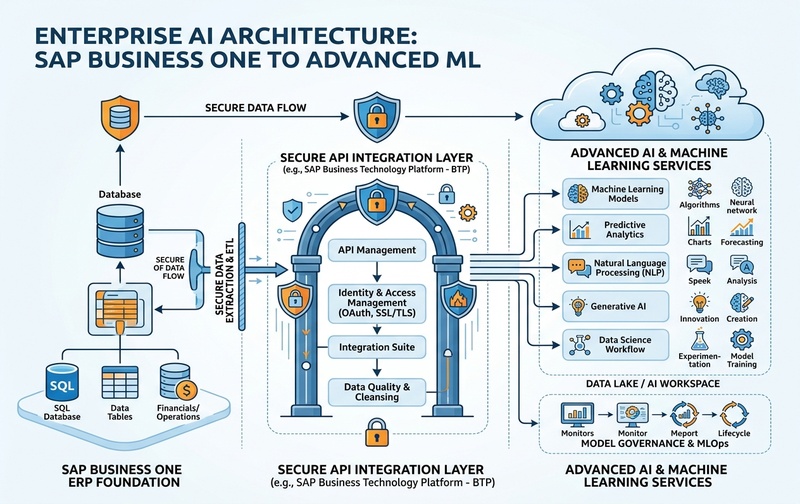
Enterprise architecture connecting SAP Business One via secure API integration (SAP BTP) to AI services
A simplified architecture may look like:
The architecture must ensure that AI access does not bypass existing enterprise controls.
Security questions should include:
- Which data can the AI access?
- Which users can request the information?
- Can the AI create or modify transactions?
- Which actions require human approval?
- Where is the information processed?
- What information is retained?
- How is sensitive data protected?
- How are model outputs validated?
SAP’s current Joule provisioning documentation itself shows that supported Joule integrations require technical prerequisites involving identity, SAP BTP, entitlements, trust configuration, and product-specific integration steps.
Enterprise AI is therefore not simply a chatbot installation. It is an architecture and governance decision.
SAP Business One AI Readiness Checklist
Before investing in AI, organizations should assess six areas.
1. Business Readiness
Ask:
- What specific business problem are we solving?
- What KPI should improve?
- How often does the problem occur?
- What does the current process cost?
- Is AI actually necessary?
A clear business case should come before tool selection.
2. Data Readiness
Assess:
- Master-data quality
- Transaction completeness
- Historical depth
- Duplicate records
- Data consistency
- Data ownership
- Data-access rules
Poor data creates poor AI outcomes.
3. Integration Readiness
Determine:
- Which APIs are available?
- Which external systems must connect?
- Is SAP BTP or another integration layer already available?
- Does the use case require real-time or batch data?
- How will errors be handled?
Integration complexity can materially affect ROI.
4. Security Readiness
Define:
- Authentication
- Role-based authorization
- Data restrictions
- Sensitive-data policies
- Approval controls
- Logging
- Audit trails
Generative AI should never become a shortcut around SAP authorization.
5. Process Readiness
AI cannot improve a process that nobody understands.
Document:
- Current workflow
- Responsible users
- Approval steps
- Business rules
- Exceptions
- Escalations
- Success criteria
Automate only after the process is understood.
6. ROI Readiness
Measure the current baseline.
Depending on the use case, track:
- Hours spent
- Error rate
- Inventory value
- Forecast accuracy
- Stock-outs
- Procurement variance
- Days sales outstanding
- Processing time
- Management-reporting effort
Without baseline metrics, proving AI ROI becomes difficult.
How CXOs Should Prioritize SAP Business One AI Opportunities
Executives should avoid approving AI projects simply because a use case sounds innovative.
A better framework evaluates each opportunity across five dimensions.
The strongest early projects usually have:
High business value + reliable data + low-to-medium complexity + manageable risk.
For example, identifying slow-moving inventory may be a better first AI project than giving an autonomous AI agent authority to post financial transactions.
Start with controlled value.
Then scale.
SAP Business One AI for Pharmaceutical Companies
As the pharmaceutical industry races toward digital innovation, SAP Business One has taken a giant leap forward with Joule, the new AI-powered module designed to transform business decision-making. For pharma CEOs looking to stay competitive, Joule isn’t just a tech upgrade — it’s a strategic necessity.
We are at the forefront of delivering this cutting-edge capability to pharma enterprises aiming to optimize operations, boost compliance, and unlock faster, data-driven insights.
Why AI Matters in the Pharma Sector
The pharma industry operates in a high-stakes environment marked by regulatory scrutiny, volatile demand, and R&D cycles. Traditional ERP have done their part — but now, the integration of AI with SAP Business One through Joule is revolutionizing how pharma businesses function.
Joule AI in SAP B1 helps pharmaceutical companies:
- Identify supply chain disruptions before they occur
- Predict stock-outs and automatically suggest purchase plans
- Accelerate drug development through intelligent data analysis
- Ensure audit-readiness with smart compliance tracking
- Gain real-time visibility into batch quality metrics
Meet Joule: The AI Co-Pilot in SAP Business One
Joule is not just another ERP feature — it’s a smart assistant embedded within SAP Business One. Using natural language processing, it understands and responds to user queries, providing actionable business insights instantly. Whether you’re reviewing inventory, financials, or compliance data, Joule delivers predictive suggestions based on historical trends and real-time data.
Key Features of Joule in Pharma ERP Workflows:
- 🔎 Smart Query Handling: Ask about batch status or inventory levels, and Joule fetches it.
- 📈 Predictive Analytics: Forecast demand for critical drugs and optimize production cycles.
- 🧠 Machine Learning Insights: Improve formulation precision with trend-driven analysis.
- 📊 Intuitive Dashboards: Visualize operational KPIs with AI-suggested alerts.
Strategic Benefits for Pharma CEOs
For C-level executives, the real power of AI in SAP B1 with Joule lies in decision intelligence. Instead of relying on fragmented reports or manual data crunching, CEOs gain a 360-degree command center for all core operations.
Here’s how pharma leaders benefit:
- Accelerated Go-to-Market: AI pinpoints bottlenecks in formulation and packaging timelines
- Enhanced Regulatory Readiness: Stay audit-ready with automated documentation trails
- Reduced Operational Risk: Early warnings on supplier inconsistencies or batch variances
- Informed Investment Planning: Use AI-driven cash flow projections to steer R&D investment
Local Pharma, Global Standards
For Indian pharmaceutical manufacturers, adopting SAP Business One with Joule positions them at par with global standards. The AI layer bridges the gap between operational complexity and strategic agility — a must-have for exporters and GMP-certified facilities.
Final Thoughts: Lead with Intelligence
The future of pharma ERP is not just digital — it’s intelligent. With Joule AI in SAP B1, companies move from reactive management to proactive leadership. Whether it’s navigating regulatory changes or expanding to new markets, CEO can now make faster, smarter decisions backed by AI insights.
SAP Business One AI Pharma Use Cases
Pharmaceutical companies are particularly data-intensive. They may need to manage batch-controlled inventory, expiry exposure, procurement, production, quality-related processes, distribution, demand fluctuations, regulatory documentation, and working capital.
AI can potentially strengthen analysis around these processes—but businesses should distinguish clearly between ERP intelligence and regulated pharmaceutical decision-making.
Possible SAP Business One AI use cases for pharmaceutical companies may include:
- Expiry-risk analysis: Identify inventory that may become commercially difficult to consume before expiry.
- Demand-pattern analysis: Analyze historical demand signals to support planning.
- Batch and inventory exception reporting: Surface unusual inventory movements or operational patterns for human review.
- Procurement analysis: Identify supplier-performance or purchase-price changes requiring attention.
- Management intelligence: Give business leaders faster visibility into operational and financial exceptions.
However, AI should not be represented as automatically guaranteeing GMP compliance, drug quality, regulatory approval, formulation accuracy, or product safety. Those outcomes involve regulated processes, specialist systems, procedures, validation, controls, and human accountability. AI can support decision-making. It does not replace governance.
SAP Business One AI Implementation Roadmap
Organizations should adopt a structured, risk-mitigated approach to AI deployment:
Step 1: Identify One High-Value Problem
Do not start by asking: “Where can we use AI?”
Start with: “Which recurring business problem is expensive enough to solve?”
Choose one measurable use case.
Step 2: Audit SAP Business One Data
Determine whether the required information exists and is reliable.
Check:
- Completeness
- Accuracy
- Consistency
- History
- Ownership
Fix critical data problems before model development.
Step 3: Define the Business KPI
Examples:
- Reduce excess inventory by X%
- Reduce manual reporting time
- Improve forecast accuracy
- Reduce invoice-processing effort
- Detect anomalies earlier
- Improve collections prioritization
AI initiatives need measurable outcomes.
Step 4: Define the Architecture
Identify:
- SAP B1 data source
- Integration method
- AI technology
- Security model
- User interface
- Approval workflow
Avoid creating unmanaged shadow integrations.
Step 5: Build a Controlled Pilot
Test the AI against a limited scope.
Compare AI output with:
- Historical results
- Existing reports
- Expert judgment
- Business rules
Document failures as carefully as successes.
Step 6: Introduce Human Validation
Before automating actions, determine:
- Who reviews recommendations?
- What confidence threshold is acceptable?
- Which actions require approval?
- How are exceptions managed?
Human oversight is especially important for financial, operational, compliance, and customer-impacting decisions.
Step 7: Measure Business Impact
Compare the pilot against the original KPI.
If the solution produces measurable value, expand gradually.
If it does not, improve or stop the initiative.
AI should earn its place in the technology landscape.
From ERP Reporting to AI-Assisted Decision-Making
For years, businesses have used ERP systems primarily to record transactions and generate reports.
AI creates the possibility of a different operating model.
Instead of asking only:
“What happened?”
organizations can increasingly investigate:
- Why did it happen?
- What looks unusual?
- What requires attention?
- What may happen next?
- What information should management review?
- Which process can be automated safely?
That does not make traditional ERP obsolete.
It increases the value of the ERP foundation.
SAP Business One remains the system managing the underlying business processes and transactions.
AI becomes useful when it makes trusted ERP information easier to analyze, understand, and act upon.
The Real SAP Business One AI Opportunity
The biggest opportunity is not adding an AI chatbot to SAP Business One.
It is reducing the distance between business data and business decisions.
A successful SAP Business One AI strategy should help organizations move from:
Reduce manual data-crunching effort by shifting to AI-driven query guidance and auto-reconciliation.
Instead of digging through end-of-month files, get alert summaries the moment anomalous activity is flagged.
Focus on the critical business query (e.g. “Which item margins fell?”) instead of report navigation.
Reduce the time elapsed between operational shift, detection, and executive management response.
Automate administrative overhead (like invoice processing or order matching) safely and with auditability.
But success depends on getting the foundation right.
Companies need:
- Reliable ERP data
- Well-defined processes
- Secure integrations
- Appropriate AI technology
- Clear business KPIs
- Human oversight
- Governance
Without those elements, AI risks becoming another disconnected technology project. With them, SAP Business One data can become a much stronger source of business intelligence.