
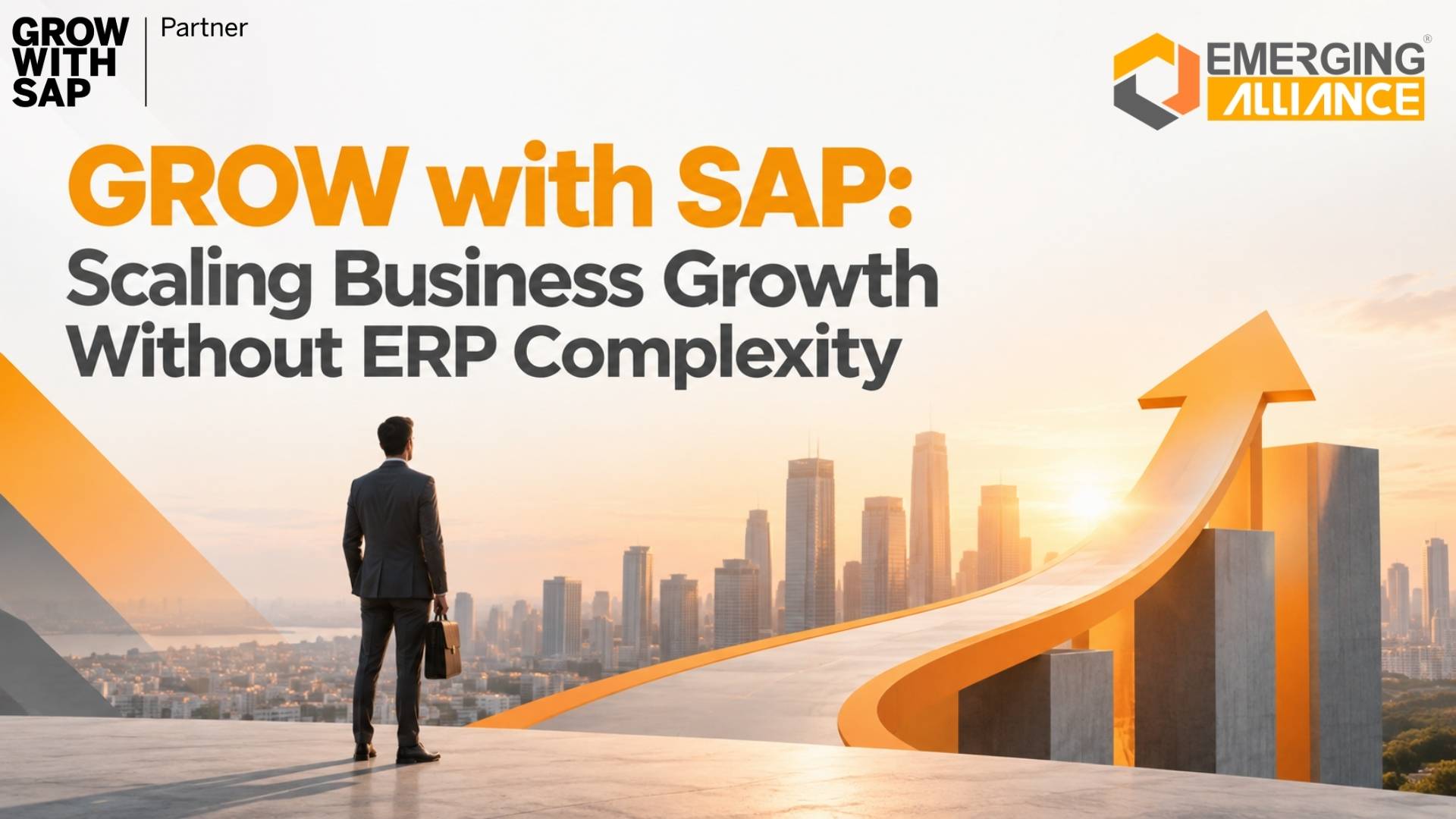
GROW with SAP: Scaling Business Growth Without ERP Complexity
Quick Answer: How GROW with SAP Can Reduce ERP Complexity as Businesses Scale
GROW with SAP can help growing businesses replace fragmented processes, heavy customization, and disconnected data with a more standardized cloud ERP foundation. By supporting common processes, connected information, and scalable operations, it can reduce the technology complexity that often increases when companies add locations, users, products, transactions, and reporting requirements.
Business Growth Can Turn ERP Complexity Into a Business Problem
Business growth changes what an ERP environment must support. A system that worked well for one location, a smaller workforce, limited product lines, and straightforward reporting can face very different demands after several years of expansion.
New locations add users, approvals, inventory movements, and reporting responsibilities. Additional business units introduce different process needs. Higher transaction volumes increase pressure on controls and reporting. New products or services create new pricing, procurement, fulfillment, and accounting requirements. Regional expansion can add compliance and localization considerations.
Growth also increases the suppliers, customers, employees, warehouses, and sales teams the business must coordinate. Leadership may need consolidated information while local teams still require operational detail.
The question is not whether the ERP can process more transactions. It is whether the operating model can scale without requiring more workarounds, applications, manual intervention, and IT effort at every stage.
Complexity often builds gradually. A spreadsheet fills a reporting gap. A separate application solves a new requirement. A custom workflow supports one unit. Another interface connects a new system. Individually reasonable decisions can create an environment that becomes harder to replicate, govern, and maintain.
The real decision becomes: can the current ERP foundation support the next stage of growth without allowing ERP complexity to grow at the same rate?
Where ERP Complexity Starts to Slow Business Growth

ERP complexity builds as companies scale, creating fragmented data silos, spreadsheet dependencies, and process bottlenecks that slow business growth.
ERP complexity becomes a growth constraint when information and processes stop moving cleanly across the organization.
Disconnected applications can create separate versions of operational information. Multiple databases make customer, supplier, inventory, and financial data harder to align. Manual transfers delay processes, while duplicate entry increases effort and conflicting information.
Inconsistent workflows add another problem. One location may use controlled approvals while another relies on email. One unit may post directly in ERP while another works through spreadsheets. These differences make reporting and process control harder.
Customization becomes a constraint when it grows without governance. Specialized changes increase dependencies, testing, documentation, and upgrade considerations. The issue is not customization itself; it is turning every local preference into permanent system logic.
Point-to-point integrations compound the problem. A change in one application may affect several interfaces. Teams can spend significant effort tracing why transactions fail or why reports do not reconcile.
Spreadsheets may support planning, approvals, reconciliations, or inventory tracking. They are useful tools, but permanent spreadsheet bridges can move critical decisions outside governed ERP data.
The business effects are cumulative: slower decisions, inconsistent information, operational delays, higher dependency on specialist employees, and more difficulty standardizing processes across locations. Growth continues, but each new entity inherits more complexity.
At this stage, the requirement is no longer another local fix. The business needs a foundation that can support more activity while reducing unnecessary process variation and disconnected information.
The Hidden IT Cost of Supporting a Complex ERP Environment
For CTOs and IT leaders, ERP complexity appears as a growing maintenance burden.
Every integration creates dependencies. Interfaces need monitoring, mapping, error resolution, credential management, and testing. When connected applications change APIs or business rules, the ERP landscape may also require adjustment.
Customizations create similar responsibilities. IT must know why each one exists, who depends on it, and how it behaves during upgrades. Poor documentation makes improvements harder to plan.
Application sprawl increases troubleshooting effort. An incorrect order, invoice, inventory quantity, or report may originate outside ERP. IT may have to trace the transaction through interfaces, middleware, spreadsheets, and third-party systems.
Data management becomes harder when applications use different identifiers, validation rules, or update schedules. Vendor coordination adds another layer when several providers share one process.
The strategic cost is the use of IT capacity. Skilled teams can become focused on keeping the existing environment stable instead of supporting analytics, automation, new locations, and future business capabilities.
This does not mean every legacy application or customization should disappear. It means leadership should understand the architecture it is carrying forward. If every new business requirement produces another custom layer, manual bridge, or point-to-point connection, the company may need a more standardized ERP strategy rather than another technical patch.
Why Standardized ERP Becomes Important During Business Expansion
Standardization matters when growth requires a company to repeat successful processes across more locations, teams, and business units.
A standardized ERP approach creates a common foundation for processes, data, controls, and configuration. Finance can follow consistent posting and closing logic. Procurement can use common approvals. Sales can use defined order processes. Inventory movements can follow shared rules, while reporting relies on more consistent data.
The objective is not to make every unit identical. Regions, legal entities, and industries may require legitimate variations. The goal is to separate necessary differentiation from historical preference or workarounds.
That is the difference between standardization and simply adding customization. Customization changes the system to preserve a particular way of working. Standardization first asks whether a common process can meet the requirement, then uses controlled configuration or extensions where a justified difference remains.
This approach matters during expansion because repeatable processes are easier to deploy than processes dependent on local spreadsheets, undocumented approvals, and custom integrations.
A growing business therefore needs more than ERP capacity. It may need a common, scalable ERP foundation with connected data, controlled configuration, repeatable processes, and a technology model that can absorb new capabilities without continuously rebuilding the core.
How GROW with SAP Addresses the Need for a Scalable ERP Foundation

GROW with SAP delivers a standardized, modern cloud ERP operating model that unifies core functions on SAP S/4HANA Cloud Public Edition.
GROW with SAP is relevant because it is built around a standardized cloud ERP operating model. In SAP’s current terminology, SAP GROW is positioned as an entry point to SAP Cloud ERP, built on SAP S/4HANA Cloud Public Edition.
The value becomes clearer when tied to the business problem.
SAP also positions the offering around industry best practices and continuous innovation.
This differs from simply moving an existing ERP to cloud infrastructure. Hosting a customized system in the cloud changes where it runs, but may leave process variation, custom code, integrations, and fragmented data intact. GROW with SAP is better evaluated as a standardized SAP cloud ERP solution and operating model.
Suitability still depends on business requirements, existing systems, industry needs, integration requirements, organizational readiness, and the desired balance between standardization and differentiation.
How GROW with SAP Can Simplify Processes as the Business Scales
Process variation becomes harder to control as a business adds locations and units. A small local difference can eventually affect controls, training, reporting, support, and integrations.
A standardized ERP foundation can reduce unnecessary variation in core processes.
In finance, common workflows can support consistent transactions, approvals, closing, and reporting. In procurement, standardized steps can reduce differences in requisitions, purchase orders, and supplier transactions. In sales, common order-to-cash processes can create clearer handoffs to fulfillment and finance.
Inventory and supply chain can use shared rules for material movements, purchasing, fulfillment, and operational data. Teams can use a common process model while retaining necessary configuration.
GROW with SAP supports this principle by using SAP-delivered best practices as a starting point. SAP describes the underlying public-cloud ERP approach as providing industry best practices and continuous innovation.
For leadership, governance matters. Standardization should not force every process into an identical template. Regulatory, industry, competitive, and local requirements still matter.
The stronger approach is to standardize common processes and challenge variations that do not create meaningful value. Exceptions can then be designed deliberately instead of becoming uncontrolled customizations.
As the company expands, new units can start from an established process foundation, train around common workflows, and use more consistent reporting. Standardized ERP can support scale without recreating complexity in every location.
How GROW with SAP Supports Connected Business Operations
Growth exposes gaps between functions. Finance may depend on sales data held elsewhere, procurement may sit apart from inventory planning, and local operational applications may not feed management reporting quickly.
A cloud ERP foundation can reduce some of this fragmentation by connecting core business processes around shared data and transaction flows.
For decision-makers, the value is consistency and visibility. When core functions use aligned data structures and workflows, leaders can spend less time reconciling reports and more time interpreting performance.
Connected operations can improve coordination. Sales activity can flow into fulfillment, inventory, and finance through defined relationships. Procurement can connect with supply requirements and financial commitments without repeated manual transfers.
This does not mean every external application disappears after adopting GROW with SAP. Growing companies may still require industry platforms, CRM, logistics tools, e-commerce systems, planning applications, or regulatory services.
Integration remains an architecture decision. SAP provides cloud integration and extension capabilities, but the design must reflect the company’s technology landscape.
The target should be fewer unnecessary disconnections, not one application for everything. Core processes and governed data can use a common ERP foundation while required applications remain deliberately integrated.
When GROW with SAP May Be Relevant for a Growing Business
Evaluating GROW with SAP may make sense when growth is exposing structural weaknesses in the current ERP environment.
Common triggers include scaling limits, fragmented systems, rising customization, expansion requiring more consistency, or a strategic move toward a cloud ERP operating model. It may also matter when IT spends substantial effort maintaining interfaces, reconciling data, or supporting custom code.
However, evaluation should not begin with the assumption that GROW with SAP is automatically suitable.
Highly specialized processes may require a detailed fit review. Complex integrations need architecture analysis. Industry-specific requirements and major legacy dependencies may affect scope and migration sequencing.
Process readiness is equally important. Leaders must decide where common processes are desirable and where variation is necessary. Reproducing every existing process can simply move old complexity into a new platform.
The operating model also matters. Leadership should define how configuration, extensions, integrations, data governance, upgrades, and ownership will be managed after implementation.
The qualification question is therefore not whether GROW with SAP is universally better. It is whether a standardized SAP cloud ERP model fits the company’s business processes, growth plans, industry requirements, integration landscape, and readiness for change.
What Changes for CEOs and CTOs When ERP Becomes a Growth Enabler
CEOs and CTOs approach ERP from different directions, but growth brings their priorities together.
The CEO wants operations to scale consistently. New locations should not require reinventing core processes. Leadership needs dependable visibility, and expansion should not be slowed by fragmented workflows or operational friction.
The CTO needs an architecture that supports those goals sustainably. Integrations should be governed, customization justified, and the ERP core maintainable. Data, extensions, security, and external applications should fit an intentional technology model.
A scalable ERP strategy connects both perspectives. Standardization can improve process consistency while reducing variants IT supports. Connected data can improve visibility while stronger integration governance improves maintainability.
GROW with SAP should therefore be evaluated through joint business and technology outcomes. The decision is not simply whether the company wants a newer ERP. It is whether leadership is prepared to use a standardized ERP foundation to support future business requirements.
That changes the implementation conversation. Executives can instead define essential capabilities, standard processes, justified differences, and necessary integrations.
This reframing is important. ERP becomes a growth enabler when technology decisions reinforce the operating model the business wants to scale.
From ERP Complexity to a Scalable ERP Strategy
The decision path is straightforward even when the technology landscape is not.
Business growth increases scope, transactions, reporting needs, and process coordination. If ERP evolves through disconnected systems, workarounds, customizations, and point-to-point integrations, complexity can rise with it. IT carries more maintenance responsibility while leadership gets slower access to consistent information.
The response is not automatically a new ERP. First define what the future operating model requires: standardization, connected data, controlled extensions, repeatable processes, and technology that supports expansion.
A scalable cloud ERP approach can then be evaluated against those requirements. GROW with SAP becomes relevant when the organization sees value in a standardized public-cloud ERP foundation and is willing to assess process fit, integrations, extensions, data, and change requirements.
The discussion should start with the current landscape: core systems, manual bridges, essential customizations, critical integrations, required process differences, historical variations, and planned expansion.
Those questions create a practical basis for a discussion with an SAP specialist. The objective is not to buy “cloud” as a label. It is to determine whether a standardized cloud ERP approach can reduce unnecessary complexity while creating a stronger foundation for future growth.
Conclusion: Building Growth on a Less Complex ERP Foundation
Growth should not require continuously adding systems, customizations, spreadsheets, manual handoffs, and integration dependencies. When that becomes the default response to expansion, ERP complexity can restrict the business it should support.
GROW with SAP can be evaluated as a standardized cloud ERP approach for organizations seeking a scalable foundation, connected processes, and process consistency. It is not automatically suitable for every business. Fit depends on processes, industry requirements, growth plans, existing systems, integrations, data, readiness, and the desired operating model.
The strongest decision starts with understanding the current environment and the future operating model the company wants to build.
Frequently Asked Questions About GROW with SAP
Talk to Our Specialist About Your Growth Plans
Emerging Alliance can discuss your current ERP environment, growth requirements, process complexity, integration landscape, and future technology needs, then explore whether GROW with SAP fits your direction. Use the conversation as a focused demo discussion around real processes and expansion priorities—not a generic product presentation.