
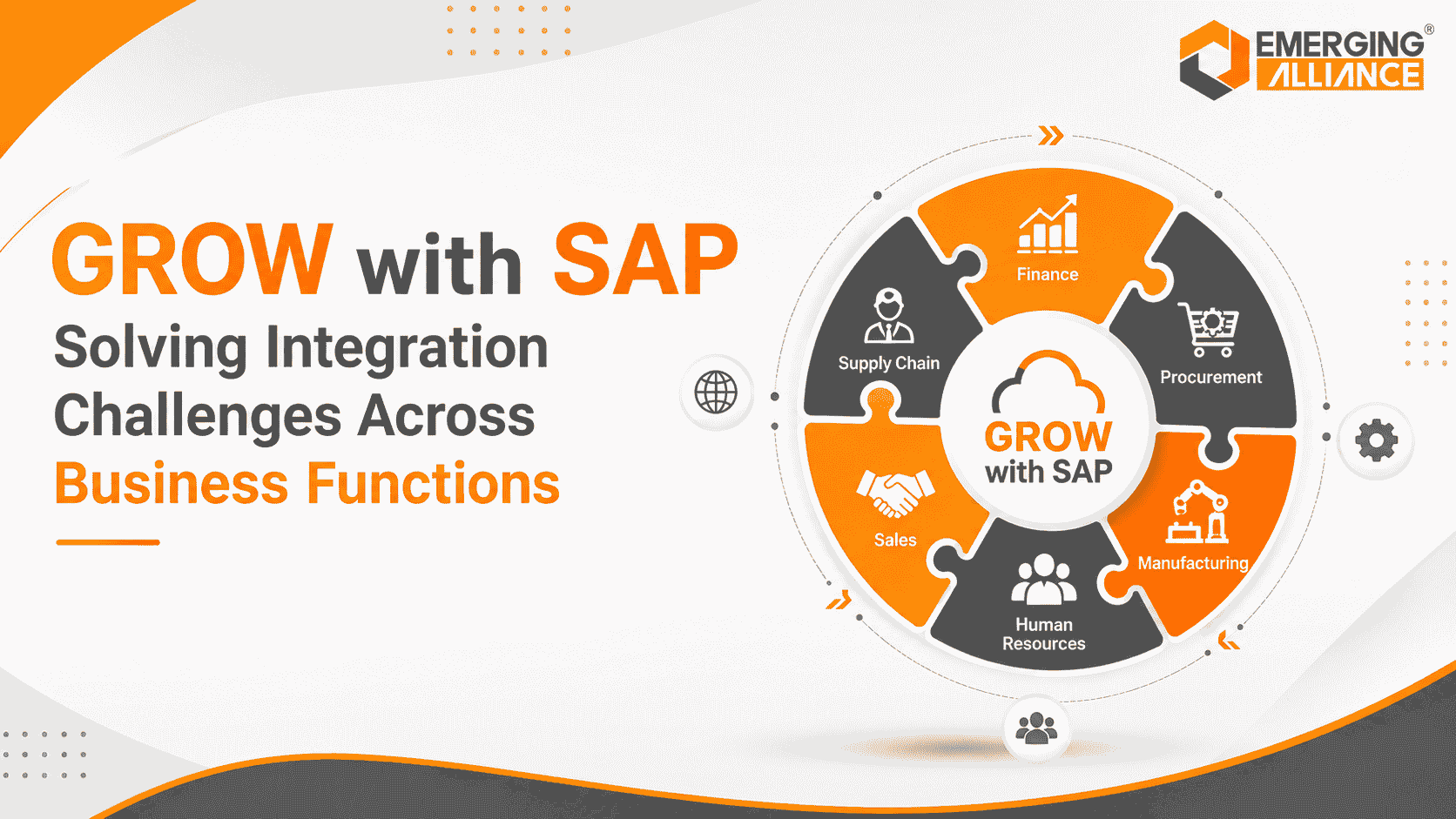
GROW with SAP Solving Integration Challenges Across Business Functions
Quick Answer
GROW with SAP solves business integration challenges by connecting finance, procurement, manufacturing, sales, inventory, supply chain, and reporting on a unified cloud ERP platform.
Instead of transferring data manually between disconnected applications, organizations can standardize processes, automate workflows, access real-time information, and improve collaboration across departments. This creates a connected digital foundation that supports faster decisions, stronger governance, operational efficiency, and scalable growth.
Key Takeaways
- GROW with SAP connects core business functions through SAP Cloud ERP.
- Integrated data reduces reconciliation, duplication, and reporting delays.
- Real-time visibility improves planning and decision-making.
- Standardized workflows strengthen governance and process consistency.
- Cloud-based scalability supports new locations, users, products, and business models.
- Successful implementation requires process alignment, clean data, change management, and the right SAP partner.
Disconnected Business Systems as a Barrier to Growth
As organizations expand, disconnected finance, procurement, manufacturing, and sales systems can become one of the biggest barriers to operational performance.
Finance may rely on one application, procurement on another, manufacturing on a separate planning system, and sales on its own customer platform. Employees then use spreadsheets, emails, and manual data transfers to connect processes that should work together automatically.

Disconnected systems create data silos and operational bottlenecks that hinder sustainable enterprise expansion.
This fragmentation creates:
- Multiple versions of business data
- Repetitive data entry
- Delayed financial and operational reporting
- Weak coordination between departments
- Limited visibility into inventory and production
- Inconsistent customer information
- Higher operational risk
- Slower business decisions
The issue is not simply that departments use different software. The larger problem is that a decision in one department cannot immediately trigger the correct action in another.
A customer order may not update production planning. A purchase commitment may not appear in the financial forecast. A material shortage may not be visible to sales before a delivery date is promised.
GROW with SAP helps eliminate this fragmentation by creating a connected cloud ERP environment in which data and business processes flow across functions.
SAP describes SAP S/4HANA Cloud Public Edition as a flexible ERP foundation designed to support core processes across finance, supply chain, HR, and sales using preconfigured best practices and embedded intelligence.
Why Enterprise Integration Has Become a Business Priority
Modern enterprises operate across departments, legal entities, locations, suppliers, distribution channels, and customer segments.
Although every department has its own responsibilities, business outcomes depend on coordinated execution.
For example:
- Procurement decisions affect cash flow and production availability.
- Inventory accuracy influences sales commitments.
- Manufacturing performance affects delivery schedules.
- Customer orders affect revenue forecasts.
- Supplier delays influence production and customer satisfaction.
- Financial controls affect purchasing and credit decisions.
When these activities operate in isolated systems, management receives an incomplete view of the business.
Leaders may know what happened in finance but not why it happened operationally. They may see lower sales without immediately identifying inventory constraints, production delays, pricing issues, or procurement shortages.
An integrated cloud ERP shifts the management question from:
“How can each department work more efficiently?”
to:
“How can every department operate as one connected enterprise?”
This is why cloud ERP integration is increasingly treated as a business transformation priority rather than an isolated IT project.
Common Integration Challenges Across Business Functions
Finance and Procurement Misalignment
When finance and procurement operate on separate platforms, purchasing activity may not be reflected immediately in budgets, cash-flow projections, accounts payable, or management reporting.
Teams may need to reconcile:
- Purchase requisitions
- Purchase orders
- Goods receipts
- Supplier invoices
- Payment approvals
- Budget consumption
- Supplier balances
Manual reconciliation increases processing time and makes it harder for finance leaders to understand committed expenditure.
With integrated finance and procurement processes, purchasing activity can flow into financial records with stronger visibility and control. SAP’s public-cloud procurement capabilities include centralized purchasing, automated accounts-payable processes, supplier information, and real-time insights.
Manufacturing and Inventory Misalignment
Manufacturing depends on accurate information about:
- Raw material availability
- Work-in-progress
- Bills of material
- Production capacity
- Purchase-order status
- Quality requirements
- Finished-goods inventory
When manufacturing and inventory systems are disconnected, production teams may discover material shortages only after schedules have been finalized.
This can result in:
- Production stoppages
- Expedited purchasing
- Excess safety stock
- Missed delivery commitments
- Underutilized capacity
- Higher production costs
SAP S/4HANA Cloud Public Edition supports production engineering, planning, execution, and quality-related manufacturing processes within its available scope.
Sales and Operations Misalignment
Sales teams need reliable answers before making customer commitments.
They require visibility into:
- Available inventory
- Planned production
- Customer credit
- Current pricing
- Delivery capacity
- Order status
- Outstanding receivables
Without integrated systems, sales representatives may depend on old reports or manually contact finance, warehouse, and production teams. This slows quotation and order confirmation while increasing the risk of unrealistic delivery promises.
Spreadsheet-Dependent Reporting
Spreadsheets are often used to compensate for disconnected systems.
They may initially appear flexible, but spreadsheet-based consolidation creates:
- Duplicate data
- Version-control problems
- Formula errors
- Manual reporting delays
- Limited audit trails
- Dependence on individual employees
- Low confidence in management reports
Executives then spend valuable time validating information instead of acting on it.
Legacy-System Complexity
Legacy applications may support individual departments adequately while failing to support end-to-end business processes.
Every new interface, spreadsheet, database, or manual workaround increases complexity. As the organization grows, these temporary solutions become part of the operating model and become increasingly difficult to replace.
Disconnected Systems vs GROW with SAP
| Operational Area | Disconnected Systems | GROW with SAP Environment |
|---|---|---|
| Business data | Multiple departmental databases | Shared and governed business data |
| Reporting | Manual consolidation | Real-time operational and financial reporting |
| Finance | Reconciliation after transactions | Transactions connected with financial processes |
| Procurement | Limited spend visibility | Integrated purchasing and supplier processes |
| Manufacturing | Delayed material information | Connected planning, inventory, and production data |
| Sales | Outdated availability information | Improved visibility into orders and fulfillment |
| Approvals | Email and spreadsheet workflows | Standardized digital workflows |
| Governance | Inconsistent processes | Defined controls and process standards |
| Scalability | More applications and interfaces | Extendable cloud ERP foundation |
| Decision-making | Reactive and report-dependent | Faster and more data-driven |
How GROW with SAP Connects Business Functions
GROW with SAP combines SAP Cloud ERP with implementation services, adoption support, best practices, and a scalable foundation for growing organizations.
SAP explains that the broader SAP GROW offering includes cloud ERP, embedded AI capabilities, adoption support, and ongoing innovation. SAP GROW Fast is the structured implementation service designed to deliver SAP Cloud ERP through a predefined scope and proven methodology.
Unified Financial Management
Finance teams can work with connected information from operational transactions instead of waiting for data to be transferred from other systems.
Relevant processes can include:
- General ledger
- Accounts payable
- Accounts receivable
- Asset accounting
- Cost management
- Cash-flow visibility
- Financial planning
- Margin analysis
- Compliance and reporting
SAP states that its public-cloud finance capabilities unify transactions, analytics, and planning while supporting accounting, cost management, enterprise risk, and compliance processes.
This integration helps finance teams move from retrospective reporting toward active business support.
Integrated Procurement
Procurement can connect purchasing requirements with inventory, manufacturing, supplier management, approvals, and finance.
This supports:
- More accurate purchase planning
- Better supplier coordination
- Digital approval workflows
- Improved spend visibility
- Reduced procurement cycle time
- Stronger budget control
- Better material availability
When procurement data is connected, purchasing teams can consider both immediate requirements and their wider financial and operational impact.
Connected Manufacturing
Manufacturing teams can use shared information to coordinate:
- Demand
- Material requirements
- Production orders
- Capacity
- Inventory
- Procurement
- Quality
- Cost
This reduces the need to compile information from separate systems before making production decisions.
It also helps organizations move from reactive production management toward more coordinated planning and execution.
End-to-End Sales Visibility
Sales teams can access more reliable information when customer, inventory, pricing, finance, and fulfillment processes operate on the same digital foundation.
This helps teams:
- Confirm orders faster
- Provide more realistic delivery dates
- Reduce pricing inconsistencies
- Check customer credit status
- Track fulfillment progress
- Respond to customer enquiries more accurately
The result is not only better internal efficiency but also a more consistent customer experience.
Centralized and Governed Data
A connected cloud ERP reduces duplicate departmental databases and provides a more consistent source of operational information.
Shared data can improve:
- Master-data accuracy
- Reporting consistency
- Cross-functional accountability
- Planning reliability
- Auditability
- Management confidence
Centralized data does not mean every user sees everything. Access should still be controlled according to roles, responsibilities, and governance policies.
Real-Time Analytics
Traditional reporting often explains what happened after the opportunity to respond has passed.
Integrated analytics help leaders monitor areas such as:
- Revenue
- Margin
- Cash flow
- Procurement performance
- Inventory movement
- Production output
- Order fulfillment
- Working capital
- Operational KPIs
SAP’s finance documentation describes financial data in SAP S/4HANA Cloud Public Edition as real-time and continuously reconciled.
Workflow Automation
Routine actions can be standardized and automated, including:
- Purchase approvals
- Invoice processing
- Notifications
- Exception routing
- Order processing
- Financial postings
- Document handling
- Task assignments
Automation reduces administrative effort, but its greater value comes from creating consistent and traceable processes.
Standardized Business Processes
GROW with SAP emphasizes preconfigured processes and industry best practices.
Standardization can help organizations:
- Reduce unnecessary process variation
- Simplify employee training
- Strengthen governance
- Accelerate deployment
- Make future expansion easier
- Avoid excessive customization
SAP positions SAP S/4HANA Cloud Public Edition as a ready-to-run ERP using preconfigured end-to-end processes and industry best practices.
Connected Enterprise Scenario
Consider a manufacturing company receiving a high-value customer order.
In a disconnected environment:
- Sales asks the warehouse to confirm stock.
- The warehouse checks a separate system.
- Manufacturing reviews production capacity manually.
- Procurement checks material shortages in another application.
- Finance verifies credit through email.
- Management calculates profitability using a spreadsheet.
- Each step introduces delay and potential error.

An integrated ERP connects all business departments to enable real-time tracking, forecasting, and fulfillment.
In an integrated GROW with SAP environment:
- Sales enters or reviews the customer order.
- Inventory availability becomes visible.
- Manufacturing requirements can be assessed.
- Procurement identifies supply requirements.
- Finance reviews credit and financial impact.
- Management gains visibility into operational and financial implications.
The business can respond faster because every department is working from connected data and coordinated processes.
Business Benefits of GROW with SAP Integration
Faster Decision-Making
Real-time and connected information helps management identify issues earlier and respond with greater confidence.
Reduced Manual Work
Automation reduces repetitive entry, reconciliation, report preparation, and departmental follow-up.
Greater Operational Efficiency
End-to-end processes remove unnecessary handoffs and reduce delays between business functions.
Improved Financial Control
Connected procurement, sales, inventory, and manufacturing data gives finance teams stronger visibility into business activity.
Better Governance
Standardized workflows support defined approval rules, segregation of duties, traceability, and audit readiness.
Higher Employee Productivity
Employees spend less time searching for information, transferring data, and correcting inconsistencies.
Stronger Cross-Functional Collaboration
Teams can coordinate around shared transactions, data, and performance indicators instead of departmental spreadsheets.
Improved Customer Responsiveness
Sales and service teams can provide faster and more reliable information about availability, delivery, orders, and account status.
Enterprise Scalability
Organizations can add users, business functions, locations, and capabilities without rebuilding the entire digital foundation.
SAP states that SAP S/4HANA Cloud Public Edition supports expansion through additional features, modules, and users, while operating on a subscription-based cloud model.
Continuous Innovation
Because SAP S/4HANA Cloud Public Edition is delivered as software as a service, SAP manages infrastructure-related activities such as installation and upgrades, subject to the terms and scope of the subscribed service.
GROW with SAP Implementation Best Practices
Define Business Outcomes
Do not begin with a list of software features.
Define measurable outcomes such as:
- Faster financial close
- Reduced order-processing time
- Better inventory accuracy
- Shorter procurement cycles
- Improved on-time delivery
- Reduced manual reporting
- Better working-capital visibility
Map End-to-End Processes
Review complete business processes rather than separate departmental activities.
Examples include:
- Lead to cash
- Source to pay
- Plan to produce
- Record to report
- Hire to retire
- Issue to resolution
Standardize Before Customizing
Excessive customization can increase cost, complexity, testing effort, and upgrade risk.
Organizations should first evaluate whether SAP’s standard processes can meet the underlying requirement.
Improve Master-Data Quality
Cloud ERP performance depends on reliable data.
Important data objects may include:
- Customers
- Suppliers
- Materials
- Products
- Pricing
- Bills of material
- Assets
- Employees
- Cost centers
Data cleansing should begin before migration, not during the final deployment phase.
Prioritize Critical Integrations
Not every legacy integration should be recreated.
Assess each integration according to:
- Business necessity
- Data ownership
- Transaction volume
- Risk
- Future relevance
- Available standard APIs
- Maintenance requirements
Invest in Change Management
ERP transformation changes how employees work.
Successful adoption requires:
- Clear communication
- Role-based training
- Process ownership
- Super-user involvement
- Leadership sponsorship
- Post-go-live support
Measure Results
Track implementation outcomes using predefined KPIs.
Without a measurement framework, organizations may complete the technical deployment without confirming whether business performance improved.
Why Choose Emerging Alliance for GROW with SAP?
Technology alone does not create an integrated enterprise. The implementation partner must understand how financial, operational, supply-chain, manufacturing, and sales processes affect one another.
Emerging Alliance helps organizations plan and execute GROW with SAP transformation through:
Rather than treating implementation as a software installation, Emerging Alliance focuses on building a practical operating model that improves visibility, collaboration, governance, and scalability.
SAP also emphasizes the role of qualified partners in defining a focused scope, using standardized implementation methods, reducing project uncertainty, and protecting business continuity during deployment.
Build a Connected Enterprise with GROW with SAP
Disconnected systems make growth more difficult than it needs to be.
They increase reporting delays, manual work, operational risk, and dependence on departmental knowledge. More importantly, they prevent leaders from seeing how one business decision affects the rest of the organization.
GROW with SAP provides a path to connect finance, procurement, manufacturing, sales, supply chain, analytics, and other core processes through a unified cloud ERP foundation.
With standardized workflows, governed data, automation, and real-time visibility, organizations can operate with greater speed, control, and confidence.
The objective is not simply to replace software.
It is to create a connected enterprise capable of supporting sustainable growth.
Frequently Asked Questions
Schedule a GROW with SAP Consultation
Is your business still relying on disconnected systems, spreadsheet-based reporting, or manual reconciliation?
Emerging Alliance can help you evaluate:
- Current integration gaps
- Process inefficiencies
- Data readiness
- Cloud ERP suitability
- Implementation priorities
- Migration requirements
- Expected business outcomes
Schedule a GROW with SAP consultation or Cloud ERP Readiness Assessment with Emerging Alliance to build a practical roadmap for connected business operations.