

ERP for Cable Manufacturing: Tackling the Operational Gaps Behind Rising Production Costs
Quick Answer: How ERP for Cable Manufacturing Tackles Rising Production Costs
ERP for cable manufacturing helps manufacturers connect raw-material inventory, production planning, material consumption, costing, work-in-progress and finished-goods management within a centralized system. This becomes increasingly important when rising production costs are driven by material price fluctuations, excess consumption, production waste, inventory discrepancies, manual processes and limited cost visibility.
For cable and wire manufacturers, the value of ERP is not simply automation. It is the ability to connect operational data so management can identify where materials are being consumed, where production variances occur, how orders affect production requirements and how those activities influence product costs.
A manufacturing ERP can support processes across procurement, inventory, production, sales, costing and reporting, depending on the system, configuration and integrations involved. The right solution should therefore be evaluated against the manufacturer’s actual production model rather than selected solely on the basis of available features.
Why Rising Production Costs Are Becoming an Operational Problem
Cable manufacturing is highly dependent on materials, production efficiency and accurate costing. Even relatively small discrepancies in material consumption or production output can affect the cost of finished products.
For example, a manufacturer may be dealing with:
These problems are often interconnected:
A purchasing team may know how much material was received, while production tracks consumption separately. Finance may calculate costs using another data source. Sales may not have immediate visibility into production status.
The result is not necessarily one major operational failure. Instead, small information gaps accumulate across the manufacturing process and make rising production costs harder to understand and control.
This is where an ERP for cable manufacturing becomes relevant.
Cable Manufacturing ERP: Where Operational Gaps Begin
The need for ERP usually becomes apparent when individual processes work reasonably well but the connections between them do not.
A cable manufacturer may have separate processes for purchasing, inventory, production, sales and finance. If these processes depend heavily on spreadsheets, manual updates or disconnected applications, information can become fragmented.
Consider a simple production flow:
➔
➔
➔
➔
➔
➔
➔
Every stage affects the next.
If inventory information is inaccurate, production planning can be affected. If production consumption is not recorded accurately, costing becomes less reliable. If sales and production data are disconnected, customer commitments become harder to coordinate.
ERP brings these activities into a connected operational framework.
The objective is not simply to digitize individual tasks. It is to create one consistent flow of operational information.
ERP for Cable Manufacturing and Raw-Material Control
Raw materials represent a major part of manufacturing operations, making inventory visibility particularly important for cable and wire producers.
Depending on the manufacturing process, materials may include conductors, insulation materials, compounds, packaging materials and other production inputs.
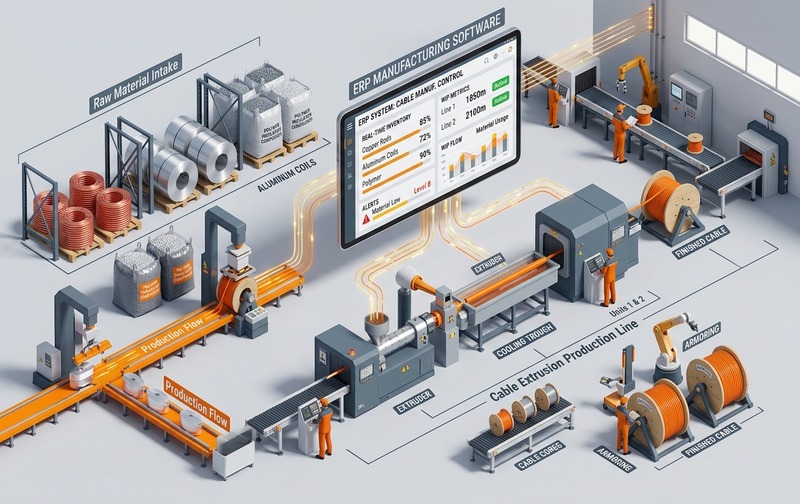
Connecting raw-material procurement, conductor inventory, extrusion lines, and material consumption within an integrated ERP system.
An ERP system can connect material requirements with purchasing, inventory and production activities.
This allows businesses to establish clearer relationships between:
➔
➔
➔
➔
That visibility can help management investigate discrepancies instead of relying on disconnected records.
Managing Material Availability
Production planning depends on knowing whether required materials are actually available.
If inventory information is delayed or inaccurate, manufacturers may experience:
An integrated ERP environment can provide a more structured view of material availability and requirements.
The exact functionality depends on the ERP platform and implementation design, but the underlying objective remains the same: connect inventory information with production requirements.
ERP for Cable Production Planning and Scheduling
Production planning becomes more difficult as product variations, order volumes and manufacturing requirements increase.
Cable manufacturers may produce different products based on specifications such as:
A disconnected production process makes it harder to understand which orders require which materials and when those materials need to be available.
An ERP system can provide a centralized environment for production orders, material requirements and production status.
This gives production teams a structured view of what needs to be produced and allows other departments to work from the same operational information.
The important consideration is not whether an ERP contains a generic “production planning” feature.
The Real Planning Question:
Can the system support the manufacturer’s actual production logic without creating excessive manual work?
Cable Production Costing: Finding the Sources of Cost Variance
Production costing is one of the most important areas to address when production costs are rising.
A manufacturer needs visibility into the relationship between planned production costs and actual production activity.
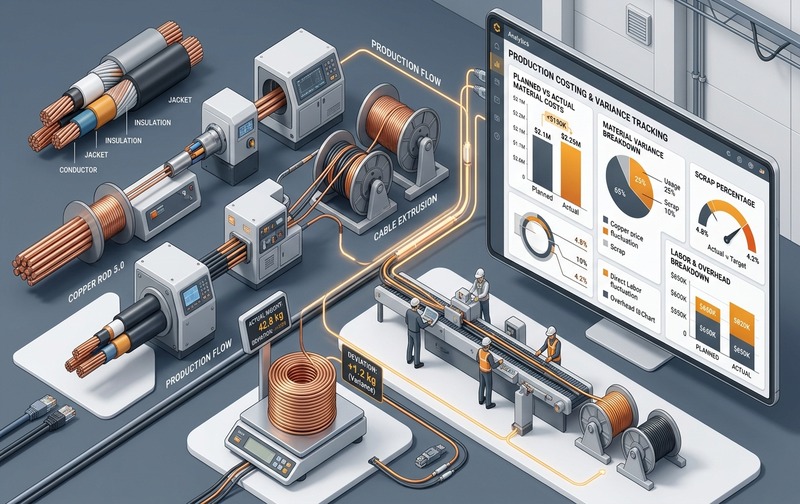
Tracking cable production costing, planned versus actual material consumption, and scrap variances in real time.
Relevant cost factors can include:
When these figures are maintained separately, identifying the reason for a cost increase becomes difficult.
For example, if the cost of a finished cable increases, management needs to determine whether the increase resulted from:
- Higher material prices?
- Higher-than-expected material consumption?
- Production waste?
- Changes in product specifications?
- Labour or overhead changes?
- Incorrect costing data?
ERP can help establish the data relationships required to investigate these questions.
However, ERP does not automatically eliminate cost variance. The quality of the results depends on accurate master data, production transactions, inventory records, costing methodology and system configuration.
That distinction is important when evaluating ERP software.
Managing Material Consumption and Production Variance
Material consumption is particularly important in cable manufacturing because production output must be evaluated against the materials used.
Suppose a production order requires a defined quantity of material. If actual consumption consistently exceeds the expected quantity, the manufacturer needs visibility into the variance.
Possible reasons may include:
An ERP system can provide the transaction-level data needed to compare planned requirements with actual consumption.
This gives production and finance teams a common information base for investigating variance.
Core Principle:
The objective should therefore be variance visibility, not the unsupported assumption that ERP itself will automatically reduce material consumption.
ERP for Cable Manufacturing and Inventory Visibility
Inventory management becomes more complex when manufacturers must manage raw materials, work in progress and finished products simultaneously.
Without connected inventory information, businesses may struggle to answer basic operational questions:
An ERP system can connect these inventory states with procurement, production and sales transactions.
For management, this creates a more complete view of inventory rather than treating stock as an isolated warehouse function.
From Inventory Data to Production Decisions
Inventory information becomes more valuable when it supports decisions.
For example:
➔
➔
➔
This relationship helps manufacturers move away from reactive inventory management toward a more coordinated planning process.
Connecting Sales Orders With Cable Production
Production problems do not always originate inside the production department.
A customer order can create downstream requirements across procurement, inventory and manufacturing.
When sales and production operate independently, businesses can face problems such as:
ERP can connect sales transactions with inventory and production processes, subject to the system’s configuration.
The result is a clearer operational flow:
➔
➔
➔
➔
➔
➔
This connection is particularly valuable when product specifications vary from order to order.
Cable and Wire ERP for Product Specifications and Variants
Cable manufacturers rarely operate with one simple product configuration.
Products may differ by specification, size, material, construction, insulation or customer requirement.
This creates a master-data challenge.
The ERP must be able to represent products consistently while supporting the production rules associated with each product or variant.
Before selecting an ERP, manufacturers should therefore examine:
The objective is to avoid creating unnecessary manual work every time a new product variation enters production.
ERP Reporting for Cable Manufacturing Management
Operational data becomes useful only when decision-makers can interpret it.
Management reporting should connect manufacturing activity with business outcomes.
Relevant reporting areas can include:
Production
Production orders, output and production status.
Inventory
Raw materials, WIP and finished-goods availability.
Consumption
Planned versus actual material usage.
Costing
Product costs and production variances.
Sales
Orders, fulfilment status and production requirements.
Procurement
Material requirements and purchasing activity.
These reports can help executives and operational leaders move from retrospective reporting toward more timely decision-making.
What Cable Manufacturers Should Evaluate Before Choosing ERP
Not every manufacturing ERP is equally suitable for every cable or wire manufacturer.
The evaluation should begin with the manufacturing process rather than the software feature list.
Odoo ERP for Cable and Wire Manufacturers
Odoo can be considered as part of an ERP evaluation for cable and wire manufacturing, particularly where businesses require an integrated environment across areas such as sales, inventory, purchasing, manufacturing and finance.
However, the correct question is not simply:
“Can Odoo be used for cable manufacturing?”
The more useful question is:
“Can Odoo, with the required configuration, customization and integrations, support our specific cable manufacturing processes?”
That distinction matters.
A manufacturer should map its current processes before implementation and identify which requirements can be handled through standard functionality and which may require configuration, customization or third-party integration.
The evaluation should particularly examine:
This approach reduces the risk of selecting an ERP based purely on a feature checklist.
When Cable Manufacturers Should Consider an ERP Upgrade
An ERP evaluation may become relevant when operational complexity starts exceeding the capabilities of existing processes.
Common triggers include:
These are not proof that a particular ERP is required.
They are signals that the business should examine whether its existing information architecture can support its current manufacturing complexity.
From Rising Production Costs to Better Operational Visibility
Rising production costs are not always caused by one identifiable issue.
For cable and wire manufacturers, cost pressure can emerge from a combination of material prices, consumption variance, production waste, inventory problems, product complexity and inefficient information flow.
ERP can help by connecting the data behind these processes.
The business objective should therefore be broader than simply “implement ERP to reduce costs.”
A More Realistic Strategic Objective:
Create connected operational data that helps management understand material usage, production activity, inventory position and cost variance.
Once those relationships are visible, manufacturers have a stronger foundation for identifying where operational improvements are actually required.
Frequently Asked Questions About ERP for Cable Manufacturing
Evaluate ERP for Your Cable & Wire Manufacturing Operations
If your business is facing material visibility gaps, production tracking issues, manual costing, inventory discrepancies or limited visibility into rising manufacturing costs, an ERP evaluation can help identify where your current processes need better integration.
Discuss your cable and wire manufacturing ERP requirements with our team and explore an approach aligned with your production, inventory, costing and reporting needs.
Request an ERP Demo