
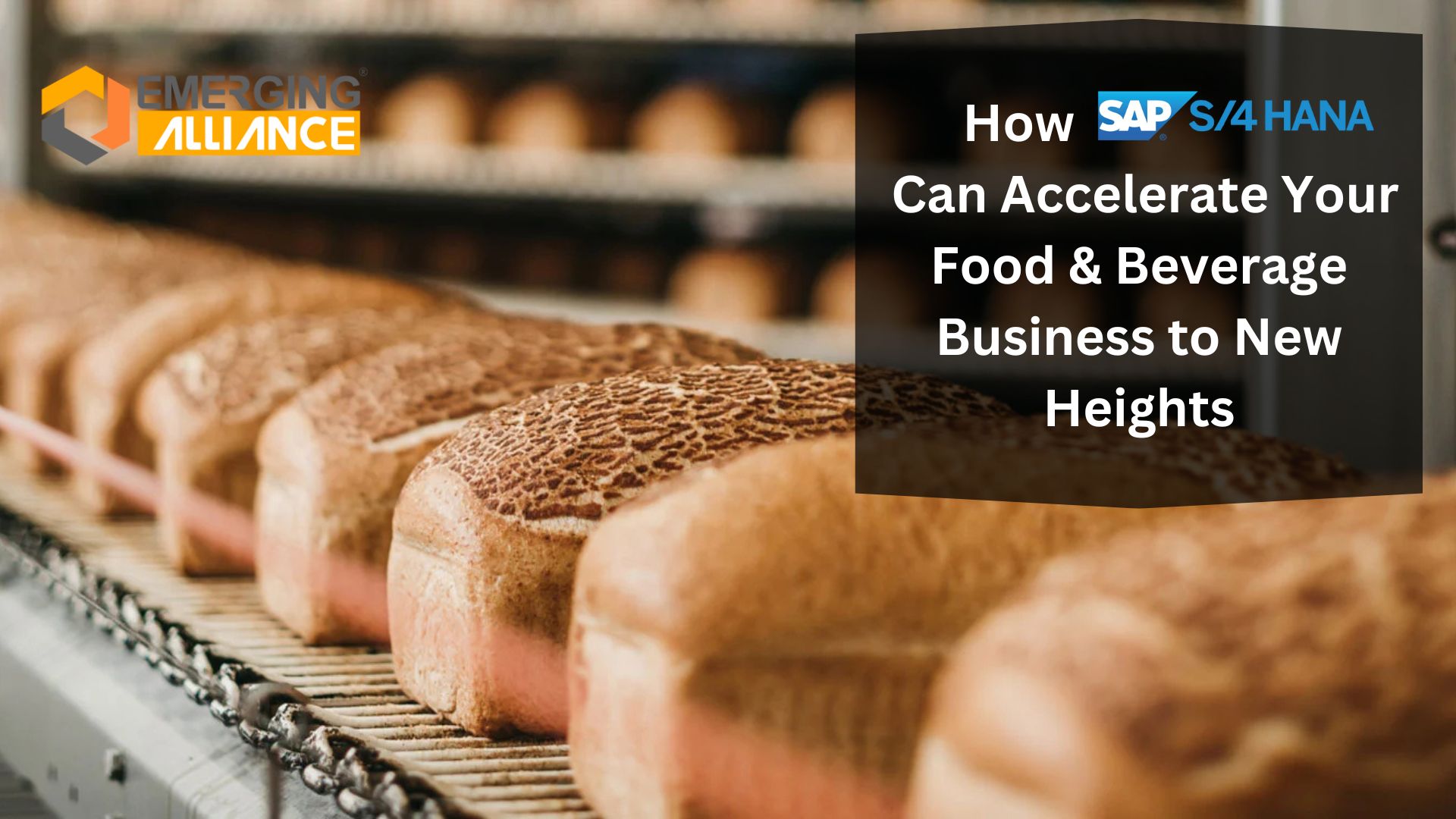
How SAP S/4 HANA Can Accelerate Your Food & Beverage Business to New Heights
The Key to Operational Excellence in Food & Beverage: SAP S/4 HANA
The Food & Beverage (F&B) industry is one of the most dynamic and fast-paced sectors, requiring businesses to stay agile and responsive to market demands. To thrive in such a competitive environment, it’s essential for businesses to adopt robust, scalable technology solutions. This is where S4 HANA (SAP S/4 HANA) comes into play. S4 HANA is an integrated Enterprise Resource Planning (ERP) solution designed to streamline operations and drive business growth, particularly for small and mid-sized enterprises (SMEs) in the Food & Beverage industry.
In this blog, we’ll explore why so many food and beverage businesses are choosing SAP S/4 HANA for Food & Beverage Industry as their go-to ERP solution and how SAP HANA solutions for Food & Beverage industry can help unlock growth opportunities.
What is S4 HANA (SAP S/4 HANA)?
S4 HANA is an all-in-one ERP solution designed specifically for small to mid-sized businesses. Unlike larger ERP systems that can be complex and costly, SAP S/4 HANA offers an affordable, flexible, and scalable platform that can grow with your business needs. It integrates essential business processes, from accounting and finance to inventory, procurement, sales, and customer relationship management.
When tailored for the Food & Beverage Industry, S4 HANA provides specialized features that address the unique challenges faced by businesses in this sector, such as regulatory compliance, traceability, production planning, and supply chain management.
Why Food & Beverage Businesses Trust S4 HANA for Growth
Real-Time Data & Insights for Better Decision-Making
In the fast-paced world of food and beverage manufacturing and distribution, data is king. With SAP S/4 HANA for Food & Beverage Industry, businesses can gain real-time insights into every aspect of their operations. Whether it’s tracking raw materials, managing production schedules, or monitoring sales performance, S4 HANA gives F&B businesses the tools they need to make informed decisions quickly.
• Access to actionable data enables you to improve inventory management, reduce waste, and optimize production.
• Advanced reporting tools offer deep insights into financials, sales trends, and customer behavior, allowing businesses to identify growth opportunities.
Streamlined Operations Across the Supply Chain
The SAP HANA solutions for Food & Beverage Industry help streamline the entire supply chain, from procurement to production to distribution. In the food and beverage industry, managing a seamless supply chain is critical to ensure timely delivery, product freshness, and compliance with regulations.
With SAP S/4 HANA, you can:
• Track raw materials and finished goods throughout the supply chain for better traceability.
• Automate procurement processes to ensure that raw materials are always available when needed, reducing production downtime.
• Optimize production scheduling to minimize delays and increase efficiency.
Regulatory Compliance & Quality Control
The Food & Beverage industry is heavily regulated, with strict standards related to food safety, quality control, and labeling. S4 HANA helps businesses comply with local and international regulations by providing tools for accurate reporting, documentation, and product traceability.
• Traceability features allow you to track the origin and movement of every ingredient or product batch, ensuring that quality control standards are met.
• Automated reporting helps simplify compliance with food safety regulations, making it easier to pass audits and avoid costly fines.
Scalable and Customizable for Business Growth
As food and beverage businesses scale, their needs evolve. SAP S/4 HANA is highly customizable and scalable, which makes it an ideal solution for growing companies. Whether you’re expanding into new markets, adding new products, or increasing production capacity, S4 HANA can be adapted to fit the changing requirements of your business.
• Modular architecture allows businesses to add features or expand capabilities as needed.
• Cloud-based deployment options provide the flexibility to scale quickly without the need for significant infrastructure investment.
Improved Customer Relationship Management (CRM)
In today’s competitive market, building strong relationships with customers is key to long-term success. S4 HANA for Food & Beverage Industry includes integrated customer relationship management (CRM) tools that help businesses manage customer interactions, sales, and marketing campaigns.
• Customer insights and data can be used to personalize marketing efforts and sales strategies, leading to higher conversion rates.
• Integrated communication tools make it easier to manage customer orders, track inquiries, and resolve issues efficiently.
Cost Control & Profitability Optimization
Managing costs and improving profitability are top priorities for any business in the Food & Beverage industry. S4 HANA offers powerful tools to help you control costs across your entire operation, from production to distribution.
• Cost tracking and analysis tools allow you to monitor production costs, raw material expenses, and overhead costs in real time.
• Profitability analysis features enable you to identify the most profitable products, sales channels, and customers, helping to prioritize growth initiatives.
Mobile Access & Remote Capabilities
The modern food and beverage business is rarely confined to the office. With S4 HANA, your team can access critical business data from anywhere, thanks to mobile app capabilities and cloud deployment options. Whether your team is in the warehouse, on the production floor, or meeting with clients, SAP S/4 HANA ensures that everyone has access to the information they need in real-time.
• Mobile access helps managers monitor key performance indicators (KPIs) and make decisions on the go.
• Cloud-based solution ensures that all team members are working with the most up-to-date information, no matter where they are located.
Empowering Food & Beverage Businesses for Long-Term Success
S4 HANA for Food & Beverage Industry is a comprehensive solution that helps businesses streamline operations, improve profitability, and enhance decision-making. With its specialized features for the food and beverage sector, SAP S/4 HANA offers everything a business needs to stay competitive in a fast-moving industry.
Whether you’re looking to optimize your supply chain, improve customer relationships, ensure regulatory compliance, or scale for growth, SAP S/4 HANA solutions for Food & Beverage Industry provide the tools and insights that modern businesses need to thrive.
Ready to Take Your Food & Beverage Business to the Next Level?
If you’re interested in exploring how S4 HANA can drive growth for your food and beverage business, contact us today for a personalized demo. Unlock the full potential of your business with SAP S/4 HANA — the trusted ERP solution for the food and beverage industry.
Ready to dive deeper into the topics you love? Visit our website to explore a treasure trove of valuable content, resources, and insights that will captivate your mind and fuel your curiosity!
FAQs About SAP S/4 HANA
1. How does SAP S/4 HANA handle batch-level traceability and recalls in the Food & Beverage industry?
SAP S/4 HANA enables end-to-end batch traceability, allowing businesses to track raw materials through production to final distribution. In the event of a recall, it can isolate affected batches instantly, minimizing financial and reputational damage.
2. Can SAP S/4 HANA manage shelf-life–sensitive inventory and reduce spoilage effectively?
Yes. It supports shelf-life expiration management, FEFO (First Expiry First Out), and real-time inventory visibility, helping reduce waste and ensure product freshness across the supply chain.
3. What specific regulatory compliance frameworks can SAP S/4 HANA support for F&B businesses?
It supports compliance with global and local food safety standards (such as HACCP, FDA, FSSAI) through automated documentation, audit trails, and traceability reporting. However, exact compliance coverage depends on configuration and localization.
4. How does SAP S/4 HANA improve demand forecasting accuracy in volatile F&B markets?
It integrates historical sales data, seasonality patterns, and real-time inputs to improve demand planning. When combined with advanced analytics, it reduces stockouts and overproduction.
5. What is the typical implementation complexity of SAP S/4 HANA for mid-sized F&B companies?
Implementation is non-trivial. It requires process standardization, data migration, and change management. Timelines typically range from a few months to over a year depending on customization, legacy systems, and organizational readiness.
6. How customizable is SAP S/4 HANA for unique production processes like recipe/formula management?
It supports recipe-based production, yield variability, co-products, and by-products. Customization is possible, but excessive tailoring can increase cost and maintenance complexity.
7. Does SAP S/4 HANA integrate with existing shop floor or IoT systems in food manufacturing?
Yes. It can integrate with MES (Manufacturing Execution Systems) and IoT platforms to capture real-time production data, though integration effort depends on existing system architecture.
8. How does SAP S/4 HANA help control fluctuating raw material costs in the F&B sector?
It provides real-time cost tracking, variance analysis, and procurement insights. Businesses can identify cost drivers and adjust sourcing or pricing strategies accordingly.
9. What are the key risks businesses should consider before adopting SAP S/4 HANA?
Major risks include high upfront investment, implementation complexity, dependency on skilled consultants, and potential disruption during transition. ROI depends heavily on proper adoption and process alignment.
10. How does SAP S/4 HANA support multi-channel distribution (retail, wholesale, direct-to-consumer)?
It centralizes order management, pricing, and inventory across channels, enabling consistent fulfillment and visibility. Integration with e-commerce platforms may require additional configuration.
Want to speak to an expert? Fill in the form below, and we will be in touch with you shortly!