


Inventory Inaccuracies in Chemical Manufacturing? SAP S/4HANA for Better Inventory Control
Quick Answer
SAP S/4HANA can help chemical manufacturers improve inventory visibility, material planning, stock reconciliation, and batch traceability by connecting inventory transactions with procurement, production, warehouse operations, and financial processes. Its effectiveness depends on the selected deployment model, system configuration, master-data quality, and integration requirements. Manufacturers should evaluate how the solution supports their inventory-control processes before deciding on implementation scope.
Inventory Control Challenges in Chemical Manufacturing
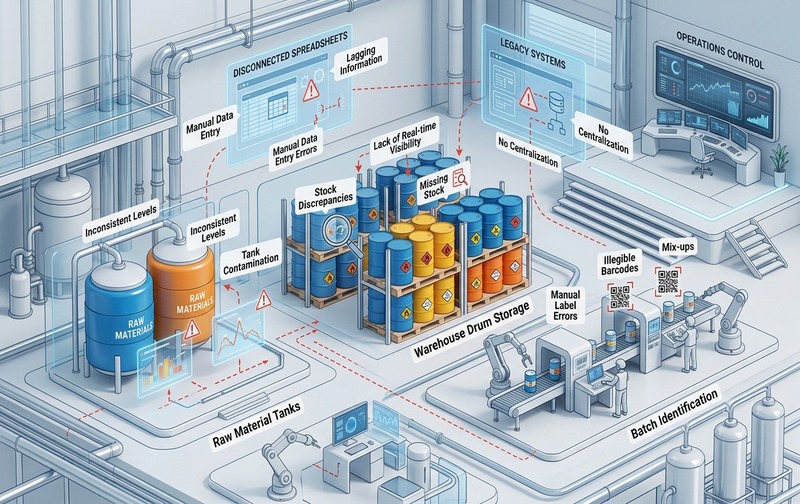
Operational bottlenecks and stock discrepancies across chemical raw materials, drum storage, hazardous substances, and shop-floor production stages.
Chemical manufacturers manage inventory across raw materials, intermediates, work-in-progress, finished products, packaging materials, and sometimes hazardous substances. Maintaining accurate stock records requires coordination between procurement, warehouse teams, production, quality, and finance.
When these functions operate with disconnected records or delayed transaction updates, inventory discrepancies can affect production schedules, purchasing decisions, order fulfilment, and financial reporting.
Stock discrepancies across chemical warehouses
Manual data entry, delayed goods receipts, unrecorded material movements, and inconsistent unit-of-measure conversions can cause differences between recorded inventory and physical stock.
For example, a warehouse may show sufficient raw material for a production order even though the actual available quantity is lower. Production teams may then face delays, while procurement may need to arrange urgent replenishment.
An effective inventory-control process must provide reliable stock records and establish clear procedures for recording receipts, issues, transfers, adjustments, and physical counts.
Batch and lot traceability gaps
Chemical products often require batch-level identification to support quality management, material genealogy, customer requirements, and product investigations. Depending on the product and applicable requirements, manufacturers may also need to track shelf life, retest dates, storage conditions, or quality status.
If batch information is maintained separately from inventory transactions, employees may struggle to identify where a material originated, where it was transferred, or which production orders consumed it.
Batch traceability therefore needs to be integrated into everyday operational processes rather than treated as a separate recordkeeping activity.
Excess inventory and material shortages
Inaccurate stock balances can create two opposing problems: purchasing material that is already available and failing to replenish material that is genuinely required.
Excess stock can increase carrying costs, storage requirements, and the risk of obsolescence. Shortages can interrupt production, delay customer orders, and trigger unplanned purchasing.
Chemical manufacturers need inventory information that supports purchasing and production decisions while accounting for lead times, demand, material availability, and relevant shelf-life or quality restrictions.
SAP S/4HANA Inventory Management for Chemical Manufacturing
SAP S/4HANA provides integrated enterprise resource planning capabilities that can connect inventory movements with purchasing, production, warehouse operations, and financial accounting. The precise capabilities available depend on the selected SAP S/4HANA edition, licensed scope, configuration, and connected systems.
For chemical manufacturers, the business objective is to establish a dependable operational view of material quantities, locations, statuses, and movements.
Real-time inventory visibility and stock accuracy
When inventory transactions are recorded correctly and promptly, SAP S/4HANA can provide a more consistent view of recorded stock across relevant storage locations and organizational units.
Goods receipts, goods issues, transfers, and production-related material movements can update inventory records according to the configured business process.
This helps teams investigate stock differences, understand material availability, and make purchasing or production decisions using current system information.
However, system visibility does not automatically guarantee physical accuracy. Receiving controls, disciplined transaction posting, physical inventory procedures, and employee training remain essential.
Batch management and material identification
Where batch management is configured and applicable, SAP S/4HANA can support the identification and tracking of materials by batch across relevant inventory and production processes.
This can help teams locate specific batches, investigate material movements, and connect inventory records with manufacturing transactions.
Manufacturers should define the information that must be captured for each material, including batch identifiers, supplier references, manufacturing dates, expiry or retest dates where relevant, and quality status.
The design should also establish how batch information is captured during goods receipt, production consumption, finished-product receipt, and dispatch.
Inventory status and quality coordination
Chemical materials may be subject to inspection, release, restriction, or other operational controls before they can be used or dispatched.
A configured inventory and quality-management process can help distinguish stock that is available for use from stock that requires inspection or is otherwise restricted.
The business must define which statuses control material availability and how quality decisions are communicated to procurement, production, warehouse, and customer-service teams.
Quality-management functionality, additional applications, and integrations may be required depending on the intended process. These requirements should be confirmed during solution design rather than assumed to be included in every deployment.
Chemical Inventory Accuracy Across Procurement and Production
Inventory accuracy depends on more than warehouse transactions. Purchasing decisions, production consumption, and finished-goods receipts must also reflect actual material movements.
Connected Chemical Inventory Operational Flow
Raw material planning and procurement control
Procurement teams need dependable information about available stock, expected receipts, supplier lead times, and production requirements.
SAP S/4HANA can connect purchasing and inventory processes so that relevant material receipts and movements are reflected in system records.
With appropriate planning parameters and accurate master data, planners can use this information to review replenishment requirements and reduce avoidable purchasing caused by incomplete stock visibility.
The planning process should account for supplier lead times, minimum order quantities, storage constraints, demand variability, and material-specific restrictions.
Production consumption and material reconciliation
Chemical production frequently involves recipes, formulations, planned quantities, and actual consumption. Differences between planned and actual material usage can affect inventory balances, production costs, and yield analysis.
An integrated ERP process can connect production orders with material withdrawals and production receipts, subject to the configured manufacturing processes.
This gives production and finance teams a clearer basis for investigating consumption variances and reconciling material usage.
Accurate results still depend on recording actual quantities, handling substitutions correctly, defining appropriate tolerances, and posting production transactions at the right time.
Warehouse transfers and physical inventory verification
Transfers between storage locations, production areas, and warehouses must be recorded consistently. Otherwise, the system may show the correct total quantity but an incorrect location or availability status.
Manufacturers should establish standard procedures for internal transfers, stock adjustments, cycle counting, and full physical inventory.
Where appropriate, barcode scanning or warehouse-management capabilities can help capture material identifiers and reduce manual entry. These capabilities may require additional configuration, equipment, licensing, or integration.
Batch Traceability and Quality Control in Chemical Manufacturing
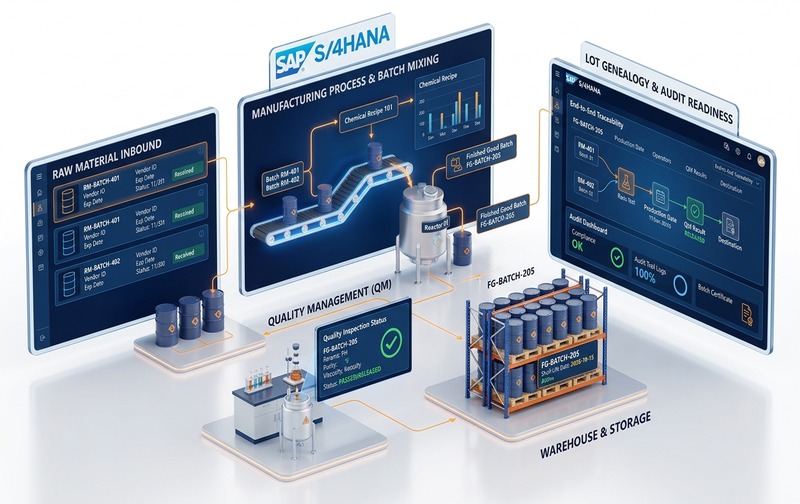
Connected batch genealogy and quality control from raw material receipt through manufacturing formulations, inspection release, and warehouse storage.
Traceability is particularly important when a manufacturer needs to investigate a material discrepancy, respond to a customer complaint, assess a quality issue, or identify affected batches.
A traceability process should connect incoming materials with their subsequent movements and consumption, while maintaining the records required for finished products and dispatches.
Supplier-to-production batch tracking
A defined batch-management process can help manufacturers link incoming material batches with inventory records and relevant production transactions.
This makes it easier to investigate which materials were available for a production order and which batches were recorded as consumed.
The required level of genealogy depends on the product, manufacturing process, customer commitments, and applicable quality procedures. More detailed genealogy may require additional manufacturing or quality capabilities.
Shelf-life, expiry, and retest-date controls
For materials with defined shelf-life or retest requirements, inventory processes should capture the relevant dates and apply appropriate operational rules.
Planning and warehouse procedures can then use this information to identify stock requiring review and reduce the risk of unsuitable material being selected for production.
The organisation must validate how date fields, batch determination, stock status, and alerts behave in its configured environment. Recording a date alone does not guarantee that expired or restricted stock will be blocked in every process.
Quality investigations and audit readiness
When a quality issue occurs, teams may need to identify affected batches, review stock movements, and determine which production orders or deliveries are connected to the material.
Reliable transaction history and consistent batch records can shorten the time required to investigate these events.
Manufacturers should validate that their solution retains the records required by internal procedures, customer agreements, and applicable regulations. SAP implementation alone does not establish regulatory compliance; compliance depends on the complete process, configuration, controls, validation, and operating practices.
Inventory Valuation and Working Capital Control
Inventory records influence financial reporting as well as daily operations. Incorrect quantities, delayed postings, inconsistent material data, or unresolved transaction differences can complicate inventory reconciliation and cost analysis.
Inventory valuation and financial reconciliation
An integrated ERP environment can connect inventory movements with relevant financial postings according to the configured valuation and accounting design.
This helps finance teams investigate differences between operational transactions and financial balances, review material costs, and maintain more consistent reporting.
The valuation approach must be designed for the organisation’s accounting requirements, materials, and operating model. Finance and implementation teams should confirm valuation settings, account determination, costing requirements, and period-end procedures before deployment.
Excess stock and working capital exposure
Inventory that remains unused for extended periods can tie up working capital and occupy storage capacity. In chemical manufacturing, some materials may also carry additional handling, storage, or expiry-related considerations.
A reliable inventory record gives decision-makers a better basis for reviewing stock ageing, slow-moving materials, replenishment patterns, and purchasing commitments.
Management should distinguish between stock that is physically present, stock that is available for use, stock already committed to production, and stock requiring quality or commercial review.
Inventory performance indicators
A practical reporting framework can help management assess whether inventory-control improvements are working.
Useful indicators include:
Inventory record accuracy: the agreement between system quantities and verified physical quantities.
Stockout frequency: how often material shortages interrupt planned operations.
Inventory turnover: how frequently inventory is consumed or sold over a defined period.
Slow-moving inventory: stock with limited movement over a defined review period.
Batch traceability completeness: whether required batch relationships can be retrieved and verified.
Material consumption variance: the difference between planned and actual consumption, using a consistent calculation method.
Inventory adjustment value: the financial value of corrections posted during a reporting period.
Each metric needs an agreed definition, data source, review frequency, and accountable owner. Establishing a baseline before implementation is necessary to evaluate subsequent changes fairly.
Integrating Chemical Inventory with Warehouse and Production Systems
An ERP platform provides the greatest operational value when inventory information moves consistently between the systems and teams that depend on it.
Barcode scanning and warehouse execution
Barcode scanning can help employees identify materials, record movements, and reduce repetitive manual entry during receiving, picking, transfers, and physical counts.
The appropriate design depends on the warehouse process, scanning devices, label standards, and the integration method selected.
Before implementation, manufacturers should verify how the scanning solution handles batch numbers, units of measure, storage locations, inventory status, and transaction errors. Barcode functionality should not be assumed to be available in the required form without configuration or an additional solution.
Production, laboratory, and external-system integration
Chemical manufacturers may need to exchange information between ERP, manufacturing systems, laboratory applications, weighing equipment, warehouse platforms, or other operational tools.
Integration requirements should specify which system owns each data element, when information is exchanged, how errors are handled, and how duplicate or incomplete transactions are prevented.
A well-designed integration approach can reduce disconnected records, but poorly defined interfaces can create additional reconciliation work. Data ownership and exception handling should therefore be part of the initial solution design.
SAP S/4HANA Implementation Considerations for Chemical Plants
A successful implementation begins with the business processes that need to improve, not simply with software configuration.
Material master data and unit-of-measure consistency
Inconsistent material descriptions, duplicate records, incorrect units of measure, and incomplete batch settings can undermine inventory accuracy.
Before migration, organisations should review material master data, storage locations, batch-management requirements, conversion rules, planning parameters, and relevant quality attributes.
Data cleansing should include business-owner approval and validation against actual warehouse and production practices.
Inventory migration and opening-stock validation
Migrating inventory requires more than transferring quantities from an existing system. The project team should define how opening stock, storage locations, batches, stock status, valuation data, and outstanding transactions will be handled.
Reconciliation should compare approved source records with the migrated balances. Representative transactions should be tested before go-live, including receipts, transfers, production consumption, stock adjustments, and relevant financial postings.
Unresolved differences should have assigned owners and documented resolution steps.
Standard functionality, configuration, and additional solutions
Not every requirement needs custom development. Some needs may be addressed through standard functionality and configuration, while others may require integrations, specialised applications, or extensions.
A fit-to-standard assessment should classify requirements into these categories and document the business reason for any deviation from the proposed standard process.
This helps decision-makers evaluate implementation scope, dependencies, maintenance implications, and total cost of ownership before approving the design.
User adoption and operational governance
Employees need clear procedures for recording transactions and resolving exceptions. Without consistent adoption, the organisation may continue to experience inaccurate stock records even after deploying a new ERP platform.
Training should be role-specific and based on realistic scenarios, such as receiving a batch-controlled material, transferring stock, recording consumption, handling quality restrictions, and completing physical counts.
Management should also define who owns master data, approves inventory adjustments, monitors reconciliation, and reviews performance indicators after go-live.
Evaluating SAP S/4HANA for Chemical Manufacturing Operations
Chemical manufacturers should evaluate ERP suitability against measurable operational requirements. A product demonstration is most useful when it reflects the organisation’s materials, inventory processes, manufacturing structure, and integration landscape.
A structured evaluation should cover:
Inventory visibility: how the system represents stock by material, location, batch, and relevant status.
Material planning: how procurement and production requirements use available inventory and expected receipts.
Traceability: how users investigate batch movements and relevant production relationships.
Quality controls: how restricted, inspection, or released stock is represented and used.
Financial integration: how inventory transactions affect valuation and reconciliation.
Warehouse execution: how scanning, transfers, and physical inventory processes are supported.
Implementation scope: which requirements use standard capabilities, configuration, integrations, or additional applications.
Business outcomes: which baseline indicators will be used to evaluate performance after deployment.
The evaluation should also consider deployment options, licensing, infrastructure, migration complexity, integration effort, support requirements, and long-term ownership costs.
The objective is not to assume that a platform will eliminate every inventory discrepancy. It is to establish whether the proposed solution and operating model can address the organisation’s actual control gaps and support measurable improvements.
Conclusion
Inventory inaccuracies in chemical manufacturing can affect production continuity, procurement decisions, batch traceability, financial reconciliation, and working capital. Addressing these issues requires consistent material data, disciplined transaction recording, reliable inventory procedures, and coordination across procurement, warehouse, production, quality, and finance.
SAP S/4HANA can provide an integrated foundation for inventory visibility and control when the relevant capabilities are correctly selected, configured, and adopted. The implementation must also address data migration, batch-management requirements, warehouse execution, system integration, and ongoing operational governance.
For chemical manufacturers considering an ERP investment, the next step is to map existing inventory problems to specific business requirements and validate the proposed solution against real operating scenarios.
Frequently Asked Questions
Evaluate SAP S/4HANA for Your Chemical Inventory Requirements
Facing inventory discrepancies, batch traceability gaps, or unreliable material availability? Discuss your chemical manufacturing requirements with Emerging Alliance to evaluate the SAP capabilities, integrations, and implementation approach suited to your operations.
Request an SAP S/4HANA Demo and identify the inventory-control requirements your ERP project needs to address.