


Metal Fabrication Cost Overruns? SAP S/4HANA for Better Production Planning and Cost Control
Quick Answer
Metal fabrication cost overruns can arise from inaccurate material estimates, production scheduling delays, unexpected scrap, inefficient resource utilization, and limited visibility into job costs. SAP S/4HANA can help metal fabrication businesses connect production planning, procurement, inventory, manufacturing, and financial data to improve operational visibility and support better cost-control decisions. The results depend on business requirements, data quality, process design, system configuration, and implementation. Manufacturing leaders should assess where cost variances originate before deciding which ERP capabilities and process changes are needed.
Why Metal Fabrication Businesses Face Cost Overruns
Metal fabrication operations often involve multiple production stages, including material purchasing, cutting, forming, welding, machining, assembly, finishing, and dispatch. Each stage can affect the final cost of an order.
When information is spread across disconnected spreadsheets, standalone applications, and manual records, managers may struggle to identify cost deviations before they affect delivery schedules or margins.
Several operational problems can contribute to rising manufacturing costs.
Inaccurate Material Estimates
Steel, aluminium, and other raw materials represent important cost components in fabrication. Incorrect estimates, outdated material prices, inaccurate bills of materials, and unexpected wastage can cause actual material consumption to exceed the original plan.
Without reliable material and production records, purchasing teams may order too much stock, while production teams may discover shortages after work has started.
Production Scheduling Delays
Production plans must account for machine availability, workforce capacity, material readiness, order priorities, and delivery commitments. When these factors are managed separately, one delayed operation can disrupt subsequent activities.
Unplanned waiting time, overtime, rescheduling, and missed delivery dates can increase costs and put customer relationships under pressure.
Limited Job-Cost Visibility
A production order may consume more labour, material, machine time, or external services than expected. If these costs are reviewed only after an order is completed, management may have limited opportunity to correct the underlying problem.
Decision-makers need timely information that helps them compare planned costs with actual costs and investigate material variances.
Scrap and Rework
Cutting errors, quality defects, inaccurate specifications, and repeated processing can increase material consumption and labour costs. If scrap and rework are not recorded consistently, their financial impact may be difficult to measure.
These issues demonstrate why cost control requires more than reducing purchasing prices. It also requires connected operational data, reliable production records, and a clear process for reviewing variances.
How SAP S/4HANA Supports Metal Fabrication Production Planning
SAP S/4HANA provides an integrated enterprise resource planning environment that can support manufacturing, procurement, inventory, and financial processes. For metal fabrication businesses, the value depends on selecting and configuring the capabilities that match their production model.
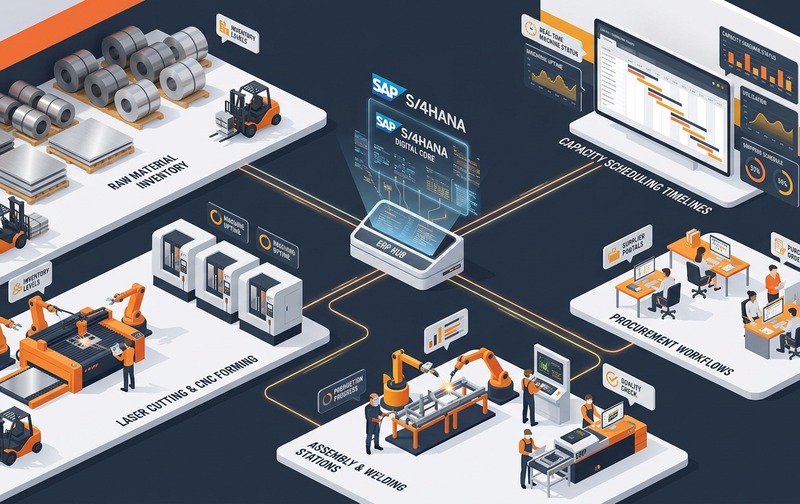
SAP S/4HANA connects material availability, machine capacity, production scheduling, and procurement to help metal fabrication teams coordinate shop-floor execution.
Connect Production Requirements With Material Availability
Production plans depend on having the correct materials available when they are needed. Material shortages can interrupt work, while excessive stock can tie up working capital and increase storage costs.
An appropriately configured SAP S/4HANA environment can help connect material requirements with inventory and procurement information. Depending on the implemented modules and planning design, teams can use this information to assess shortages, coordinate replenishment, and review the materials required for upcoming production.
Before implementation, businesses should examine how they calculate material requirements, maintain item master data, manage units of measure, and record material consumption.
Improve Production Scheduling Decisions
Production scheduling involves balancing order priorities, available capacity, material readiness, and delivery commitments. A schedule that ignores these constraints may look achievable on paper but create delays on the shop floor.
Manufacturing planning capabilities can support production-order management and coordination between relevant operational processes. The exact scheduling functionality depends on the selected SAP S/4HANA solution, configuration, and any additional planning tools.
Fabrication leaders should identify their most important scheduling constraints before selecting a solution. These may include machine bottlenecks, subcontracting delays, limited skilled labour, setup time, or frequent changes to customer specifications.
Improve Coordination Across Departments
Production planning affects procurement, warehouse operations, manufacturing, sales, and finance. If each department works from different information, teams may make decisions that conflict with current production priorities.
An integrated ERP environment can help make relevant business information available across connected processes. This supports coordination when data ownership, workflows, and reporting requirements are clearly defined.
The objective is not simply to centralize information. It is to help teams act on consistent records and reduce avoidable delays caused by disconnected processes.
SAP S/4HANA for Better Manufacturing Cost Control
Cost control becomes more effective when management can identify the difference between expected and actual resource consumption and investigate the reasons behind it.
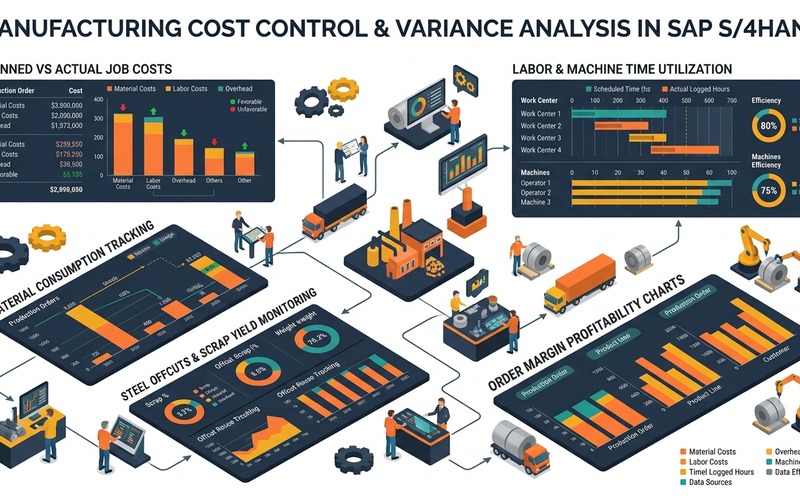
Comparing planned versus actual production costs, material consumption, scrap yield, and labour utilization helps fabrication managers identify variances earlier and protect order margins.
Compare Planned Costs With Actual Production Costs
Manufacturing teams need a reliable basis for estimating production costs. Depending on the production process and system configuration, cost estimates may consider material requirements, labour, machine-related costs, operations, and other relevant expenses.
Actual production costs should then be reviewed against the appropriate plan or estimate. Differences may indicate changes in material prices, excess consumption, longer production time, scrap, rework, or other operational factors.
SAP S/4HANA can support manufacturing and financial processes that contribute to cost analysis. However, meaningful variance reporting depends on accurate transactions, appropriate costing methods, and consistent production records.
Strengthen Material Consumption Tracking
Material costs can exceed estimates when actual consumption differs from planned requirements. Common causes include cutting losses, incorrect measurements, damaged materials, specification changes, and unrecorded stock movements.
Businesses should define how materials are issued to production, how returns are recorded, and how scrap is measured. Where supported by the chosen configuration, ERP records can help teams compare planned requirements with recorded consumption.
This information gives production and finance managers a better starting point for investigating recurring material variances.
Improve Visibility Into Order Profitability
A completed order may appear profitable based on its selling price but deliver a lower margin after additional labour, material, subcontracting, and rework costs are considered.
Reliable cost records help management evaluate whether estimates reflect actual operating conditions. They can also support future quoting decisions by revealing which types of orders, materials, or production activities create repeated cost deviations.
The analysis should account for the organization’s costing approach and available data. An ERP system cannot provide dependable profitability insights if key costs are missing, assigned incorrectly, or recorded too late.
Managing Inventory and Procurement Costs in Metal Fabrication
Inventory decisions affect production continuity, purchasing expenditure, storage requirements, and working capital. The challenge is to maintain the materials needed for production without accumulating unnecessary stock.
Reduce Avoidable Material Shortages
When inventory balances are inaccurate, production teams may assume that required materials are available when they are not. The resulting delays can lead to emergency purchases, expedited deliveries, and schedule changes.
Improving inventory accuracy requires disciplined receiving, issuing, transfers, returns, and stock adjustments. An ERP implementation should also establish responsibility for maintaining item master data and resolving discrepancies.
Connected inventory and planning information can help purchasing teams identify material requirements earlier, provided that the underlying records remain accurate and current.
Make Procurement Decisions With Better Information
Purchasing teams need visibility into upcoming production demand, existing inventory, supplier lead times, and purchasing conditions. Without this information, they may place urgent orders or purchase quantities that do not match operational requirements.
An integrated ERP process can help align procurement activity with production and inventory needs. Supplier performance, material price changes, and purchasing exceptions should also be reviewed through defined management reports.
The goal is to improve the timing and quality of purchasing decisions—not to assume that software alone will reduce material prices or guarantee savings.
Account for Scrap, Rework, and Material Yield
Material yield is particularly important when fabrication involves cutting, forming, machining, or other operations that generate offcuts or waste.
Businesses should define how usable remnants, scrap, rejected materials, and rework are classified and recorded. Without consistent definitions, reports may not show the full cost of material losses.
Where operational data is available, managers can compare expected and actual material usage, identify recurring loss patterns, and investigate whether the causes relate to estimating, process settings, material quality, or operator practices.
Connect Production Performance With Financial Reporting
Production activity affects financial performance through material consumption, labour, work in progress, finished goods, and order costs. When operational and financial records are disconnected, management may struggle to explain why margins differ from expectations.
SAP S/4HANA can connect relevant manufacturing and financial processes according to the implemented solution and accounting design. This can support more consistent reporting, provided transactions are recorded correctly and financial controls are established.
Establish Consistent Cost Reporting
Executives need reports that show more than total expenditure. Useful management information may include:
The most useful reports are those that connect an identified variance to an owner, an explanation, and a corrective action.
Identify Problems Earlier
A monthly financial report may show that costs have increased, but it may not explain which production orders or operational events caused the increase.
More frequent operational reviews can help managers investigate emerging exceptions before they become larger problems. The appropriate reporting frequency depends on production volume, order complexity, business risk, and the availability of reliable data.
ERP reporting should therefore be designed around management decisions rather than the number of dashboards a system can produce.
Implementation Requirements for Metal Fabrication Businesses
Selecting SAP S/4HANA is only one part of improving production planning and cost control. The implementation must reflect how the business actually estimates, purchases, manufactures, records, and delivers products.
Review Existing Production and Costing Processes
Before finalizing requirements, document how the business currently manages quotations, bills of materials, production orders, material issues, machine capacity, scrap, subcontracting, and financial reporting.
Identify where actual costs differ from estimates and determine whether the cause is a process weakness, incomplete data, a system limitation, or an unclear responsibility.
This assessment helps prevent an implementation from reproducing existing problems in a new system.
Define Master Data and Reporting Requirements
Item records, bills of materials, work centres, production routings, units of measure, and costing rules can influence the quality of planning and cost reporting.
The required data depends on the organization’s production model and the SAP S/4HANA capabilities selected. Data ownership, validation rules, migration checks, and change-control procedures should be agreed before go-live.
Evaluate Integration and Customization Needs
Some fabrication businesses use additional applications for CAD design, production scheduling, shop-floor data collection, quality management, warehouse operations, or customer order management.
Decision-makers should identify which systems must exchange information with SAP S/4HANA and define how errors, duplicate records, and failed transactions will be handled.
Customization should address a documented business requirement. Unnecessary changes can increase implementation complexity, testing effort, maintenance requirements, and future upgrade considerations.
Set Measurable Business Objectives
Implementation success should be assessed against agreed operational and financial measures, not simply whether the software has been installed.
Possible measures include material variance, scrap rate, production schedule adherence, rework frequency, inventory accuracy, order-cost variance, and the time required to produce management reports.
Establish a baseline before implementation and define how each measure will be calculated. Any improvement target should reflect actual business conditions rather than an unsupported industry benchmark.
Is SAP S/4HANA the Right ERP Choice for Your Metal Fabrication Business?
The right ERP approach depends on the complexity of the manufacturing operation, existing systems, reporting needs, production volume, and long-term business plans.
A business with multiple production sites, complex planning requirements, extensive integrations, or demanding financial controls may have different needs from a smaller operation with straightforward workflows.
Before committing to an implementation, executives should evaluate:
The decision should be based on a documented fit between business requirements and the proposed solution. A consultation can help identify these requirements before the organization commits to a project scope.
Frequently Asked Questions
Request an ERP Consultation for Metal Fabrication Cost Control
Cost overruns, material shortages, and production delays can reduce manufacturing margins and limit cost visibility.
Request a consultation with Emerging Alliance to review your production and cost-control challenges and explore how SAP S/4HANA can support your metal fabrication operations.