

Odoo ERP for Semiconductor Manufacturing: Capabilities, Limitations, and Key Considerations
Quick Answer: Can Odoo ERP Support Semiconductor Manufacturing?
Odoo ERP can support selected semiconductor business processes, including purchasing, inventory management, manufacturing workflows, quality checks, sales, and financial reporting. Its suitability for semiconductor manufacturing depends on the complexity of production, material traceability requirements, quality controls, integration needs, and the level of customization required. Businesses should evaluate whether Odoo can meet their operational and compliance requirements before selecting it as their core ERP platform.
How ERP Supports Semiconductor Manufacturing Operations
Semiconductor manufacturing involves interconnected processes that require accurate information across procurement, inventory, production, quality, finance, and distribution. A shortage of a critical component, an inaccurate inventory record, or an incomplete production history can affect delivery commitments, production costs, and customer relationships.
An enterprise resource planning (ERP) system connects business information across these functions. Instead of maintaining separate records in spreadsheets and disconnected applications, manufacturers can use integrated workflows to coordinate purchasing, material availability, production activities, and financial transactions.
Odoo ERP provides modular business applications that may support several of these requirements. However, semiconductor manufacturing is not a single, standardized operating model. A semiconductor equipment supplier, an electronics assembler, a component distributor, and a wafer fabrication facility can have substantially different system requirements.
The first decision is therefore not whether Odoo has manufacturing features. It is whether its available capabilities, configuration options, integrations, and customization requirements align with the company’s actual production environment.
Where Odoo ERP Can Support Semiconductor Businesses
Odoo offers applications for manufacturing, inventory, purchasing, sales, accounting, and quality-related workflows. These capabilities can provide a foundation for managing connected business processes, depending on the selected applications, configuration, edition, and implementation.
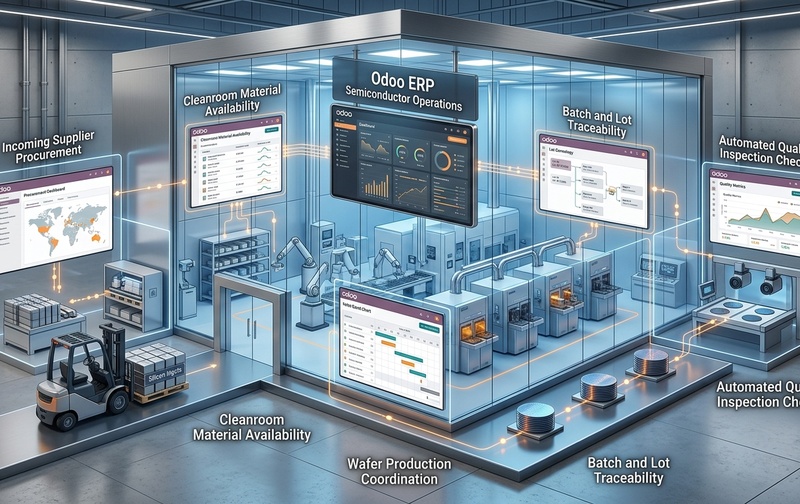
Odoo ERP coordinates core semiconductor business processes including procurement, inventory availability, work order tracking, and quality records across connected operations.
Inventory and Material Availability
Semiconductor-related businesses may manage electronic components, raw materials, work in progress, finished goods, spare parts, and customer-specific inventory. Each category can have different handling, storage, planning, and identification requirements.
An ERP system can help teams maintain stock records, manage receipts and deliveries, coordinate replenishment, and monitor material availability for planned orders. Where supported and correctly configured, lot or serial tracking can also improve the ability to identify and trace selected inventory.
The implementation must establish how materials are identified, how inventory movements are recorded, and which users can approve adjustments. For organizations handling sensitive or tightly controlled components, the team should verify whether the proposed tracking model provides the required level of traceability.
Manufacturing Orders and Production Coordination
Manufacturing workflows help businesses coordinate component consumption, work orders, material requirements, and production progress. An ERP system can connect planned production with inventory and purchasing information, making it easier to identify potential shortages before they affect schedules.
For semiconductor-related operations, the required planning model may extend beyond standard manufacturing orders. Businesses should assess whether the system can represent their actual production stages, process dependencies, yield considerations, rework procedures, and work-in-progress controls.
Complex wafer fabrication and other highly specialized production environments may require dedicated manufacturing execution systems (MES), advanced scheduling capabilities, equipment data collection, or specialized production applications. An ERP platform should not be assumed to replace these systems without a detailed technical assessment.
Purchasing and Supplier Coordination
Semiconductor supply chains can involve long lead times, component shortages, changing availability, and dependencies on specialized suppliers. Procurement teams need reliable information about purchase orders, expected delivery dates, supplier performance, and production demand.
ERP purchasing workflows can help coordinate supplier orders with inventory requirements and production plans. Better integration between procurement and inventory also helps finance and operations teams understand outstanding commitments and the potential cost of material shortages.
The business should assess whether the proposed solution supports supplier-specific requirements, approval workflows, material identification, incoming inspection, and the exchange of information with supplier portals or other external systems.
Quality Checks and Product Records
Quality requirements vary according to the product, manufacturing process, customer contract, and applicable industry standards. An ERP implementation may help organize inspection activities, quality records, nonconformance workflows, and corrective actions when these capabilities are available and configured appropriately.
However, maintaining a quality record is not the same as demonstrating complete process control. Manufacturers should verify whether the system can capture the required inspection results, retain supporting evidence, enforce approvals, and connect quality events with the affected materials, batches, work orders, or finished products.
If the business needs detailed statistical process control, laboratory information management, specialized testing equipment integration, or advanced manufacturing quality analytics, additional applications may be necessary.
Semiconductor Traceability Requires More Than Inventory Records
Traceability is one of the most important requirements to assess when selecting ERP for semiconductor-related operations. Businesses may need to identify where materials came from, which production orders consumed them, what inspections were performed, and where finished products were delivered.
An appropriate traceability design should define the identifiers used at each stage, the transactions that record material movements, and the relationships between suppliers, incoming lots, production records, and customer shipments.
Odoo’s suitability depends on the required traceability depth and the configuration or extensions used to achieve it. Before committing to an implementation, the business should test realistic scenarios rather than rely only on a demonstration.
For example, the team could test whether it can identify all finished products associated with a particular incoming material lot, retrieve relevant inspection records, and determine which customers received the affected products. It should also test the reverse scenario: starting with a finished product and tracing it back through production and material consumption.
The evaluation should cover incomplete transactions, returns, rework, inventory adjustments, split lots, merged lots, and other exceptions that occur in real operations. A traceability process is only as reliable as the data and controls that support it.
Traceability takeaway: Test realistic bidirectional tracking scenarios covering split batches, rework, and returned components before approving the system design.
Odoo ERP Limitations Semiconductor Manufacturers Should Evaluate
Odoo may be appropriate for some semiconductor-related businesses, but its standard capabilities should not be treated as proof that it can satisfy every specialized manufacturing requirement.
Advanced Manufacturing and Process Control
A business with straightforward assembly or component distribution requirements may have different needs from a facility managing highly complex production sequences. Advanced process control, detailed equipment integration, production genealogy, specialized scheduling, and manufacturing execution may require additional software or custom development.
The company should document its essential production requirements and map each one to standard functionality, configuration, integration, or customization. Requirements that cannot be demonstrated should remain open risks until they are resolved.
Integration With Specialized Systems
Semiconductor operations may depend on MES platforms, product lifecycle management (PLM) systems, warehouse management systems, test equipment, supplier systems, and business intelligence tools.
The ERP platform must exchange information with these systems reliably. An integration assessment should specify which application owns each data element, how frequently information is exchanged, how errors are handled, and how transactions are reconciled when an interface fails.
Integration costs can be underestimated when the initial proposal considers only the connection itself rather than monitoring, security, testing, upgrades, and long-term maintenance.
Customization and Upgrade Considerations
Customization can close gaps between standard ERP functionality and business requirements, but it also introduces ongoing responsibilities. Custom workflows, third-party modules, and bespoke integrations must be tested whenever related applications or business processes change.
Before approving customization, decision-makers should determine whether the requirement can be addressed through configuration, an existing supported extension, a separate specialist application, or a change in the business process.
The evaluation should include ownership of custom code, documentation, testing responsibilities, support arrangements, and the expected cost of future upgrades. A solution that appears inexpensive at the beginning may become more demanding to maintain if its architecture is not carefully designed.
Data Accuracy and Governance
ERP reporting depends on the accuracy and consistency of the underlying data. Duplicate material records, inconsistent units of measure, incomplete bills of materials, incorrect lead times, and weak inventory discipline can undermine planning and reporting.
Semiconductor businesses should establish data ownership, approval rules, naming conventions, and validation procedures before migration. They should also define which records require historical retention and how opening inventory, outstanding purchase orders, production orders, and financial balances will be reconciled.
Governance priority: Establish clear data ownership, naming standards, and change-control procedures before migration to safeguard reporting integrity.
Odoo ERP vs. Specialized Manufacturing Systems
ERP and MES platforms often serve related but different purposes. ERP generally coordinates business transactions, planning, procurement, inventory, finance, and order management. MES platforms focus more directly on executing and recording manufacturing activities on the production floor.
Some organizations may use ERP alongside MES, quality, warehouse, or product lifecycle systems. Others may need a more specialized enterprise manufacturing platform, depending on production complexity and control requirements.
| Evaluation area | What to verify |
|---|---|
| Business management | Purchasing, sales, finance, inventory, and order processing |
| Production planning | Work orders, material requirements, scheduling, and production visibility |
| Traceability | Required lot, serial, process, and product genealogy |
| Quality management | Inspection records, nonconformance handling, approvals, and evidence retention |
| Shop-floor execution | Equipment connectivity, production data capture, and process controls |
| Integration | Data exchange with MES, PLM, testing, warehouse, and reporting systems |
| Governance | Permissions, audit records, data ownership, and change controls |
| Long-term cost | Licensing, implementation, extensions, integration, support, and upgrades |
This comparison should be based on verified requirements and demonstrations, not on assumptions about product capabilities. A specialized system is not automatically better for every business, and a modular ERP is not automatically sufficient for every manufacturing environment.
How to Evaluate Odoo ERP for Your Semiconductor Business
A structured evaluation helps management understand the difference between what the software supports today and what would require additional investment.
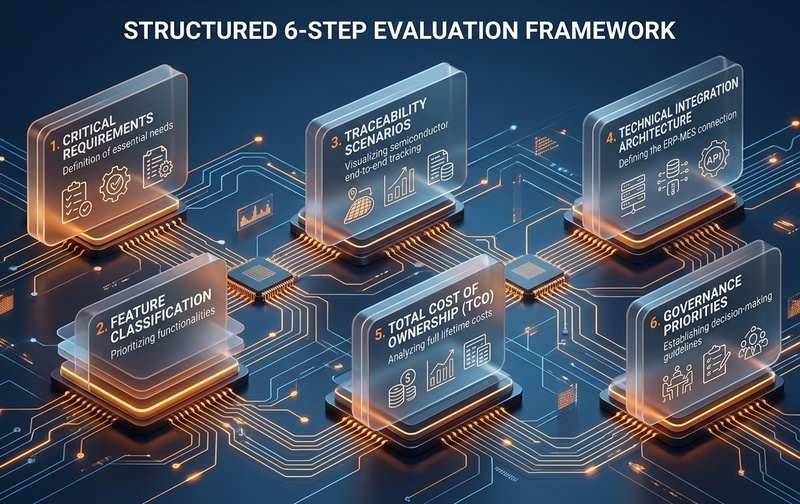
A structured 6-step evaluation framework helps semiconductor decision-makers evaluate business fit, technical integration dependencies, and multi-year total cost of ownership.
1. Document Critical Business Requirements
Start with the processes that have the greatest operational or financial impact. These may include material traceability, production planning, supplier coordination, quality inspections, inventory accuracy, customer delivery commitments, and financial reporting.
For each requirement, define the expected business outcome and how success will be measured. This creates a consistent basis for comparing software options.
2. Classify Standard Features, Configuration, and Custom Development
Ask the implementation team to classify every important requirement as standard functionality, configuration, third-party extension, integration, or custom development.
Request a demonstration of the complete workflow, including exceptions. A feature list alone does not establish that the proposed solution can handle the company’s real transactions.
3. Test Traceability and Quality Scenarios
Use representative materials, production orders, inspections, and customer shipments to test the required traceability process. Confirm that authorized users can retrieve the information needed for quality investigations, returns, and product-related issues.
Record any manual steps, missing data, or additional applications required to complete the scenario.
4. Assess Integration and Technical Architecture
Identify all systems that must exchange data with ERP. Define interface ownership, frequency, validation rules, error handling, access controls, monitoring, and recovery procedures.
Where the production environment requires real-time or machine-level information, assess whether a specialist system should remain responsible for those functions.
5. Calculate the Full Cost of Ownership
The cost of an ERP project extends beyond subscription or licensing charges. A realistic estimate should account for implementation services, process redesign, data cleansing, migration, integration, customization, training, testing, support, infrastructure, and future upgrades.
Compare alternatives over a consistent period and using the same scope. Include the cost of additional manufacturing applications where they are required.
6. Establish Implementation and Governance Priorities
A phased implementation may reduce disruption when it is based on clear dependencies and measurable outcomes. The plan should define scope, accountable owners, data migration criteria, testing responsibilities, training, cutover readiness, and post-launch support.
Management should also establish a process for approving changes and monitoring adoption. Without clear governance, customization requests and changing requirements can expand the project beyond its intended scope.
Is Odoo the Right ERP for Semiconductor Manufacturing?
Odoo may be worth evaluating when a semiconductor-related business needs connected commercial and operational workflows and its production requirements align with the capabilities that can be demonstrated in the proposed solution.
A more specialized manufacturing architecture may be necessary when operations depend on extensive shop-floor control, detailed process genealogy, equipment connectivity, advanced quality analytics, or other requirements that standard ERP workflows do not adequately cover.
The decision should be based on the fit between operational requirements and the complete solution—not on product popularity, subscription price, or the number of available modules.
Before selecting a platform, management should compare the required processes, identify capability gaps, quantify customization and integration costs, and test the highest-risk workflows. This approach provides a more reliable basis for deciding whether Odoo, a specialized manufacturing solution, or a combination of systems is appropriate.
Frequently Asked Questions About Odoo ERP for Semiconductor Manufacturing
Evaluate ERP for Your Semiconductor Manufacturing Operations
Selecting ERP for semiconductor manufacturing requires a clear understanding of production workflows, traceability, quality requirements, integration dependencies, and long-term operating costs.
Request an ERP consultation with Emerging Alliance to assess your business requirements, compare suitable ERP options, and identify the implementation priorities that matter most to your operations.