
Odoo for Chemical Industry: Implementation Timing, Benefits & Business Fit
Quick Answer: When Is the Right Time to Implement Odoo for Chemical Manufacturing?
Odoo can be a suitable ERP option for chemical manufacturers when manual processes, disconnected systems, inventory complexity, production growth, traceability requirements, quality-control needs, or delayed reporting begin affecting business performance.
The right time to implement Odoo depends less on company size and more on operational complexity, process requirements, integrations, scalability, data readiness, and implementation capability. Chemical businesses should evaluate these factors before committing to an ERP project.
For a growing chemical manufacturer, ERP implementation is not simply a technology upgrade. It changes how procurement, inventory, production, quality, sales, finance, and management reporting work together.
The Fundamental ERP Question:
The key question is therefore not only whether Odoo has the required modules. The more important question is whether its capabilities, configuration options, integrations, and implementation approach fit the company’s actual processes.
Why Chemical Manufacturers Reach the ERP Decision Point
Chemical manufacturing becomes increasingly difficult to manage as product portfolios, raw materials, production volumes, customers, locations, and compliance requirements grow.
A business may begin with spreadsheets, accounting software, separate inventory records, and manual production documents. These systems can work when operations are relatively simple. Problems emerge when multiple departments depend on the same information but maintain it separately.
The Departmental Information Silo:
A procurement team may track raw materials in one spreadsheet while production maintains another record. Warehouse quantities may not match the accounting system. Quality information may remain in separate documents. Management may have to wait for manual consolidation before understanding inventory, production, or profitability.
This creates several critical operational risks:
An ERP system can address these problems by connecting business processes through a common data environment.
For chemical manufacturers, however, the ERP decision requires additional consideration because production, quality, inventory, traceability, and product specifications can be more complex than in many conventional trading businesses.
Signs Your Chemical Business Has Outgrown Manual Processes
There is no universal revenue or employee threshold that determines when a chemical company needs an ERP.
Operational complexity is often a more useful indicator.
1. Spreadsheets Control Critical Processes
If production planning, inventory reconciliation, procurement, quality records, or management reporting depend heavily on spreadsheets, the business may have reached a point where centralized process management is necessary.
Spreadsheets can support analysis, but they become difficult to control when multiple employees update different versions of the same information.
2. Inventory Visibility Is Becoming Difficult
Chemical manufacturers may manage raw materials, work-in-process, finished goods, packaging materials, and different batches or lots.
When warehouse records cannot provide reliable information about availability, location, status, or traceability, operational decisions become slower and more error-prone.
3. Production Data Is Disconnected
Production teams need visibility into materials, production orders, consumption, output, and variances.
If this information is recorded manually and later transferred into another system, management may not have timely visibility into production performance.
4. Quality Information Is Separated From Operations
Quality decisions can affect whether materials or finished products can move into the next stage.
If inspection results, approvals, non-conformance information, and inventory status are disconnected, employees may spend significant time checking multiple records.
5. Management Reporting Takes Too Long
When management needs several days to consolidate information from finance, production, inventory, sales, and procurement, the problem is not simply reporting speed.
It indicates that business information is fragmented.
6. The Business Is Expanding
New products, warehouses, manufacturing locations, customers, suppliers, or markets increase process complexity.
An ERP project can be easier to manage when implemented before operational complexity becomes unmanageable.
Chemical Manufacturing Processes an ERP Must Support
Before evaluating Odoo or any other ERP, chemical companies should document the processes the system must support.
A typical chemical manufacturing environment may include:
➔
➔
➔
➔
➔
➔
➔
➔
➔
➔
The ERP should provide appropriate visibility across these connected processes.
Important requirements can include:
The exact configuration depends on the company’s products, processes, regulatory environment, locations, and business model.
How Odoo Supports Chemical Manufacturing Operations
Odoo provides an integrated business application environment covering areas such as manufacturing, inventory, purchasing, sales, accounting, and other business functions.
For a chemical manufacturer, the potential value comes from connecting these processes rather than operating each department independently.
End-to-End Operational Trigger Flow:
• Material Planning: A production requirement triggers material planning.
• Procurement Sync: Procurement uses inventory and purchasing information to manage required materials.
• Warehouse Real-Time Update: Warehouse transactions automatically update inventory records.
• Production Recording: Production records exact material consumption and finished output.
• Sales & Financial Postings: Sales and finance work seamlessly from connected transaction data.
This type of integration can reduce duplicate data entry and improve visibility across departments.
However, chemical companies should not assume that every industry-specific requirement will automatically be available in the exact form required.
Some processes may require configuration, custom development, third-party applications, integrations, or process redesign.
That distinction should be part of the ERP evaluation.
Batch, Lot and Traceability Requirements
Traceability is one of the most important considerations when evaluating ERP software for chemical manufacturing.
A chemical manufacturer may need to understand the relationship between:
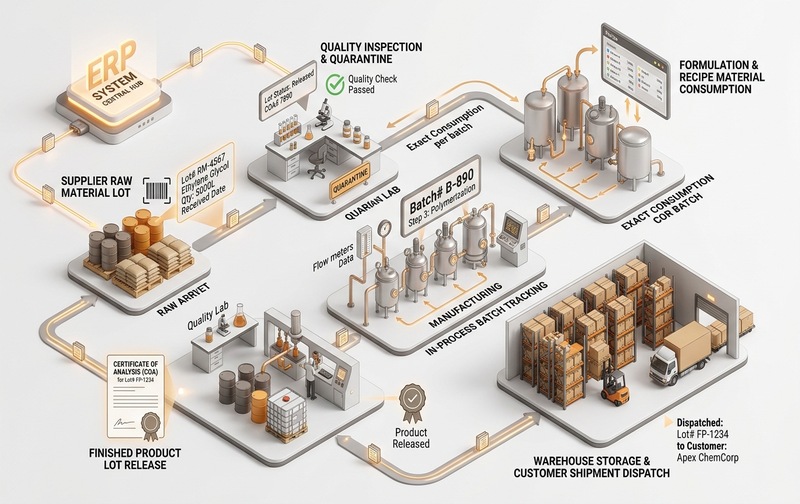
The exact traceability requirement varies by business and product.
An ERP evaluation should therefore determine:
Odoo’s inventory and manufacturing capabilities can form part of this process, but the final solution should be validated against the company’s actual traceability requirements.
This is especially important where traceability is connected to quality, customer specifications, audits, or regulatory obligations.
Inventory, Production and Quality Control
Chemical ERP requirements cannot always be evaluated module by module.
Inventory, manufacturing, and quality are interconnected.
For example, a raw material may be received into inventory, inspected, placed into an appropriate status, consumed during production, and associated with a finished batch.
A production variance may then require investigation. The ERP should provide sufficient transaction visibility to understand what happened.
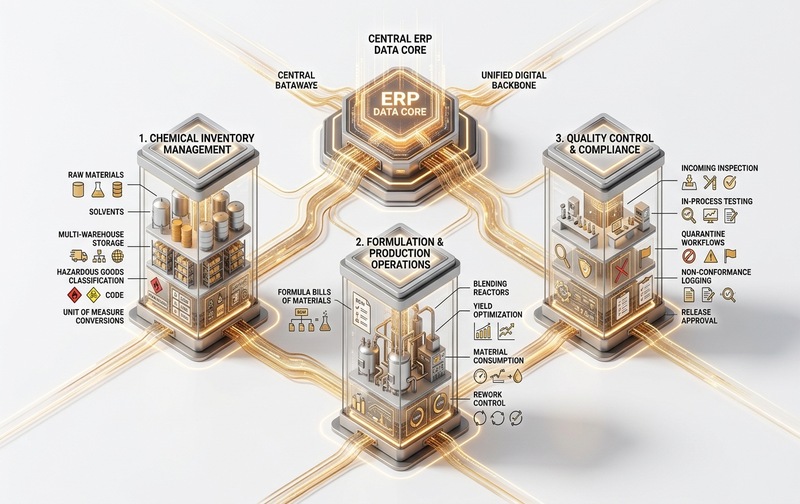
Inventory
The evaluation should consider:
Production
Important requirements may include:
Quality
Depending on the business, quality processes may include:
The objective is not simply to collect more data.
The objective is to connect operational data so that employees and management can make decisions using consistent information.
When Odoo May Be a Good Business Fit
Odoo may be worth evaluating when a chemical business needs an integrated platform but its requirements remain compatible with the system’s standard capabilities and available configuration options.
Potential fit indicators include:
However, fit should be assessed against actual processes rather than determined from company size alone.
A small chemical manufacturer with complex formulations and strict traceability requirements may need more sophisticated configuration than a larger business with simpler processes.
Odoo Implementation Risks for Chemical Companies
ERP implementation can fail even when the software itself is capable of supporting the business.
The major risks often occur during requirements definition, data preparation, configuration, integration, testing, and adoption.
Poor Requirements Definition
If the project begins without documenting existing processes and required future workflows, important requirements may be missed.
Excessive Customization
Customization may be necessary for legitimate business requirements, but excessive customization can increase implementation complexity, maintenance requirements, and future upgrade considerations.
Poor Master Data
Incorrect product, supplier, customer, warehouse, unit-of-measure, or formulation data can create operational problems after go-live.
Incomplete Data Migration
Historical and opening data should be assessed before migration. Not every legacy record necessarily needs to be transferred, but required information must be identified clearly.
Weak User Adoption
An ERP system changes how employees perform daily work. Users need appropriate training, process documentation, testing opportunities, and support during transition.
Insufficient Testing
Testing should cover realistic business scenarios rather than only individual software functions.
Complete Chemical Workflow Testing Scope:
For chemical manufacturing, testing should include complete workflows such as:
Purchase ➔ Receipt ➔ Inspection ➔ Inventory ➔ Production ➔ Consumption ➔ Finished Batch ➔ Quality ➔ Dispatch ➔ Accounting.
What to Evaluate Before Implementing Odoo
A chemical manufacturer should evaluate Odoo against business requirements in several areas.
These questions are more useful than evaluating an ERP based only on the number of modules it provides.
ERP Business Case: Cost, Complexity and Value
ERP investment should not be evaluated only by software licensing or subscription cost.
Total Project Involvements:
Measurable Value Reductions:
The potential business value should also be considered. For example, management may evaluate whether the ERP can help reduce:
At the same time, the business should identify measurable objectives before implementation.
Avoid assuming that ERP automatically creates savings. The business case should be based on its actual processes, baseline performance, implementation scope, and expected outcomes.
Practical ERP Readiness Checklist for Chemical Manufacturers
Before starting an Odoo implementation, management should be able to answer these questions:
If these questions cannot be answered, the business may need to complete additional process analysis before starting implementation.
How to Choose an Odoo Implementation Partner
Software selection is only one part of an ERP project.
Implementation capability can significantly influence the outcome.
When evaluating an Odoo implementation partner, chemical manufacturers should examine:
Practical Demonstration Best Practice:
Ask potential partners to demonstrate actual business scenarios rather than simply presenting a list of software features.
For example, ask them to demonstrate how a raw-material purchase moves through receipt, inventory, production consumption, finished-batch creation, quality processing, and final dispatch. That type of demonstration provides more useful information than a generic product presentation.
Is Your Chemical Business Ready for Odoo?
The right time to implement an ERP is usually when the cost and risk of continuing with fragmented processes begin to outweigh the effort required to improve the operating model.
For chemical manufacturers, this point may become visible through increasing inventory complexity, production growth, batch traceability requirements, disconnected quality processes, spreadsheet dependency, reporting delays, or difficulties coordinating multiple departments.
Odoo can be part of the solution, but the decision should be based on business requirements rather than software popularity alone.
A structured evaluation should establish what the business needs today, where it expects to be in the next few years, which requirements can be supported through standard capabilities, where configuration or integration is needed, and where customization may be required.
Conclusion: Making the Right Chemical ERP Decision
Odoo for chemical industry operations should be evaluated as a business-process decision, not simply as a software purchase.
Chemical manufacturers considering ERP implementation should first identify the operational problems they need to solve. These may include disconnected systems, inventory inaccuracies, production visibility gaps, batch traceability requirements, quality-control challenges, manual reporting, or growing process complexity.
From there, management can evaluate Odoo against functional requirements, traceability, integrations, scalability, customization, implementation effort, data readiness, user adoption, and long-term support.
The objective should be a solution that connects business processes and provides reliable information for employees and decision-makers.
A detailed ERP assessment can help determine whether Odoo fits the company’s current requirements, what implementation scope may be necessary, and which areas require additional configuration or integration.
Frequently Asked Questions About Odoo for Chemical Industry
Discuss Your Chemical ERP Requirements
If your chemical manufacturing business is experiencing growing inventory complexity, disconnected production data, traceability challenges, manual reporting, or increasing operational complexity, a practical ERP discussion can help identify the requirements before you commit to an implementation.
Request an Odoo ERP Demo to discuss your chemical manufacturing processes, system requirements, integrations, and implementation considerations.