
Outgrowing Your Healthcare ERP? SAP S/4HANA for Healthcare Scalability
Quick Answer: How SAP S/4HANA Solves Healthcare ERP Scalability
If your healthcare organization is expanding across locations, processes, users or transaction volumes, an ERP environment that once worked may become difficult to scale. SAP S/4HANA for Healthcare provides an enterprise ERP foundation for connecting finance, procurement, supply chain, inventory, asset and operational data. The right approach depends on your existing systems, business processes, integration requirements, data structure and long-term growth plans.
When Healthcare Growth Starts Exposing ERP Limitations
Growth creates more than additional transactions. As a healthcare organization expands, the ERP environment has to support more users, locations, suppliers, products, financial transactions, operational processes and reporting requirements.
A system that was suitable for a smaller operation can become increasingly difficult to manage when business complexity increases.
Common warning signs include:
Disconnected systems between departments
Spreadsheet-dependent reporting
Inconsistent master data
Limited visibility across locations
Manual reconciliation
Increasing dependence on workarounds
These problems can become more significant when healthcare organizations operate multiple facilities, distribution points, business units or supply-chain relationships.
The issue is not necessarily that the existing ERP is technically outdated. The more important question is whether the current ERP architecture can support the organization’s next stage of growth without creating unnecessary process complexity.
That is where SAP S/4HANA for Healthcare becomes relevant.
What SAP S/4HANA for Healthcare Scalability Means
SAP S/4HANA is an enterprise resource planning platform designed to connect business processes and operational data within a unified ERP environment.
For healthcare organizations, scalability can involve more than simply handling a larger database or higher transaction volume.
It can mean supporting:
More business locations
More users and departments
More suppliers and customers
Greater inventory complexity
Larger procurement operations
More financial transactions
Increasing reporting requirements
Additional integrations
More sophisticated management controls
The value of an enterprise ERP approach comes from connecting these processes rather than allowing each function to develop independently.
For example, procurement activity can affect inventory, inventory affects operational availability, operational transactions affect financial records, and management reporting depends on consistent information across these processes.
A scalable ERP environment therefore needs to support the relationships between these functions.
Healthcare ERP Scalability Across Finance and Operations
Financial complexity often increases alongside organizational growth.
More locations, suppliers, transactions and operational processes can make financial consolidation and management reporting more difficult when data is distributed across disconnected systems.
SAP S/4HANA can provide an integrated ERP environment in which financial processes are connected with operational transactions.
This can support areas such as:
For CFOs and finance leaders, the important consideration is not simply whether an ERP contains financial functionality.
The question is whether financial information can remain connected to the operational activities that generate it as the organization grows.
Scaling Healthcare Inventory and Supply Chain Management
Healthcare organizations can face increasing inventory complexity as they expand.
Different locations may manage different stock requirements, suppliers, purchasing cycles and operational priorities. Without appropriate system integration, organizations can struggle to maintain consistent inventory information.
A scalable healthcare ERP environment can help connect procurement, inventory and related operational processes.
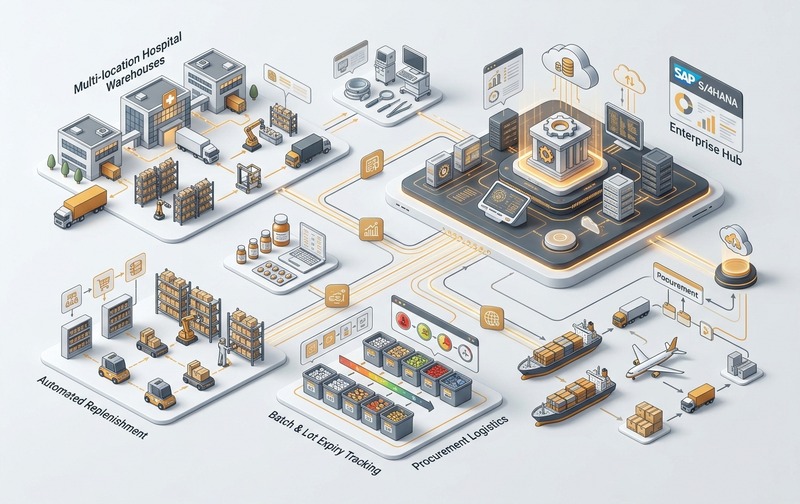
Connected healthcare supply chain and inventory visibility linking multi-facility stock, automated replenishment, and batch-lot expiry tracking in SAP S/4HANA.
Depending on the organization’s requirements, this can involve:
Purchasing processes
Supplier information
Inventory visibility
Stock movement
Material planning
Warehouse processes
Multi-location inventory management
Procurement reporting
For healthcare businesses managing medical products, supplies or other inventory-intensive operations, these connections can become increasingly important as the organization expands.
The objective is not simply to hold more inventory data. It is to maintain usable and consistent information across the processes responsible for purchasing, receiving, storing and moving that inventory.
Managing Multiple Healthcare Locations Through One ERP Environment
Expansion into additional facilities or locations can expose weaknesses in fragmented ERP environments.
When every location operates with different processes, spreadsheets or disconnected applications, management may find it difficult to obtain a consistent view of business activity.
An enterprise ERP approach can help establish common processes and centralized visibility while still supporting the operational requirements of individual business units or locations.
This can be particularly relevant for organizations managing:
However, scalability does not mean forcing every location into an identical process.
During implementation, organizations need to determine which processes should be standardized and which genuinely require local configuration or integration.
SAP S/4HANA Healthcare Integration for Growing Organizations
ERP scalability is closely connected to integration.
Healthcare organizations rarely operate their ERP in isolation. They may have separate applications for clinical operations, customer management, payroll, banking, procurement, logistics, reporting or other specialized processes.
As the organization grows, the number of connections between systems can also increase.
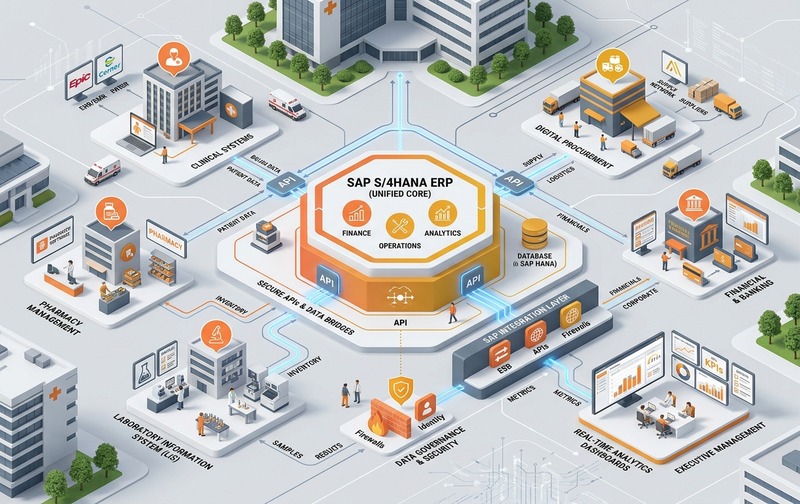
Enterprise healthcare integration architecture connecting SAP S/4HANA core with EHR/EMR clinical platforms, pharmacy management, laboratory systems, and supplier networks.
A scalable ERP strategy should therefore evaluate:
Existing applications
Data exchange requirements
API or integration requirements
Master-data synchronization
Financial integrations
Supply-chain integrations
Reporting platforms
Legacy applications
Industry-specific systems
The objective is not necessarily to replace every existing system.
In many cases, the more practical approach is to determine which systems should remain specialized and how they should exchange reliable information with the ERP environment.
Healthcare Data Visibility Becomes More Important as You Scale
Growth increases the amount of data that management needs to understand.
When information is spread across ERP systems, spreadsheets and departmental applications, executives may spend more time consolidating information before they can use it for decision-making.
An integrated ERP environment can provide a stronger foundation for connecting operational and financial information.
This can help organizations examine areas such as:
Revenue and costs
Procurement activity
Inventory levels
Supplier transactions
Business-unit performance
Operational spending
Asset information
Financial performance
The objective should be decision-ready information, rather than simply more reports.
For senior management, the practical question is whether the ERP environment can provide reliable information quickly enough to support operational and financial decisions.
When Should a Healthcare Organization Consider ERP Scalability?
There is no single employee count or transaction threshold that determines when an organization should move to a more scalable ERP architecture.
The decision is usually driven by increasing business complexity.
Signs that an organization should evaluate its ERP scalability include:
New locations, business units or markets are creating additional system requirements.
Departments depend on multiple systems that do not exchange information efficiently.
Management reporting requires substantial spreadsheet consolidation.
Finance and operations spend significant time resolving differences between systems.
More locations, suppliers or product categories are making inventory visibility harder.
Existing systems require more integrations as the organization expands.
Different locations or departments follow substantially different workflows.
Management cannot easily obtain a consolidated view of business performance.
These signals do not automatically mean SAP S/4HANA is the right answer. They indicate that the organization’s ERP architecture deserves a structured evaluation.
SAP S/4HANA for Healthcare: What to Evaluate Before Migration
Moving to a more scalable ERP platform is a significant business decision.
Healthcare organizations should evaluate the current environment before deciding on implementation or migration.
Important areas include:
Document the systems currently used by finance, procurement, inventory, supply chain, operations and other departments.
Identify which processes are standardized and which depend heavily on manual workarounds or custom applications.
Assess master data, duplicate records, inconsistent information, historical data and data ownership before migration planning begins.
Identify applications that must continue operating alongside the ERP and determine how information should move between systems.
Define the management and operational reports that are currently required and identify where existing reporting creates delays or manual effort.
Separate genuine business requirements from processes that could potentially be handled through standard ERP capabilities or configuration.
An ERP platform can only deliver operational value when users can effectively adopt the processes and workflows implemented around it.
The ERP strategy should reflect the organization’s expected business model, geographic expansion, operational complexity and technology requirements.
SAP S/4HANA Healthcare Implementation Is More Than an ERP Upgrade
A common mistake is to treat ERP transformation as a software replacement exercise.
For a growing healthcare organization, the implementation can affect processes across finance, procurement, inventory, supply chain, reporting, integrations and user operations.
That means implementation planning should consider:
A scalable ERP strategy should therefore begin with business requirements rather than starting with technology alone.
Healthcare ERP Scalability Without Creating More Complexity
Replacing an ERP system does not automatically eliminate complexity.
Poorly defined processes can simply be transferred into a more powerful platform.
The better approach is to use ERP transformation as an opportunity to examine where complexity originates.
For example:
Which processes are genuinely necessary?
Which approvals can be standardized?
Which spreadsheets can be eliminated?
Which data should have a single source of truth?
Which applications should remain specialized?
Which integrations are essential?
Which customizations create long-term maintenance requirements?
This distinction is important.
Scalability should mean the ability to support growth without proportionally increasing operational complexity.
That requires process design, governance and implementation discipline alongside ERP technology.
SAP S/4HANA for Healthcare vs Staying With a Fragmented ERP Landscape
The decision should not simply be framed as “old ERP versus new ERP.”
A more useful evaluation compares the organization’s current operating model with its future requirements.
Swipe horizontally to view full comparison across all 3 columns:
| Area | Fragmented ERP Environment | Scalable ERP Approach |
|---|---|---|
| Financial information | May be distributed across systems | Greater integration between financial and operational data |
| Inventory | Visibility can vary by system/location | Centralized ERP-based inventory processes |
| Procurement | Multiple workflows may exist | More standardized procurement processes |
| Reporting | Manual consolidation may be required | Integrated data can support consolidated reporting |
| Locations | Processes may differ substantially | Common processes can be established where appropriate |
| Integrations | Point-to-point connections can increase | Integration architecture can be planned around the ERP |
| Growth | New locations may require additional workarounds | ERP architecture can be designed around expansion |
The appropriate model depends on the organization’s current architecture, requirements, budget, implementation readiness and long-term objectives.
How to Build a Scalable SAP S/4HANA Healthcare Roadmap
A practical roadmap should begin with assessment rather than immediate implementation.
Assess the current ERP environment
Document applications, processes, integrations, data sources and operational pain points.
Identify scalability constraints
Determine whether the main limitations are related to technology, process design, data quality, integrations or organizational structure.
Define the future-state requirements
Establish what the organization needs to support over the next stage of growth.
Map ERP capabilities to business requirements
Determine which requirements can be addressed through standard functionality, configuration, integration or additional development.
Build the migration and integration strategy
Define data migration requirements, system dependencies, interfaces and transition stages.
Establish implementation priorities
Not every requirement needs to be addressed simultaneously. Prioritize the processes that have the greatest operational importance.
Plan post-go-live support
Scalability is an ongoing requirement. Support, optimization, user training and system governance should be part of the roadmap rather than an afterthought.
Is SAP S/4HANA Right for Your Growing Healthcare Organization?
SAP S/4HANA may be worth evaluating when healthcare organizations are experiencing increasing operational complexity, multiple locations, disconnected systems, growing integration requirements or limited visibility across finance and operations.
But the decision should be based on business fit rather than platform popularity.
Before selecting an ERP platform, healthcare organizations should answer:
What processes are currently limiting growth?
Where is operational data fragmented?
Which systems must remain integrated?
What information do executives need to access faster?
Which processes should be standardized?
What data needs to be migrated?
What level of customization is actually necessary?
How will users transition to the new workflows?
What support will be required after implementation?
These questions help determine whether an SAP S/4HANA transformation aligns with the organization’s actual scalability requirements.
Frequently Asked Questions About SAP S/4HANA for Healthcare
Evaluate SAP S/4HANA for Healthcare Scalability
If your healthcare ERP is struggling with growing operations, disconnected systems, or scalability challenges, it may be time to evaluate your future ERP requirements.
Emerging Alliance supports SAP S/4HANA implementation, integration, customization, migration, and ongoing support for evolving healthcare operations.
Request an SAP S/4HANA demo to explore a scalable approach for your healthcare business.