

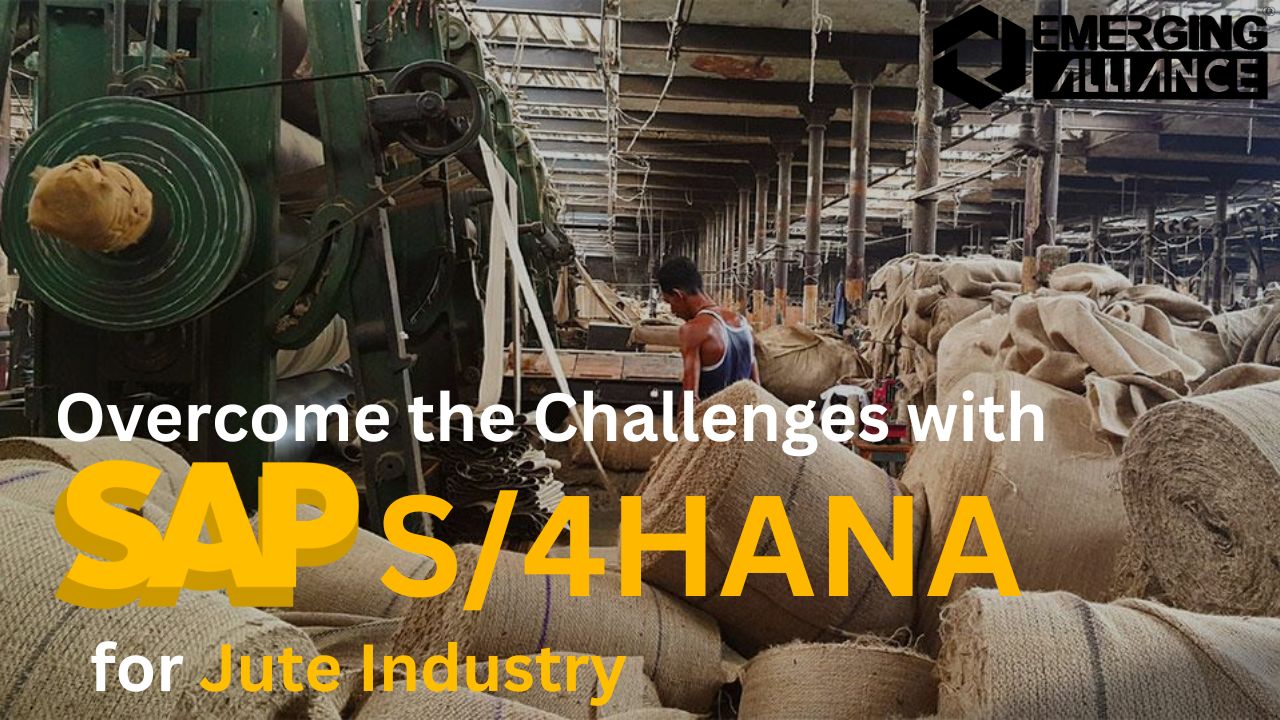
Overcome the Challenges with SAP S/4HANA for Jute Industry
How SAP HANA Address the Challenges in the Jute Manufacturing Industry
Jute, a prominent industry in India, boasts the largest production in the country and enjoys extensive exportation to various nations. Primarily utilized for wrapping and packaging agricultural and industrial commodities, jute fiber fabric serves as a crucial material. To tackle numerous challenges, SAP S/4HANA emerges as a novel solution. It diminishes manual errors, enables efficient tracking of goods, and facilitates quicker decision-making predictions. In this post, we will explain the challenges faced by Jute Industry and how to overcome these Challenges
Understanding the Challenges
Before delving into the solutions offered by SAP S/4HANA, it’s essential to grasp the challenges that the jute industry encounters:
Supply Chain Complexity:
The jute industry operates within a complex supply chain, involving multiple stakeholders, from farmers to manufacturers to distributors. Coordinating these various entities efficiently while maintaining quality and sustainability standards can be a daunting task.
Inventory Management:
Effective inventory management is crucial in ensuring that raw materials are available when needed without excessive stockpiling. Jute being a natural fiber, its availability can be impacted by factors like weather conditions and seasonal variations, making inventory management even more challenging.
Regulatory Compliance:
Compliance with regulatory standards, particularly regarding environmental sustainability and labor practices, is paramount in the jute industry. Ensuring adherence to these regulations adds another layer of complexity to operations.
Market Volatility:
Fluctuations in market demand and prices can significantly impact the profitability of jute businesses. Navigating these fluctuations while optimizing production and pricing strategies requires real-time insights and agility.
The SAP S/4HANA Advantage
SAP S/4HANA, an intelligent, integrated ERP system, offers a comprehensive solution to address the challenges faced by the jute industry:
Streamlined Supply Chain Management with SAP S/4HANA for Jute Industry:
With SAP S/4HANA, jute businesses can gain real-time visibility into their entire supply chain, from procurement to production to distribution. This enables better coordination among stakeholders, optimized inventory levels, and enhanced responsiveness to market demand fluctuations.
Advanced Inventory Optimization through SAP S/4 HANA Software:
Leveraging advanced analytics and machine learning capabilities, SAP S/4HANA enables predictive inventory planning. By analyzing historical data, market trends, and external factors like weather patterns, businesses can optimize their inventory levels, minimizing stockouts and excess inventory costs.
Ensuring Regulatory Compliance with SAP HANA :
SAP S/4HANA comes equipped with features designed to facilitate regulatory compliance. Whether it’s tracking environmental impact metrics or ensuring adherence to labor standards, the system provides the tools and frameworks necessary to demonstrate compliance and mitigate risks.
Agile Decision-Making through SAPs/4HANA for Jute Industry:
With real-time data analytics and reporting capabilities, SAP S/4HANA empowers jute industry leaders to make data-driven decisions swiftly. Whether it’s adjusting production schedules in response to market changes or optimizing pricing strategies based on demand forecasts, businesses can adapt quickly to dynamic market conditions.
In conclusion, SAP S/4HANA offers a compelling solution for overcoming the challenges faced by the jute industry. By providing real-time visibility, advanced analytics, and integrated processes, it empowers jute businesses to optimize their operations, ensure compliance, and capitalize on market opportunities. As the jute industry continues to evolve, embracing digital transformation with SAP S/4HANA will be instrumental in driving sustainable growth and competitiveness.
To learn more about our services and solutions, visit us at: https://emerging-alliance.net/
Ready to dive deeper into the topics you love? Visit our website to explore a treasure trove of valuable content, resources, and insights that will captivate your mind and fuel your curiosity!
Top 10 FAQs
1. How does SAP S/4HANA help jute manufacturers manage seasonal raw material fluctuations?
SAP S/4HANA uses predictive analytics and historical procurement data to forecast raw jute availability during seasonal changes. It helps manufacturers maintain optimal stock levels, avoid production delays, and reduce dependency on emergency procurement during shortages.
2. Can SAP S/4HANA improve traceability in the jute supply chain?
Yes. SAP S/4HANA provides end-to-end supply chain visibility by tracking raw jute from farmers and suppliers through production and distribution. This improves traceability, quality assurance, and transparency for export compliance.
3. How does SAP S/4HANA reduce manual errors in jute manufacturing operations?
The platform automates procurement, inventory updates, production planning, and financial processes. By minimizing manual data entry and disconnected spreadsheets, SAP S/4HANA significantly reduces operational errors and improves data accuracy.
4. What inventory challenges in the jute industry can SAP S/4HANA solve?
SAP S/4HANA helps address overstocking, stock shortages, warehouse inefficiencies, and raw material wastage. Its real-time inventory monitoring and predictive planning tools ensure better inventory control and cost optimization.
5. How can SAP S/4HANA help jute exporters comply with international regulations?
SAP S/4HANA supports compliance management by monitoring environmental standards, labor regulations, export documentation, and sustainability reporting. This is particularly useful for jute exporters dealing with strict international trade requirements.
6. Is SAP S4HANA useful for managing price volatility in the jute market?
Absolutely. SAP S/4HANA provides real-time market insights, demand forecasting, and profitability analysis. Manufacturers can quickly adjust pricing strategies, procurement plans, and production schedules based on changing market conditions.
7. How does SAP S/4HANA improve production planning in jute mills?
integrates production planning with inventory, procurement, and sales data. This allows jute mills to optimize machine utilization, reduce downtime, and align production with customer demand forecasts.
8. Can SAP S/4HANA support sustainability goals in the jute industry?
Yes. Since jute is considered an eco-friendly fiber, sustainability tracking is important. SAP S/4HANA helps businesses monitor energy usage, waste management, carbon footprint, and sustainable sourcing practices through integrated reporting tools.
9. What benefits does real-time analytics in SAP S/4HANA offer to jute manufacturers?
Real-time analytics help decision-makers identify production bottlenecks, monitor operational KPIs, track sales performance, and respond quickly to disruptions in supply or demand. This improves agility and overall business performance.
10. Why should traditional jute businesses invest in SAP S/4HANA digital transformation?
Traditional jute businesses often struggle with fragmented systems and manual operations. SAP S/4HANA modernizes operations through automation, centralized data management, intelligent reporting, and scalable processes, helping businesses remain competitive in domestic and export markets.
Want to speak to an expert? Fill in the form below, and we will be in touch with you shortly!