
Salesforce for Medical Equipment: Sales, Service & Equipment Lifecycle Management
Quick Answer
Salesforce can help medical equipment companies centralize customer data, manage complex sales cycles, coordinate field teams, track equipment-related customer information, improve service visibility, and connect sales with downstream operations. The value comes from configuring Salesforce around the company’s sales, service, installed-equipment, and integration requirements—not simply deploying a generic CRM.
Why Medical Equipment Companies Need More Than a Standard CRM
Medical equipment businesses operate differently from many conventional B2B companies.
A sales opportunity may begin with a distributor, hospital, clinic, laboratory, or healthcare group and involve multiple stakeholders before a purchase decision is made. The process can include product demonstrations, technical evaluations, quotations, regulatory documentation, negotiations, installation, after-sales service, maintenance, spare parts, and repeat purchases.
This creates a problem when customer information is distributed across spreadsheets, email, disconnected applications, sales representatives’ devices, and service systems.
Hospitals & Healthcare Networks
Involving clinical department heads, biomedical engineering teams, procurement committees, finance officers, and executive directors in multi-stage clinical evaluations.
Specialized Diagnostic Clinics
Requiring targeted modality demonstrations, flexible financing models, structured warranty coverage, and high-reliability uptime commitments.
Independent Pathology & Labs
Focusing heavily on analytical throughput, calibration compliance, reagent supply agreements, and predictive preventive maintenance schedules.
Distributor & Dealer Channels
Managing geographic territory rights, co-selling opportunities, partner margin structures, tier-based incentives, and joint customer support.
Sales teams may know the status of an opportunity while service teams lack visibility into the customer relationship. Management may have revenue forecasts but limited visibility into which opportunities depend on demonstrations or technical approvals. Field teams may manage customer interactions separately from the commercial history.
The Four Critical Visibility Gaps of Disconnected Systems:
- Commercial vs. Service Silos: Service engineers visit customer sites without knowing open sales bids, while account reps quote new systems unaware of critical recurring service tickets.
- Demonstration Blind Spots: Deals stall in clinical evaluations or trial stages because demo device allocation and technical sign-offs are logged on personal notepads or email chains.
- Unreliable Executive Forecasts: Management receives projected pipeline numbers disconnected from clinical approval milestones and budget release timelines.
- Lost Account History: Customer records, installation notes, and key doctor relationships vanish when sales reps transition out of territories.
For medical equipment companies, the CRM therefore needs to support more than lead and opportunity tracking.
It needs to create a connected view of the customer relationship across the commercial and post-sales lifecycle.
That is where Salesforce can become strategically valuable.
What Salesforce Can Manage for Medical Equipment Businesses
Salesforce can provide a centralized platform for managing customer and prospect information across sales and service processes.
Instead of allowing customer information to remain fragmented, companies can structure information around accounts, contacts, opportunities, activities, products, service interactions, and relevant equipment information.
The exact configuration depends on the business model, product portfolio, geography, sales structure, and existing technology environment.
For a medical equipment company, the most important capabilities typically include:
Account and Contact Management
Maintaining structured hierarchies for hospital groups, purchasing bodies, clinical departments, biomedical heads, and key opinion leaders (KOLs).
Lead and Opportunity Management
Capturing hospital and clinic inquiries, qualifying purchasing intent, and steering opportunities through rigorous procurement stages.
Sales Pipeline Visibility
Tracking deal progress by product modality, territory, expected close date, probability weighting, and commercial value.
Product and Quotation-Related Workflows
Configuring complex multi-component device configurations, software licenses, warranty options, and generating customized clinical proposals.
Sales Activity Tracking
Recording clinical presentations, stakeholder meetings, hospital visits, technical consultations, and compliance reviews in a unified timeline.
Customer Communication History
Centralizing emails, call records, tender documentation, and meeting minutes accessible to all commercial and customer-facing teams.
Field Sales Coordination
Equipping mobile sales representatives with real-time customer history, meeting scheduling, route planning, and instant mobile visit logging.
Service and Support Workflows
Managing hospital service tickets, break-fix requests, preventive maintenance reminders, and biomedical service dispatch schedules.
Equipment or Installed-Base Visibility
Tracking installed serial numbers, software firmware revisions, warranty expirations, service contract tiers (AMC/CMC), and maintenance logs.
Customer Follow-Up Automation
Automating alerts for quotation expirations, contract renewal notifications, consumable reordering reminders, and follow-up tasks.
Reporting and Forecasting
Delivering executive real-time dashboards for sales projections, rep conversion rates, territory revenue analysis, and service resolution metrics.
ERP and Business-System Integration
Connecting CRM opportunities with ERP back-office systems for inventory checks, purchase order conversion, billing, and fulfillment.
The objective is not to put every process into one system without distinction.
The objective is to connect the information that decision-makers and operational teams need to manage the customer lifecycle effectively.
Managing Complex Medical Equipment Sales Cycles
Medical equipment sales rarely follow a simple lead-to-order process.
A potential customer may require product information, demonstrations, technical discussions, internal approvals, commercial negotiations, and multiple follow-ups before a purchase occurs.
When these activities are tracked manually, management can struggle to answer basic questions:
Which opportunities are genuinely active?
Separating active hospital purchasing cycles from stalled inquiries where clinical budgets were postponed or allocated elsewhere.
Which deals have stalled?
Pinpointing opportunities lingering in demonstration or quotation review beyond standard benchmark thresholds to trigger targeted sales support.
Which sales representatives need intervention?
Identifying reps encountering bottlenecks during committee technical reviews, clinical trials, or contract legal negotiations.
Which opportunities are waiting for customer approval?
Clarifying whether delays originate internally (quote revisions, demo scheduling) or with the hospital’s biomedical and finance sign-off committee.
Which products are generating the strongest pipeline?
Analyzing demand across specialized device families, imaging systems, diagnostic analyzers, or surgical equipment lines.
Which accounts have expansion potential?
Evaluating established customer hospitals with nearing warranty expirations, high consumable utilization, or regional satellite clinic openings.
Salesforce can centralize these activities so sales managers have greater visibility into opportunity progression.
Sales teams can use standardized stages, activities, tasks, reminders, account information, and opportunity records to create greater consistency across the sales process.
This is particularly important when a company has multiple sales representatives, territories, distributors, or product categories.
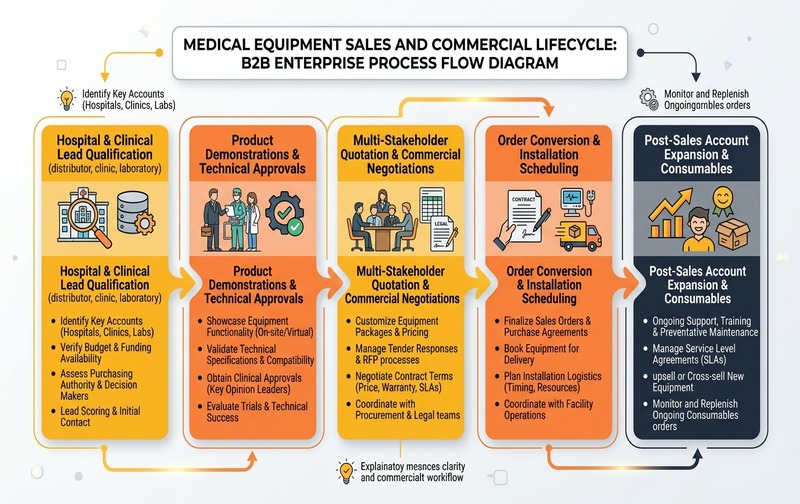
Figure 1: Strategic B2B process flow infographic detailing Salesforce CRM pipeline and lifecycle management for medical equipment companies, covering lead qualification, clinical demonstrations, technical approvals, quotation negotiations, and installation scheduling.
Medical Equipment Sales & Lifecycle Stages Framework
| Lifecycle Stage | Core Workflows & Activities | Primary Stakeholders | Key Data / System Handoff |
|---|---|---|---|
| 1. Lead & Clinical Qualification | Inquiry intake from clinics/hospitals, medical conference leads, territory allocation, budget validation. | Field Sales Rep, Channel Partner, Hospital Department Head | Salesforce Lead converted to Account, Contact, and Opportunity record. |
| 2. Demonstration & Technical Evaluation | Demo unit scheduling, on-site clinical trial, biomedical review, regulatory compliance sign-off. | Clinical Specialist, Biomedical Engineer, Physicians / KOLs | Demo tracking records, technical evaluation forms logged against Opportunity. |
| 3. Proposal, Pricing & Negotiation | Multi-component device configuration, warranty packaging, discount governance, hospital tender submission. | Sales Manager, Commercial Director, Hospital Procurement Committee | Salesforce CPQ / Quotes, discount approval workflow, contract terms. |
| 4. Order Conversion & Installation | PO verification, dispatch coordination, hospital site preparation, device commissioning, clinical staff training. | Project Manager, Field Service Engineer, Hospital Facility Manager | ERP Sales Order creation; Asset record created in Salesforce with serial number. |
| 5. Post-Sales Lifecycle & Expansion | Preventive maintenance, break-fix support, warranty-to-AMC renewal, consumable replenishment, model upgrades. | Service Manager, Field Engineer, Key Account Manager | Service Cases, Maintenance Work Orders, Contract renewal Opportunities. |
Connecting Sales With Medical Equipment Customers
Medical equipment companies often maintain long-term relationships with hospitals, clinics, laboratories, distributors, and other healthcare organizations.
The commercial relationship does not end when an order is closed.
Customers may require installation, training, maintenance, replacement parts, upgrades, consumables, additional equipment, or support.
A CRM should therefore help the business understand the broader customer relationship instead of treating every purchase as an isolated transaction.
Salesforce can help teams maintain a consolidated view of customer interactions, allowing sales and service teams to work from more consistent customer information.
This can support account expansion because sales teams can identify existing relationships and understand previous interactions before approaching the customer with another opportunity.
Improving Field Sales Management
Medical equipment sales frequently involve field representatives who spend significant time visiting customers, conducting demonstrations, attending meetings, and developing relationships.
Without centralized activity tracking, management may have limited visibility into field activity.
Salesforce can help organizations structure field-sales workflows around accounts, contacts, opportunities, activities, visits, follow-ups, and sales targets.
This can improve management visibility without requiring sales representatives to maintain separate spreadsheets or manually consolidate information for every review meeting.
The goal is not simply to track employee activity.
The more valuable objective is to connect field activity with commercial outcomes.
For example, management should be able to understand whether customer visits are progressing opportunities, generating new opportunities, strengthening existing accounts, or requiring additional technical or commercial support.
Managing the Equipment Lifecycle After the Sale
The customer relationship becomes more complex after equipment is installed.
A medical equipment company may need visibility into what equipment a customer purchased, when it was installed, which service activities have occurred, and what future commercial opportunities may exist.
This information can become particularly valuable for companies with recurring service requirements, equipment upgrades, consumables, replacement cycles, or maintenance contracts.
A connected CRM environment can help teams move from a transaction-focused model toward lifecycle-based customer management.
Instead of asking only:
“What did this customer buy?”
the business can work toward understanding:
“What equipment does this customer have, what support does it require, what is its commercial history, and what opportunity exists next?”
That shift can improve account planning and customer retention.
Supporting Service and After-Sales Operations
For medical equipment companies, service quality can directly influence customer retention and future revenue.
Customers may expect timely responses to service requests, maintenance coordination, technical support, and clear communication.
If service information is separated from customer and commercial information, sales teams may not understand current service issues, while service teams may have limited visibility into the broader customer relationship.
Salesforce can help organizations create more connected service workflows, depending on the Salesforce products and architecture selected.
Potential processes include:
Customer Service Requests
Multi-channel intake for hospital maintenance and breakdown inquiries via portal, email, or phone.
Case Management
Structured case assignment, severity categorization, escalation rules, and resolution tracking.
Service Communications
Automated updates to hospital biomedical teams regarding technician dispatch and repair status.
Field-Service Coordination
Scheduling field biomedical engineers, mobile work orders, on-site diagnostics, and parts usage.
Maintenance-Related Workflows
Automating scheduled periodic preventive maintenance (PPM), calibration logs, and safety tests.
Customer History
Unified 360-degree historical view of all equipment repairs, engineer visit notes, and replaced components.
Service Performance Reporting
Monitoring First-Time Fix Rates (FTFR), Mean Time to Repair (MTTR), and SLA compliance benchmarks.
Escalation Management
Systematic routing of critical hospital machine downtime to senior technical directors and regional leadership.
The right configuration depends on whether the organization needs CRM functionality alone or a broader Salesforce service and field-service architecture.
Why ERP Integration Matters
Salesforce should not automatically replace an ERP system.
Medical equipment businesses typically need different systems for different responsibilities.
CRM platforms are generally focused on customer relationships, sales, service, and engagement, while ERP systems manage areas such as financial accounting, inventory, purchasing, order processing, and other core business operations.
The real opportunity is integration.
For example, Salesforce may manage the commercial relationship while an ERP system manages inventory and financial transactions.
Relevant information can then move between systems based on defined business requirements.
A Typical Integration Architecture May Connect:
Customer, account hierarchies, leads, quotes, and opportunity progression information.
Products, warehouse inventory levels, sales orders, invoices, and financial accounting ledger.
Cases, work orders, service activities, parts consumption, and field technician dispatch.
Middleware data synchronization, API validation, and automated cross-system process orchestration.
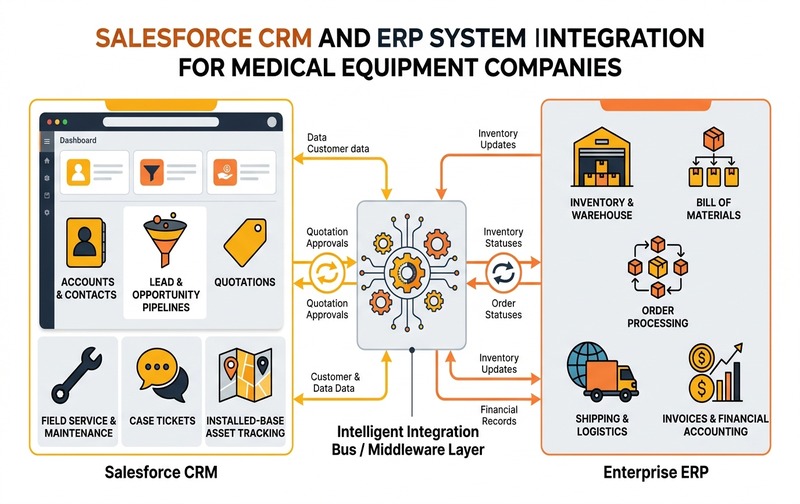
Figure 2: Enterprise system integration architecture diagram connecting Salesforce CRM commercial front-office sales and field service with ERP back-office inventory, order processing, and financial accounting for medical equipment businesses.
The exact architecture should be designed around business processes rather than assuming every field needs to be synchronized between every system.
System Responsibility Matrix: Salesforce CRM vs. ERP
| Operational Domain | Salesforce CRM Responsibility | ERP System Responsibility | Integration Flow |
|---|---|---|---|
| Customer & Account Data | Lead generation, prospect qualification, stakeholder roles, interaction log. | Credit limit, payment terms, tax codes, billing addresses, financial history. | Bi-directional synchronization upon opportunity qualification. |
| Product Catalog & Stock | Product descriptions, sales kits, customer-specific pricing tiers, CPQ quoting. | Master item catalog, bill of materials (BOM), real-time warehouse inventory. | ERP to Salesforce (Real-time or daily item & stock sync). |
| Order Processing | Opportunity won, signed tender contract, commercial quote finalization. | Sales order entry, picking, packing, shipping, delivery challan, invoicing. | Salesforce to ERP (Won deal pushes Sales Order creation). |
| Installed Base & Service | Installed asset records, serial numbers, warranty terms, AMC/CMC contracts, tickets. | Spare parts replenishment, service billing, depreciation, repair costing. | Bi-directional (Asset creation from dispatch; parts billing to ERP). |
Salesforce for Medical Equipment Distributors
Distribution businesses often face different challenges from manufacturers.
A distributor may manage multiple brands, territories, sales representatives, hospitals, clinics, dealers, and product categories.
Pipeline visibility becomes particularly important when management needs to understand:
Which products are generating demand?
Identifying fast-moving diagnostic lines vs. capital equipment requiring extended sales cycles across different brands.
Which territories are performing?
Comparing geographic market penetration, regional distributor quotas, and hospital tender win rates.
Which customers have repeat-purchase potential?
Flagging private hospitals and clinical chains with recurring consumable requirements or multiple branch expansions.
Which opportunities are approaching closure?
Highlighting high-probability deals scheduled to close within the current fiscal month or quarter.
Which sales representatives require support?
Spotting reps struggling with technical demonstrations, pricing objections, or partner co-selling alignment.
Salesforce can provide a centralized commercial layer for managing these relationships.
However, distributor-specific requirements should be mapped before implementation. Product availability, pricing, inventory, order processing, credit management, and financial transactions may remain dependent on the ERP or other operational systems.
Salesforce for Medical Equipment Manufacturers
Manufacturers may have more complex requirements involving direct sales, distributors, channel partners, service teams, product portfolios, installed equipment, and long-term customer relationships.
For these businesses, Salesforce can serve as a customer and commercial engagement layer while the ERP remains responsible for core operational and financial processes.
The implementation should account for the full customer lifecycle rather than focusing only on lead capture.
A stronger architecture considers how information moves from prospecting to opportunity management, quotation, order processing, installation, service, and future account expansion.
Reporting and Forecasting for Management
Medical equipment companies need management visibility that goes beyond the number of leads generated.
Executives may need to understand:
Salesforce reporting and dashboards can help management convert operational information into structured business visibility.
However, dashboards are only as reliable as the underlying data.
If sales representatives use inconsistent stages, duplicate accounts, incomplete opportunity values, or outdated customer records, sophisticated dashboards will still produce unreliable decisions.
Therefore, CRM implementation should include clear data definitions, ownership rules, workflows, and governance.
Common Salesforce Implementation Mistakes in Medical Equipment Businesses
The biggest CRM mistake is assuming that software alone will fix a fragmented sales process.
Several implementation problems can reduce the value of Salesforce.
Treating Salesforce as a Generic CRM
A medical equipment company has specific sales and service requirements. A generic configuration may not reflect product demonstrations, technical evaluations, field activity, installed equipment, service relationships, or complex stakeholder structures.
Over-Customizing the Platform
Customization can solve genuine business requirements, but excessive customization increases complexity and future maintenance requirements. The better approach is to distinguish between essential business requirements and processes that can be standardized.
Ignoring ERP Integration
If sales, inventory, orders, invoices, and customer information remain disconnected, employees may continue using spreadsheets and manual processes. Integration should therefore be considered during solution design rather than treated as an afterthought.
Focusing Only on Sales
The customer relationship continues after the opportunity is won. Ignoring service, installation, maintenance, customer support, and future account opportunities can limit the long-term value of the CRM.
Migrating Poor-Quality Data
Moving duplicate, incomplete, or inconsistent customer records into a new CRM does not solve the underlying data problem. Data cleansing, mapping, ownership, and validation should be completed before migration.
How to Decide Whether Salesforce Is the Right Fit
Salesforce can be a strong fit when a medical equipment company needs greater control over customer relationships, sales processes, field activities, service interactions, reporting, and integrations.
But the decision should not be based only on the platform’s feature list.
Business leaders should evaluate:
- How complex is the current sales cycle?
- How many teams interact with the customer?
- How are field sales activities managed?
- How is equipment and customer history maintained?
- How are service activities tracked?
- Which ERP and operational systems need integration?
- How reliable is the existing customer data?
- What reporting does management currently lack?
- Which processes genuinely require customization?
- What should the CRM achieve over the next three to five years?
This approach helps companies evaluate Salesforce against their actual operating model instead of implementing technology simply because it is widely used.
Salesforce vs. a Basic CRM for Medical Equipment Companies
A basic CRM may be sufficient for a smaller organization that primarily needs contact management and simple opportunity tracking.
However, requirements become more complex when the business has multiple territories, large customer accounts, field teams, service operations, distributors, equipment relationships, or ERP integration requirements.
At that point, the evaluation should focus on scalability and process integration rather than simply comparing the number of CRM features.
The right question is not:
“Which CRM has the most features?”
It is:
“Which CRM architecture can support our customer lifecycle without creating unnecessary operational complexity?”
Architectural Comparison: Configured Salesforce Platform vs. Basic Standalone CRM
| Evaluation Area | Configured Salesforce Platform Approach | Basic Standalone CRM Approach |
|---|---|---|
| Hospital Account Hierarchy | Multi-level parent-child structures (Group → Hospital → Departments → Doctors/Committees). | Flat account structure; struggles to map multiple clinics or complex medical trusts. |
| Clinical Demo Management | Tracks demo unit inventory, hospital trial milestones, technical feedback, and return dates. | Generic task or note; no physical asset allocation or clinical sign-off workflow. |
| Installed-Base Asset Tracking | Maintains serial numbers, installed location, warranty periods, AMC contracts, and maintenance history. | Rarely supports installed assets; customer history terminates once deal is marked “Won”. |
| Field Engineering & Service | Full Field Service Lightning (FSL) integration, preventive maintenance schedules, spare parts. | Basic email helpdesk tickets; no mobile dispatch or parts usage tracking. |
| ERP Back-Office Integration | Robust bidirectional APIs, enterprise middleware connectors (MuleSoft, Boomi, SAP, Oracle). | Limited point-to-point webhook connectors; often leads to recurring data sync errors. |
| Long-Term Scalability | Scales across regional territories, international entities, multiple brands, and complex channels. | Requires rip-and-replace migration as soon as transaction volumes and team size expand. |
Building a Scalable Salesforce Architecture
A successful implementation should start with business-process mapping.
First, identify how leads become customers.
Next, document the opportunity process, stakeholder involvement, product requirements, quotation process, approval stages, and handoff to operations.
Then define what happens after the sale.
This includes installation, service, maintenance, customer support, renewals, upgrades, replacement opportunities, and cross-selling.
Finally, determine which information belongs in Salesforce, which belongs in the ERP, and which must be synchronized between systems.
This creates a technology architecture based on business responsibilities rather than forcing every process into a single application.
The Business Impact of a Well-Designed Salesforce Implementation
A properly designed Salesforce environment can help medical equipment companies improve visibility across the customer lifecycle.
Potential business outcomes include:
Better sales pipeline visibility
More consistent sales processes
Improved account management
Greater field-sales visibility
Faster access to customer information
Better coordination between sales and service
More structured forecasting
Stronger customer retention opportunities
Improved cross-selling and upselling visibility
Reduced dependence on disconnected spreadsheets
Better integration between CRM and ERP processes
These outcomes are not automatic.
They depend on implementation quality, data governance, user adoption, integration architecture, and ongoing optimization.
Frequently Asked Questions
Conclusion
For medical equipment businesses, Salesforce should be evaluated as more than a lead and contact management system.
The real opportunity is to connect sales, customer engagement, field activity, service, equipment-related information, reporting, and enterprise-system integration around a consistent customer lifecycle.
A well-designed Salesforce implementation can give management greater visibility into pipeline performance while helping sales and service teams work with more complete customer information.
But technology is only one part of the decision.
The implementation must reflect the company’s sales model, equipment lifecycle, service requirements, data structure, ERP environment, integration needs, and future growth plans.
If your medical equipment business is considering Salesforce, the first step should be understanding where your current customer and sales processes are breaking down—and then designing the CRM architecture around those gaps.
Planning Salesforce for Your Medical Equipment Business?
Speak with Emerging Alliance to evaluate your sales, service, integration, and customer-lifecycle requirements and identify the right Salesforce approach for your organization.
Our enterprise consultants can help you map complex hospital account hierarchies, structure clinical demo workflows, and design seamless ERP integrations to drive predictable commercial growth.