
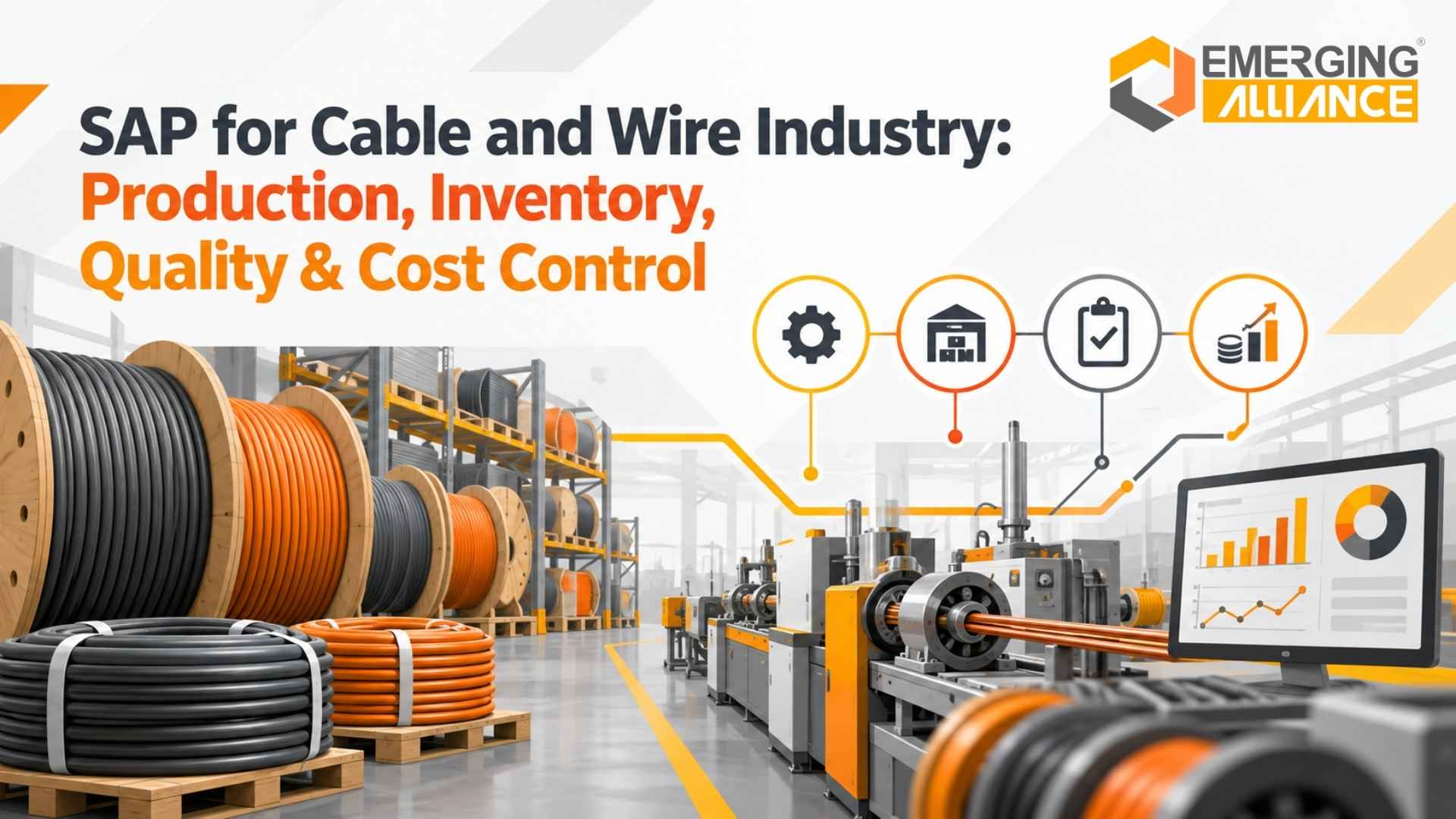
SAP for Cable and Wire Industry: Production, Inventory, Quality & Cost Control
Quick Answer: How SAP Supports Cable and Wire Manufacturing
SAP can help cable and wire manufacturers connect production planning, raw-material inventory, quality processes and production costing in one ERP environment.
For manufacturers using SAP Business One, integrated production, inventory, procurement, warehouse and financial data can improve operational visibility, reduce manual coordination and give management better control over material consumption, production performance and manufacturing costs.
Why Cable and Wire Manufacturers Need Better ERP Control
Cable and wire manufacturing depends on the continuous coordination of raw materials, production processes, inventory, quality requirements and customer orders.
A delay or data gap in one area can affect several others.
For example, inaccurate inventory information can delay production planning. Poor production visibility can make it harder to understand material consumption. Incomplete quality records can make traceability difficult. Limited cost visibility can also affect pricing and profitability decisions.
These challenges become more complex when manufacturers manage:
A manufacturing ERP should therefore do more than record transactions. It should connect operational information so decision-makers can understand what is being produced, what materials are available, what production requires and what each manufacturing activity is costing.
That is where SAP Business One can become relevant for cable and wire manufacturers.
How SAP Connects Cable and Wire Manufacturing Operations
The primary value of an ERP system is the connection between business processes.
For a cable and wire manufacturer, the operational flow can involve:
When these activities operate with disconnected spreadsheets and systems, management may spend significant time reconciling information.
An integrated ERP environment provides a common source of operational and financial data.
This can help manufacturers connect:
The objective is not simply to automate individual processes. It is to create better visibility across the manufacturing cycle.
Production Planning and Process Control
Production is at the centre of cable and wire manufacturing. However, production efficiency depends heavily on the availability of the right materials, production requirements and accurate product information.
SAP Business One can support manufacturers by bringing production-related information into a connected ERP environment.
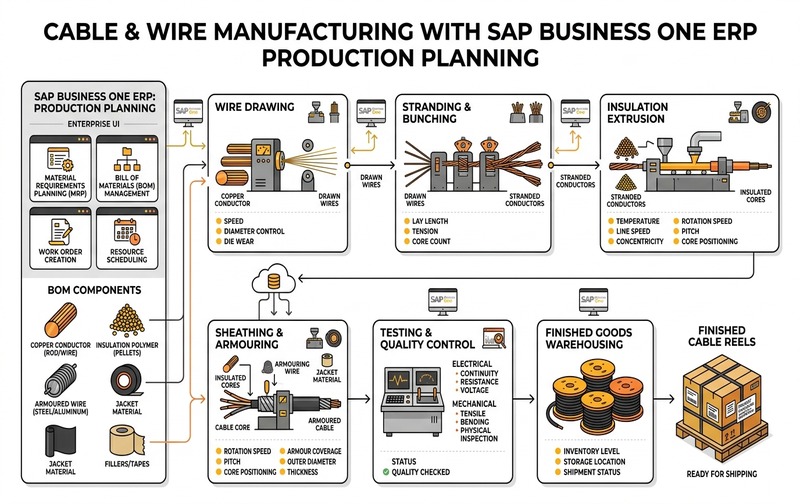
Detailed manufacturing process workflow for cable and wire industry in SAP Business One ERP, illustrating MRP, multi-level BOM, wire drawing, stranding, extrusion, and finished reel warehousing.
Production Planning Based on Actual Demand
Production planning should reflect actual business requirements rather than relying entirely on manual spreadsheets.
Manufacturers can use sales requirements, inventory levels and material requirements as inputs for production planning.
This can help production teams determine:
- What needs to be produced
- How much needs to be produced
- Which materials are required
- Whether materials are available
- When production needs to begin
This connection between demand and production can help reduce unnecessary production and avoid avoidable delays caused by missing materials.
BOM and Production Order Management
Cable and wire products can involve different material combinations and specifications.
A structured Bill of Materials (BOM) provides the basis for defining the materials required for production.
Production orders can then provide visibility into:
This creates a more structured relationship between product specifications and manufacturing execution.
Managing Multiple Production Stages
Cable and wire production can involve several stages depending on the product and manufacturing process.
An ERP system can help maintain visibility across production activities instead of treating production as one isolated transaction.
This is particularly useful when management needs to understand where a production order currently stands and whether material or operational issues are affecting completion.
Reducing Production Delays and Material Variance
Production delays can occur when planning information and inventory information are disconnected.
By connecting production requirements with inventory and procurement information, manufacturers can identify material requirements earlier and reduce dependency on manual coordination.
Actual material consumption can also be compared with planned requirements to identify production variances.
Inventory Control for Raw Materials, WIP and Finished Cables
Inventory is one of the most important control areas for cable and wire manufacturers because raw materials directly affect production continuity and product cost.
A manufacturing ERP should provide visibility across raw materials, work-in-progress and finished goods.
Raw-Material Inventory Visibility
Cable and wire manufacturers may manage materials such as:
Aluminium
Conductors
Insulation materials
Sheathing materials
Packaging materials
Other production components
Accurate inventory information helps production and procurement teams understand what is available before production begins.
This can reduce the risk of discovering material shortages only after a production order has already been scheduled.
Work-in-Progress Inventory Tracking
Work-in-progress represents material that has entered production but has not yet become finished goods.
Without proper visibility, WIP can make inventory reporting and production analysis more difficult.
ERP-based production tracking can provide better visibility into material movement through manufacturing activities and help management understand the status of production orders.
Finished-Goods Inventory Management
Once production is completed, finished products need to be available for customer fulfilment and delivery.
An integrated ERP environment can connect production output with warehouse inventory and sales requirements.
This gives teams better visibility into:
- Available finished goods
- Warehouse stock
- Open customer orders
- Production requirements
- Stock movement
Reducing Stockouts, Excess Inventory and Material Wastage
The objective of inventory management is not simply to hold more stock.
Manufacturers need the right materials at the right time while avoiding unnecessary inventory accumulation. Connecting inventory with production planning and procurement can help decision-makers make better replenishment and purchasing decisions.
Quality Management and Traceability
Production efficiency alone is not enough for cable and wire manufacturers. Product quality and traceability are equally important.
Quality problems can affect customer relationships, production costs, delivery schedules and product reputation.
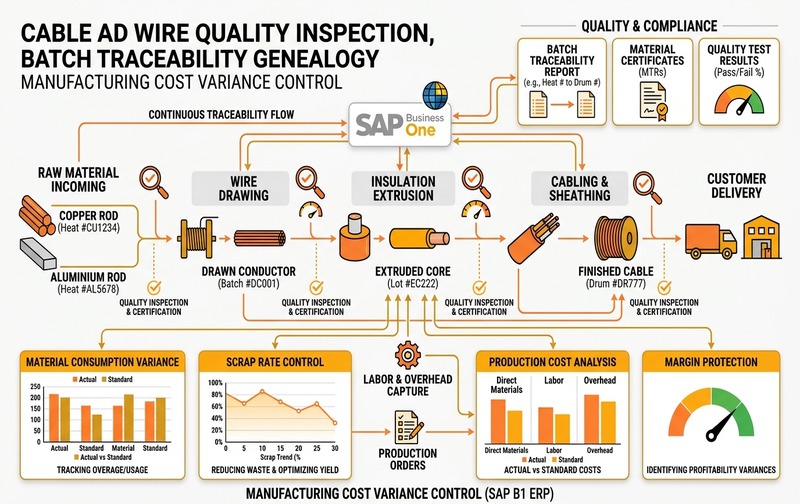
End-to-end quality inspection, heat batch traceability genealogy, and manufacturing cost variance control framework in SAP Business One ERP for cable and wire manufacturing.
Quality Checks Across Production
Quality requirements can exist at different points in the manufacturing process.
Depending on the manufacturer’s process, checks may involve incoming materials, production stages and finished products.
The ERP environment should provide structured records that allow teams to maintain visibility into quality-related activities.
Batch and Material Traceability
Traceability becomes particularly important when manufacturers need to determine which materials were used in a particular production batch or finished product.
A connected system can support the relationship between:
➔
Production Order
➔
Batch
➔
Finished Product
➔
Customer
This can make it easier to investigate quality issues and identify affected inventory when necessary.
Managing Quality Issues and Non-Conformance
When a quality issue occurs, teams need more than a simple record stating that a product failed inspection.
They may need to determine:
Connected production and inventory information can make this investigation more structured.
Supporting Consistent Product Quality
Quality management should be connected to production rather than handled as an isolated activity.
When production, inventory and quality information are connected, management gets better visibility into how operational issues can affect finished-product quality.
Cost Control Across Cable and Wire Manufacturing
For cable and wire manufacturers, production cost visibility is critical because raw-material prices and material consumption can significantly influence margins.
An ERP system can help connect production activities with financial information.
Tracking Material Costs
Raw materials can represent a significant component of manufacturing cost.
Changes in material prices can therefore affect product economics.
An integrated ERP environment can help manufacturers maintain better visibility into inventory valuation and material-related costs.
Understanding Production Costs
Manufacturing cost analysis can involve multiple components, including:
The exact costing approach depends on the company’s processes and configuration.
The important objective is to provide management with a clearer view of how production activities contribute to overall product cost.
Identifying Production Variance
Comparing planned requirements with actual production consumption can highlight differences.
For example, management may need to investigate situations where:
- Actual material consumption exceeds planned requirements
- Production output differs from expectations
- Production costs increase unexpectedly
- Material wastage affects margins
These insights can support corrective operational decisions.
Protecting Margins Through Better Cost Visibility
Better cost visibility can help management make more informed decisions around:
Procurement
Production planning
Material usage
Product profitability
Customer orders
The goal is not simply to reduce costs. It is to understand where costs are generated so the business can manage them more effectively.
SAP Business One Capabilities for Cable and Wire Manufacturers
The relevance of SAP Business One comes from how its capabilities can be connected to the operational requirements of a manufacturing business.
The exact configuration depends on the manufacturer’s processes, product complexity, integrations and business requirements.
This distinction is important: SAP Business One should be configured around the manufacturer’s processes rather than forcing every manufacturer into an identical workflow.
What Cable and Wire Manufacturers Can Improve With SAP
The business value comes from connecting the processes discussed above.
Is SAP Business One Suitable for Your Cable and Wire Manufacturing Business?
SAP Business One can be relevant for cable and wire manufacturers that need stronger integration between production, inventory, purchasing, sales and financial operations.
However, suitability should be evaluated based on the company’s actual operating model.
Consider factors such as:
The right ERP decision should be based on process fit rather than simply selecting a system because it is widely used.
When Standard SAP Business One May Need Industry-Specific Customization
Not every cable and wire manufacturer operates in exactly the same way.
Some businesses may require additional functionality because of their production processes, integrations or reporting requirements.
Potential areas can include:
Industry-Specific Production Requirements
Manufacturers with specialized production workflows may require additional configuration or extensions.
Advanced Planning Requirements
Complex production environments may require more advanced planning capabilities than standard workflows provide.
Specialized Quality Processes
Certain businesses may require customized inspection, approval or quality workflows.
Machine and Production Data Integration
Manufacturers using connected machinery or production systems may require integration between shop-floor systems and ERP.
Barcode and Warehouse Requirements
High-volume warehouse operations may benefit from barcode-based processes and additional warehouse functionality.
Customer-Specific Reporting
Businesses serving different customer segments may require customized operational or commercial reports.
The correct approach is to first identify the requirement and then determine whether it can be handled through standard SAP Business One functionality, configuration, integration or an industry-specific add-on.
Choosing the Right SAP Partner for Cable and Wire Manufacturing
The ERP platform is only one part of a successful implementation.
The implementation partner also needs to understand how manufacturing operations work.
Evaluate a partner based on:
Manufacturing Process Understanding
The partner should understand production, inventory, procurement and costing rather than treating the project as a generic ERP deployment.
SAP Business One Expertise
Look for demonstrated experience implementing and supporting SAP Business One.
Industry-Specific Customization
The partner should be able to identify where standard functionality is sufficient and where additional solutions may be required.
Data Migration and Integration
Existing master data, inventory, customers, suppliers and transactional information need to be handled carefully during migration.
User Training
Production, inventory, procurement, finance and management users need role-specific training.
Post-Go-Live Support
Manufacturing operations cannot afford prolonged ERP disruption. Support after implementation is therefore an important evaluation criterion.
Conclusion
For cable and wire manufacturers, ERP value is not limited to replacing spreadsheets or digitizing individual transactions.
The larger opportunity is connecting production, inventory, quality and cost control within a single operational framework.
SAP Business One can help create this connection by bringing manufacturing, inventory, procurement, sales and financial information into a more integrated environment.
For businesses dealing with material consumption, production planning, inventory complexity, quality requirements and cost pressure, the right ERP system can provide the visibility needed to make better operational decisions.
The important step is to evaluate the actual manufacturing processes first and then determine how SAP Business One should be configured, integrated or extended to support them.
Frequently Asked Questions
See How SAP Business One Fits Your Cable & Wire Manufacturing Operations
If your cable or wire manufacturing business is dealing with production visibility gaps, inventory complexity, quality tracking challenges or limited cost visibility, the right ERP configuration can make a significant operational difference.
Speak with an SAP Business One specialist to discuss your production, inventory, quality and costing requirements and see how SAP Business One can fit your manufacturing operations.