


SAP S/4HANA for Aerospace and Defense: Managing Production, Traceability and Cost Control
Quick Answer
SAP S/4HANA can help aerospace and defense manufacturers connect production planning, procurement, inventory, finance, and project management processes. For businesses managing complex bills of materials, long supplier lead times, engineering changes, and strict quality requirements, an appropriately configured ERP environment can improve operational visibility and coordination. The right implementation must also address component traceability, quality documentation, engineering-system integration, security, and regulatory obligations. Aerospace manufacturers should evaluate standard SAP capabilities, complementary solutions, customization, implementation costs, and business-specific requirements before deciding whether SAP S/4HANA fits their operating model.
Aerospace and Defense Manufacturing Challenges That Require Better ERP Control
Aerospace and defense manufacturers operate in environments where production schedules, engineering specifications, supplier reliability, product quality, and financial controls are closely connected. A delay in one process can affect several others, from material procurement to final delivery.
Manufacturers may need to coordinate complex assemblies, multiple production stages, long-lead-time components, changing engineering specifications, and extensive documentation. Managing these activities through disconnected spreadsheets and standalone applications can make it difficult to maintain consistent operational information.
The challenge is not simply tracking inventory or recording production transactions. Business leaders need to understand how operational changes affect delivery commitments, costs, product configuration, and customer requirements.
Production delays & component shortages
Missing long-lead components halt multi-stage assemblies when purchasing and shop floors operate in silos.
Traceability & quality compliance
Manual record retrieval across disconnected tools creates severe audit risks under AS9100 and defense standards.
Engineering changes & delivery dates
Outdated drawing revisions lead to scrap, rework, and missed contractual milestones when CAD/PLM isn’t linked to ERP.
Production delays and material shortages
A missing component can prevent an entire assembly from progressing. When purchasing, inventory, and production teams work with inconsistent information, planners may identify shortages too late to adjust schedules or communicate delivery risks.
An integrated ERP environment can help teams assess material availability, review purchasing status, evaluate production requirements, and coordinate corrective action. The actual benefits depend on data accuracy, planning configuration, supplier information, and how consistently teams use the system.
Traceability and quality documentation
Manufacturers must often demonstrate which materials, components, production activities, and inspections relate to a particular product or assembly.
When records are spread across separate systems, retrieving the correct information for an investigation, inspection, or customer request can require significant manual effort.
A well-designed ERP and quality-management environment can help connect relevant material and production records. However, the required traceability depth and evidence depend on product requirements, applicable standards, business processes, and system configuration.
Engineering changes and delivery commitments
A revised component specification can affect bills of materials, purchasing decisions, work in progress, inspection requirements, and planned production dates.
Without effective coordination between engineering and manufacturing, teams may work with outdated information or discover the implications of a change after production has started.
Manufacturers should therefore evaluate how their ERP environment exchanges approved engineering data, manages affected orders, and communicates changes to relevant teams.
| Operational Challenge | Siloed / Manual Risk | SAP S/4HANA Control Mechanism | Operational Benefit |
|---|---|---|---|
| Assembly Bottlenecks | Late shortage detection halts complex multi-level builds | Integrated Material Requirements Planning (MRP Live) | Proactive procurement & schedule synchronization |
| Traceability Compliance | Disconnected paper/spreadsheet logs risk audit failure | Bidirectional serial number & batch genealogy | Rapid audit evidence & root-cause defect containment |
| Engineering Revisions | Manufacturing against obsolete drawing versions | Engineering Change Management (ECM) with PLM integration | Immediate order updates, scrap reduction & WIP alignment |
| Project Cost Slippage | Untracked variances discovered only at program closeout | Project System (PS) & Controlling (CO) real-time variance | Precise cost attribution to contracts and work breakdown |
How SAP S/4HANA Supports Aerospace and Defense Operations
SAP S/4HANA provides enterprise resource planning capabilities that connect financial and operational processes. Its suitability for an aerospace manufacturer depends on the selected edition, deployed components, implementation design, and required integrations.
The objective is to establish a consistent operational foundation so that purchasing, manufacturing, inventory, finance, and management teams can work from reliable business information.
Production planning and material requirements
Production planning coordinates demand, bills of materials, inventory availability, procurement, and manufacturing orders. Material requirements planning can help identify future material requirements and determine when procurement or production activities need to take place.
For aerospace manufacturers, this coordination is particularly important when assemblies contain numerous components with different lead times and availability constraints.
Planners need to evaluate whether the proposed solution supports their manufacturing methods, planning parameters, capacity constraints, production-order processes, and scheduling requirements. More advanced scheduling or specialized manufacturing needs may require additional capabilities or integrated systems.
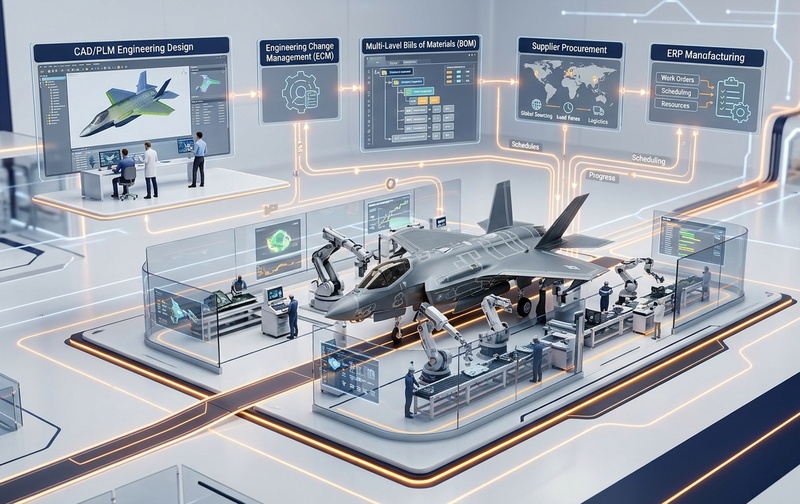
SAP S/4HANA connects multi-level bills of materials, supplier lead times, and engineering revisions across aerospace production stages.
Procurement and supplier coordination
Procurement teams must balance material availability, supplier lead times, purchasing commitments, and production priorities.
An ERP environment can connect purchase requisitions, purchase orders, goods receipts, inventory records, and financial postings. This connection helps teams review purchasing activity alongside production demand and stock availability.
Supplier performance monitoring, advanced supply-chain planning, and specialized supplier collaboration may require additional configuration, analytics, or complementary applications.
Inventory and financial visibility
Inventory management and financial accounting are closely related. Material movements affect stock balances, while purchasing, production consumption, and inventory valuation influence financial reporting.
An integrated ERP environment can help finance and operations teams reconcile inventory movements with relevant financial information and investigate cost variances.
The quality of these insights depends on accurate master data, appropriate valuation methods, transaction discipline, and a properly designed chart of accounts and costing structure.
Production Planning, BOM Management and Engineering Change Control
Complex aerospace products often involve multiple assembly levels, component dependencies, controlled specifications, and changes that must be communicated across departments.
Effective production planning requires more than maintaining a list of materials. It requires an accurate representation of what must be manufactured, which materials are needed, and how changes affect existing commitments.
Multi-Level Bills of Materials (BOM) Governance
Multi-level BOMs maintain dependencies between subassemblies, raw materials, and finished aircraft systems, ensuring version control and correct production versions across manufacturing lines.
Controlled Engineering Change Management (ECM)
Engineering revisions establish formal approval workflows, validity dates, stock disposition rules, and automated updates to open purchase orders and shop-floor work orders.
Managing bills of materials
A bill of materials (BOM) identifies the components and quantities required to produce an assembly or finished product. Multi-level BOMs represent the relationships between subassemblies and their constituent materials.
Manufacturers should assess whether the selected SAP configuration can support their BOM structures, production versions, revision-control requirements, and manufacturing processes.
Engineering and product lifecycle management systems may remain the authoritative source for design information. In such environments, integration must transfer approved information accurately and prevent unauthorized or outdated specifications from being used in production.
Controlling engineering changes
An engineering change can affect material availability, purchase orders, production orders, inspection requirements, and the cost of work already completed.
A controlled change process should identify affected products and orders, determine whether existing materials remain usable, and communicate required actions to engineering, procurement, manufacturing, and quality teams.
The precise workflow depends on how engineering change management is implemented and whether SAP S/4HANA is integrated with a product lifecycle management (PLM) solution.
Before implementation, businesses should document how revisions are approved, how effective dates are handled, and how the system identifies affected inventory and work in progress.
Improving production visibility
Production visibility requires consistent information about order status, material consumption, planned quantities, completed operations, and outstanding work.
ERP reporting can help managers identify exceptions and compare planned activity with actual results. Manufacturing execution systems (MES) may provide additional shop-floor data, including detailed work-center activity, machine information, and operation-level execution.
The integration should be designed around specific decisions that planners and production managers need to make rather than collecting data without a clear operational purpose.
Component Traceability, Quality Management and Audit Readiness
Traceability is a central consideration for manufacturers handling components whose origin, configuration, inspection history, or usage must be established.
The appropriate design depends on customer contracts, product risk, applicable standards, and the manufacturer’s quality-management procedures.
Serial numbers, batches and material history
Serial-number tracking can help identify individual components or products, while batch management can support the tracking of groups of materials. Depending on the configuration, relevant records may connect material receipts, production consumption, stock movements, and product identification.
Manufacturers should determine whether they need forward traceability, backward traceability, or both.
- Forward traceability: Helps identify where a particular material, heat lot, or supplier component was used across all finished products and assemblies.
- Backward traceability: Helps investigate which materials, suppliers, production records, inspection certificates, and operator activities relate to a particular customer-delivered product.
These processes require consistent identification, transaction recording, and data retention. Simply enabling serial numbers or batch records does not automatically satisfy every aerospace traceability requirement.
Inspection and nonconformance management
Quality teams may need to record inspection results, document defects, restrict affected stock, investigate nonconformances, and coordinate corrective actions.
An appropriately designed ERP and quality-management environment can help connect relevant inspection and material records to purchasing and production activities. More specialized quality workflows may require additional SAP capabilities or integration with a quality management system (QMS).
A manufacturer should verify how the proposed solution handles inspection plans, acceptance criteria, failed inspections, material disposition, and audit evidence.
Compliance and controlled documentation
Requirements vary across aerospace and defense programs. Depending on the business and contracts involved, manufacturers may need to consider standards such as AS9100, export-control obligations under ITAR or EAR, or contractual requirements associated with DFARS.
ERP software can support selected business controls and documentation processes, but it does not independently establish compliance with these requirements.
Organizations must assess applicable obligations, access restrictions, record retention, process controls, cybersecurity, and supporting documentation with qualified compliance and security professionals.
The implementation should clearly identify which requirements are met by standard functionality, which require configuration or integration, and which remain organizational responsibilities.
| Standard / Obligation | Compliance Scope | ERP & System Capabilities | Organizational Responsibility |
|---|---|---|---|
| AS9100 / ISO 9001 | Quality management systems & operational risk management | Inspection plans, nonconformance notifications, audit trails | Quality policy enforcement, internal audits, management reviews |
| ITAR & EAR | Export controls & controlled technical data access | Role-based authorizations, data classification, access logging | Legal export screening, citizenship verification, physical facility security |
| DFARS / Cybersecurity | Defense procurement rules & controlled unclassified info (CUI) | Encrypted data storage, tenant isolation, secure API protocols | NIST SP 800-171 / CMMC certifications, operational SOP adherence |
Supply Chain Visibility and Aerospace Inventory Control
Aerospace manufacturers may depend on specialized components, approved suppliers, long procurement cycles, and materials that cannot be replaced quickly.
Poor visibility into supplier commitments and inventory availability can create production interruptions, excess stock, and delivery uncertainty.
Managing long-lead-time components
Planning teams need to understand future demand, stock availability, purchase-order status, expected receipts, and the production orders that depend on incoming materials.
ERP-based planning can help identify potential shortages and support purchasing decisions. However, reliable results require realistic lead times, accurate inventory records, appropriate planning parameters, and timely supplier updates.
Businesses should evaluate how the proposed system handles safety stock, reorder parameters, procurement lead times, and exceptions requiring management attention.
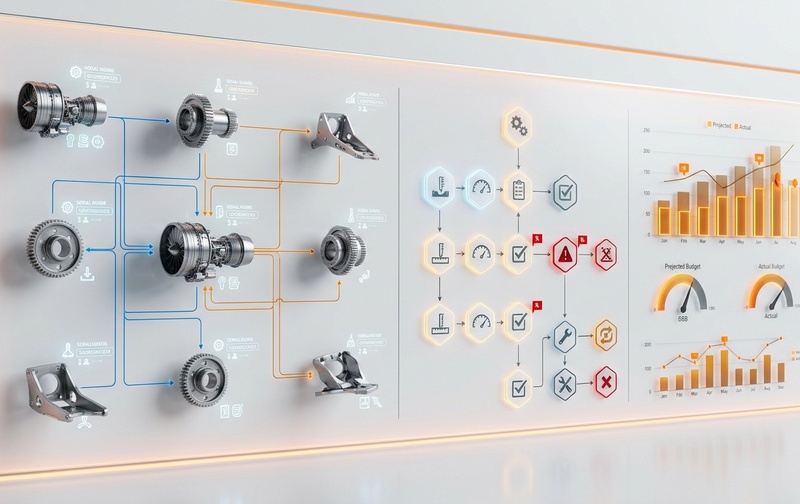
End-to-end component traceability and project cost control in SAP S/4HANA ensure audit readiness and financial visibility.
Improving supplier coordination
Supplier reliability affects production continuity. Procurement teams need visibility into order confirmations, expected delivery dates, late receipts, and the impact of delays on production schedules.
An ERP environment can consolidate purchasing and receipt information, while supplier portals or supply-chain applications may provide additional collaboration capabilities.
Manufacturers should define how supplier changes are communicated, how delivery risks are escalated, and who is responsible for updating procurement and production plans.
Balancing inventory availability and working capital
Holding additional inventory may reduce the risk of shortages, but it also ties up working capital and can create storage, obsolescence, and handling costs.
An effective inventory strategy considers component criticality, supplier reliability, demand variability, replenishment time, and production consequences.
ERP reporting can help teams analyze inventory balances, material consumption, and purchasing activity. Management should use these insights to establish appropriate inventory policies rather than treating inventory reduction as an isolated objective.
Project Cost Control, Production Variances and Financial Visibility
Aerospace and defense programs can involve multiple production stages, long delivery schedules, significant material costs, and contract-specific financial requirements.
Decision-makers need to understand whether actual expenditure aligns with budgets and whether changes in production activity affect expected profitability.
Monitoring planned and actual costs
Cost visibility requires reliable information about materials, labor, production activities, overhead, and relevant project expenses.
SAP S/4HANA can support financial and management accounting processes, subject to the selected solution and configuration. Manufacturers should evaluate which costing methods, allocation rules, and reporting dimensions are required for their operations.
A useful reporting model distinguishes planned costs, actual costs, committed expenditure, and forecast costs where supported by the implemented solution.
Investigating production variances
A variance occurs when actual results differ from the expected or planned amount. Variances may arise from material price changes, scrap, rework, production inefficiency, or changes in manufacturing requirements.
ERP data can help finance and operations teams investigate these differences, provided transactions are recorded consistently and costing rules reflect the business model.
The objective is to connect a financial variance to an operational cause and a responsible action. A report that identifies a cost difference without explaining its source offers limited value for decision-making.
Supporting management decisions
Executives need to understand how changes in material costs, production schedules, and project expenditure affect business performance.
Well-designed reporting can help leaders review financial performance alongside operational information. Project accounting, contract accounting, and program-specific requirements must be assessed separately because not every requirement is covered by the same standard ERP configuration.
Manufacturers should define the reports and decision thresholds they need before implementation begins.
| Cost Dimension | Baseline / Calculation Source | Primary Variance Drivers | Corrective Operational Action |
|---|---|---|---|
| Direct Materials | BOM standard cost & planned purchase pricing | Raw material price inflation, vendor surcharges, scrap rates | Strategic supplier renegotiation & scrap root-cause analysis |
| Direct Labor & Machine | Routing standard hours & work-center rates | Overtime, rework cycles, equipment calibration downtime | Routing optimization, maintenance scheduling & operator training |
| Subcontracting / Outside Processing | Subcontract purchase orders & contractual rates | Expedited freight, specialized testing surcharges, transit delays | Approved supplier list consolidation & batch transit scheduling |
| Project / Program Overheads | Costing sheets & work breakdown structure (WBS) allocations | Engineering change delays, extended facility utilization | Milestone billing adjustments & program governance review |
SAP S/4HANA Integration and Implementation Requirements
The value of an ERP implementation depends on how well the solution fits the organization’s processes and exchanges information with its existing systems.
Aerospace manufacturers should evaluate the full application landscape, including engineering, production, quality, warehouse operations, reporting, and cybersecurity requirements.
Integration with PLM, MES and QMS
PLM systems can manage product definitions and engineering changes. MES platforms can support shop-floor execution, while QMS applications may provide specialized quality workflows.
The ERP environment must exchange the correct information with these systems, including relevant material records, product structures, production orders, inspection information, and completion status.
Integration planning should identify the authoritative source for each data type, the frequency of updates, validation rules, error handling, and responsibility for resolving inconsistent records.
Not every manufacturer needs every integration. The scope should reflect actual operational requirements and the capabilities already available within the existing technology environment.
| System Layer | Primary Functional Role | Authoritative Master Data | Data Exchanged With SAP S/4HANA |
|---|---|---|---|
| PLM (Product Lifecycle Management) | CAD designs, product structures, engineering changes | Engineering BOMs (EBOM), drawings, design revisions | Approved manufacturing BOMs (MBOM), change notices, effective dates |
| SAP S/4HANA (Enterprise ERP) | Core planning, procurement, inventory, finance & costing | Material master, vendor master, chart of accounts, production orders | Central operational repository & cross-functional financial postings |
| MES (Manufacturing Execution) | Shop-floor scheduling, machine logging, operator tracking | Work-center activity, machine telemetry, time confirmations | Actual material consumption, labor confirmations, completion status |
| QMS (Quality Management System) | Detailed inspection plans, calibration, CAPA workflows | Inspection lot results, nonconformance reports, certificates | Stock release / block status, usage decision, vendor rating inputs |
Data migration and master data quality
ERP implementations depend on accurate material masters, BOMs, supplier records, inventory balances, financial data, and other master data.
Incomplete or inconsistent data can undermine planning, reporting, traceability, and transaction accuracy after deployment.
Before migration, organizations should identify duplicate records, outdated materials, inconsistent units of measure, missing supplier information, and obsolete BOMs.
Data cleansing, mapping, reconciliation, testing, and business-owner approval should be included in the implementation plan.
Customization, testing and change management
Custom development may be necessary when business requirements cannot be met appropriately through standard functionality or supported configuration. However, customization can increase implementation complexity, testing requirements, maintenance effort, and upgrade considerations.
Organizations should prioritize business-critical requirements and evaluate whether process standardization, configuration, integration, or custom development provides the most sustainable solution.
Testing should cover end-to-end scenarios, including procurement through receipt, production through completion, quality exceptions, financial postings, and relevant traceability workflows.
Training and change management are equally important. Employees must understand the revised processes, their responsibilities, and how to resolve exceptions correctly.
Deployment model, security and total cost
Businesses should compare the deployment options available for their chosen SAP S/4HANA offering and evaluate infrastructure, security, data residency, integration, availability, and operating requirements.
Total cost of ownership should account for applicable licensing or subscriptions, implementation services, integrations, data migration, testing, training, support, infrastructure, and future maintenance.
For defense-related operations, access restrictions and security obligations may materially affect solution architecture. These requirements should be validated with qualified SAP, cybersecurity, and compliance specialists before a deployment decision is finalized.
Evaluating SAP S/4HANA for Your Aerospace and Defense Business
Selecting an ERP system requires a structured assessment of operational needs, implementation feasibility, financial considerations, and business priorities.
The appropriate solution for an aerospace component supplier may differ from the requirements of a defense contractor, an aircraft maintenance organization, or a manufacturer producing complex assemblies.
Step 1: Assess Business Requirements and System Fit
Begin by documenting the processes that create the greatest operational risk or administrative burden. Examples include recurring material shortages, limited traceability, inconsistent engineering revisions, production cost variances, disconnected quality records, and unreliable delivery information. For each requirement, define the expected workflow, relevant users, source data, required controls, and measurable business outcome. Map these requirements against standard SAP capabilities, configuration options, complementary applications, and necessary integrations. Record any gaps that require further validation.
Step 2: Establish Implementation Priorities
Not every requirement needs to be delivered simultaneously. Organizations should prioritize capabilities according to business impact, regulatory importance, operational risk, implementation dependencies, and resource availability. A phased implementation may be appropriate when it reduces delivery risk and allows teams to validate important processes before expanding the scope. However, sequencing must preserve essential data integrity and end-to-end process controls. Define ownership for master data, testing, process approval, training, and post-implementation support before project execution begins.
Step 3: Define Measurable Success Criteria
Implementation success should be measured against an agreed baseline rather than general expectations of improved efficiency. Relevant measures may include production schedule adherence, material shortage frequency, inventory accuracy, purchase-order delivery performance, traceability record completeness, cost variance, and time required to retrieve quality documentation. Choose metrics that reflect the organization’s priorities and establish how each measure will be calculated. Clear targets make it easier for executives to assess whether the investment is delivering operational value and where further process improvements are needed.
Step 4: Evaluate the Business Case
The business case should compare implementation costs with realistic expected benefits, taking into account delivery risk, operating expenditure, productivity, inventory requirements, reporting quality, and ongoing maintenance. Avoid assuming that software alone will eliminate production delays, guarantee compliance, or reduce costs by a predetermined percentage. Benefits depend on process design, data quality, user adoption, integration performance, and effective operational management. A structured requirements assessment helps the organization determine whether SAP S/4HANA is a suitable fit, which capabilities should be implemented first, and what additional investment may be necessary.
Frequently Asked Questions
Evaluate SAP S/4HANA for Your Aerospace and Defense Operations
Production delays, traceability gaps, engineering changes, and limited cost visibility can create interconnected challenges for aerospace and defense manufacturers. Addressing them requires an ERP environment that fits the organization’s manufacturing processes, quality controls, data requirements, and technology landscape.
Emerging Alliance can help businesses evaluate relevant SAP requirements, integration needs, and implementation considerations.
Request an SAP S/4HANA consultation or demo to discuss your production planning, component traceability, quality management, integration, and cost-control priorities.
The next step is to establish which capabilities fit your existing processes, where additional configuration or integration is required, and how the proposed implementation can support measurable operational objectives.