
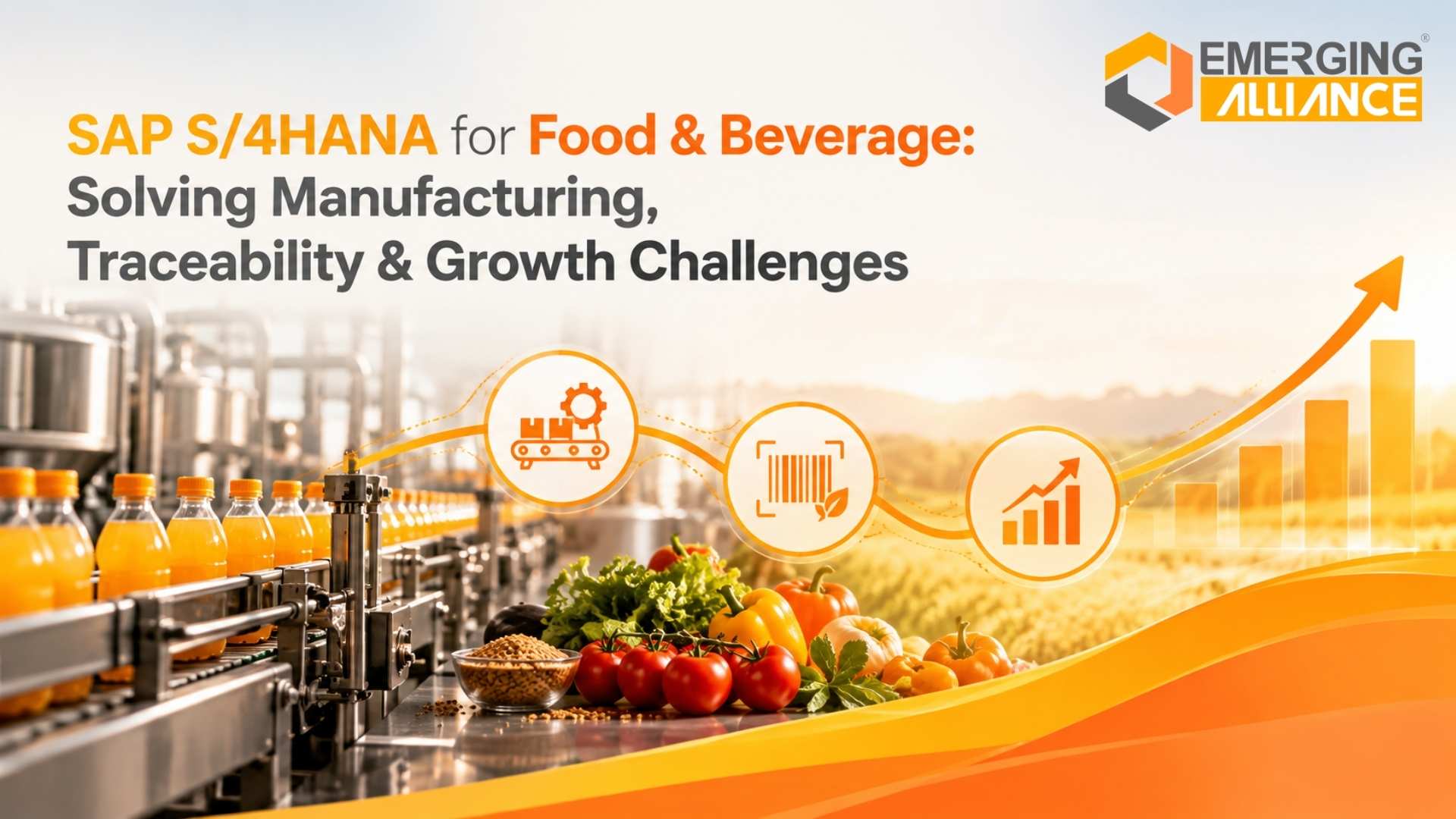
SAP S/4HANA for Food & Beverage: Solving Manufacturing, Traceability & Growth Challenges
Quick Answer: What is SAP S/4HANA for Food & Beverage?
SAP S/4HANA for Food & Beverage provides an integrated ERP foundation for food and beverage manufacturers that need stronger control over production, recipes, inventory, batch traceability, quality, procurement, finance and supply-chain operations. Instead of managing these processes through disconnected systems and spreadsheets, businesses can connect operational and financial data within a unified ERP environment.
For food and beverage companies, the value is not simply having a modern ERP. The more important question is whether the ERP can support batch-driven manufacturing, shelf-life requirements, recipe-based production, quality controls, traceability, production planning and profitability visibility while the business expands.
SAP S/4HANA can support these requirements through capabilities across manufacturing, inventory management, procurement, quality management, supply chain, finance and analytics. The appropriate scope depends on the company’s manufacturing model, locations, products, regulatory requirements, integrations and growth plans.
Why Food & Beverage Manufacturing Creates ERP Complexity
Food and beverage businesses operate differently from many other manufacturing sectors. Products may have limited shelf life, raw materials can vary in cost and availability, production can be recipe-driven, and every production batch may need to be connected to specific ingredients, suppliers, quality results and finished products.
These conditions create several operational risks:
Batch Availability vs Stock Gaps
A business may know how much inventory it owns but still struggle to identify which batches are available for production.
Recipe vs Finance Data Disconnect
Production teams may have recipe information while finance lacks accurate actual consumption and yield data.
Isolated Quality Inspections
Quality teams may maintain inspection information separately from inventory records.
Margin Volatility Blindspots
Management may receive financial reports without enough visibility into the operational reasons behind margin changes.
As operations expand across plants, warehouses, distributors or regions, these gaps become more difficult to manage.
A suitable ERP environment therefore needs to connect the complete process:
Connected Food & Beverage Operating Process
This connected process is where SAP S/4HANA can become relevant for food and beverage organizations.
How SAP S/4HANA Supports Food Manufacturing Operations
The business case for an SAP ERP platform should begin with processes rather than software features.
For a food or beverage manufacturer, the ERP environment needs to connect production requirements with material availability, purchasing, inventory, quality, costing and financial reporting.
SAP S/4HANA can provide an integrated foundation for these processes, helping organizations establish consistent information across departments.
The specific configuration depends on the company’s manufacturing model. Process manufacturing requirements can involve recipes, production resources, process orders, material consumption and yield management.
This is particularly relevant where production depends on formulas, controlled processes and batch output rather than simple discrete assembly.
Recipe-Based Production and Process Manufacturing
Recipe and formula management are central to many food manufacturing operations.
A production process may depend on defined ingredients, quantities, production stages, resources and expected yields. Changes in ingredient costs, availability or formulation can also affect product profitability.
An ERP environment should therefore help connect:
SAP S/4HANA process-manufacturing capabilities can support production planning and execution for organizations using batch-oriented manufacturing processes.
The business benefit comes from connecting the production process with inventory, procurement and financial information rather than maintaining these records independently.
Batch Management and End-to-End Traceability
Traceability is one of the most important ERP requirements for food and beverage companies.
A manufacturer may need to determine which supplier batch entered production, which finished-goods batches were produced from those materials, where those products were stored, and which customers or distribution channels received them.
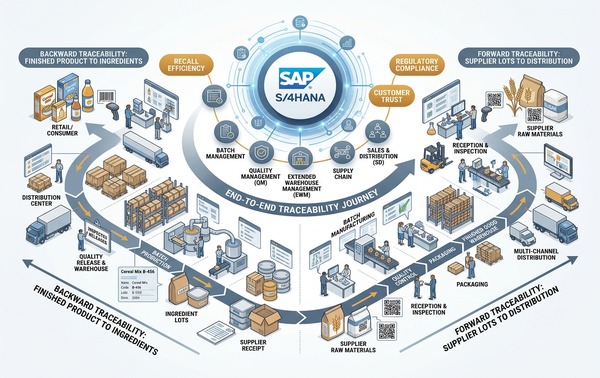
Figure 1: Bidirectional batch traceability in SAP S/4HANA connecting supplier lots, recipe execution, quality gates, and customer distribution.
This creates two critical traceability directions:
Backward Traceability
Backward traceability determines where a finished product or production batch originated.
Forward Traceability
Forward traceability determines where a particular raw-material or production batch was subsequently used or distributed.
A connected ERP environment can help establish relationships between materials, production batches, inventory movements, quality information and sales or distribution processes.
This becomes particularly important during quality investigations, customer complaints, product withdrawals or recalls.
Instead of searching through disconnected spreadsheets and systems, management can work toward a more structured batch genealogy across the supply chain.
Shelf Life, Expiry and Perishable Inventory Control
Food and beverage inventory cannot be managed solely according to quantity.
Shelf life matters.
A warehouse may have sufficient stock on paper but still face operational problems if a significant portion is approaching expiry.
An effective ERP process should therefore consider:
This information can support better inventory planning and warehouse decisions.
For businesses using FEFO principles, inventory visibility can help operational teams prioritize products according to remaining shelf life rather than simply using the oldest receipt date.
The objective is not only better warehouse control. It can also help reduce avoidable expiry, inventory write-offs and unnecessary working-capital exposure.
Quality Management Across the Production Lifecycle
Quality cannot be treated as a separate final inspection activity in food manufacturing.
Quality requirements can apply when raw materials arrive, during production and before finished products are released.
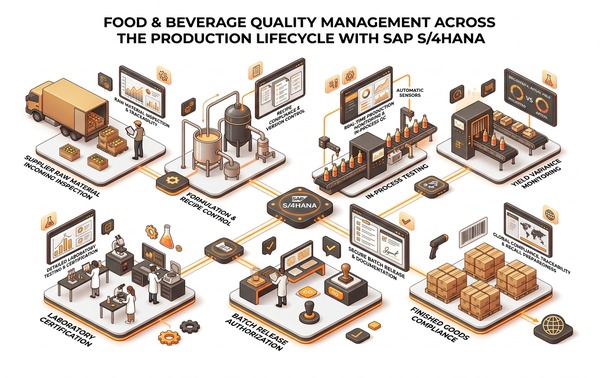
Figure 2: Quality inspection lifecycle in SAP S/4HANA from incoming ingredient receipt to in-process monitoring and batch release.
An integrated ERP approach can connect quality processes with relevant materials, batches and production activities.
A typical process may include:
Integrated Quality Lifecycle Flow
This structure can improve visibility between quality and operations.
If a quality issue is identified, the organization can investigate the relevant material or production batch and determine its operational impact more efficiently.
For management, this creates a more complete picture of quality-related operational risk instead of treating quality data as an isolated departmental record.
Procurement and Raw Material Visibility
Raw materials are often one of the most important cost components in food manufacturing.
Prices can fluctuate, suppliers may have different lead times, and availability can affect production schedules.
An ERP platform should therefore connect procurement decisions with inventory requirements and production planning.
SAP S/4HANA can help organizations integrate purchasing, inventory and production information so that teams have a more consistent view of material requirements.
This can support better decisions around:
The objective is not simply to automate purchase orders. It is to connect procurement decisions to the broader operating model.
Production Planning, Demand and Capacity
Food manufacturers often deal with seasonal demand, changing customer requirements and limited production capacity.
Planning becomes more difficult when material availability, machine capacity, workforce requirements and customer demand are maintained in separate systems.
An integrated planning environment can help connect demand with production requirements and material availability.
Management can then evaluate questions such as:
Do we have enough raw material for planned production?
Can available production capacity meet demand?
Which materials may constrain production?
What happens if demand changes?
Which production orders should receive priority?
How will production changes affect inventory?
Better planning does not eliminate uncertainty. It gives decision-makers better information for responding to it.
Costing, Yield and Profitability Visibility
Growth without margin visibility can create serious financial risk.
Food manufacturers may experience differences between expected and actual material consumption, production yield, wastage and input costs.
For example, a change in raw-material prices may affect product margins even when sales revenue remains stable.
An integrated ERP environment can connect operational activity with financial information, helping management investigate:
Operational Costing to Margin Chain
This is more useful than looking only at final financial results.
Executives can use this information to investigate where profitability is being affected and whether the issue relates to purchasing, production efficiency, wastage, pricing or product mix.
Supply Chain Visibility Across Multiple Locations
As food and beverage businesses grow, operational complexity often increases faster than headcount.
Multiple plants, warehouses, distributors and sales regions can create fragmented information.
A centralized ERP environment can help standardize core processes while providing management with a consolidated view of operations.
This can be particularly valuable for organizations managing:
The objective is to provide consistent information without forcing every operational process into an identical model where legitimate business differences exist.
Analytics for Faster Management Decisions
ERP value should ultimately translate into better decisions.
For senior management, the relevant information may include:
The advantage of integrated ERP data is that these indicators can be analyzed using connected operational and financial information.
This can help leadership move from asking “What happened?” toward investigating “Why did it happen, and what should we change?”
Integrating SAP S/4HANA With the Existing Technology Environment
An ERP implementation rarely operates in isolation.
Food and beverage manufacturers may already use:
The appropriate integration architecture depends on the existing technology landscape.
Before implementation, businesses should document which systems own which data, where information needs to move, which integrations are business-critical and which processes should be standardized instead of integrated unnecessarily.
This assessment can prevent the ERP project from becoming a collection of disconnected interfaces.
Overview: Solving Food & Beverage Operational Challenges
| Operational Challenge | SAP S/4HANA Capability | Business Outcome |
|---|---|---|
| Ingredient and product traceability | Batch management | Faster batch investigation and targeted recall analysis |
| Expiring inventory | Shelf-life management | Better stock rotation and lower expiry exposure |
| Incoming-material quality | Quality Management | Stronger receipt inspection and release controls |
| Production quality | In-process inspection | Better quality visibility during manufacturing |
| Complex production | Process manufacturing | More consistent production execution |
| Disconnected procurement | Integrated sourcing and inventory | Better material and supplier visibility |
| Multi-location stock | Integrated inventory management | Improved inventory visibility across operations |
| Separate finance and operations | Integrated ERP | Stronger cost and performance visibility |
| Business growth | Scalable enterprise processes | Greater process standardization across plants and entities |
SAP S/4HANA Implementation Challenges for Food Businesses
The technology itself is only one part of the implementation.
Food and beverage organizations should pay particular attention to master data, recipes, materials, batches, production processes, quality requirements and historical information.
Common implementation considerations include:
Master Data
Material, customer, supplier, recipe and production data must be reviewed and standardized.
Process Design
Existing workflows should be evaluated before being converted into ERP processes.
Data Migration
Historical and operational data needs to be mapped, cleansed and validated.
Integration
Existing manufacturing, warehouse, quality and external systems need defined integration requirements.
Customization
Custom development should have a clear business justification rather than reproducing inefficient legacy processes.
Testing
Production, inventory, quality, procurement and finance scenarios should be tested together.
User Adoption
Production, warehouse, quality, finance and management users need role-specific training.
Go-Live Support
Post-implementation support is essential for resolving process and data issues after deployment.
A successful ERP project therefore requires both technology expertise and a detailed understanding of business processes.
SAP S/4HANA vs SAP Business One for Food Businesses
Not every food and beverage company automatically needs the same SAP platform.
The appropriate choice depends on factors such as:
For some growing organizations, SAP Business One may be a more appropriate starting point. Larger or more complex organizations may require the broader capabilities and architecture of SAP S/4HANA.
The right decision should therefore come from a structured business and technology assessment rather than selecting a platform solely because it is more advanced.
What to Evaluate Before Investing in an SAP Food & Beverage ERP
Before starting an ERP project, leadership should document the current operating environment.
A practical evaluation should examine:
This assessment creates a more defensible basis for ERP investment decisions.
When SAP S/4HANA Makes Sense for a Food & Beverage Business
SAP S/4HANA can be relevant when a food or beverage organization needs to move beyond fragmented operational systems and establish stronger integration across manufacturing, supply chain, quality and finance.
It becomes particularly relevant when the business is experiencing:
However, platform selection should always follow business requirements.
The goal is not to implement the largest ERP available. The goal is to establish an ERP environment that can support the organization’s current processes and future operating model.
Conclusion
For food and beverage manufacturers, ERP value depends on how effectively technology addresses real operational challenges.
SAP S/4HANA for Food & Beverage can provide an integrated foundation for process manufacturing, recipe-driven production, batch traceability, quality management, shelf-life control, procurement, inventory, production planning and financial visibility.
The strongest business case comes when these capabilities are evaluated as one connected operating model rather than as a list of individual ERP features.
Before investing, organizations should assess their manufacturing processes, traceability requirements, data quality, integrations, deployment needs, scalability expectations and implementation scope.
For companies considering an SAP ERP transformation, the next step should be a structured assessment of current processes and future requirements.
Frequently Asked Questions About SAP S/4HANA for Food & Beverage