
SAP S/4HANA for Iron and Steel Manufacturing: Strengthening Production, Cost & Supply Chain Control
Quick Answer
SAP S/4HANA for iron and steel manufacturing provides an integrated ERP environment for connecting procurement, raw-material management, production planning, inventory, quality, costing, supply chain and finance. For steel manufacturers dealing with fragmented systems, rising production costs, inventory visibility gaps or disconnected operational data, an integrated ERP approach can help create stronger control across the manufacturing lifecycle.
Unlike a generic ERP approach, SAP S/4HANA can support complex manufacturing processes where material consumption, production output, quality, inventory valuation, costing and financial performance need to be connected. This makes it relevant for iron and steel companies looking to improve operational visibility, standardize processes across plants and support data-driven decision-making.
The value, however, depends on how well the ERP environment is aligned with the company’s manufacturing processes, integrations, data structure and implementation strategy.
The Operational Gaps Holding Back Iron and Steel Manufacturing
Iron and steel manufacturing involves interconnected processes rather than isolated business functions. Raw materials must be procured and planned, production needs to be scheduled, inventory must be controlled, quality requirements must be monitored and production costs need to flow into financial reporting.
When these processes operate through disconnected systems, spreadsheets or manually reconciled data, management can struggle to obtain a consistent view of operations.
Common challenges include:
⚠️ Limited visibility into raw-material availability and consumption
⚠️ Disconnected production and inventory information
⚠️ Manual production planning and scheduling
⚠️ Difficulty tracking production costs
⚠️ Limited visibility into scrap, yield and material variances
⚠️ Delays in consolidating plant-level information
⚠️ Fragmented quality and production data
⚠️ Manual reconciliation between operations and finance
⚠️ Inconsistent reporting across manufacturing locations
⚠️ Difficulty integrating shop-floor and enterprise systems
Direct Commercial Impact of Operational Disconnections
These gaps can have a direct commercial impact.
A production variance that is identified late can affect costing. An inventory discrepancy can affect planning. Delayed production information can affect customer commitments. When operational and financial data are disconnected, management may also have difficulty identifying where margins are being affected.
This is where an integrated manufacturing ERP strategy becomes important.
How SAP S/4HANA Supports Iron and Steel Manufacturing Operations
SAP S/4HANA can provide a connected ERP foundation across core business and manufacturing processes.
For an iron and steel manufacturer, the objective should not simply be to digitize individual departments. The larger objective is to connect the flow of information across the business.
A typical process can span:
When these processes are connected, operational events can provide information that supports financial and management decisions.
For example, changes in material consumption can affect production costs. Production output can influence inventory availability. Quality results can influence production decisions. Inventory and procurement information can influence planning.
The ERP environment therefore becomes more than a transaction-processing system. It can become a central source of operational and financial information.
Production Planning and Process Control Across Steel Operations
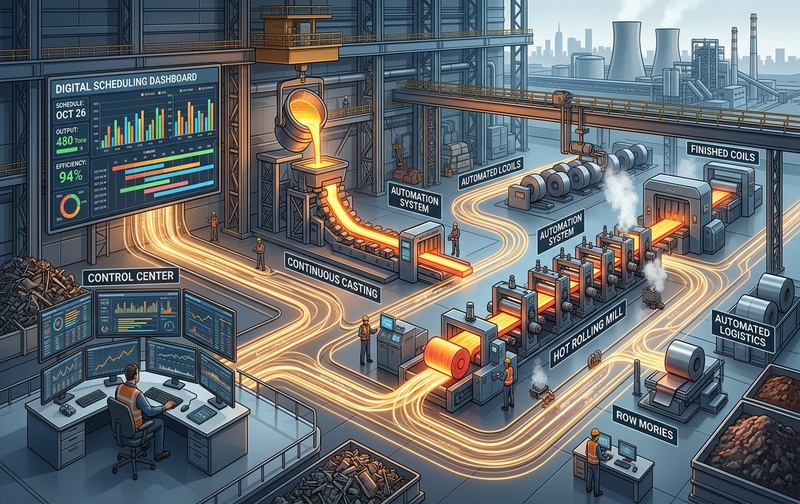
SAP S/4HANA connects production planning with shop-floor execution to synchronize capacity, material availability, and furnace operations.
Production planning is one of the most important areas for an iron and steel manufacturer.
Manufacturing operations need to coordinate materials, production capacity, schedules, orders and available inventory. Changes in production requirements can have downstream effects on procurement, warehouse operations, delivery commitments and costs.
An ERP environment can help manufacturers establish greater visibility across production planning by connecting relevant business information.
Key areas include:
⚙️ Production planning
📋 Material requirements
📦 Production orders
🏭 Capacity considerations
📊 Material availability
🗓️ Production scheduling
✅ Production confirmations
🔄 Inventory movements
📈 Production reporting
The objective is not simply to automate production transactions. It is to create a more consistent flow of information between planning and execution.
For organizations operating multiple production units or plants, standardized processes and centralized visibility can become particularly important.
Raw Material, Inventory and Procurement Control
Raw materials represent a significant operational and financial consideration in iron and steel manufacturing.
Poor visibility into material availability can affect production planning. Excess inventory can increase working-capital requirements, while insufficient materials can disrupt production schedules.
An integrated ERP environment can connect procurement and inventory processes so organizations can monitor material movements and purchasing requirements more effectively.
Relevant areas include:
📑 Procurement planning
📝 Purchase orders
📥 Goods receipts
🚚 Material movements
🔍 Inventory availability
💰 Stock valuation
🏢 Supplier information
⚡ Material consumption
🔄 Replenishment requirements
The benefit is stronger visibility across the relationship between purchasing, inventory and production.
Instead of evaluating procurement and production as separate activities, management can assess how material availability affects manufacturing requirements and business performance.
Production Costing, Yield and Scrap Management
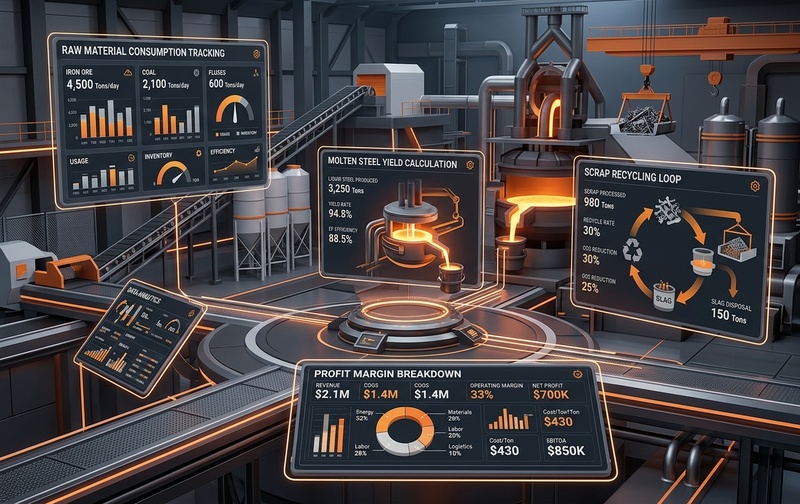
Real-time integration between shop-floor material consumption, scrap reporting, and financial costing in SAP S/4HANA reveals true product margins.
Production cost control is a critical consideration for steel manufacturers because material consumption, production output, energy requirements, labor, overheads, yield and scrap can influence the economics of manufacturing.
A disconnected environment can make it difficult to determine where production-cost variations originate.
For example:
An ERP environment should help organizations connect these data points.
SAP S/4HANA can provide a foundation for integrating operational and financial information so manufacturers can analyze production costs in relation to business transactions and manufacturing activities.
This can support better visibility into:
💲 Material costs
🏭 Production costs
📊 Inventory valuation
📉 Production variances
🎯 Yield
♻️ Scrap
💡 Overheads
📈 Product profitability
For finance and operations leaders, this connection between manufacturing activity and financial information can be more valuable than isolated production reporting.
Quality Management Across Iron and Steel Production
Quality management is closely connected to manufacturing performance.
Iron and steel manufacturers may need to manage product specifications, inspections, production-related quality information and customer requirements.
When quality information is isolated from production and inventory systems, organizations may have difficulty establishing a complete view of material and production history.
An integrated ERP environment can help connect quality-related information with relevant business and manufacturing processes.
This can support greater visibility across:
🔍 Quality inspections
🏷️ Material batches or production lots
📏 Product specifications
📊 Production results
📦 Inventory status
⚠️ Non-conformance processes
🤝 Customer requirements
The exact configuration depends on the manufacturer’s processes, product structure and quality-management requirements.
Supply Chain Visibility from Procurement to Customer Delivery
Steel manufacturing does not operate independently of the wider supply chain.
Procurement, production, inventory, logistics and customer orders influence one another.
A delay in raw-material availability can affect production. A production delay can affect inventory availability. An inventory shortage can affect customer fulfilment.
An integrated ERP environment can provide a connected view across these activities.
This can help organizations monitor the movement of information from:
For supply-chain and operations leaders, the objective is to reduce information gaps between these stages.
Better visibility can also help management identify bottlenecks earlier and coordinate decisions across departments.
Finance and Manufacturing Data in One Operational View
For CFOs and finance teams, manufacturing ERP cannot be evaluated only from an operational perspective.
Production decisions ultimately affect financial performance.
Material consumption, inventory valuation, production costs, procurement expenditure and sales performance all contribute to the financial picture.
A connected ERP environment can help bridge the gap between operational transactions and financial reporting.
This can support visibility into:
🏭 Manufacturing costs
📊 Inventory value
💳 Procurement expenditure
📉 Production variances
📈 Product profitability
💵 Revenue
📑 Financial reporting
⚡ Operational performance
For management, this means operational information can be evaluated alongside financial outcomes rather than being reconciled manually across separate systems.
SAP S/4HANA for Multi-Plant and Growing Steel Manufacturers
Growing steel manufacturers may face another challenge: maintaining consistent processes across plants and business units.
Different locations may develop their own spreadsheets, reports, workflows or systems. Over time, this can create inconsistent processes and make consolidated reporting more difficult.
An ERP strategy can help organizations standardize core processes while maintaining visibility across locations.
For multi-plant organizations, important considerations include:
🗂️ Common master-data structures
📑 Standardized procurement processes
📦 Consistent inventory management
📊 Production reporting
⚖️ Financial consolidation
🏭 Plant-level visibility
📈 Centralized management reporting
🔗 Integration between locations
The goal should not be to force every operation into an identical process where differences are necessary. Instead, organizations should establish a controlled ERP framework while allowing legitimate operational requirements to be addressed.
Integration Considerations for a Steel Manufacturing ERP
ERP implementation rarely happens in isolation.
Steel manufacturers may already have systems supporting production, warehouse operations, quality, logistics, maintenance or other specialized processes.
The ERP strategy therefore needs to consider integration from the beginning.
Potential integration areas include:
💻 Shop-floor systems
⚙️ Manufacturing execution systems
📦 Warehouse management
🔬 Quality systems
🏭 Production equipment
🚛 Logistics platforms
👥 CRM
🤝 Supplier systems
💳 Financial applications
📊 Reporting and analytics platforms
Integration should be evaluated based on business requirements rather than technology alone.
Before implementation, organizations should identify which system owns each critical piece of information, how data moves between systems and which processes require real-time or scheduled integration.
This prevents integration problems from becoming an afterthought during deployment.
SAP S/4HANA Implementation Considerations for Iron and Steel Companies
Choosing an ERP platform is only one part of an ERP transformation.
Implementation quality can have a significant influence on the eventual business outcome.
Before beginning an SAP S/4HANA implementation, an iron and steel manufacturer should evaluate:
Business Process Readiness
Document current procurement, inventory, production, quality, sales and finance workflows.
Data Quality
Review master data, material information, supplier records, customer information, inventory data and other critical datasets before migration.
Integration Requirements
Identify existing applications and determine which integrations are essential to daily operations.
Manufacturing Complexity
Document plant-specific processes, production structures, costing requirements, quality processes and reporting requirements.
Reporting Requirements
Define the operational and financial information management needs before designing reports and dashboards.
User Adoption
Production, warehouse, procurement, finance and management teams need processes that are practical for daily use.
Testing and Migration
Data migration, integration testing, process testing and user acceptance testing should be planned as core implementation activities rather than final-stage tasks.
Post-Go-Live Support
ERP transformation does not end when the system goes live. Ongoing support, optimization and process improvements are important for long-term value.
SAP S/4HANA vs Traditional ERP Approaches for Steel Manufacturing
The right ERP approach depends on the organization’s size, operational complexity, existing technology environment and transformation objectives.
A traditional or fragmented ERP environment may continue to support basic transactions, but organizations can encounter limitations when they need greater integration across manufacturing and financial processes.
An SAP S/4HANA-based approach can be evaluated when the business requires:
| Business requirement | ERP consideration |
|---|---|
| Multiple plants | Centralized process and management visibility |
| Complex manufacturing | Integrated production and business processes |
| Better costing | Stronger connection between operational and financial data |
| Inventory visibility | Connected procurement, inventory and production information |
| Supply-chain coordination | Visibility across interconnected processes |
| Data-driven management | More consistent operational information |
| Business growth | Scalable enterprise architecture |
| System integration | Connectivity with surrounding business applications |
The important question is not simply whether SAP S/4HANA has the required functionality.
The more important question is whether the solution can be configured and integrated around the organization’s actual operating model.
When Should a Steel Manufacturer Consider SAP S/4HANA?
SAP S/4HANA may be worth evaluating when an organization is experiencing persistent operational or information-management problems such as:
📌 Multiple disconnected systems
📌 Limited plant-level visibility
📌 Manual production reporting
📌 Difficulties controlling production costs
📌 Inventory inaccuracies
📌 Fragmented procurement information
📌 Inconsistent processes across plants
📌 Slow management reporting
📌 Difficulties integrating operational and financial information
📌 Legacy ERP limitations
📌 Business expansion requiring a more scalable ERP foundation
The decision should be based on business requirements rather than adopting technology simply because it is newer.
A structured ERP assessment can help determine whether SAP S/4HANA is appropriate and which processes should be prioritized.
What Should You Evaluate Before Choosing an ERP for Steel Manufacturing?
A steel manufacturer evaluating an ERP platform should assess more than the feature list.
Key evaluation areas include:
Can the ERP support the organization’s actual production model?
Can production and financial information be connected effectively?
Can material movements and inventory information be managed consistently?
Can quality processes be integrated into the broader operational workflow?
Can procurement, inventory, production and delivery information be connected?
Can the ERP work with existing manufacturing and business systems?
Can the architecture support future plants, products and business growth?
Does the implementation partner understand both ERP and the organization’s manufacturing environment?
Can legacy data be cleaned, mapped and migrated effectively?
Is there a plan for optimization and ongoing support?
This evaluation framework can help management move beyond comparing software features and focus on actual business requirements.
Evaluating SAP S/4HANA for Your Iron and Steel Operations
If your iron or steel manufacturing business is dealing with production visibility gaps, disconnected systems, rising production costs, inventory challenges, manual reporting or limited supply-chain visibility, an ERP assessment can help identify where technology can provide measurable operational value.
The right approach starts with understanding your current processes, identifying the gaps that affect cost and operational control, and determining where SAP S/4HANA can fit into your existing technology landscape.
Emerging Alliance can help organizations evaluate ERP requirements across implementation, customization, integration, migration, cloud deployment, support and ongoing optimization.
Conclusion
Iron and steel manufacturing requires coordination across procurement, raw materials, production, inventory, quality, costing, supply chain and finance.
When these processes operate through disconnected systems, organizations can struggle to obtain timely and consistent information for operational and financial decisions.
SAP S/4HANA for iron and steel manufacturing can provide an integrated ERP foundation for connecting these processes and improving visibility across the manufacturing lifecycle.
However, the value of the platform depends on implementation quality, process alignment, data readiness and integration strategy.
For steel manufacturers considering ERP transformation, the priority should therefore be to identify the operational gaps first and then determine how SAP S/4HANA can address those requirements.
Frequently Asked Questions
Improve Steel Manufacturing Control with SAP S/4HANA
Facing production complexity, rising costs, inventory gaps or supply-chain inefficiencies? See how SAP S/4HANA can align with your steel manufacturing processes.
Book a demo to explore the right implementation, integration and customization approach for your business.