
SAP S/4HANA for Oil and Gas: Improving Operational Control Across Complex Field Operations
Quick Answer: What Does SAP S/4HANA Deliver for Oil and Gas Companies?
SAP S/4HANA for Oil and Gas helps energy companies connect asset management, maintenance, procurement, inventory, field logistics, finance and industry-specific operations within a unified ERP environment.
The objective is not simply digitalization—it is stronger visibility over operational costs, asset performance, materials, logistics and financial outcomes across complex oil and gas operations.
Core ERP Question:
For companies struggling with disconnected systems, costly asset downtime, field inventory gaps, procurement delays or fragmented financial reporting, the real ERP question is whether the business can control operations from a common data foundation.
Connecting Field Operations with Financial Performance
Oil and gas businesses operate in an environment where a single operational problem can quickly become a financial problem.
Consider the operational cascade across the energy value chain:
An unavailable spare part can delay maintenance schedules and leave field crews waiting.
Delayed maintenance directly reduces operational asset availability and reliability.
Poor asset availability can abruptly interrupt upstream extraction or midstream transport.
Disconnected purchasing data inflates procurement costs through rushed spot buys.
Untracked field inventory locks working capital into materials that are difficult to locate or reuse.
At the same time, finance teams need accurate cost information, operations teams need reliable asset and material visibility, and management needs a consolidated view of business performance.
When these processes operate through separate systems, spreadsheets and manual handoffs, management may have information—but not necessarily operational control.
The Strategic Imperative for ERP Integration:
That is where the business case for SAP S/4HANA for Oil and Gas becomes stronger. The objective is to establish an integrated operational and financial foundation capable of connecting what happens in the field with what appears in procurement, inventory, maintenance and finance.
SAP’s current Oil, Gas and Energy portfolio places particular emphasis on:
For an oil and gas company evaluating ERP modernization, these capabilities matter because the ERP decision is ultimately about control, visibility and economic performance across complex operations.
Why Oil and Gas Operations Become Harder to Control as the Business Scales
Oil and gas companies rarely struggle because they lack operational data. They struggle because critical data may exist across too many disconnected systems, locations, teams and processes.
A growing organization can simultaneously manage dozens of operational entities and assets:
Each function may perform effectively on its own while the overall operating model remains fragmented.
This creates an important management problem:
Can decision-makers see how operational activity translates into cost, risk and profitability?
Without integrated information, management may know how much was spent without understanding which assets, maintenance activities, locations or operational conditions drove that expenditure.
An ERP environment should therefore do more than process transactions. It should connect operational events with their financial consequences.
The Hidden Cost of Disconnected Oil and Gas Processes
Disconnected operations create several forms of cost that may not appear as one obvious ERP problem.
1. Excess Inventory
Maintenance teams need critical materials available when equipment requires attention. But poor visibility can lead organizations to compensate by holding excessive stock.
The Compounding Cost Result:
high inventory value + duplicated materials + slow-moving stock + emergency purchasing.
Capital remains locked in inventory while teams may still struggle to find the correct component when it is actually required.
2. Unplanned Asset Downtime
When equipment history, maintenance schedules, spare-part availability, workforce requirements and procurement information are fragmented, maintenance execution becomes harder to coordinate.
Downtime then becomes more than a maintenance KPI.
It can affect production capacity, operating expenditure and revenue.
3. Procurement Leakage
Urgent maintenance demand can result in expedited procurement, limited supplier comparison or repeated purchasing.
Without centralized visibility, organizations find it difficult to understand:
- what is being purchased
- why it is being purchased
- where demand originates
- supplier performance
- contract utilization
- material availability
- total spending
4. Field Inventory Loss
Remote operations create another layer of complexity. Materials, rental equipment and service-related items can move between supply bases and remote operational locations.
SAP’s current Field Logistics functionality specifically supports movement between supplying bases and remote locations, including forward and return scenarios for both owned and supplier-related materials.
If those movements are not properly tracked, organizations risk unnecessary replacement purchases, material delays and inaccurate inventory positions.
5. Delayed Financial Visibility
Management needs to understand the cost of operations while there is still time to act.
If operational data reaches finance only after manual consolidation, management reporting becomes backward-looking.
The organization can explain what happened. But it becomes harder to intervene while it is happening.
Where SAP S/4HANA Fits into Oil and Gas Operations
The value of SAP S/4HANA comes from connecting previously fragmented business processes around a consistent transactional and financial foundation.
Rather than treating maintenance, materials, procurement, logistics and finance as isolated functions, the ERP model enables their dependencies to become visible.
Consider a maintenance requirement. An equipment issue can trigger a maintenance process. That process may require:
End-to-End Operational and Financial Tracking:
When these activities are integrated, management can trace operational demand through its financial impact.
When they are disconnected, teams spend more time reconciling the process than controlling it.
Asset Management: From Reactive Maintenance to Lifecycle Control
Assets are among the most economically significant elements of an oil and gas operation.
Pumps, compressors, pipelines, drilling equipment, processing units, storage infrastructure and other critical equipment require continuous monitoring and maintenance.
Poor asset management creates two expensive extremes:
❌ Under-Maintenance
Under-maintenance increases reliability and downtime risk.
❌ Over-Maintenance
Over-maintenance consumes unnecessary labor, materials and operational capacity.
Strategic Lifecycle Objective:
The goal is therefore not simply more maintenance. It is the right maintenance activity at the right time, supported by the right information and materials.
SAP’s current Oil, Gas and Energy portfolio positions enterprise asset management around reliability, performance, lifecycle efficiency and balancing asset performance, cost and risk.
With an integrated ERP environment, organizations can connect areas such as:
This gives management a better basis for understanding the true cost of maintaining critical assets.
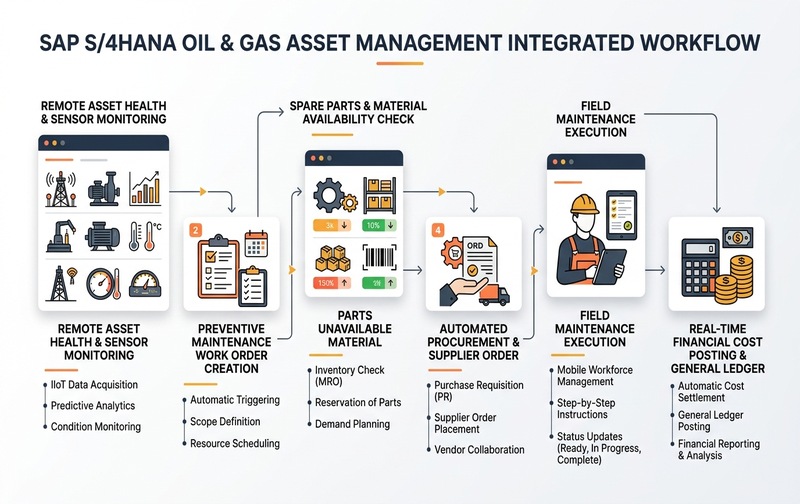
End-to-end asset lifecycle management in SAP S/4HANA connecting equipment condition monitoring, maintenance execution, spare-parts procurement, and real-time financial postings.
Maintenance Cost Control Beyond the Work Order
Many businesses measure maintenance through completed work orders. Senior management requires a broader view.
The more important questions are:
Which assets consume the highest maintenance spend?
Which equipment repeatedly fails?
How much emergency procurement is associated with breakdown maintenance?
Are maintenance costs increasing faster than asset output?
Which spare parts create unnecessary working-capital exposure?
Should an asset continue to be repaired, overhauled or replaced?
The ERP system becomes valuable when operational maintenance records can be analyzed alongside cost information.
This changes maintenance from an isolated technical function into a measurable component of business performance.
Procurement Control for High-Value Operational Requirements
Oil and gas procurement frequently involves high-value materials, specialized equipment, contractors, services and time-sensitive purchasing.
When procurement processes are fragmented, management can struggle to distinguish legitimate operational urgency from avoidable purchasing inefficiency.
SAP S/4HANA can help establish a more structured relationship between:
Operational-to-Procurement Governance Cycle:
This improves visibility into purchasing decisions and allows organizations to evaluate procurement in operational context.
For example, repeated urgent purchases of the same spare part may indicate:
The purchasing transaction is therefore only one part of the problem. Integrated ERP data helps expose the process causing the purchase.
Field Logistics: Better Visibility Across Remote Operations
Remote field operations create logistical conditions that standard warehouse processes alone may not fully address.
Equipment and materials can move:
SAP Field Logistics documentation describes forward and return scenarios between supplying bases and remote locations, including owned products and supplier-related items.
Current SAP documentation also distinguishes non-stock materials directly procured for maintenance activities and tracks relevant logistics activities around such items.
Strategic Operational Outcome:
For management, the outcome is not merely better logistics administration. It is greater visibility into where operational materials are, why they moved and what they cost.
That can reduce dependence on spreadsheets, calls and manual reconciliation between field personnel, warehouses and procurement teams.
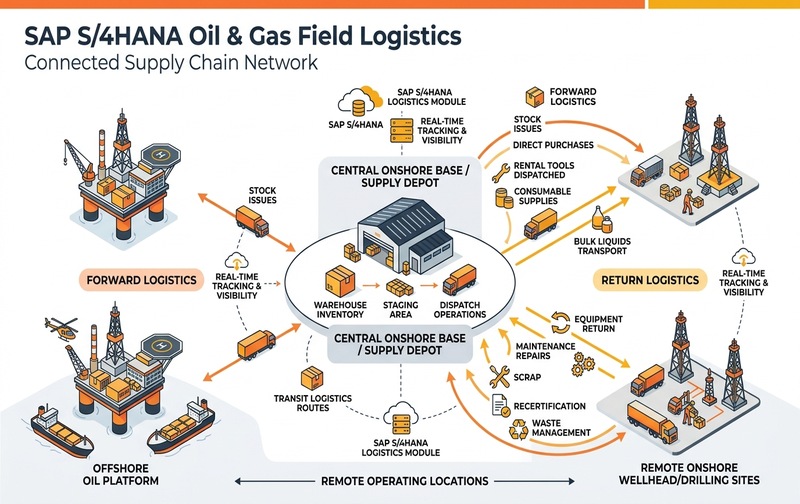
Comprehensive Field Logistics model in SAP S/4HANA showing forward stock distribution, direct purchases, and return logistics loops between central supply bases and remote operating sites.
Inventory Control Without Sacrificing Operational Readiness
Oil and gas inventory management involves a difficult balance.
Too little inventory increases the risk that maintenance cannot proceed. Too much inventory increases working capital and carrying costs.
The answer is therefore not simply inventory reduction.
The Strategic Objective:
Right material + right quantity + right location + right availability
ERP visibility can help decision-makers distinguish between:
This enables inventory decisions to become more closely aligned with maintenance criticality and operational requirements.
Hydrocarbon and Commodity Management Visibility
Oil and gas companies have requirements that extend beyond conventional manufacturing ERP processes.
Depending on business scope, organizations may need to manage hydrocarbon products, bulk movement, transportation, distribution, contracts, pricing and commodity-related transactions.
SAP’s S/4HANA Oil & Gas documentation includes industry capabilities such as Hydrocarbon Product Management, Transportation and Distribution, marketing and pricing processes, Bulk Distribution Requirements Planning and Trader’s and Scheduler’s Workbench.
SAP also positions commodity procurement and sales as processes that can be integrated with core financial and logistics activities.
This integration matters because commodity and physical logistics decisions eventually become financial outcomes. A disconnected environment makes those relationships harder to analyze.
From Operational Activity to Financial Visibility
For CFOs and management teams, ERP modernization should ultimately improve financial control.
Every operational process creates financial consequences:
Maintenance consumes materials and labor.
Procurement creates commitments and liabilities.
Inventory consumes working capital.
Projects consume budgets.
Assets create lifecycle costs.
Logistics creates transportation costs.
Operational interruptions can affect revenue.
SAP S/4HANA brings finance closer to these transactions, reducing the gap between operational execution and financial analysis.
Instead of relying heavily on month-end reconciliation between multiple systems, management can work toward a more integrated view of:
The result is not merely faster reporting. The more important benefit is earlier management visibility.
Cost Visibility at Asset, Location and Operational Level
A total operating-cost number is useful. Knowing what created that cost is more valuable.
An ERP architecture should allow management to progressively analyze expenditure across relevant dimensions:
Progressive Cost Analysis Hierarchy:
That drill-down capability improves management conversations.
Traditional Disconnected Conversation:
“Why are maintenance costs higher this quarter?”
Connected ERP-Driven Conversation:
“Which facilities, assets, maintenance activities or purchased materials caused the increase?”
That distinction is fundamental to cost control.
Environmental, Health and Safety Integration
Safety and environmental requirements are fundamental in oil and gas operations.
Operational processes can involve hazardous substances, restricted materials, environmental obligations and detailed compliance procedures.
SAP currently positions environmental, health and safety management as part of its Oil, Gas and Energy portfolio, with capabilities designed to support environmental tracking and compliance processes.
Current Field Logistics documentation also includes restricted-item functionality for materials subject to handling, transport, storage, safety or regulatory restrictions.
For management, integrating compliance-related information with operational processes can reduce the risk created when safety or environmental data exists separately from the transactions that generated it.
Supply Chain Visibility Across Complex Energy Operations
Oil and gas supply chains can span suppliers, warehouses, terminals, processing facilities, field locations and customers.
The management challenge is not simply knowing whether a transaction occurred. Decision-makers need visibility into dependencies.
Operational Dependency Example:
Logistics & Demand Dependency Example:
SAP currently describes end-to-end energy supply-chain visibility, replanning, forecasting, risk management and integrated logistics as core areas of its Oil, Gas and Energy portfolio.
This is where an integrated ERP architecture becomes strategically important. It enables management to evaluate a process as a chain rather than a series of unrelated departmental transactions.
AI and Analytics: From Reporting to Decision Support
Oil and gas ERP strategies are increasingly moving beyond transactional automation.
SAP’s current Oil, Gas and Energy direction includes AI-assisted and increasingly autonomous scenarios around asset management, commodity management and project delivery.
The important point for ERP decision-makers is not to implement AI simply because it is available. AI creates greater value when it operates on reliable and connected business data.
If asset, material, maintenance, procurement and financial information remain fragmented, intelligent automation inherits that fragmentation.
The Required Implementation Sequence:
The ERP foundation matters first.
SAP S/4HANA Across Upstream, Midstream and Downstream Operations
Oil and gas organizations do not share one identical operating model. ERP scope should therefore follow the actual business.
A successful S/4HANA strategy should therefore avoid copying another company’s implementation scope.
The right ERP scope is the minimum complete scope required to solve the organization’s critical operational and financial control gaps.
When an Oil and Gas Company Should Reconsider Its ERP Environment
An ERP review becomes particularly important when growth or complexity begins exposing limitations in the existing system.
Typical warning signs include:
multiple disconnected operational applications
excessive spreadsheet dependency
slow month-end consolidation
limited asset-cost visibility
repeated emergency procurement
excessive spare-parts inventory
difficulty locating field materials
maintenance and finance data not aligning
procurement data disconnected from maintenance demand
poor visibility across locations
frequent manual data reconciliation
inconsistent master data
limited real-time management reporting
One symptom alone does not automatically justify an ERP transformation.
But when several occur simultaneously, the underlying problem may no longer be a departmental process issue. It may be an enterprise integration problem.
SAP S/4HANA Evaluation Checklist for Oil and Gas Decision-Makers
Before evaluating software demonstrations, executives should define the business problems the ERP needs to solve.
If most of these answers require separate systems and manual consolidation, the ERP evaluation should focus on integration and process control, not just feature comparison.
SAP S/4HANA Implementation: Scope Before Software
One of the biggest ERP mistakes is beginning with a list of software modules. Begin with business processes instead.
A practical sequence is:
1. Identify critical business problems: Determine where the organization loses visibility, time, working capital or control.
2. Map the end-to-end processes: Understand how maintenance, procurement, inventory, field operations and finance interact.
3. Identify integration gaps: Determine where information is manually re-entered, reconciled or transferred.
4. Define the minimum complete scope: Include enough processes to solve the problem end to end.
5. Establish master-data governance: Assets, materials, vendors, equipment, locations and financial structures require clean ownership.
6. Define measurable outcomes: Examples can include lower emergency procurement, improved inventory visibility, faster reporting or reduced manual reconciliation.
7. Design for future scale: The architecture should support future operational and geographic expansion without unnecessary over-implementation today.
Under-implementation
Too little scope to solve the real process problem.
Over-implementation
Unnecessary complexity, cost and change burden.
What Business Improvement Should SAP S/4HANA Deliver?
ERP success should not be measured by whether the system went live. It should be measured by whether the operating model improved.
For an oil and gas organization, relevant outcomes may include:
stronger asset visibility
better maintenance planning
improved material availability
lower dependence on emergency purchasing
better field inventory tracking
stronger procurement control
improved working-capital visibility
faster financial reporting
better operational cost analysis
improved management decision support
less manual reconciliation
greater process standardization
The exact KPI should depend on the business case. That is why the implementation should begin with measurable problems rather than software features.
SAP S/4HANA or Another ERP: The Real Decision
The ERP decision should not begin with:
“Which system has the most features?”
It should begin with:
“Which platform can support the level of operational integration our business requires?”
For asset-intensive oil and gas organizations, the evaluation should consider how deeply the ERP needs to connect:
Assets + Maintenance + Materials + Procurement + Logistics + Finance + Industry Processes
A system may perform accounting effectively while still leaving maintenance disconnected. Another may manage inventory but provide insufficient support for complex field operations.
The appropriate ERP architecture depends on the operational model, organization size, existing systems, geographic footprint and future strategy. The evaluation should therefore be based on end-to-end business scenarios rather than generic feature checklists.
Building an Oil and Gas ERP Around Operational Control
Digital transformation creates value only when it improves how the organization operates.
For oil and gas companies, that means connecting information that traditionally sits across operational and financial boundaries:
- Asset maintenance should not be separated from spare-parts availability.
- Spare-parts demand should not be separated from procurement.
- Procurement should not be separated from inventory.
- Operational activity should not be separated from financial impact.
- And management reporting should not depend on repeatedly reconciling all of those processes afterward.
SAP S/4HANA for Oil and Gas creates the strongest business case when it becomes the connecting layer between operational execution, financial control and management visibility.
The result is not simply another ERP system. It is a more structured operating model built around consistent data, connected processes and measurable business outcomes.
Frequently Asked Questions
Explore common questions about SAP S/4HANA for Oil, Gas and Energy operations:
Book an SAP S/4HANA Oil & Gas Demo
Bring your current operational challenges to the discussion.
We can map them against the relevant SAP S/4HANA processes and identify where stronger integration, automation and visibility could create measurable business improvement.
Talk to Emerging Alliance about your SAP S/4HANA Oil & Gas requirements.