
SAP S/4HANA for Oil and Gas: Operations, Implementation & Business Control Guide
Quick Answer: SAP S/4HANA for Oil and Gas Operations, Implementation & Business Control
SAP S/4HANA for Oil and Gas provides an integrated ERP foundation for managing finance, procurement, assets, maintenance, projects, inventory, supply chain and other operational processes across complex energy businesses.
For oil and gas organizations, its value is not simply replacing legacy ERP. The larger opportunity is connecting operational and financial data so leaders can improve asset visibility, cost control, maintenance planning, procurement governance and enterprise-wide decision-making.
Successful implementation, however, depends on process design, industry requirements, integration architecture, data readiness and selecting the right deployment and implementation approach.
Oil and gas companies operate in an environment where asset-intensive operations, volatile costs, complex supply chains, maintenance requirements, field activities, regulatory obligations and capital-intensive projects must all remain closely controlled.
When these processes operate through disconnected systems, spreadsheets or highly customized legacy ERP environments, business leaders can struggle to answer basic but critical questions:
- ❓What is the true cost of operating an asset?
- ❓Which maintenance activities are affecting production availability?
- ❓Where are procurement costs increasing?
- ❓Which projects are moving beyond budget?
- ❓How much inventory is tied up across locations?
- ❓Are financial results aligned with operational performance?
- ❓Can management access reliable information without extensive manual reconciliation?
This is where SAP S/4HANA can become strategically important.
Rather than treating ERP as only a finance system, oil and gas companies can use an integrated ERP architecture to connect operational transactions with financial impact and establish stronger business control across the organization.
This guide examines where SAP S/4HANA fits within oil and gas operations, the capabilities businesses should evaluate, implementation considerations, integration and migration risks, and how decision-makers can determine whether the platform is the right fit.
Why Oil and Gas Operations Require Stronger Enterprise Control
Oil and gas businesses operate across multiple interconnected functions.
A procurement delay can affect maintenance. Maintenance can affect asset availability. Asset downtime can affect production. Production changes can influence logistics, revenue, cash flow and financial forecasting.
Yet many organizations still manage these activities through fragmented applications.
Common problems include:
The issue is therefore larger than ERP modernization.
It is a business control problem.
A modern ERP architecture should help management connect:
When these processes share governed data and integrated workflows, management gains a clearer view of what is happening operationally and what it means financially.
SAP S/4HANA Across the Oil and Gas Value Chain
Oil and gas companies vary significantly depending on where they operate in the industry value chain.
The ERP design must therefore reflect the actual business model rather than applying a generic template.
Upstream Operations
Upstream organizations may need to coordinate activities related to exploration, production assets, field operations, equipment maintenance, procurement, contractors, projects and production-related financial processes.
ERP capabilities can support areas such as:
Depending on the operating model and SAP solution architecture, additional industry-specific functionality may also be required.
Midstream Operations
Midstream businesses typically focus on transportation, storage, terminals, pipelines and associated infrastructure.
Important control areas include:
The primary ERP requirement is often connecting asset-intensive operations with procurement and financial control.
Downstream Operations
Downstream businesses may include refining, distribution, terminals, wholesale operations and other commercial activities.
Relevant requirements can include:
Because operational models differ significantly, an implementation should begin with value-chain requirements rather than simply replicating an existing ERP configuration.
Core SAP S/4HANA Capabilities for Oil and Gas Businesses
The value of SAP S/4HANA comes from bringing multiple business processes onto an integrated transactional and data foundation.
Financial Management and Enterprise Controlling
Finance is central to almost every operational decision in an asset-intensive organization.
SAP S/4HANA can support areas including:
The larger advantage is integration.
A procurement transaction, maintenance activity, inventory movement or project expense can ultimately flow into financial reporting without requiring separate manual consolidation processes.
This gives CFOs and business leaders better visibility into the financial effect of operational decisions.
Asset Management and Maintenance Control
Equipment reliability can directly affect operational continuity.
Oil and gas organizations frequently manage:
Compressors
Pipelines
Processing equipment
Storage facilities
Field equipment
Terminals
Vehicles
Production assets
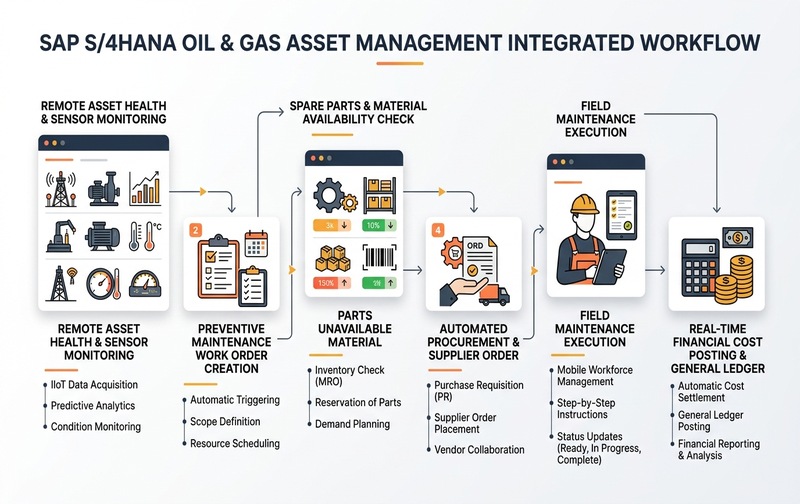
An integrated asset-management environment can help coordinate:
The key benefit is not merely digitizing work orders.
It is connecting asset condition, maintenance activity, material consumption and financial cost.
This allows management to examine maintenance performance from both operational and financial perspectives.
Procurement and Supplier Management
Procurement complexity increases when companies operate across multiple plants, fields, projects and geographic locations.
SAP S/4HANA can help establish more consistent processes for:
Standardized workflows can reduce dependence on informal purchasing processes and improve visibility into commitments before invoices reach finance.
For management, this creates better control over:
Inventory and Materials Visibility
Oil and gas businesses can carry significant inventories of materials, maintenance spares and operational supplies.
Poor visibility can create two opposing risks:
Stock shortages
Critical materials may not be available when maintenance or operations need them.
Excess inventory
Companies may purchase materials that already exist elsewhere in the organization.
SAP S/4HANA can support centralized visibility into:
Better master-data governance is critical because ERP technology cannot compensate for duplicate or inaccurate material records.
Project and Capital Expenditure Control
Oil and gas companies frequently manage capital-intensive projects.
These may include:
Management often needs visibility into:
When project procurement, finance and asset accounting are integrated, leaders can obtain stronger control over project expenditure and capitalization.
Supply Chain and Operational Planning
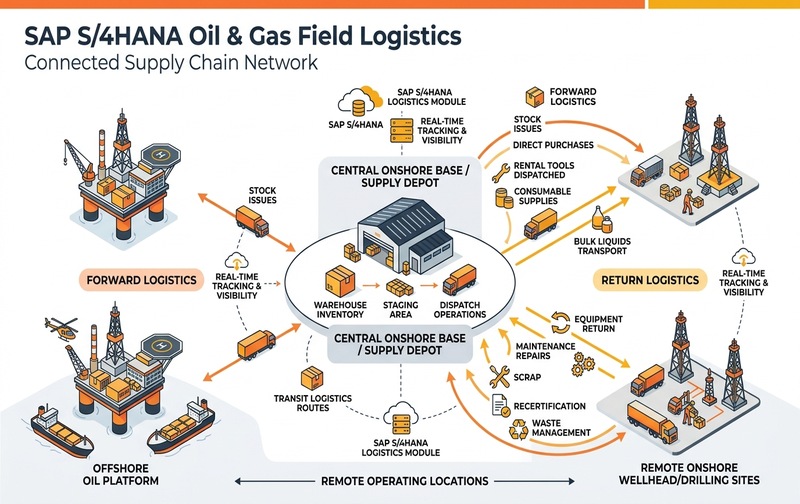
Oil and gas supply chains can involve multiple facilities, suppliers, transportation providers and storage locations.
An integrated ERP environment can improve visibility across:
However, SAP S/4HANA should not automatically be expected to replace every specialized operational application.
The target architecture should determine which processes belong within the ERP core and which require specialist systems integrated with it.
Industry-Specific Requirements Beyond Core ERP
A common SAP implementation mistake is assuming that standard ERP processes alone will cover every oil and gas requirement.
They may not.
Depending on the business model, geography and SAP landscape, organizations may need functionality or integration related to areas such as:
The exact capabilities available depend on the chosen SAP products, deployment model, extensions and integration architecture.
Therefore, implementation planning should separate requirements into three categories:
ERP Core
Processes that should remain standardized within SAP S/4HANA.
Industry Extensions
Processes requiring industry-specific SAP functionality or extensions.
Specialized Applications
Processes best handled by dedicated operational platforms integrated with ERP.
This classification prevents unnecessary customization of the ERP core.
Business Control Improvements Enabled by an Integrated ERP
The strongest business case for SAP S/4HANA is often not an individual feature.
It is the ability to establish a more connected operating model.
From Fragmented Data to Shared Information
Instead of individual departments maintaining separate versions of information, governed master and transactional data can support common reporting.
From Reactive Maintenance to Structured Asset Management
Maintenance activities can be connected with equipment history, materials and costs.
From Purchase Visibility After the Invoice to Earlier Spend Control
Management can see approved commitments earlier in the procurement lifecycle.
From Isolated Projects to Integrated Cost Monitoring
Project budgets, commitments and actual costs can be evaluated together.
From Manual Reconciliation to Integrated Financial Reporting
Operational transactions can flow into accounting and controlling processes.
From Spreadsheet Reporting to Data-Driven Management
Management teams can work from a more consistent ERP data foundation rather than repeatedly assembling information manually.
Real-Time Data and Management Visibility
One of the major architectural differences associated with SAP S/4HANA is its SAP HANA database foundation.
For business leaders, however, the technical architecture matters only when it produces a practical outcome.
The target should be faster access to trusted operational and financial information.
Examples include visibility into:
Reporting design should therefore be considered during implementation—not after go-live.
A successful ERP program should define:
- Which decisions management needs to make
- Which KPIs support those decisions
- Which transactions generate the necessary data
- Who owns data quality
- How information will be reported
This moves reporting from a technical afterthought to a business-control requirement.
SAP S/4HANA Implementation Challenges in Oil and Gas
Technology is only one part of an ERP transformation.
Several implementation risks repeatedly determine whether organizations achieve the expected business value.
Excessive Customization
Legacy ERP environments often contain years of custom developments.
Replicating every customization in a new environment can:
- Increase implementation complexity
- Increase testing requirements
- Raise support costs
- Complicate upgrades
- Preserve inefficient processes
Each customization should therefore answer a simple question:
Poor Master Data
Migration frequently exposes long-standing problems with:
◆ Vendor records
◆ Customer records
◆ Equipment masters
◆ Asset records
◆ Chart of accounts
◆ Cost centers
◆ Project structures
Migrating inaccurate data simply moves the problem into a newer ERP platform.
Data cleansing must therefore begin well before cutover.
Weak Process Ownership
ERP projects can become overly IT-driven.
• But procurement processes belong to procurement.
• Maintenance processes belong to operations and maintenance teams.
• Financial processes belong to finance.
Each critical process needs a business owner responsible for:
Controls
Data
Approvals
Testing
Adoption
KPIs
Without clear ownership, ERP design becomes fragmented.
Integration Complexity
Oil and gas companies often operate numerous specialist systems.
Examples may include:
Every integration should have clearly defined ownership, data direction, frequency, exception handling and monitoring.
Change Management Gaps
A technically successful deployment can still underperform when users continue working outside the ERP.
Typical symptoms include:
Training should therefore focus on business processes and roles rather than simply teaching users which buttons to click.
A Practical SAP S/4HANA Implementation Roadmap
Oil and gas organizations should treat implementation as business transformation rather than software installation.
Phase 1: Business Assessment
Document current operational and financial pain points.
Evaluate:
- Existing ERP landscape
- Business entities
- Geographic scope
- Value-chain processes
- Operational systems
- Data problems
- Reporting gaps
- Controls
- Integrations
- Custom developments
The output should be a clear business case and transformation scope.
Phase 2: Process and Architecture Design
Define the target operating model.
Determine:
- Processes to standardize
- Industry-specific requirements
- Necessary extensions
- Integration architecture
- Data ownership
- Reporting requirements
- Security model
- Approval workflows
- Deployment architecture
This phase is critical because architecture decisions made early can affect the entire ERP lifecycle.
Phase 3: Fit-to-Standard Evaluation
Compare business requirements against available SAP processes.
Requirements should be classified as:
- Standard
- Configurable
- Extension required
- Integration required
- Genuine customization required
This prevents custom development from becoming the default solution.
Phase 4: Data Preparation
Clean, map and govern data before migration.
Priority objects can include:
- Vendors
- Customers
- Materials
- Equipment
- Assets
- Accounts
- Cost centers
- Projects
- Open transactions
Data migration should be rehearsed through multiple test cycles.
Phase 5: Configuration and Integration
Configure approved business processes and build required integrations.
Testing should include:
- Process testing
- Integration testing
- Security testing
- Data validation
- Performance testing
- Reporting validation
- End-to-end scenarios
Testing isolated modules is not enough. A procurement transaction, for example, should be tested through its entire business and accounting lifecycle.
Phase 6: User Acceptance and Readiness
Business users should validate realistic operational scenarios.
Examples include:
- Emergency maintenance
- Planned maintenance
- Purchase requisition to payment
- Material transfer
- Capital procurement
- Project expenditure
- Inventory adjustment
- Period-end activities
User acceptance testing should prove that the new process works operationally—not merely that the software executes a transaction.
Phase 7: Cutover and Go-Live
Cutover planning should define:
- Final migration
- Open transactions
- Reconciliation
- User access
- Interfaces
- Reporting
- Support responsibilities
- Escalation procedures
ERP go-live is the beginning of operational adoption, not the end of transformation.
Phase 8: Stabilization and Continuous Improvement
After go-live, monitor:
- Process exceptions
- User adoption
- Data quality
- Integration failures
- Reporting accuracy
- System performance
- Business KPIs
A structured improvement backlog can then prioritize further automation and optimization.
SAP S/4HANA Migration from Legacy SAP Environments
Many oil and gas organizations evaluating S/4HANA already operate SAP ECC or heavily customized legacy environments.
Migration should not automatically mean copying the existing system.
The transition provides an opportunity to examine:
Organizations generally need to determine whether their transformation is closer to:
System Conversion
Retaining much of the existing environment while converting to S/4HANA.
New Implementation
Designing a new environment using standardized processes and selectively migrating necessary data.
Selective Transformation
Combining elements of conversion and redesign according to business requirements.
The appropriate approach depends on the condition of the existing system, business transformation objectives and complexity of historical customization.
Integration Architecture for Connected Oil and Gas Operations
ERP rarely operates alone in an oil and gas organization.
A well-designed architecture should therefore treat integration as a core design discipline.
Important questions include:
Poor integration architecture can recreate data silos even after an ERP transformation.
The goal should be a controlled application landscape in which S/4HANA serves as the transactional and financial backbone while specialized systems perform functions for which they are specifically designed.
Cloud, Private Cloud and Deployment Considerations
Deployment strategy should follow business and technical requirements rather than a generic preference for cloud or on-premise infrastructure.
Decision-makers should evaluate:
Organizations pursuing extensive standardization may evaluate different options from companies with deeply specialized industry processes and complex integration landscapes.
The implementation partner should therefore validate functionality and deployment compatibility before the architecture is finalized.
Security, Controls and Governance Requirements
Oil and gas ERP environments frequently contain financially and operationally sensitive information.
Security design should cover:
Security should be designed during the implementation rather than added just before go-live.
A user should receive only the access necessary to perform the required business role.
SAP S/4HANA Cost Factors for Oil and Gas Companies
There is no universal implementation cost because ERP scope varies significantly.
The total investment can be influenced by:
Business Scope
More entities, countries, plants and processes increase implementation complexity.
Deployment Model
Infrastructure and subscription arrangements vary according to architecture.
Industry Requirements
Specialized functionality may require additional implementation effort or solutions.
Integrations
Each external system introduces design, development, testing and monitoring requirements.
Data Migration
Large or poor-quality datasets require more cleansing and migration effort.
Customization
Extensive custom development increases implementation and lifecycle cost.
Change Management
Large, distributed user populations require stronger training and adoption programs.
Support Model
Post-go-live application management should be considered in total cost of ownership.
Decision-makers should therefore evaluate total lifecycle cost, not implementation price alone.
Business Case and ROI Measurement
An ERP business case should connect technology investment with measurable operating improvements.
Potential KPI categories include:
Finance
- Closing cycle
- Manual journal activity
- Reconciliation effort
- Reporting cycle
- Working-capital visibility
Procurement
- Purchase-order cycle time
- Maverick spending
- Approval turnaround
- Supplier performance
- Contract utilization
Inventory
- Inventory value
- Stock-outs
- Slow-moving materials
- Duplicate materials
- Inventory accuracy
Asset Management
- Planned versus reactive maintenance
- Maintenance backlog
- Equipment downtime
- Maintenance cost by asset
- Spare-parts consumption
Projects
- Budget variance
- Commitment visibility
- Forecast accuracy
- Project cost variance
The baseline should be measured before implementation.
Otherwise, organizations may complete a major ERP transformation without being able to demonstrate whether business performance actually improved.
Business Fit Criteria for SAP S/4HANA
SAP S/4HANA becomes particularly relevant when an oil and gas organization faces increasing complexity across multiple functions.
Typical indicators include:
However, platform selection should still begin with requirements.
A smaller or less complex organization may not need the same ERP architecture as a multinational upstream or integrated energy company.
ERP fit should be determined by business complexity, control requirements and future operating model rather than brand recognition alone.
Selecting the Right SAP Implementation Partner
Oil and gas ERP transformation requires more than technical configuration.
The implementation partner should understand the relationship between operational processes and financial outcomes.
Evaluate potential partners against criteria such as:
Industry Understanding
Can the team explain upstream, midstream or downstream requirements relevant to your operating model?
S/4HANA Capability
Does the partner have experience with the relevant S/4HANA processes, architecture and migration approach?
Process Expertise
Can consultants challenge inefficient workflows rather than simply reproduce them?
Integration Capability
Can the team design interfaces across operational and enterprise applications?
Data Migration Experience
Is there a structured methodology for cleansing, mapping, migration and reconciliation?
Governance
Are scope, risks, decisions and changes managed through a clear governance framework?
Change Management
Does the implementation approach address adoption, training and process ownership?
Post-Go-Live Support
Who will manage stabilization, enhancements, upgrades and continuous improvement?
The lowest implementation quote does not necessarily represent the lowest long-term ERP cost.
Architecture quality, process design and implementation discipline can have a larger impact on total cost of ownership.
Common ERP Implementation Mistakes to Avoid
Several risks deserve executive attention before implementation begins.
⚠️ Recreating the Legacy System
Migrating every historical customization removes much of the opportunity for process simplification.
⚠️ Treating ERP as an IT Project
ERP affects operating processes, financial controls, organizational responsibilities and management information.
⚠️ Delaying Data Cleansing
Waiting until migration testing begins can create costly delays.
⚠️ Ignoring Integrations Until Late in the Project
Interfaces should be included in architecture planning from the beginning.
⚠️ Designing Reports After Go-Live
Management reporting requirements should influence data and process design.
⚠️ Underestimating User Adoption
Users can recreate old processes through spreadsheets when new workflows are not practical.
⚠️ Declaring Success at Go-Live
The real measure of success is whether the business achieves improved control and measurable operating outcomes.
SAP S/4HANA Evaluation Framework for Decision-Makers
Before committing to implementation, CEOs, CFOs, CIOs, CTOs and operations leaders should answer five questions.
1. What Business Problem Are We Solving?
Identify concrete problems such as asset-cost visibility, procurement control, project overruns, fragmented reporting or legacy-system complexity.
2. Which Processes Need Standardization?
Determine where standardized ERP processes can replace inconsistent local practices.
3. Which Industry Requirements Are Truly Differentiated?
Separate essential oil and gas requirements from historical customizations.
4. What Must Integrate With ERP?
Map operational, financial and specialist applications before defining the architecture.
5. How Will Success Be Measured?
Establish measurable KPIs and baselines before implementation.
If these questions cannot be answered clearly, the organization may not yet be ready to select an implementation scope.
From ERP Modernization to Business Control
The business value of SAP S/4HANA for oil and gas is not created by deploying a new ERP platform alone.
Value comes from redesigning how the organization controls:
A successful transformation connects operational activity with financial consequences.
Management should be able to move from:
“What happened?”
to:
“Where did it happen, why did it happen, what is the financial impact, and what action is required?”
That is the larger objective of an integrated digital ERP environment.
SAP S/4HANA for Oil and Gas FAQs
Planning an SAP S/4HANA transformation for your oil and gas operation?
Emerging Alliance can demonstrate how SAP S/4HANA can support your operational processes, integration requirements, data management and business growth needs.
Book an SAP S/4HANA Demo with Our Experts