
SAP S/4HANA for Sugar Industry: From Cane-to-Cash Complexity to Margin Control
Quick Answer
SAP S/4HANA for the sugar industry provides an integrated ERP foundation for managing complex operations across cane procurement, weighbridge transactions, production planning, inventory, quality, plant maintenance, sales and finance.
For sugar manufacturers, the business problem is rarely limited to production. Margin leakage can begin with inconsistent cane data, continue through transportation and weighbridge processes, surface as poor recovery or inventory visibility, and ultimately appear in finance only after corrective action is difficult.
A well-designed SAP S/4HANA environment connects these operational and financial processes so management can evaluate production performance, costs, inventory, maintenance requirements and profitability using a common data foundation.
For CEOs, CFOs, CIOs and plant leadership, the objective is therefore not simply to implement another ERP. It is to establish stronger control from cane procurement to production, inventory, sales and margin analysis.
Why Sugar Manufacturing Demands More Than a Generic ERP
Sugar manufacturing combines agriculture, procurement, logistics, continuous production, asset-intensive operations, inventory management and financial control.
That makes the ERP requirement fundamentally different from a conventional manufacturing operation.
A sugar business may need to coordinate growers, harvesting contractors, transporters, cane yards, weighbridges, production teams, laboratories, warehouses, maintenance departments, finance teams and sales operations within the same operating cycle.
The challenge increases further when multiple mills, plants, distilleries, cogeneration units or geographical locations are involved.
When these processes operate through disconnected applications, spreadsheets or heavily customized legacy ERP systems, management can struggle to answer basic business questions quickly.
❓ What quantity of cane has arrived?
❓ What is the actual procurement cost?
❓ Which suppliers or regions are delivering stronger quality?
❓ What is the current crushing performance?
❓ How does actual recovery compare with target?
❓ How much finished sugar is available?
❓ What quantities of molasses and other by-products have been generated?
❓ Where is maintenance affecting production capacity?
❓ Which plant, product or business unit is contributing most effectively to margin?
This is where the case for an integrated ERP for the sugar industry becomes much stronger.
Margin Pressure Across the Sugar Value Chain
Profitability in sugar manufacturing is shaped by hundreds of operational decisions between cane sourcing and product dispatch, where small information gaps create major financial leakage.
Improving margin in sugar manufacturing is not only about selling at a higher price.
Profitability is influenced by hundreds of operational decisions made between cane sourcing and final product dispatch.
A small information gap at one stage can create a much larger financial impact later.
Cane Procurement Without End-to-End Visibility
Cane procurement involves more than issuing purchase orders.
Sugar businesses may need visibility into growers, cane varieties, sourcing areas, harvesting activity, transportation, arrival quantities, quality parameters and settlement processes.
When procurement information exists outside the primary ERP environment, finance and production teams may be working from different versions of operational reality.
That can make procurement cost analysis, supplier settlement and production planning harder to control.
A sugar-industry ERP architecture should therefore connect procurement information with the downstream production and financial processes that depend on it.
Weighbridge Transactions and Data Accuracy
The weighbridge is a critical control point between physical material movement and digital business records.
Manual data transfers between weighbridge systems, procurement applications and ERP software can introduce delays, duplicate entries and reconciliation work.
Industry-specific SAP S/4HANA implementations commonly integrate cane-management and weighbridge processes with the ERP layer so transactions can move through a more controlled digital workflow.
This type of integration is already visible in specialized S/4HANA sugar solutions in the market, where cane receipt, weighbridge automation and farmer-related processes are connected with the ERP environment.
Production Variance and Recovery Performance
For a sugar mill, simply knowing how much was produced is not enough.
Management needs context.
Actual production should be evaluated alongside cane input, planned output, recovery, process losses, material consumption, operating time and cost.
Without timely production data, management may identify a poor recovery trend only after significant production has already occurred.
SAP S/4HANA for sugar manufacturing can provide a common transactional foundation for capturing production activity and connecting it with material, maintenance and financial information.
That makes operational variance more visible to production and management teams.
Cane Procurement to Factory Control with SAP S/4HANA

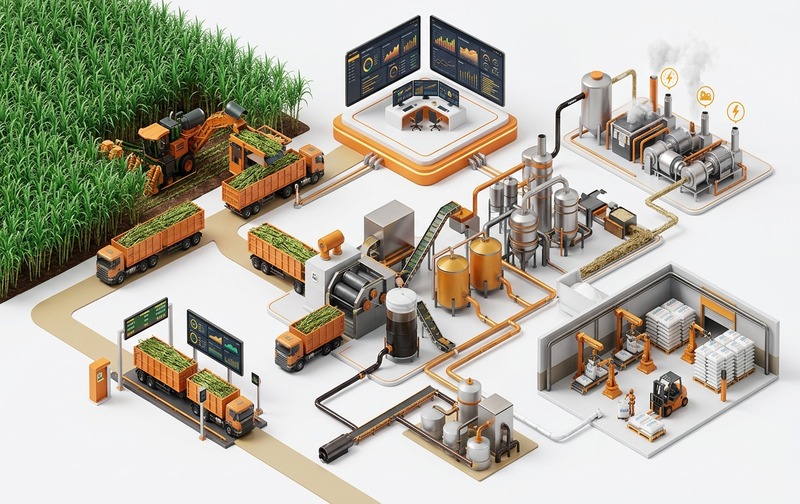
SAP S/4HANA provides a unified digital core connecting cane sourcing, automated weighbridges, plant maintenance, by-product recovery, and executive financial controlling into one seamless data architecture.
The value of SAP S/4HANA in a sugar environment comes from integration.
Instead of viewing procurement, production, warehouse operations and finance as separate systems, the organization can manage them as connected business processes.
A typical sugar ERP landscape may connect:
Farmer and supplier information, cane procurement, weighbridge transactions, materials, production, quality, inventory, plant maintenance, by-products, sales, distribution, finance, costing, approvals and management analytics.
The exact architecture depends on the operating model and may involve industry-specific applications or extensions alongside the S/4HANA core.
Cane Procurement and Supplier Management
Cane sourcing is one of the earliest points where better business control can influence the final margin.
An integrated environment can help organizations connect supplier master data, procurement transactions, receipt information and financial settlement.
For management, the advantage is not simply faster processing.
It is the ability to evaluate procurement activity together with production and financial outcomes.
For example, procurement teams may focus on cane availability while plant leadership evaluates recovery and finance evaluates procurement cost.
With connected data, those decisions no longer need to exist independently.
This creates a stronger basis for supplier evaluation, procurement planning and cost analysis.
Weighbridge and Cane Receipt Integration
Physical movement should match the ERP transaction.
When weighbridge information is integrated with business systems, organizations can reduce dependency on repeated manual data entry between operational checkpoints.
A structured workflow can connect vehicle arrival, weighing, cane receipt, supplier information and subsequent accounting processes.
The objective should be traceability:
Traceability Workflow
➔
➔
➔
➔
➔
That visibility becomes especially valuable for sugar businesses managing large volumes during peak crushing periods.
Production Planning and Crushing Visibility
Production teams need a reliable view of planned versus actual performance.
SAP S/4HANA can connect production planning with materials, capacity, inventory and financial information so operational teams work from a consistent data foundation.
For sugar companies, this can improve visibility across crushing plans, material availability, production quantities, consumption, output and production costs.
Management can then investigate exceptions instead of relying only on end-of-period reports.
The result is a shift from retrospective reporting toward more active operational control.
Recovery, Yield and Production Cost Analysis
One of the most important questions in sugar manufacturing is not simply:
How much sugar did we produce?
It is:
What did we consume, what did we recover, what did it cost and where did the variance originate?
This is where integrated operational and financial data becomes valuable.
Production data can be examined alongside procurement costs, material consumption, overheads, maintenance expenditure and finished-product output.
This gives CFOs and operations leadership a clearer basis for understanding why the margin changed instead of only seeing that the margin changed.
Inventory Control Across Raw Materials and Finished Goods
Sugar businesses can manage multiple categories of inventory across the production cycle.
Visibility may be required for maintenance materials, chemicals, packaging materials, finished sugar, by-products and other operating supplies.
When inventory data is fragmented, businesses can face both overstocking and shortages.
SAP S/4HANA can provide centralized inventory information connected with purchasing, manufacturing and finance.
This allows planners to understand not simply what stock exists, but also how inventory relates to demand, production and working capital.
For CFOs, this matters because inventory is not just an operational quantity.
It is capital.
By-Product Management: Molasses, Bagasse and Beyond
The economics of a modern sugar business may extend beyond the primary finished product.
Molasses, bagasse and other outputs can have significant operational and commercial value depending on the business model.
Some sugar businesses also operate adjacent distillery, ethanol or cogeneration activities.
ERP design must therefore consider the complete production environment rather than treating secondary outputs as an afterthought.
Industry-focused SAP solutions already position by-product management, distillery processes and cogeneration as part of the broader sugar operating model.
A connected ERP foundation helps businesses account for materials, production outputs, transfers, sales and associated financial impact more consistently.
Quality Control Across the Production Cycle
Quality affects procurement decisions, production outcomes and customer expectations.
A disconnected quality process can create another data island.
Integrating quality-related information with procurement and production processes gives relevant teams better context when investigating deviations.
Instead of discovering a problem only after finished goods are available, quality information can become part of the operational decision process.
For management, the benefit is stronger traceability between input, process and output.
Plant Maintenance and Production Continuity
Sugar mills are asset-intensive operations.
Unexpected equipment failure during a critical production period can affect throughput, maintenance expenditure and overall manufacturing performance.
ERP-driven maintenance management connects equipment information, maintenance planning, work activities, spare parts and costs with the wider operating environment.
This enables organizations to move beyond reactive maintenance toward more structured planning.
The important management question becomes:
Which maintenance activities protect production capacity, and what is the cost of maintaining that capacity?
With an integrated ERP, maintenance is no longer isolated from operations and finance.
Finance, Costing and Margin Visibility
This is where many ERP transformation projects ultimately create executive value.
Operational data needs to become financial insight.
SAP S/4HANA can connect procurement, inventory, production, maintenance and sales transactions with financial accounting and controlling processes.
The CFO can therefore move closer to understanding margin based on the same operational activity being managed across the business.
Instead of relying heavily on manual reconciliation between operational reports and financial spreadsheets, the organization can establish a more consistent information foundation.
This can strengthen:
- Working-capital analysis.
- Production cost visibility.
- Procurement cost analysis.
- Inventory valuation.
- Maintenance expenditure control.
- Plant or business-unit profitability.
- Actual-versus-plan comparison.
- Period-end financial reporting.
The goal is not more reports.
The goal is faster identification of the operational factors affecting financial performance.
From Operational Data to Executive Decisions
Sugar companies generate large quantities of operational data.
But more data does not automatically create better decisions.
The real challenge is turning transactions into usable management information.
Senior management may want to see cane availability, crushing performance, recovery, stock, production costs, maintenance exceptions and profitability without asking multiple teams to manually combine reports.
An integrated SAP S/4HANA environment can give different functions access to information derived from the same business transactions.
This creates a more reliable foundation for dashboards, analytics and management reviews.
For CEOs and CFOs, that means operational discussions can increasingly focus on exceptions and action rather than debating whose spreadsheet is correct.
SAP S/4HANA and the Connected Sugar Enterprise
The ERP core does not necessarily need to perform every specialized industry activity itself.
A modern architecture can combine S/4HANA with purpose-built applications, integrations and extensions for sugar-specific requirements.
That is particularly relevant for processes such as field operations, cane management, weighbridge automation, specialized supplier workflows and mobile applications.
Some current sugar-industry S/4HANA solutions use SAP Business Technology Platform extensions alongside the ERP core for industry-specific processes such as weighbridge automation and cane receipt.
The architectural objective should be straightforward:
Keep the ERP core controlled while connecting industry-specific processes through a governed integration and extension strategy.
This can make future upgrades and process changes easier to manage than an environment dominated by uncontrolled customization.
SAP S/4HANA for Multi-Plant Sugar Operations
ERP complexity increases significantly as the organization expands.
One mill may develop its own purchasing process.
Another may use different material codes.
A third may calculate reports differently.
Finance then spends time consolidating inconsistent information.
A standardized S/4HANA operating model can help larger sugar groups establish common processes, master-data structures and financial controls across multiple business units.
Local operational requirements can still exist, but they can be managed within a clearer enterprise governance framework.
This becomes particularly important when management needs consolidated visibility across mills, distilleries, cogeneration facilities or geographical regions.
Real-World SAP S/4HANA Adoption in Sugar
The use of S/4HANA in the sugar sector is not theoretical.
A public NTT DATA case study on Royal Eswatini Sugar Corporation describes SAP S/4HANA supporting an environment spanning farming, manufacturing and supply-chain requirements. It reports integration of approximately 50 information systems and a 14% saving in SAP running costs.
The lesson is not that every sugar company will achieve the same result.
The more useful takeaway is that large sugar operations can use S/4HANA as an integration and management foundation across a complex operational landscape.
Business outcomes will depend on architecture, implementation scope, process maturity, adoption and ongoing optimization.
Legacy ERP vs SAP S/4HANA for Sugar Manufacturing
The ERP decision often starts when an existing environment becomes increasingly difficult to manage.
Legacy systems may still process transactions successfully while creating other problems.
Reporting may require manual consolidation.
Integrations may be fragile.
Customizations may restrict upgrades.
Processes may vary by location.
Operational data may not connect easily with finance.
Management reporting may arrive too late.
The relevant question is therefore not:
“Does our existing ERP still work?”
It is:
“Can our current ERP support the level of visibility, standardization, integration and scalability required for the next stage of the business?”
That is a much more strategic test.
When Should a Sugar Company Consider SAP S/4HANA?
SAP S/4HANA becomes particularly relevant when operational scale or complexity begins exceeding the capabilities of the existing ERP environment.
Typical indicators include increasing multi-plant complexity, extensive manual reconciliation, disconnected production systems, fragmented master data, growing customization, limited real-time profitability visibility, difficult integrations or increasing dependence on spreadsheets.
A growing organization should also consider whether its current ERP architecture can support future acquisitions, new production facilities, distillery or cogeneration operations, geographic expansion and changing reporting requirements.
ERP selection should therefore reflect the future operating model, not only today’s transaction volume.
SAP S/4HANA Implementation for the Sugar Industry
A successful implementation should begin with processes rather than software screens.
The organization first needs to understand how information currently moves from sourcing to settlement.
A practical transformation sequence is:
➔
➔
➔
➔
➔
➔
➔
➔
During discovery, teams should map cane procurement, weighbridge processes, manufacturing, quality, warehouse activity, maintenance, sales and finance.
The next objective is to identify which activities can adopt standard S/4HANA processes and which genuinely require an industry-specific integration or extension.
That distinction is important.
Recreating every legacy customization in the new ERP can transfer old complexity into a new platform.
A better transformation program uses migration as an opportunity to simplify.
Sugar ERP KPIs Worth Bringing into One Decision Environment
ERP value becomes easier to measure when technology implementation is linked with operational KPIs.
Sugar manufacturers should determine which metrics need consistent, timely visibility across management levels.
Relevant measures may include cane received, procurement cost, crushing volume, recovery, production output, process variance, inventory levels, inventory aging, equipment downtime, maintenance cost, production cost, sales realization, working capital and contribution margin.
cane received, procurement cost
crushing volume, recovery
production output, process variance
inventory levels, inventory aging
equipment downtime, maintenance cost
production cost
sales realization
working capital, contribution margin
The objective is not to create a dashboard with dozens of metrics.
It is to identify which operating indicators explain business performance and connect them to accountable decisions.
Choosing an SAP S/4HANA Implementation Partner for Sugar Manufacturing
Technology knowledge alone is not enough for an industry-specific ERP transformation.
An implementation partner must understand how sugar operations move from cane sourcing through production and commercial settlement.
During partner evaluation, decision-makers should examine the proposed process architecture rather than relying only on generic SAP credentials.
Ask how the solution will handle cane procurement.
Ask how weighbridge information will integrate.
Ask how production and recovery will be monitored.
Ask how by-products will be represented.
Ask how plant maintenance will connect with production and cost.
Ask how management will see profitability.
Ask which requirements will use standard SAP, which will require integration and which genuinely need extension.
Those questions reveal whether the implementation approach is based on sugar-industry realities or simply a generic manufacturing template.
Business Control Before ERP Complexity
The strongest case for SAP S/4HANA for the sugar industry is not digitization for its own sake.
It is control.
As sugar businesses scale, fragmented systems can make every additional plant, workflow and integration harder to manage.
A structured S/4HANA architecture creates an opportunity to replace that fragmentation with a common operational and financial foundation.
For management, the shift is significant:
➔
➔
➔
➔
SAP S/4HANA for Sugar Industry: The Decision Ahead
A sugar ERP transformation should not begin with the question:
“Which SAP modules should we implement?”
It should begin with:
“Where are we losing operational control, visibility or margin today?”
Once those gaps are clear, the organization can determine how SAP S/4HANA, industry-specific integrations and standardized processes should support the future operating model.
For larger sugar manufacturers, multi-plant groups and businesses expanding into related operations, this creates a scalable foundation for managing increasing complexity without allowing ERP complexity to grow at the same rate.
Frequently Asked Questions
Book an SAP S/4HANA Sugar Industry Demo
If your sugar manufacturing operation is dealing with fragmented procurement, disconnected production data, manual reporting, poor cost visibility or increasing ERP complexity, see how SAP S/4HANA can help connect critical processes and improve operational visibility.
Book an SAP S/4HANA Sugar Industry Demo to explore how the solution can address your current process gaps and support a more connected, scalable ERP environment.