
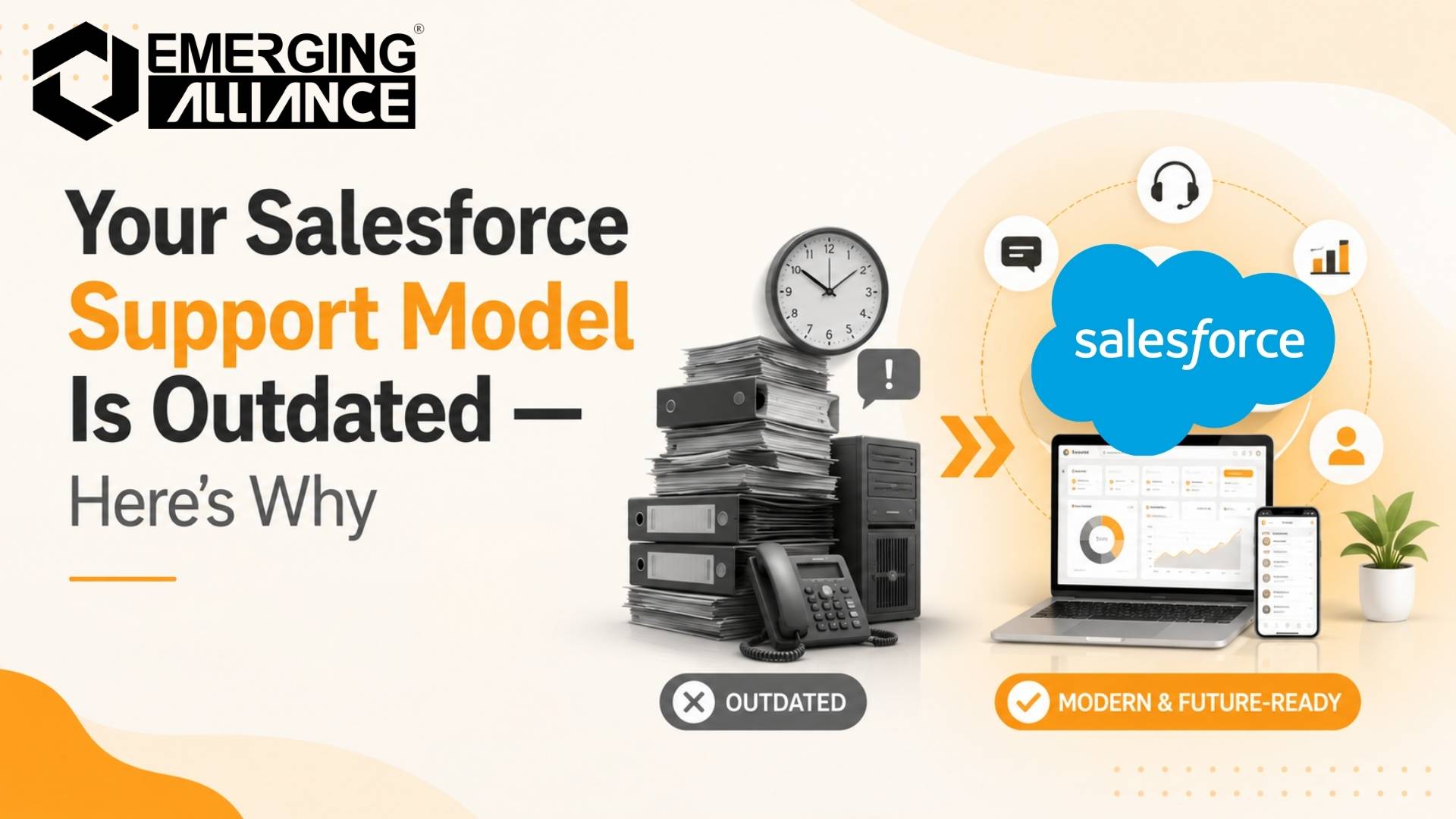
Your Salesforce Support Model Is Outdated — Here’s Why
Modern Salesforce Support for Today’s Enterprise
Salesforce Support has evolved far beyond ticket resolution and user assistance. Yet many enterprises continue operating with outdated support models that were designed for static CRM environments, not today’s rapidly changing digital ecosystems.
The challenge is no longer simply keeping Salesforce operational. The real challenge is ensuring that Salesforce continuously supports business growth, automation, compliance, customer experience, and revenue generation.
As organizations expand across departments, regions, and customer touchpoints, traditional support structures often create hidden operational inefficiencies, workflow bottlenecks, reporting gaps, and increasing technical debt.
The result?
- Slower decision-making
- Reduced user adoption
- Delayed innovation initiatives
- Increased compliance exposure
- Revenue leakage through disconnected processes
- Rising operational costs
Modern enterprises need a strategic Salesforce Support approach that continuously optimizes the platform rather than merely maintaining it.
Why Traditional Salesforce Support Services No Longer Meet Enterprise Needs
Many organizations still rely on a reactive support model.
A user raises a ticket. A support team resolves it. The case closes.
While this approach may have worked during the early stages of a Salesforce CRM implementation, it becomes increasingly ineffective as business complexity grows.
Modern enterprises operate across multiple Salesforce Clouds, third-party applications, customer portals, analytics platforms, and automated workflows.
Without proactive oversight, businesses often experience:
- Workflow failures that remain undetected
- Duplicate or inaccurate CRM data
- Low user adoption across departments
- Delayed reporting and forecasting
- Process inconsistencies across regions
- Compliance and audit challenges
Modern Salesforce support services must actively identify optimization opportunities before they impact business performance.
Salesforce Support and Maintenance Services Should Drive Business Outcomes
Enterprise leaders should view Salesforce Support and Maintenance Services as a business enablement function rather than an IT helpdesk.
The platform directly influences sales productivity, customer experience, service efficiency, and executive visibility.
A modern Salesforce Support strategy focuses on:
Continuous Process Optimization
Business processes change frequently.
Sales teams evolve.
Service operations expand.
Compliance requirements increase.
Support teams must continuously align Salesforce CRM systems with changing business objectives.
User Adoption Improvement
Low adoption is often one of the largest hidden costs of a Salesforce investment.
Modern support includes:
- User behavior monitoring
- Process simplification
- Role-based dashboards
- Targeted training initiatives
- Executive reporting enhancements
Automation Expansion
Organizations frequently underutilize automation capabilities.
Ongoing support should identify opportunities to automate:
- Lead management
- Case routing
- Approval workflows
- Customer communications
- Escalation processes
- Data validation controls
Automation reduces manual effort while improving consistency and scalability.
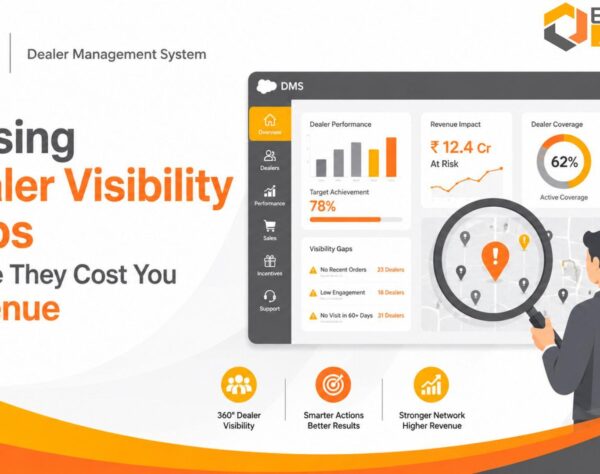
Visibility Gaps Are Creating Revenue Leakage Across Salesforce CRM Systems
One of the biggest risks facing growing enterprises is lack of visibility.
Many leadership teams assume their Salesforce environment is functioning correctly simply because users can log in and perform daily tasks.
However, operational blind spots often exist beneath the surface.
Common enterprise scenarios include:
Sales Forecasting Inaccuracies
Multiple teams use different reporting structures.
Pipeline visibility becomes inconsistent, creating forecasting challenges for finance and executive leadership.
Customer Service Bottlenecks
Cases remain open longer than expected because routing logic no longer aligns with current operational structures.
Integration Failures
Critical integrations between Salesforce systems and ERP platforms stop functioning properly without immediate visibility.
Data Quality Issues
Duplicate records and incomplete customer profiles reduce reporting accuracy and impact customer engagement efforts.
Modern Salesforce CRM support services focus on proactive monitoring, governance, and performance optimization to eliminate these visibility gaps.
Why Enterprises Are Moving Toward Managed Salesforce Support Services
Leading organizations increasingly adopt managed support models instead of traditional break-fix approaches.
The reason is simple.
Salesforce is now a business platform, not merely a CRM application.
A modern Salesforce Support and Maintenance Partner provides access to:
Strategic Governance
- Platform health assessments
- Security reviews
- Compliance monitoring
- Technical roadmap planning
- Architecture optimization
Specialized Expertise
Access to:
- Salesforce Development Services
- Salesforce Marketing Cloud specialists
- Salesforce Service Cloud experts
- Integration consultants
- Reporting and analytics professionals
Faster Innovation
Instead of waiting for large implementation projects, businesses continuously improve Salesforce capabilities through incremental enhancements.
Reduced Internal Resource Dependency
Organizations avoid the cost and risk of building large in-house Salesforce support teams while maintaining access to specialized expertise.
This approach improves agility and supports long-term scalability.
The Connection Between Salesforce Support, ROI, and Enterprise Growth
Many executives focus heavily on Salesforce implementation cost and deployment budgets.
However, the long-term value of Salesforce depends largely on what happens after go-live.
A successful Enterprise Salesforce implementation requires continuous optimization.
Without structured support, organizations often experience:
- Declining platform adoption
- Increasing customization complexity
- Reporting inconsistencies
- Delayed enhancement projects
- Reduced operational efficiency
By contrast, organizations with mature Salesforce managed services models benefit from:
- Faster business process improvements
- Better decision-making visibility
- Higher user engagement
- Improved customer experiences
- Stronger compliance controls
- More predictable growth
The greatest return on Salesforce investment comes from continuous evolution, not one-time deployment.
Emerging Alliance: Your Strategic Salesforce Transformation Partner
Modern enterprises require more than a traditional support vendor.
They need a partner capable of aligning technology, processes, people, and business objectives.
Emerging Alliance helps organizations move beyond reactive Salesforce Support by delivering:
- Strategic Salesforce consulting
- Salesforce Development Services
- Salesforce implementation services
- Integration and automation expertise
- Governance and compliance frameworks
- Continuous platform optimization
Our approach focuses on measurable business outcomes, operational efficiency, and scalable enterprise growth.
Whether you are managing Salesforce Service Cloud, Salesforce Marketing Cloud, or complex multi-cloud environments, Emerging Alliance helps ensure your platform remains aligned with your evolving business strategy.
Ready to Modernize Your Salesforce Support Model?
If your Salesforce environment is generating tickets instead of business value, it may be time to rethink your support strategy.
Frequently Asked Questions
1. How is modern Salesforce Support different from traditional support models?
Modern Salesforce Support focuses on proactive optimization, automation, governance, and business outcomes rather than simply resolving user issues.
2. What do Salesforce Support Services typically include?
Services may include platform monitoring, administration, development support, reporting optimization, security reviews, integration management, and user adoption initiatives.
3. How do Salesforce managed services improve ROI?
Managed services help organizations continuously optimize workflows, improve adoption, automate processes, and reduce operational inefficiencies that impact business performance.
4. Can Salesforce CRM support services help improve reporting accuracy?
Yes. Support teams can enhance data quality, reporting structures, dashboard configurations, and governance processes to improve decision-making visibility.
5. What industries benefit most from enterprise Salesforce support?
Manufacturing, healthcare, pharmaceuticals, financial services, technology, distribution, professional services, and retail organizations often benefit significantly from structured support programs.
6. How does Salesforce Service Cloud support operational efficiency?
Ongoing support ensures workflows, routing rules, SLAs, and service processes remain aligned with business requirements, improving customer service performance.
7. What challenges arise after Salesforce CRM implementation?
Common challenges include low user adoption, reporting inconsistencies, integration failures, customization complexity, governance issues, and process inefficiencies.
8. How does a Salesforce Support and Maintenance Partner support compliance requirements?
They help implement security controls, audit readiness processes, access governance, monitoring frameworks, and regulatory compliance measures.
9. Can Salesforce support services assist with automation initiatives?
Yes. Support teams identify opportunities to automate approvals, workflows, customer interactions, data validation, notifications, and business processes.
10. When should an organization consider upgrading its Salesforce model?
Organizations should reassess their support approach when experiencing growth, multiple cloud deployments, reporting challenges, integration complexity, or increasing operational inefficiencies.
Schedule a consultation today and discover how modern Salesforce Support can improve visibility, automation, compliance, and enterprise growth.