
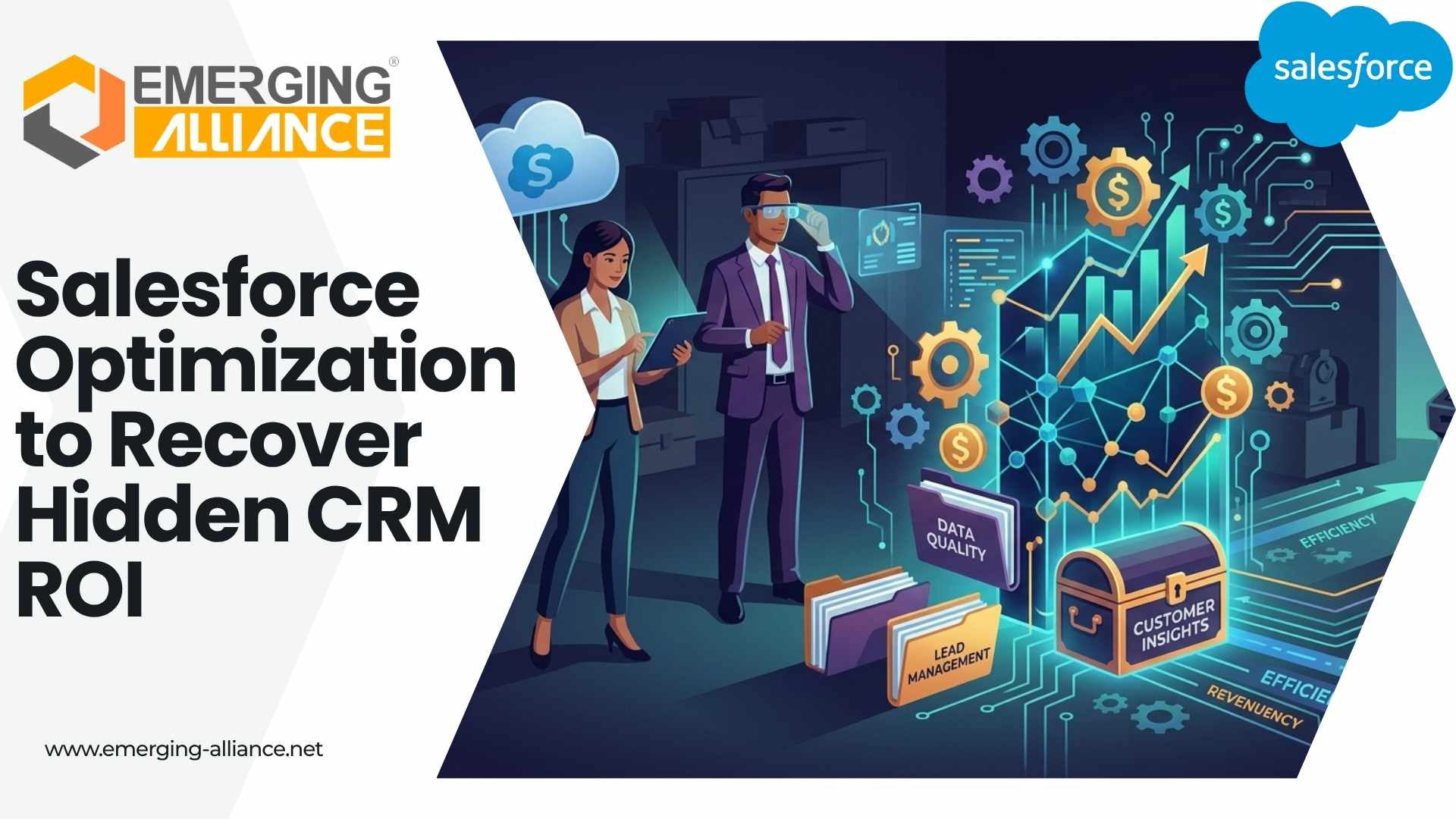
Salesforce Optimization to Recover Hidden CRM ROI
Salesforce Optimization – Uncover feature waste & unlock unused capabilities
Salesforce Optimization is no longer a post-implementation activity—it is a financial control mechanism. Most enterprises invest heavily in Salesforce CRM expecting measurable returns, yet the reality is different: ROI leakage begins immediately after go-live due to poor governance, underutilization, and misaligned configurations.
Senior leaders often assume that once Salesforce implementation is complete, value realization follows automatically. In practice, the opposite happens. Without structured Salesforce CRM Optimization, organizations experience declining adoption, increasing costs, and fragmented insights across business units.
This is particularly critical in today’s environment where Salesforce’s cloud-based platform is deeply embedded into sales, service, and operations workflows. If not continuously optimized, it becomes an expensive system of record instead of a system of value.
Where Salesforce ROI Actually Leaks Post-Implementation
The biggest misconception about Salesforce ROI is that it is determined at the time of implementation. In reality, ROI erosion happens silently across licensing, usage, and configuration layers.
Most organizations face three structural inefficiencies. First, Salesforce licenses are often over-provisioned, with a significant gap between purchased users and active users. Second, there is a mismatch in license types—Enterprise licenses being used where Professional or platform licenses would suffice. Third, unused modules such as Salesforce Sales Cloud or Salesforce Financial Services Cloud features remain inactive, creating hidden shelfware.
- Over-licensed users inflate the Salesforce Cost Structure without adding value
- Misaligned license tiers distort Salesforce investment efficiency
- Unused features reduce Salesforce implementation ROI significantly
Additionally, lack of visibility into Salesforce performance leads to poor decision-making. Without a structured Salesforce ROI calculator or tracking model, leadership teams cannot quantify returns from their Customer Relationship Management (CRM) platform.
The Hidden Cost of Underutilized Salesforce Capabilities
Beyond licensing inefficiencies, the real cost lies in underutilized capabilities. Many enterprises invest in Salesforce customization services and Salesforce development services and consulting solutions, but fail to activate or scale those capabilities effectively.
A typical enterprise scenario involves fragmented Salesforce data integration, where systems like ERP, marketing automation, and service platforms operate in silos. This directly impacts Salesforce Data Integration ROI, as decision-makers lack unified visibility.
- Disconnected systems reduce Salesforce CRM strategy effectiveness
- Poor adoption limits the impact of Salesforce customization
- Inefficient workflows weaken Salesforce ROI optimization outcomes
Moreover, excessive or redundant customization without governance leads to technical debt. Organizations that rely heavily on ad-hoc Salesforce Development Service often struggle with scalability, performance degradation, and rising maintenance costs.
This is where Optimizing Salesforce becomes critical—not just as a technical exercise, but as a strategic initiative aligned with business outcomes.
Building a Measurable Salesforce ROI Optimization Framework
To recover lost value, enterprises must shift from reactive fixes to a structured Salesforce ROI optimization framework. This requires aligning technology usage with measurable business outcomes.
A high-impact Salesforce CRM Optimization strategy focuses on three core pillars. First, usage analytics to identify adoption gaps across teams. Second, license rationalization to align cost with actual usage. Third, process optimization to eliminate inefficiencies in workflows and reporting.
Organizations that adopt this approach can transform Salesforce investments into measurable returns.
- Implement governance models to track Salesforce ROI continuously
- Align Salesforce implementation partner strategies with business KPIs
- Use benchmarking to evaluate Salesforce for businesses across industries
Equally important is redefining the Salesforce CRM strategy to ensure that every feature, integration, and customization contributes to revenue growth, cost reduction, or risk mitigation.
From Implementation to Value Realization: The Strategic Shift
The real competitive advantage lies not in deploying Salesforce, but in continuously evolving it. Enterprises that treat Salesforce system implementation as a one-time project often fail to unlock long-term value.
A mature organization views Salesforce Consulting Services as an ongoing partnership focused on optimization, not just deployment. This includes periodic audits, performance tuning, and aligning the platform with changing business models.
In this context, Salesforce supports become critical—not just for troubleshooting, but for driving innovation and scalability. Whether it is enhancing workflows, improving analytics, or refining integrations, continuous optimization ensures sustained ROI.
Recover Your Salesforce ROI with a Strategic Optimization Audit
If your organization is investing in Salesforce CRM but struggling to quantify returns, it’s time to reassess your approach.
Our Salesforce Optimization framework is designed to identify hidden inefficiencies, rationalize costs, and unlock unused capabilities across your CRM ecosystem.
What you can expect:
- Clear visibility into your Salesforce Cost Structure
- A comprehensive Salesforce ROI diagnostic
- License and usage optimization strategy
- Actionable roadmap to improve Salesforce implementation ROI
FAQs About Salesforce Optimization
1. How can enterprises identify hidden ROI leakage in Salesforce after implementation?
By analyzing user activity logs, license utilization, feature adoption rates, and workflow efficiency, organizations can pinpoint where value is not being realized across Salesforce CRM.
2. What is the financial impact of unused Salesforce licenses on enterprise CRM budgets?
Unused or misaligned Salesforce licenses directly inflate the Salesforce Cost Structure, often accounting for 15–30% of avoidable CRM spend in mid-to-large enterprises.
3. How does Salesforce Optimization differ from a standard Salesforce implementation?
While Salesforce implementation focuses on deployment, Salesforce Optimization is a continuous process aimed at improving usage, reducing inefficiencies, and maximizing Salesforce ROI over time.
4. What role does usage analytics play in Salesforce ROI optimization?
Usage analytics helps track adoption, identify underutilized features, and measure performance, enabling data-driven decisions for optimizing Salesforce investments.
5. How can organizations align Salesforce customization with business outcomes?
By linking every customization to measurable KPIs such as revenue growth, cycle time reduction, or cost savings, ensuring that Salesforce customization delivers tangible ROI.
6. Why do enterprises struggle with Salesforce data integration ROI?
Because disconnected systems and inconsistent data flows limit visibility, reducing the effectiveness of Salesforce data integration and impacting decision-making.
7. What are the risks of over-customization in Salesforce environments?
Over-customization increases maintenance costs, reduces system scalability, and creates technical debt, ultimately affecting Salesforce performance and ROI.
8. How does Salesforce Optimization support long-term digital transformation goals?
It ensures that Salesforce evolves with business needs, enabling scalability, agility, and continuous alignment with enterprise-wide digital strategies.
9. What metrics should CXOs track to evaluate Salesforce ROI effectively?
Key metrics include user adoption rates, cost per active user, pipeline conversion rates, sales cycle duration, and revenue attribution from CRM-driven activities.
10. When should an organization consider a Salesforce Optimization audit?
When there is low adoption, rising costs, unclear ROI, or after major changes such as scaling operations, adding new modules, or restructuring business processes.
Fill out the form to schedule your Salesforce Optimization Assessment and start converting your CRM investment into measurable business value.