
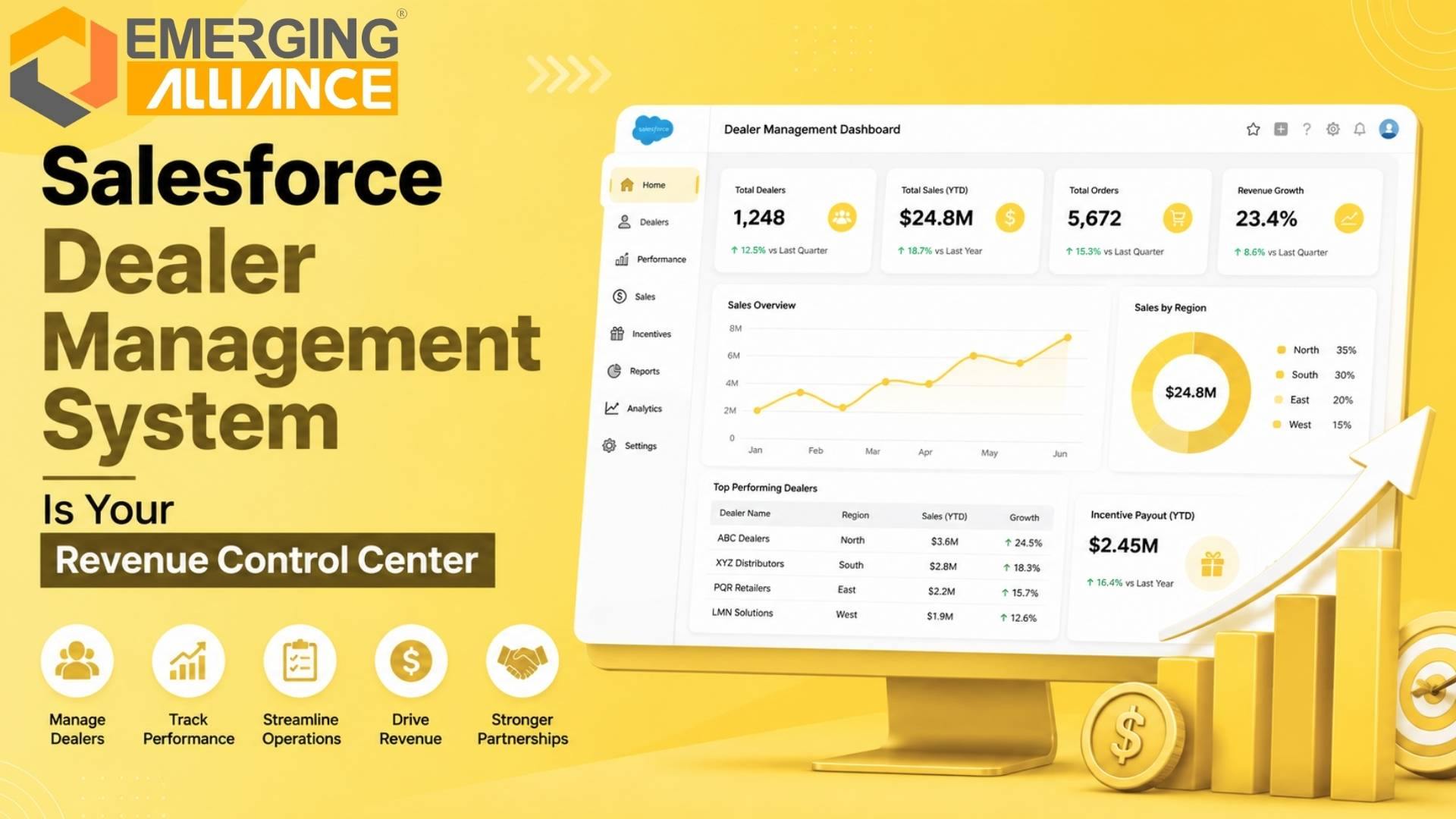
Salesforce Dealer Management System Is Your Revenue Control Center
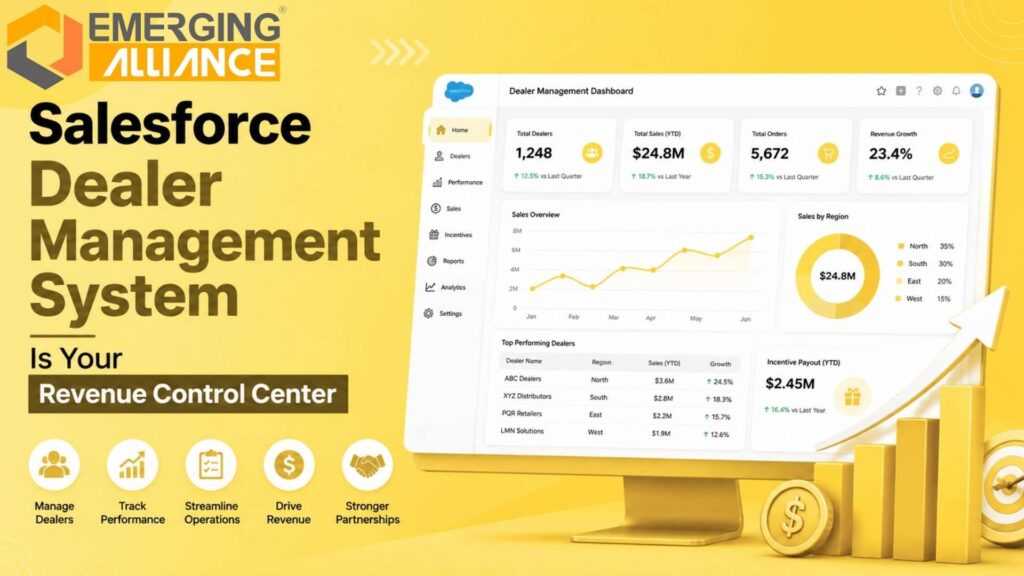
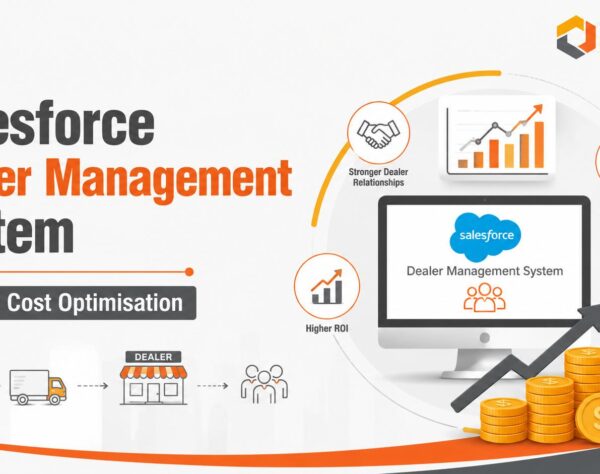
Salesforce Dealer Management System turns dealer data into faster market decisions
A disconnected dealer network creates more than operational confusion. It creates revenue leakage, delayed decisions, inventory inefficiencies, and poor customer visibility. For automotive enterprises, dealer-driven businesses, and distribution-heavy operations, fragmented dealer communication often becomes the biggest barrier to scalable growth. This is where a Salesforce Dealer Management System becomes a strategic business control layer instead of just another software platform.
Modern enterprises no longer want isolated dealer operations. They need centralized visibility across sales, inventory, finance, service operations, customer engagement, and partner performance.
A scalable Salesforce DMS helps organizations:
- Standardize dealer workflows
- Improve market responsiveness
- Automate dealer engagement
- Eliminate reporting delays
- Strengthen forecasting accuracy
- Reduce operational dependency on manual processes
For enterprise leaders, the conversation is no longer about managing dealers. It is about controlling revenue operations at scale.
Why Traditional Dealer Operations Create Revenue Blind Spots
Many enterprises still operate dealer ecosystems using disconnected spreadsheets, email approvals, local systems, and delayed reporting structures.
The result is operational fragmentation.
Without centralized dealer visibility, leadership teams struggle to answer critical business questions:
- Which dealer networks are underperforming?
- Where is inventory movement slowing down?
- Which regions are generating pipeline leakage?
- How quickly are leads being converted?
- Are dealer incentives driving actual profitability?
- Which workflows are creating customer delays?
A modern Dealer Management System Salesforce architecture addresses these gaps through unified operational visibility.
Instead of reactive reporting, enterprises gain real-time dealer intelligence.
This becomes especially critical for businesses managing:
- Multi-location dealer operations
- Regional distributors
- Automotive retail ecosystems
- Vehicle service networks
- Enterprise dealer franchises
- Global channel partner structures
Operational complexity increases with growth. Manual coordination cannot scale with enterprise expansion.
How Salesforce DMS Improves Enterprise Decision-Making
A modern Salesforce Dealer Management System connects dealer operations into a centralized cloud-based ecosystem.
The value is not just automation. The value is enterprise control.
Unified Dealer Visibility Across the Enterprise
Leadership teams gain a centralized view of:
- Dealer performance
- Lead conversion
- Vehicle inventory movement
- Service requests
- Warranty tracking
- Regional demand patterns
- Customer engagement activity
Instead of waiting for static reports, enterprises can act on live operational data.
This significantly improves:
- Demand forecasting
- Dealer allocation planning
- Market expansion decisions
- Revenue planning
- Inventory optimization
Faster Dealer Workflow Automation
Dealer operations often slow down because approvals, escalations, and coordination happen manually.
With Salesforce automation for dealers, enterprises can automate:
- Dealer onboarding workflows
- Lead distribution
- Incentive approvals
- Service ticket routing
- Inventory alerts
- Escalation management
- Partner communication workflows
Automation reduces operational dependency on individual teams while improving consistency across dealer networks.
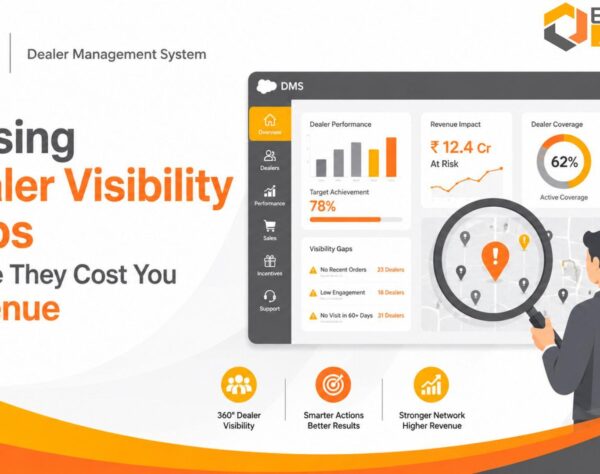
Real-Time Dealer Performance Analytics
Traditional dealer reporting is often delayed and incomplete.
A modern Salesforce DMS implementation enables real-time analytics across:
- Sales performance
- Dealer productivity
- Inventory aging
- Customer engagement
- Service turnaround times
- Regional growth trends
Executives gain operational clarity faster, enabling quicker strategic decisions.
Salesforce Dealer Management System With ERP Systems Creates Operational Alignment
One of the biggest enterprise challenges is disconnected operational systems.
Dealer systems often operate independently from ERP platforms, finance systems, inventory platforms, and CRM environments.
This creates data duplication and reporting inconsistencies.
A properly designed Salesforce DMS with ERP systems closes this gap.
Why ERP Integration Matters
Without ERP integration:
- Inventory visibility becomes inaccurate
- Finance reporting gets delayed
- Order fulfillment slows down
- Customer data becomes inconsistent
- Dealer forecasting loses accuracy
When Salesforce integrates with ERP ecosystems like SAP, enterprises gain synchronized operational visibility.
This creates a connected enterprise architecture across:
- Sales
- Finance
- Procurement
- Inventory
- Customer support
- Service management
- Dealer operations
Enterprise Scenario: Multi-Region Automotive Operations
Consider an automotive enterprise operating across multiple dealer regions.
Without centralized systems:
- Regional inventory remains isolated
- Lead allocation becomes inconsistent
- Dealer incentives become difficult to monitor
- Forecasting accuracy declines
- Service delays impact customer retention
With a connected Salesforce Dealer Management System, enterprise teams gain centralized operational governance while dealers maintain localized flexibility.
This balance is critical for scalable enterprise growth.
Salesforce DMS Customization Supports Complex Dealer Ecosystems
No two dealer networks operate the same way.
This is why enterprises increasingly prioritize Salesforce DMS customization instead of rigid off-the-shelf platforms.
Dealer operations differ based on:
- Industry
- Geography
- Franchise structure
- Inventory models
- Compliance requirements
- Sales cycles
- Service workflows
A flexible architecture allows enterprises to adapt the platform to business operations rather than changing operations to fit software limitations.
Areas Enterprises Commonly Customize
Dealer Approval Workflows
Custom approval structures based on hierarchy, geography, or product category.
Inventory Allocation Logic
Dynamic inventory distribution based on regional demand trends.
Dealer Incentive Management
Automated partner incentive tracking and performance calculations.
Service Management Processes
Customized workflows for warranty, repairs, and maintenance operations.
Reporting Dashboards
Executive dashboards tailored for finance, operations, sales, and leadership teams.
Customization becomes a competitive advantage when dealer operations evolve rapidly.
The ROI of Salesforce Dealer Management System Goes Beyond Automation
Enterprise leaders often evaluate Salesforce DMS pricing through a software cost lens.
That is the wrong approach.
The real ROI comes from operational acceleration and revenue protection.
Key Business Impact Areas
Reduced Revenue Leakage
Better visibility reduces missed opportunities, delayed approvals, and dealer inefficiencies.
Faster Decision-Making
Real-time analytics eliminate reporting delays.
Improved Dealer Productivity
Automated workflows reduce manual coordination.
Stronger Inventory Optimization
Enterprises can align inventory movement with live demand patterns.
Better Customer Experience
Connected dealer ecosystems improve response times and service quality.
Scalable Enterprise Expansion
Cloud-based dealer software enables faster onboarding of new dealer networks.
A mature Salesforce Dealer Management System becomes an operational intelligence platform — not just a dealer portal.
Why Enterprises Choose Emerging Alliance for Salesforce DMS Transformation
Technology implementation alone does not solve enterprise operational problems.
The real value comes from aligning technology with business workflows, dealer operations, scalability goals, and growth strategy.
This is where Emerging Alliance operates differently.
Emerging Alliance helps enterprises design connected dealer ecosystems that support:
- Operational visibility
- Automation scalability
- ERP alignment
- Dealer performance governance
- Enterprise reporting
- Long-term digital transformation
Instead of focusing only on deployment, Emerging Alliance helps enterprises build dealer operations designed for growth, adaptability, and control.
For organizations evaluating the Best Dealer Management System for automotive operations, the priority should not only be software functionality.
The priority should be operational architecture.
Transform Dealer Operations Into a Revenue Intelligence System
Dealer operations can either become a growth accelerator or a hidden operational bottleneck.
Disconnected systems create delayed decisions.
Manual workflows create scalability problems.
Limited visibility creates revenue risk.
A modern Salesforce Dealer Management System helps enterprises move from fragmented dealer management to centralized revenue control.
For CEOs, CIOs, Operations Heads, and digital transformation leaders, the objective is no longer software modernization alone.
The objective is enterprise-wide operational intelligence.
Ready to Modernize Your Dealer Ecosystem?
Emerging Alliance helps enterprises build scalable, integrated, and automation-driven dealer management environments aligned with long-term business growth.
FAQs About Salesforce for Dealer Management System
1. How does Salesforce Dealer Management System improve dealer communication?
A Salesforce Dealer Management System centralizes communication between enterprises and dealers, enabling faster updates, streamlined approvals, real-time notifications, and improved collaboration across sales, inventory, and service operations.
2. What factors affect Salesforce DMS pricing?
Salesforce DMS pricing depends on customization requirements, integration complexity, dealer network size, workflow automation scope, and analytics capabilities.
3. How does Salesforce DMS improve dealer workflow automation?
Salesforce DMS automates dealer onboarding, approvals, lead distribution, inventory alerts, service workflows, and partner communication processes to reduce manual dependency.
4. Can Salesforce Dealer Management System integrate with ERP platforms?
Yes. Salesforce DMS with ERP systems enables integration with platforms like SAP to synchronize finance, inventory, procurement, and operational data.
5. Is Salesforce DMS suitable for automotive enterprises?
Yes. Many automotive enterprises use Salesforce for automotive dealers to improve inventory visibility, dealer coordination, customer engagement, and service operations.
6. How does Salesforce DMS support dealer performance analytics?
The platform provides real-time dashboards for sales tracking, inventory movement, dealer productivity, service performance, and regional market analysis.
7. What are the biggest challenges during Salesforce DMS implementation?
Common challenges include legacy system integration, fragmented dealer data, workflow standardization, user adoption, and scalability planning.
8. Can Salesforce Dealer Management System support multi-region dealer networks?
Yes. Cloud-based dealer software helps enterprises manage global or regional dealer ecosystems with centralized visibility and localized operational flexibility.
9. How does Salesforce automation for dealers improve customer experience?
Automation reduces response delays, improves lead allocation, accelerates service workflows, and enables faster communication across dealer operations.
10. Why should enterprises customize Salesforce DMS?
Salesforce DMS customization allows enterprises to align workflows, reporting structures, approvals, inventory models, and compliance processes with business operations.
Talk to our experts. Book a consultation with Emerging Alliance and transform your dealer operations into a connected revenue control center.