
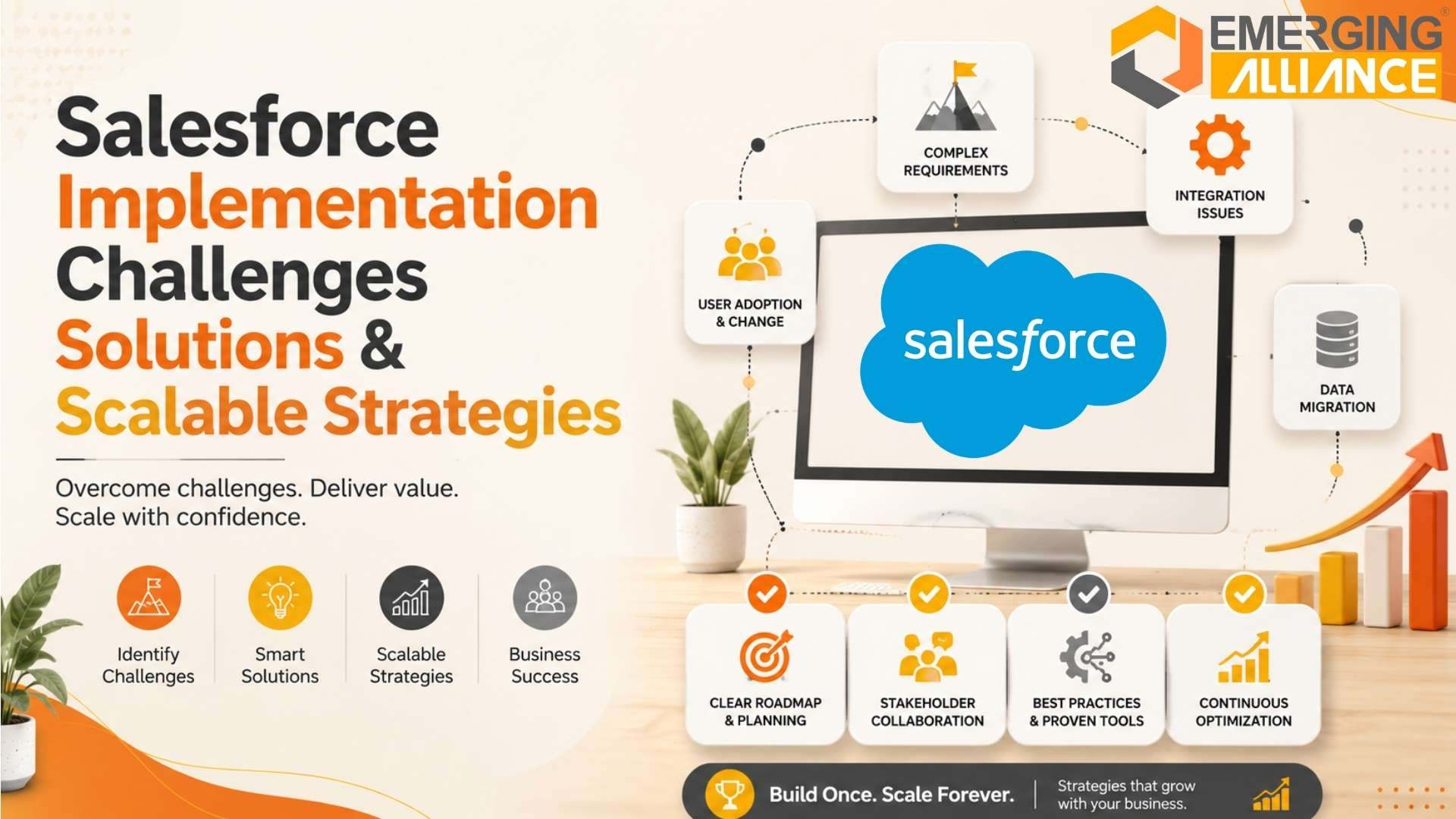
Salesforce Implementation Challenges Solutions & Scalable Strategies
Turn Salesforce Implementation challenges into scalable business success
Modern enterprises are under pressure to improve customer experience, accelerate revenue cycles, and unify operations across departments. Yet many organizations discover that Salesforce Implementation becomes a bottleneck instead of a growth enabler when systems are deployed without long-term operational alignment.
Disconnected workflows, fragmented customer data, poor integrations, and inconsistent reporting create visibility gaps that directly impact revenue, customer retention, and executive decision-making. For enterprises scaling across regions, teams, and business units, these inefficiencies multiply quickly.
A successful Salesforce implementation is no longer just a CRM deployment project. It is a strategic business transformation initiative that impacts sales operations, finance visibility, service delivery, compliance management, and customer lifecycle automation.
This is where enterprises need more than technical deployment support. They need a strategic transformation partner capable of aligning technology with operational goals, scalability requirements, and revenue growth strategies.
Why Enterprise Salesforce Implementation Projects Often Fail
Many organizations invest heavily in CRM platforms but still struggle with adoption, reporting accuracy, and process efficiency. The issue is rarely the platform itself. The problem is poor implementation strategy.
Without a structured roadmap, businesses end up with disconnected systems, manual processes, and operational silos.
Common enterprise implementation challenges
- Inconsistent sales workflows across teams
- Poor customer data centralization
- Limited automation across departments
- Delayed reporting and forecasting visibility
- Integration gaps between ERP, CRM, and finance systems
- Low user adoption due to process complexity
- Revenue leakage caused by manual approvals and follow-ups
- Scalability issues during business expansion
A fragmented CRM environment slows down decision-making and creates operational friction across the customer lifecycle.
For enterprises operating across multiple business units or geographies, these issues become even more expensive over time.
Salesforce CRM Implementation Must Be Built Around Business Operations
A scalable Salesforce CRM implementation should support enterprise operations rather than forcing businesses to adapt around technology limitations.
Organizations that achieve long-term ROI typically focus on process alignment before deployment begins.
Key priorities for enterprise CRM transformation
Sales process automation
Sales teams should spend less time on manual updates and more time closing opportunities. Automated workflows improve lead routing, quotation approvals, follow-ups, and customer engagement tracking.
Customer lifecycle automation
Modern enterprises require visibility across the entire customer journey, from lead generation to post-sales service management.
Revenue operations automation
Disconnected sales and finance systems often create delays in invoicing, approvals, and revenue forecasting. Integrated workflows improve operational control and forecasting accuracy.
Customer data centralization
A centralized CRM environment eliminates duplicate records, inconsistent reporting, and fragmented customer histories.
Executive reporting visibility
Leadership teams require real-time dashboards that provide operational insights across sales performance, pipeline health, customer engagement, and revenue forecasting.
A properly structured Salesforce implementation creates operational consistency across departments while improving scalability and governance.
The Role of Salesforce Integrations in Enterprise Scalability
Many enterprises underestimate the importance of integrations during CRM deployment.
A CRM platform cannot operate effectively in isolation. Enterprise growth depends on seamless data flow between Salesforce and other critical business systems.
Critical integration areas for enterprise operations
- ERP and finance system integration
- Marketing automation platforms
- Customer support and ticketing systems
- Inventory and supply chain systems
- HR and workforce management platforms
- E-commerce and dealer management systems
- Analytics and business intelligence platforms
When Salesforce integrations are poorly designed, businesses face duplicated work, inconsistent reporting, and delayed operational visibility.
For example, a manufacturing enterprise may generate sales opportunities in Salesforce but still rely on manual ERP coordination for quotations, inventory validation, and order approvals. This creates delays, forecasting inaccuracies, and customer dissatisfaction.
A well-planned Salesforce deployment eliminates these operational bottlenecks through connected workflows and real-time synchronization.
Enterprise Salesforce Customization Requires Strategic Governance
Customization is one of the biggest strengths of Salesforce, but uncontrolled customization can create long-term complexity.
Many organizations over-customize during initial deployment without considering scalability, compliance, or future upgrades.
This often leads to:
- Complex maintenance requirements
- Slow platform performance
- Difficult integrations
- Reporting inconsistencies
- User adoption challenges
- Expensive future modifications
Enterprise Salesforce customization should focus on operational efficiency, governance, and scalability.
Best practices for scalable customization
Standardize business workflows
Avoid building separate workflows for every department unless operationally necessary.
Prioritize long-term scalability
Customization decisions should support future expansion, acquisitions, and regional operations.
Build role-based visibility
Executives, managers, finance teams, and sales users require different operational views and dashboards.
Maintain governance controls
Strong governance reduces compliance risks and protects reporting integrity across teams.
Optimize for user adoption
Simple workflows improve employee productivity and reduce training overhead.
A strategic Salesforce consulting partner helps enterprises balance flexibility with operational discipline.
Salesforce Implementation Cost Is Not Just a Technology Expense
Many decision-makers evaluate Salesforce implementation cost based only on licensing and deployment.
However, the real business impact comes from operational inefficiencies caused by poor implementation decisions.
A fragmented CRM environment can lead to:
- Delayed sales cycles
- Missed revenue opportunities
- Manual reporting dependencies
- Poor customer experience
- Inefficient approval workflows
- Reduced forecasting accuracy
- Increased operational overhead
The true ROI of Salesforce implementation comes from operational transformation.
Enterprise ROI drivers
- Faster customer response times
- Improved sales conversion visibility
- Better cross-functional collaboration
- Reduced manual process dependency
- Centralized reporting and analytics
- Improved forecasting confidence
- Scalable customer engagement workflows
- Better executive decision-making
Organizations that approach Salesforce deployment strategically typically gain stronger operational agility and better long-term scalability.
Why Enterprises Need a Strategic Salesforce Implementation Partner
Technology alone does not solve operational complexity.
Enterprises need a Salesforce implementation partner that understands business transformation, workflow optimization, automation strategy, and enterprise scalability.
A strategic implementation approach should include:
Business process assessment
Understanding operational gaps before deployment begins.
CRM architecture planning
Designing scalable workflows aligned with long-term growth objectives.
Integration strategy
Connecting Salesforce with ERP, finance, support, and operational systems.
Change management
Improving user adoption through structured onboarding and workflow simplification.
Managed services support
Continuous optimization after deployment to improve scalability and performance.
This is where Emerging Alliance positions itself differently.
Rather than focusing only on technical implementation, Emerging Alliance works with enterprises to align Salesforce with operational strategy, customer experience goals, and long-term digital transformation initiatives.
Real-World Enterprise Scenario
Consider a fast-growing enterprise operating across multiple sales regions.
The organization uses different systems for CRM, finance approvals, support management, and reporting. Sales teams manually follow up on leads while finance teams rely on spreadsheets for forecasting.
The result:
- Delayed approvals
- Inconsistent reporting
- Duplicate customer records
- Slow response times
- Limited executive visibility
- Revenue forecasting gaps
With a structured Salesforce CRM implementation supported by automation and integrations:
- Lead management becomes centralized
- Approvals move into automated workflows
- Customer interactions become fully trackable
- Executive dashboards provide real-time visibility
- Sales forecasting becomes more accurate
- Teams operate from a single source of truth
The business gains operational control without increasing process complexity.
Build a Scalable Salesforce Ecosystem with Emerging Alliance
Enterprise CRM transformation requires more than software deployment.
It requires a scalable operational strategy that aligns customer engagement, automation, reporting, integrations, and business growth into one connected ecosystem.
Emerging Alliance helps enterprises design and implement scalable Salesforce environments that improve operational visibility, reduce workflow bottlenecks, and support long-term growth.
Whether your organization is planning a new Salesforce implementation, optimizing an existing CRM environment, or scaling enterprise operations across regions, the right implementation strategy can significantly improve operational efficiency and revenue performance.
Speak with Emerging Alliance
Discover how a strategic Salesforce implementation can help your enterprise:
- Improve workflow automation
- Eliminate operational silos
- Centralize customer visibility
- Strengthen reporting accuracy
- Scale customer operations efficiently
- Improve enterprise decision-making
FAQs
1. What is the biggest challenge during enterprise Salesforce implementation?
The biggest challenge is aligning CRM workflows with real business operations. Poor process mapping often leads to low adoption, reporting gaps, and workflow inefficiencies.
2. How do Salesforce implementation services improve operational efficiency?
Salesforce implementation services automate workflows, centralize customer data, improve reporting visibility, and reduce manual process dependency across departments.
3. How long does a Salesforce CRM implementation take for enterprises?
Implementation timelines vary based on integrations, customization, workflow complexity, and organizational scale. Enterprise projects usually require phased deployment strategies.
4. Why are Salesforce integrations important for scalability?
Salesforce integrations connect CRM workflows with ERP, finance, marketing, and operational systems to improve visibility, automation, and data consistency.
5. What affects Salesforce implementation cost?
Implementation cost depends on business complexity, customization requirements, integration scope, user count, automation needs, and long-term support requirements.
6. How can Salesforce customization improve customer lifecycle automation?
Customization helps automate lead management, approvals, customer engagement workflows, service management, and reporting processes tailored to business operations.
7. What industries benefit most from enterprise Salesforce deployment?
Industries such as manufacturing, automotive, healthcare, distribution, retail, financial services, and professional services benefit significantly from scalable CRM operations.
8. Why do enterprises require certified Salesforce consultants?
Certified Salesforce consultants help organizations design scalable CRM architectures, improve governance, reduce deployment risks, and optimize operational workflows.
9. How does Salesforce support revenue operations automation?
Salesforce improves pipeline visibility, automates approvals, centralizes customer interactions, and enhances forecasting accuracy for revenue-focused teams.
10. What should businesses look for in a Salesforce consulting partner?
Businesses should evaluate industry expertise, integration capabilities, scalability planning, automation strategy, governance experience, and long-term managed services support.
Connect with Emerging Alliance for a strategic consultation and transformation roadmap tailored to your business operations.