
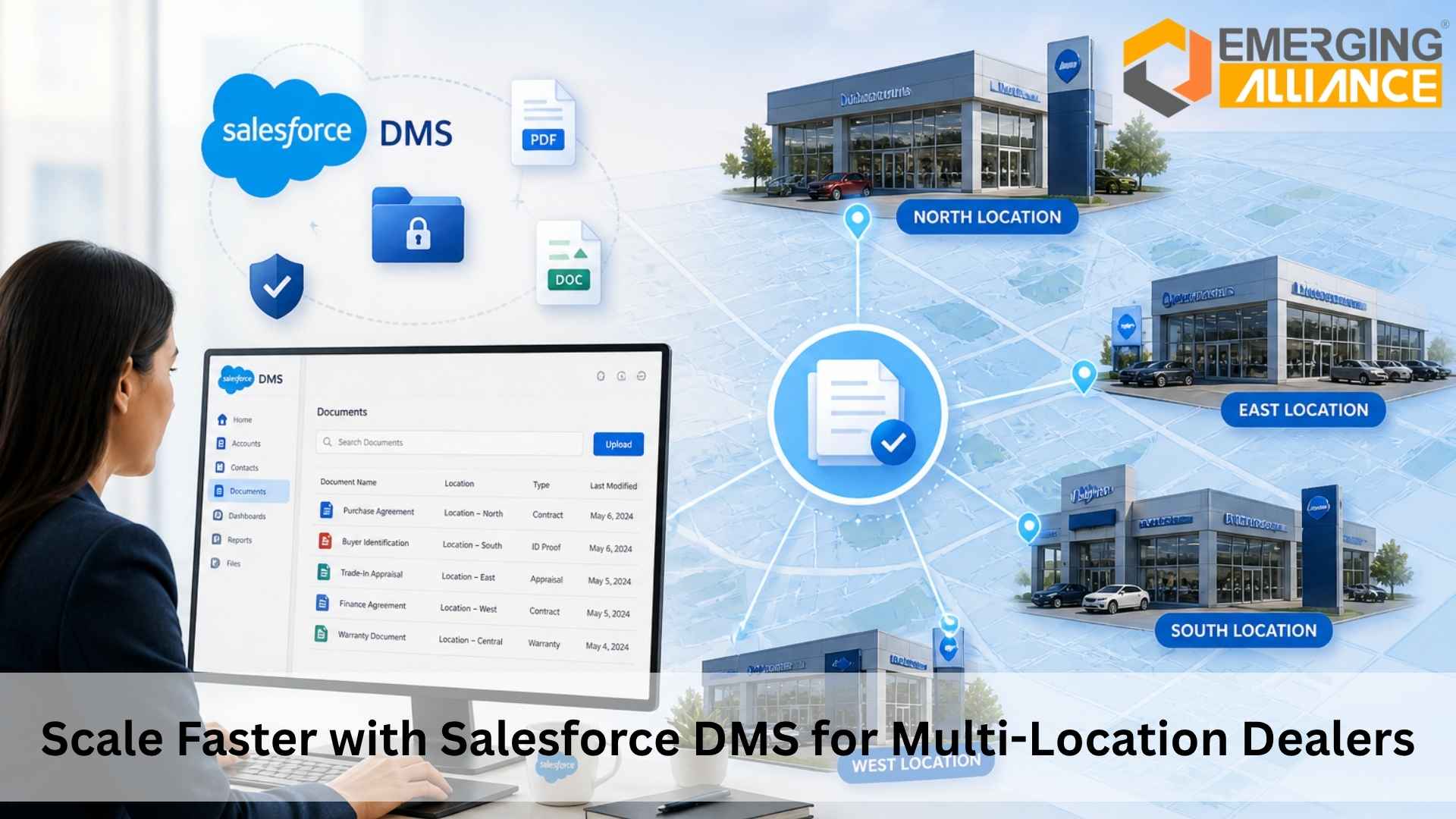
Scale Faster with Salesforce DMS for Multi-Location Dealers
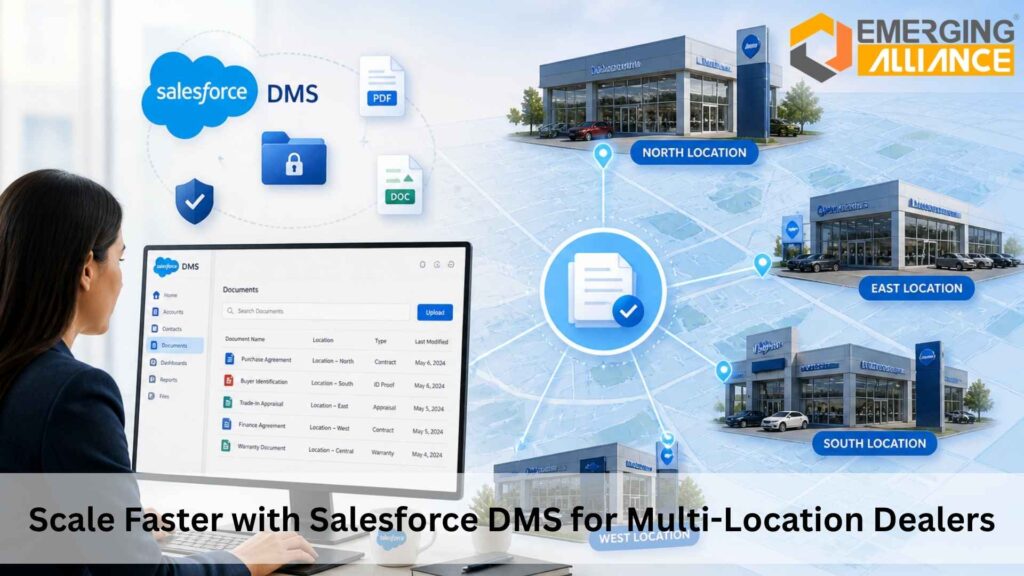
Centralize dealer operations, improve visibility, and scale expansion without operational complexity
Salesforce DMS for enterprise dealer networks means growth is no longer limited by market demand—it is limited by operational scalability. As dealer ecosystems expand across cities, regions, and business units, organizations begin facing structural problems:
- Disconnected dealer operations
- Inconsistent customer experience
- Fragmented inventory visibility
- Delayed reporting cycles
- Manual approvals slowing execution
- Lack of centralized governance
Most traditional dealer platforms were never designed for enterprise-scale expansion. This is where a modern Dealer Management System Salesforce architecture becomes a strategic growth enabler.
A well-structured Salesforce Dealer Management System does more than digitize dealer operations. It creates a centralized operating model that allows enterprises to scale dealer networks with greater control, faster execution, and measurable ROI.
At Salesforce, the platform foundation enables enterprises to unify dealer operations, customer engagement, inventory visibility, and workflow automation into a single ecosystem.
At Emerging Alliance, the focus is not simply implementation—it is helping enterprises architect scalable dealer ecosystems aligned with long-term business growth.
Why Legacy Dealer Systems Fail During Expansion
Most legacy dealer management systems are optimized for isolated dealership operations—not enterprise-wide scalability.
As organizations expand into multi-location dealer environments, common operational gaps emerge:
- Different processes across dealer branches
- Multiple disconnected databases
- Lack of real-time inventory synchronization
- Limited CRM visibility
- Delayed financial reporting
- Manual coordination between departments
This operational fragmentation creates hidden financial leakage.
Without centralized visibility, leadership teams struggle to answer critical questions:
- Which dealer locations are underperforming?
- Where is inventory aging?
- Which sales teams are converting efficiently?
- What is the real profitability per location?
- Which regions require operational intervention?
A cloud-based Salesforce DMS platform solves this by creating a unified operational architecture across the entire dealership network.
How Salesforce DMS Enables Enterprise Scalability
A modern Salesforce DMS cloud solution introduces centralized governance while preserving operational flexibility at individual dealer locations.
This creates a scalable operational model where expansion no longer increases complexity proportionally.
Key capabilities include:
Centralized Dealer Visibility
Leadership teams gain real-time visibility into:
- Sales performance
- Inventory movement
- Service operations
- Lead conversion metrics
- Dealer productivity
- Revenue forecasting
Through centralized dashboards, enterprises can monitor the entire network from a single platform.
Standardized Dealer Processes
A structured Salesforce dealer automation system ensures operational consistency across all locations.
This includes:
- Automated approvals
- Workflow standardization
- Lead assignment automation
- Service scheduling
- Warranty tracking
- Inventory allocation workflows
This level of Dealer automation with Salesforce CRM reduces dependency on manual coordination while improving execution speed.
Multi-Location Inventory Control
Inventory fragmentation is one of the largest hidden risks in dealer operations.
A centralized Salesforce inventory management framework enables:
- Real-time inventory visibility
- Cross-location stock tracking
- Faster inventory movement
- Reduced stock duplication
- Lower carrying costs
- Better demand forecasting
With integrated Salesforce DMS inventory control, organizations improve working capital efficiency while reducing stock-related delays.
Salesforce DMS Integration with ERP Systems
Dealer operations cannot operate in isolation.
Modern enterprises require seamless integration between CRM, ERP, finance, service, and supply chain systems.
A structured Salesforce DMS with ERP systems integration enables:
- Financial synchronization
- Real-time inventory updates
- Unified customer records
- Automated order processing
- Connected service workflows
- Centralized operational reporting
This creates a single source of truth across the organization.
For leadership teams, this means faster decision-making with higher operational accuracy.
Improving Dealer Sales Performance with Salesforce CRM
Most dealership networks lose revenue due to inconsistent lead management.
Without a centralized Salesforce lead tracking system, dealer inquiries often become fragmented across emails, spreadsheets, and local systems.
A connected Salesforce CRM dealer integration enables:
- Centralized lead capture
- Automated lead routing
- Sales funnel visibility
- Customer engagement tracking
- Follow-up automation
- Opportunity forecasting
This improves conversion rates while increasing accountability across dealer sales teams.
Salesforce DMS Customization for Enterprise Dealer Workflows
No two dealer ecosystems operate the same way.
Rigid dealer software often forces enterprises to modify operations around software limitations.
A customizable Dealer Management System on Salesforce platform changes this approach.
Organizations can fully customize Salesforce for dealer workflow based on:
- Regional operations
- Product categories
- Multi-brand structures
- Service processes
- Compliance frameworks
- Internal approval hierarchies
This flexibility is one of the biggest reasons enterprises are moving away from traditional DMS platforms.
Predictable ROI Through Salesforce DMS Cost Optimization
One of the biggest misconceptions in digital transformation is that ROI comes only from revenue growth.
In reality, the largest gains often come from operational efficiency.
A structured Salesforce DMS cost analysis helps enterprises identify hidden losses caused by:
- Duplicate inventory
- Slow approvals
- Manual workflows
- Inefficient lead handling
- Delayed reporting
- Poor inter-dealer coordination
With a centralized Salesforce DMS platform, organizations gain measurable improvements in:
- Dealer productivity
- Inventory turnover
- Lead conversion rates
- Service efficiency
- Customer retention
- Forecasting accuracy
This creates predictable operational scalability without uncontrolled cost escalation.
Why Cloud-Based Salesforce DMS Accelerates Expansion
Traditional on-premise dealer systems slow down expansion because every new location requires additional infrastructure and manual setup.
A modern Salesforce DMS cloud software model eliminates these limitations.
Key cloud advantages include:
- Faster dealer onboarding
- Lower IT dependency
- Centralized upgrades
- Scalable architecture
- Remote accessibility
- Easier multi-region deployment
This makes Salesforce for automotive dealers particularly effective for organizations planning aggressive expansion.
The Future of Dealer Management Systems
The next generation of dealer management systems will be driven by intelligence, automation, and predictive analytics.
Forward-looking enterprises are already leveraging:
- AI-powered dealer insights
- Predictive inventory forecasting
- Automated customer engagement
- Intelligent service scheduling
- Real-time operational analytics
The future of the Best Dealer Management Systems lies in connected ecosystems—not disconnected software modules.
Organizations that modernize early gain operational advantages that are difficult for competitors to replicate later.
Salesforce DMS Implementation Strategy Matters
Technology alone does not guarantee outcomes.
A poorly structured Salesforce DMS implementation can simply digitize existing inefficiencies.
Successful implementation requires:
Strategic Business Mapping
The platform architecture must align with:
- Expansion strategy
- Dealer operational structure
- Reporting hierarchy
- Customer lifecycle goals
- Inventory movement models
Phased Rollout Approach
Large dealer ecosystems should avoid disruptive big-bang deployments.
A phased implementation approach ensures:
- Faster adoption
- Lower operational disruption
- Better process refinement
- Easier training
- Controlled scalability
Continuous Optimization
Dealer ecosystems evolve continuously.
A scalable Dealer Management System Salesforce implementation should support:
- Workflow refinement
- New dealer onboarding
- Analytics optimization
- Process automation enhancements
- Integration expansion
At Emerging Alliance, the implementation approach focuses on measurable operational transformation—not just software deployment.
Why Enterprises Choose Salesforce DMS for Multi-Location Growth
Enterprises adopting Salesforce Dealer Management System software typically prioritize:
- Faster dealer expansion
- Centralized operational visibility
- Better inventory governance
- Standardized dealer workflows
- Improved customer engagement
- Lower operational complexity
- Predictable scalability
This is why Salesforce continues to emerge as a strategic platform for high-growth dealer ecosystems.
Scaling Dealer Operations Without Compromising Control or Efficiency
If your dealership network is expanding, operational fragmentation becomes a growth risk—not just an IT challenge.
The real question is not whether your business needs a Dealer Management System.
The real question is whether your current architecture can scale without increasing operational inefficiency.
Emerging Alliance helps enterprises:
- Design scalable Salesforce DMS platform architectures
- Enable intelligent workflow automation
- Integrate ERP, CRM, and dealer ecosystems
- Optimize operational efficiency across locations
- Deliver measurable ROI through centralized visibility
Build a future-ready dealer ecosystem with Salesforce DMS designed for enterprise scalability.
FAQs
1. What is a Salesforce Dealer Management System?
A Salesforce Dealer Management System is a cloud-based platform that centralizes dealer operations including sales, inventory, CRM, service, and analytics.
2. How does Salesforce DMS help multi-location dealer networks?
It provides centralized visibility, workflow automation, inventory synchronization, and standardized operations across all dealer locations.
3. Can Salesforce DMS integrate with ERP systems?
Yes. A Salesforce DMS with ERP systems integration enables synchronized financial, operational, and inventory data.
4. What industries benefit most from Salesforce DMS?
Automotive, manufacturing, FMCG, electronics, equipment distribution, and multi-channel dealer ecosystems benefit significantly.
5. How does Salesforce improve dealer inventory management?
Through centralized Salesforce inventory management and real-time inventory visibility across dealer locations.
6. Is Salesforce DMS customizable?
Yes. Organizations can fully customize Salesforce for dealer workflow based on business structure and operational requirements.
7. What are the major benefits of dealer workflow automation?
Automation reduces manual errors, improves efficiency, accelerates approvals, and enhances operational consistency.
8. How does Salesforce DMS improve dealer sales performance?
It enables centralized lead tracking, automated lead routing, CRM visibility, and sales performance analytics.
9. What defines the best dealer management platform today?
Scalability, automation, integration capabilities, analytics, and cloud flexibility define the Best Dealer Management System.
10. Why is implementation strategy important in Salesforce DMS projects?
A structured implementation ensures scalability, user adoption, operational alignment, and measurable business outcomes.
Fill out the form to connect with our experts now