
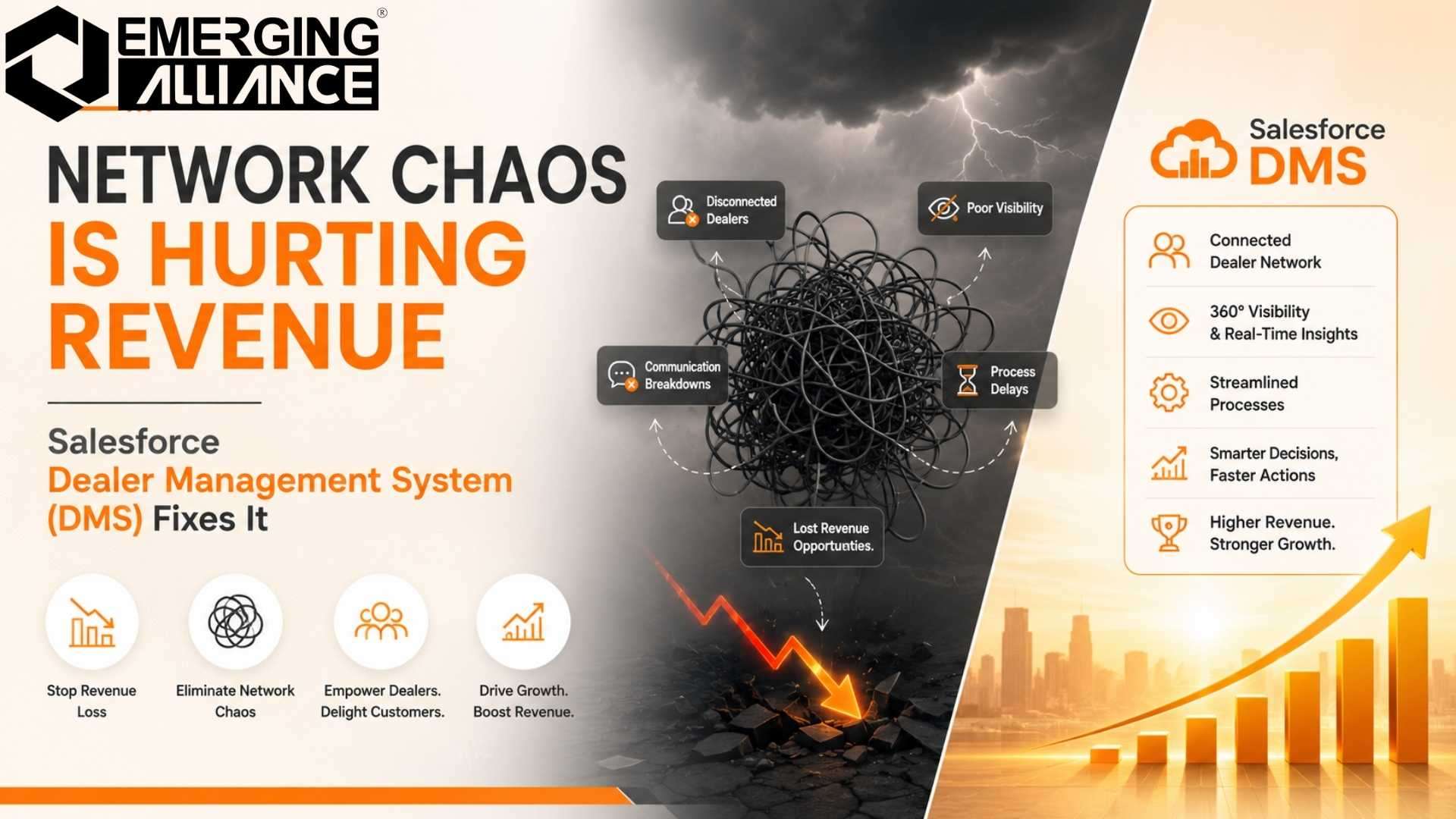
Network Chaos Is Hurting Revenue — Salesforce Dealer Management System (DMS) Fixes It
Salesforce Dealer Management System (DMS) streamlines partner engagement and accelerates revenue growth
Dealer ecosystems have become more complex than ever. Manufacturers, distributors, and automotive businesses manage multiple dealers, territories, inventory locations, leads, and customer interactions simultaneously. Yet many organizations still rely on disconnected systems, spreadsheets, emails, and manual processes. The result is poor visibility, delayed order fulfillment, inventory inaccuracies, and revenue leakage. A modern Salesforce Dealer Management System (DMS) helps organizations bring dealers, distributors, inventory, sales teams, and customers onto a single platform. Instead of managing chaos, businesses gain real-time control, faster decision-making, and scalable growth.
Dealer operations are no longer just a sales challenge—they are a business performance challenge.
Traditional Dealer Management System Challenges
Dealer networks often grow faster than operational processes. As territories expand, inefficiencies multiply.
Common challenges include:
- Lack of visibility across dealership networks
- Delayed lead assignment and follow-ups
- Inventory mismatches between dealers and warehouses
- Manual order management processes
- Inconsistent customer experiences
- Duplicate data across CRM and ERP systems
- Limited forecasting capabilities
- Difficulty managing dealer performance
These issues create hidden costs that impact profitability.
Business Impact
- Lost revenue opportunities
- Increased inventory carrying costs
- Slow customer response times
- Poor partner engagement
- Reduced customer satisfaction
- Lower dealer productivity
Modern enterprises need more than a standalone Dealer Management System. They need a connected digital ecosystem.
Salesforce Dealer Management System (DMS) Features
A Dealer Management System Salesforce platform brings CRM, inventory, orders, dealer workflows, and customer engagement together.
Instead of disconnected operations, organizations gain a unified view of their entire dealership network.
Key Salesforce DMS Features
Dealer Lifecycle Management
Manage:
- Dealer onboarding
- Approvals
- Territory assignments
- Performance tracking
- Partner engagement
Salesforce Lead Tracking System
Automate:
- Lead allocation
- Dealer follow-up
- Opportunity management
- Sales pipeline visibility
This reduces response delays and improves conversion rates.
Salesforce DMS Inventory Control
Real-time inventory visibility enables:
- Stock availability tracking
- Product movement monitoring
- Replenishment planning
- Order fulfillment optimization
Dealer Workflow Automation
Salesforce automation for dealers simplifies:
- Quotations
- Orders
- Warranty requests
- Service workflows
- Claims management
Manual processes are replaced with intelligent workflows.
Analytics and Reporting
Executives gain:
- Dealer performance dashboards
- Territory insights
- Revenue forecasts
- Inventory analysis
- Profitability reports
This enables faster and more informed decisions.
Salesforce DMS Integration with ERP Systems
One of the biggest challenges in dealership operations is disconnected systems.
Sales, finance, inventory, and logistics often operate independently.
A modern Salesforce DMS with ERP systems creates a connected enterprise.
Typical Integration Scenario
A manufacturer manages 300 dealers across multiple regions.
Without integration:
- Orders are entered manually.
- Inventory information is delayed.
- Sales teams lack visibility.
- Finance reconciliation takes days.
With Salesforce CRM dealer integration:
- Dealers place orders digitally.
- ERP systems update inventory automatically.
- Sales teams access real-time information.
- Finance receives synchronized transaction data.
- Executives view performance across the entire network.
Benefits of Salesforce DMS Integration
- Faster order-to-cash cycles
- Reduced manual errors
- Improved inventory accuracy
- Better customer experience
- Higher operational efficiency
- Stronger dealer collaboration
Organizations using ERP solutions such as SAP can create a seamless flow of information across departments.
Salesforce DMS Customization and Scalability
Every dealer network operates differently.
Generic software often creates new bottlenecks instead of solving them.
This is why many enterprises choose to customize Salesforce for DMS operations.
Salesforce DMS Customization Supports
- Multi-tier dealer structures
- Territory-based pricing
- Approval workflows
- Incentive programs
- Warranty management
- Service operations
- Dealer scorecards
- Mobile applications
Real-World Enterprise Scenario
An automotive manufacturer with hundreds of dealers experiences:
- Slow lead distribution
- Inconsistent inventory data
- Delayed order approvals
- Limited reporting capabilities
By implementing a Salesforce DMS cloud solution with ERP connectivity, the company achieves:
- Faster lead response
- Improved inventory visibility
- Reduced order processing time
- Better dealer engagement
- Higher sales productivity
Dealer automation with Salesforce CRM creates a scalable foundation for growth.
Future of Dealer Management Systems
Dealer ecosystems are becoming more digital.
Executives need visibility, speed, and agility.
The future of Dealer Management Systems includes:
AI-Powered Decision Making
Predictive insights help improve:
- Inventory planning
- Demand forecasting
- Lead prioritization
- Customer engagement
Cloud-Based Scalability
Salesforce DMS cloud software enables:
- Multi-location operations
- Global dealer collaboration
- Remote access
- Faster deployments
Data-Driven Dealer Performance
Organizations can measure:
- Revenue contribution
- Lead conversion rates
- Inventory turnover
- Customer satisfaction
End-to-End Automation of Dealer Workflows
Automation reduces:
- Human errors
- Processing delays
- Operational costs
Modern dealer networks require a digital platform that grows with the business.
Emerging Alliance
Implementing technology alone does not solve operational complexity.
Successful transformation requires process expertise, integration strategy, and industry understanding.
Emerging Alliance helps organizations:
- Design connected dealer ecosystems
- Customize Salesforce for dealer workflows
- Integrate CRM with ERP platforms
- Improve inventory and order visibility
- Automate partner engagement processes
- Enable scalable digital operations
As a digital transformation and enterprise solutions partner, Emerging Alliance focuses on business outcomes—not just software implementation.
Salesforce Dealer Management System Consultation
Disconnected dealer operations can silently reduce revenue, increase costs, and limit growth.
A modern Salesforce Dealer Management System (DMS) provides the visibility, automation, and scalability needed to build a high-performing dealer ecosystem.
Speak with a Salesforce DMS Expert
If you are evaluating how to modernize dealer operations, integrate ERP systems, or improve partner performance, Emerging Alliance can help.
✔ Schedule a consultation
✔ Request a personalized demo
✔ Assess your current dealer processes
✔ Build a scalable dealer ecosystem
Frequently Asked Questions
1. Why do businesses need a Salesforce Dealer Management System?
A Salesforce Dealer Management System helps organizations centralize dealer operations, improve visibility, automate workflows, and manage leads, inventory, and partner relationships from a single platform.
2. Which industries benefit most from Salesforce DMS solutions?
Salesforce DMS solutions are commonly used by automotive manufacturers, equipment suppliers, distributors, and businesses that rely on dealer or channel partner networks to drive sales and service operations.
3. Can Salesforce Dealer Management System be customized for unique business processes?
Yes. Salesforce DMS can be tailored to support custom approval workflows, pricing structures, incentive programs, warranty processes, and dealer-specific requirements.
4. How does Salesforce DMS help improve customer experience?
By providing real-time information, faster lead response, and streamlined order management, Salesforce DMS enables dealers to deliver more consistent and efficient customer experiences.
5. Does Salesforce DMS support integration with existing enterprise systems?
Yes. Salesforce DMS can integrate with ERP, finance, inventory, and third-party applications to ensure seamless data flow across the organization.
6. How does automation improve dealer network efficiency?
Automation reduces manual tasks, speeds up approvals, improves lead distribution, and enhances collaboration between headquarters and dealers, resulting in higher productivity.
7. What reporting capabilities are available in Salesforce DMS?
Salesforce DMS provides dashboards, analytics, and real-time reporting that help organizations monitor dealer performance, inventory levels, sales trends, and operational KPIs.
8. Can Salesforce DMS scale with growing dealer networks?
Yes. Salesforce DMS is designed to support expanding dealer ecosystems, making it easier to onboard new partners and manage increasing operational complexity.
9. How does inventory visibility impact dealer performance?
Real-time inventory visibility helps reduce stock discrepancies, improve order fulfillment, and ensure dealers have accurate information to meet customer demand.
10. What factors should companies consider before implementing Salesforce DMS?
Organizations should evaluate their current dealer processes, integration requirements, reporting needs, scalability goals, and long-term digital transformation strategy to ensure successful implementation.
Talk to our experts and discover how Salesforce Dealer Management System (DMS) can accelerate revenue growth and operational excellence.